
Omnivaleur is built for European sellers cross-listing across Marktplaats, 2dehands, Vinted, and global channels with native euro handling and multi-status sync. Foxtail targets North American platforms like Poshmark, Mercari, and eBay. Choose Omnivaleur for EU local marketplaces; pick Foxtail if your sales happen entirely on US fashion apps.
Key takeaways
- Omnivaleur natively integrates with European heavyweights Marktplaats, 2dehands, and Vinted, whereas Foxtail targets US marketplaces like Poshmark and Mercari
- Omnivaleur publishes to seven channels from one intake form: Marktplaats, 2dehands, Vinted, eBay, Shopify, WooCommerce and Facebook Marketplace (beta)
- A single item in Omnivaleur typically carries 3-5 active listings at once; the app tracks each platform's status separately
- Foxtail excels at simple US marketplace cross-posting, but lacks Dutch, Belgian, and pan-European marketplace infrastructure
- Omnivaleur handles EU compliance including DAC7 reporting thresholds, VAT margin schemes, and euro currency formatting out of the box
What is Foxtail and how does it differ from botanical foxtailing?
If you search the term "foxtail" online, search engines deliver a confusing mix of agricultural biology, canine health warnings, and e-commerce reselling software. Before dissecting software architectures and cross-listing workflows, let us clear up this naming overlap that confuses search algorithms and resellers alike.
So, what exactly are foxtails in nature? In botany, a foxtail is either a spikelet diaspore from wild grasses (such as Hordeum murinum or Setaria) or an elongated, abnormal floral formation seen in indoor horticulture, particularly cannabis cultivation. The wild grass variety features barbed seeds that create a severe physical hazard for outdoor pets, as the retrose barbs burrow into paws, ears, and lungs without working backward. In cultivation botany, foxtailing refers to buds developing slender, stacked calyx spires instead of dense, rounded clusters.
Growers frequently ask: what causes this botanical foxtailing, does foxtailing affect quality and potency, and can you harvest a foxtailed bud? The phenomenon stems from two distinct triggers: genetics or extreme environmental stress. Genetic foxtailing occurs naturally in certain equatorial sativa strains without degrading cannabinoid content or terpene profiles. In contrast, stress-induced foxtailing signals an environmental alarm bell—typically excessive light intensity (phototoxicity) or canopy temperatures exceeding 29°C. While stress foxtailing can slightly reduce overall potency due to oxidized trichomes on bleached upper calyxes, the bud remains completely harvestable. Foxtailing happens in outdoor growing as well, especially during late-season heatwaves or microclimates with intense solar radiation, though it appears far more frequently under uncooled indoor grow lights.
In the e-commerce sector, however, Foxtail refers to a dedicated multichannel listing application developed to help secondary-market merchants duplicate inventory across sales channels. While both concepts share a name, an online reseller evaluates Foxtail entirely on software uptime, inventory synchronization, API integrity, and marketplace coverage. When evaluating Omnivaleur vs Foxtail, our concern lies strictly with how each software handles your daily listing volume, reduces manual data entry, and protects your business from stockouts.
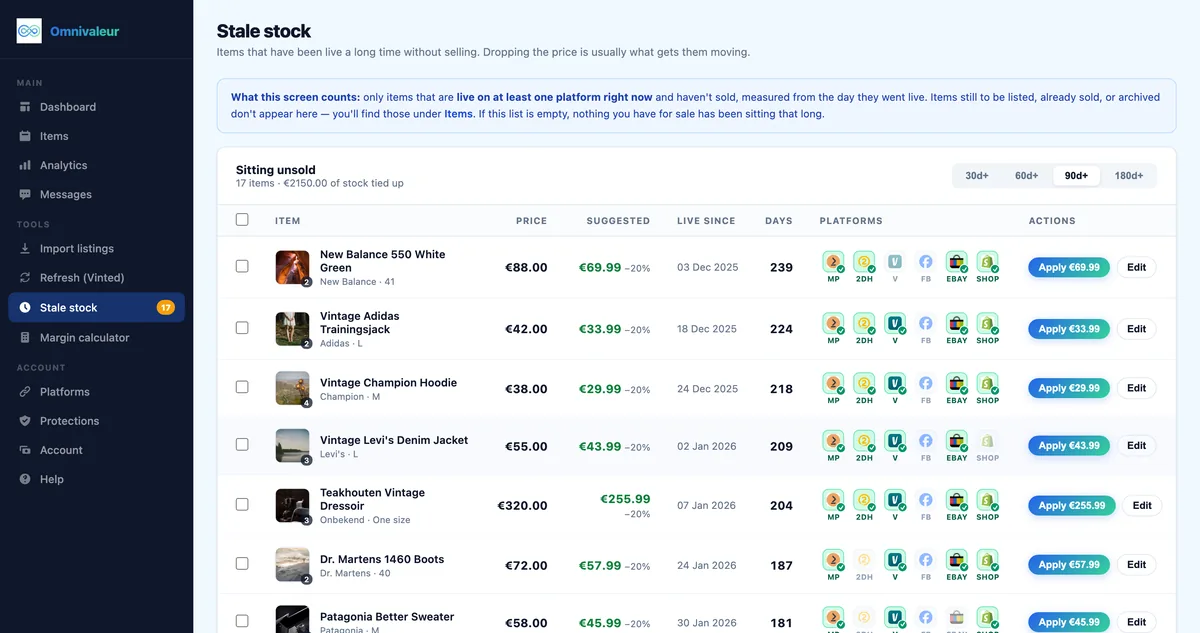
Which marketplace platforms do Omnivaleur and Foxtail actually support in 2026?
Marketplace availability defines whether a cross-listing tool is an indispensable asset or dead weight on your monthly ledger. A reseller operating in Amsterdam, Antwerp, or Berlin requires a radically different software stack than a seller based in Chicago or Dallas.
Foxtail built its foundation around the core domestic platforms of the United States: Poshmark, Mercari, eBay, and Depop, with selective integrations for Facebook Marketplace and Etsy. For a vendor moving thrifted contemporary clothing inside North America, this lineup hits the primary buyer pools. Foxtail allows you to generate a listing once and push the details across those specific platforms using desktop extension actions or browser-based workflows.
Omnivaleur tackles an entirely different geographic reality. Omnivaleur publishes to seven channels from one intake form: Marktplaats, 2dehands, Vinted, eBay, Shopify, WooCommerce and Facebook Marketplace (beta). Instead of treating Europe as an afterthought, Omnivaleur builds directly on top of the platforms where continental buyers actually spend money.
Consider the daily reality of local second-hand commerce. A buyer in the Netherlands searches Marktplaats to Vinted listings for vintage furniture or pre-owned electronics. A Belgian buyer scans 2dehands for vintage audio gear, while fashion buyers throughout France, Spain, Italy, and the Benelux transact on Vinted. If your software cannot connect to Marktplaats, 2dehands, or Vinted, you are locked out of the dominant secondary retail channels across the continent. Foxtail offers zero support for Marktplaats and 2dehands, leaving European merchants completely stranded if they attempt to run a local business through it.
| Feature / Platform Support | Omnivaleur | Foxtail |
|---|---|---|
| Core Target Market | European Union, UK & Global Hubs | North America (United States) |
| Marktplaats Support | Native automated publishing | Not supported |
| 2dehands / 2ememain Support | Native automated publishing | Not supported |
| Vinted Support | Full integration (photo, price, attribute mapping) | Limited / Not supported |
| eBay Integration | Global & European localized portals (.nl, .be, .de) | US Portal (.com) focused |
| Independent Webstores | Shopify & WooCommerce | Shopify (limited configurations) |
| US-Centric Apps (Poshmark, Mercari) | No (focus remains EU channels) | Yes (core strength) |
| Delist Automation | Multi-channel background monitoring | Manual / Chrome-assisted delisting |
| Currency Architecture | Native EUR (€) with VAT compliance handling | Native USD ($) formatting |
If you sell exclusively vintage streetwear to American college students via Depop, Poshmark, and Mercari, Foxtail addresses your ecosystem directly. If you warehouse goods in Rotterdam, Brussels, or Düsseldorf, Foxtail leaves you manually copy-pasting descriptions into your highest-converting channels.
How does pricing compare between Omnivaleur and Foxtail for active sellers?
Subscription models in the reselling software space usually fall into two categories: listing-capped tiers that penalize you as your business scales, or flat monthly access passes that encourage rapid inventory turnover. Both Omnivaleur and Foxtail maintain straightforward structures, but their pricing models reward different operational sizes.
Foxtail typically structures its pricing around entry-level monthly subscriptions starting around $25 to $40 per month, depending on promotional cycles and whether you select basic cross-listing or inventory management add-ons. For casual hobbyists running 30 active items, this feels accessible. However, as listing volume grows, tier ceilings or fee add-ons can increase your effective overhead. Furthermore, European sellers using Foxtail face foreign currency conversion fees on their credit card statements each billing cycle, adding an unnecessary 2% to 3% banking drag.
Omnivaleur structures its plans directly in euros with predictable monthly and annual tiers designed for high-volume resellers, vintage shops, and estate clearance operators. There are no surprise micro-charges when you connect your seventh marketplace or push your thousandth listing. If you want to compare how other cross-listing software structures their fee schedules against these tiers, see our analysis in Omnivaleur vs Crosslist: Which Fits European Sellers?.
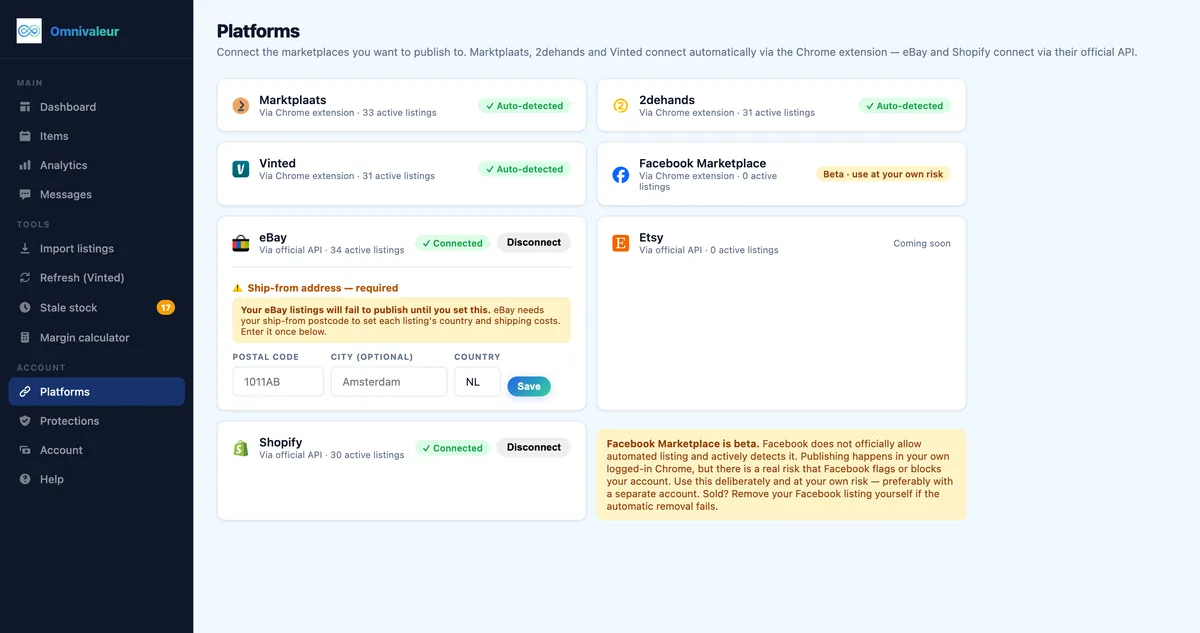
Resellers must calculate their software costs against time saved. Spending €39 on a specialized platform pays for itself if it automates five hours of manual data entry per week. At a modest valuation of €25 per hour for your administrative sourcing and listing time, automated cross-listing recovers €500 worth of labour every month for a fraction of that cost.
Which software offers a faster onboarding and day-to-day listing workflow?
Speed during intake dictates how many items hit your digital storefronts before the weekend rush. An intake pipeline full of friction leads to unlisted inventory accumulating in storage bins—what professional sellers call "death piles."
Foxtail uses a browser-dependent extension model combined with a central web application. When you list through Foxtail, you enter product attributes, upload imagery, and trigger actions through your browser. Because it targets US platforms, its attribute mapping centers on American sizing standards (US Women's Shoe Sizes, US Letter apparel sizing, inches for measurements) and platform-specific categories like Poshmark departments. If your catalog consists primarily of American apparel brands, this onboarding feels familiar and quick.
Omnivaleur approaches intake through an engine optimized for European attributes and high-speed multi-posting. Resellers enter the item details once inside a unified form: title, description, continental sizing (EU 38, EU 42, shoe sizing in standard Paris points), condition grades, and photography. The platform translates these details to the required technical parameters of each destination channel.
When publishing through Omnivaleur, your single form translates into distinct marketplace listings:
- On Marktplaats, it selects the appropriate primary category, formats shipping weight options according to PostNL or DHL parameters, and sets your asking price or bidding status.
- On 2dehands, it replicates the item with language considerations for Flemish and Walloon regional buyers.
- On Vinted, it uploads your photographs in sequence, assigns the appropriate brand database ID, marks parcel sizes (Small, Medium, or Large), and sets your fixed buy-it-now figure.
- On eBay, it populates custom item specifics, selects international dispatch rules, and formats item descriptions.
- On Shopify or WooCommerce, it generates clean product handles, assigns collections, and configures stock-keeping units (SKUs).
A single item in Omnivaleur typically carries 3-5 active listings at once; the app tracks each platform's status separately. This granular status monitoring prevents confusion when an item is draft-staged on one channel, published live on three others, and paused on a fifth.
How do Omnivaleur and Foxtail handle inventory sync and delisting when an item sells?
Publishing items is only half the battle. The real danger for a multichannel reseller arrives the moment a customer buys your product. If an item sells on Marktplaats on Friday evening while you are having dinner, how quickly does that product disappear from Vinted, eBay, and 2dehands?
Double-selling identical single-sale second-hand inventory is a quick path to account suspension. On platforms like Vinted or eBay, cancelling an order because you already sold the jacket elsewhere triggers automated negative feedback, lowers your seller rating, and risks platform-wide bans. We broke down the mechanics of preventing this operational catastrophe in our guide on how to stop selling the same item twice on Marktplaats and Vinted.
Foxtail handles delisting primarily across its supported American matrix. When a sale occurs on Poshmark or Mercari, Foxtail relies on its background listener or browser extension to prompt or execute cancellations on the counterpart channels. However, if you are attempting to juggle European channels alongside Foxtail, you are entirely on your own. You must manually check your phone, open your secondary apps, and delete each listing manually before another customer hits buy.
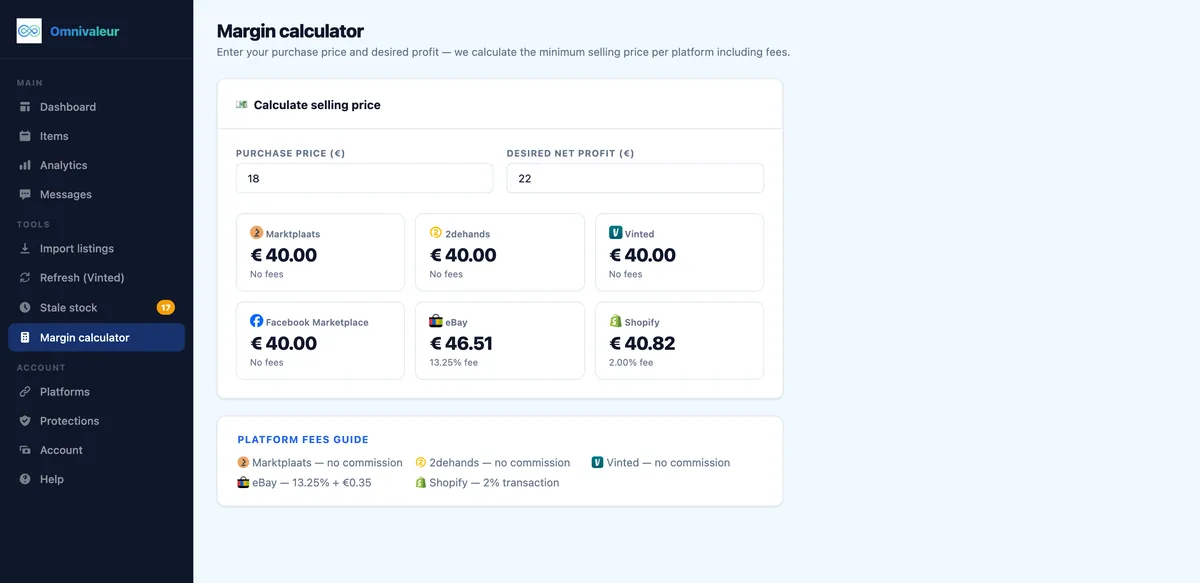
Omnivaleur tackles inventory status at an architectural level. Because it natively monitors marketplace notifications, it recognizes sales events across supported channels. When your vintage lamp clears payment on eBay, Omnivaleur flags the internal SKU as sold and triggers delist routines across Marktplaats, 2dehands, and your connected Shopify or WooCommerce store. This background coordination allows independent resellers to scale catalog depth without living in constant anxiety over conflicting notifications.
- ✓Identify the regional marketplaces where your local buyers actually spend money
- ✓Choose an intake tool that handles your local clothing sizes and parcel tiers
- ✓Enter the product measurements and upload clear photos into a single draft
- ✓Turn on background sync so listings disappear as soon as one platform sells
- ✓Keep an export of your monthly multichannel sales for your local tax records
Why does European marketplace handling make or break your reselling business?
Operating an e-commerce enterprise inside the European single market involves strict regulatory hurdles, distinctive payment preferences, and complex tax requirements that US-built tools never encounter. A cross-listing platform that does not account for these nuances forces you to perform manual bookkeeping every week.
First, consider the European Commission DAC7 directive, which requires digital platforms to report seller revenue once they exceed 30 transactions or €2,000 in gross sales within a calendar year. The Dutch tax authority enforces these rules strictly, as detailed on the Belastingdienst DAC7 portal. Resellers operating across multiple storefronts need unified exportable data so their end-of-year tax declarations match what platforms report automatically. You can read our detailed breakdown on managing these thresholds in our overview of Vinted DAC7 rules and reporting limits.
Second, professional second-hand traders within the EU routinely leverage the special margin scheme for used goods. Rather than charging standard 21% VAT on the entire retail price, merchants calculate value-added tax exclusively on their profit margin. You can review how this works under EU law in our manual on the VAT margin scheme for second-hand goods. Foxtail was designed for the American sales tax landscape—a state-by-state destination calculation completely disconnected from European VAT mechanics.
Third, buyer rights inside the EU operate under strict directives regarding return periods and remote purchases, set out clearly by Your Europe consumer shopping protections. When cross-listing across consumer-to-consumer classifieds like Marktplaats and business-to-consumer store platforms like Shopify, listing descriptions and legal policies must adjust dynamically. Omnivaleur understands the distinction between private classifieds and registered commercial e-commerce, ensuring your business stays compliant while scaling.
What level of customer support and platform reliability can you expect?
Every reseller using multichannel listing software eventually hits an API hiccup. A marketplace updates its internal security cookies, an image validation script changes, or a platform rollout alters category taxonomy. When this occurs, support response times and developer agility determine whether your catalog stays online.
Foxtail provides solid customer support within standard US operational hours (Eastern to Pacific time). If you submit an inquiry at 09:00 Central European Time (CET), you will likely wait six to eight hours for their American headquarters to come online. For urgent inventory discrepancies occurring during morning peak selling periods in Europe, this timezone delay poses real logistical hurdles.
Omnivaleur operates on European hours. Software patches, marketplace adaptations, and customer inquiries are handled while Benelux and European markets are transacting. When Marktplaats updates its listing validation forms or Vinted modifies its mobile payload parameters, Omnivaleur adjusts its ingestion pipelines rapidly, sparing sellers days of broken connections.
Reliability also extends to your software setup. Extension-only tools that execute actions directly through your personal browser session can fail if your local computer enters sleep mode, loses internet connectivity, or runs aggressive ad-blocking extensions. Omnivaleur uses robust cloud-assisted infrastructure that processes listings consistently, regardless of whether your laptop is open on your packing desk or closed in your bag.
Which cross-listing tool should you choose for your inventory in 2026?
Choosing between Omnivaleur and Foxtail does not come down to an arbitrary score; it depends entirely on where your buyers reside and which platforms generate your income.
Choose Foxtail if:
- Your primary inventory consists of contemporary American fashion, athletic shoes, or accessories.
- Your revenue streams are concentrated on Poshmark, Mercari, Depop, and US-based eBay accounts.
- You ship almost exclusively via USPS, UPS, or domestic American courier services.
- You do not need connectivity to European classified networks or Dutch/Belgian marketplaces.
Choose Omnivaleur if:
- You run a professional or growing reselling operation based in the Netherlands, Belgium, Germany, France, or broader Europe.
- Marktplaats, 2dehands, and Vinted represent non-negotiable sales channels for your business model.
- You want an intake engine that lets you publish to seven channels from one intake form: Marktplaats, 2dehands, Vinted, eBay, Shopify, WooCommerce and Facebook Marketplace (beta).
- A single item in Omnivaleur typically carries 3-5 active listings at once; the app tracks each platform's status separately so you avoid catastrophic double-sales.
- You require native euro currency handling, European metric and sizing conversions, and clean financial reports for DAC7 and VAT margin compliance.
No single tool rules every market on earth. Match your software to your geography, eliminate friction at intake, and let automation handle the repetitive administrative tasks so you can focus on sourcing profitable inventory.
Frequently asked questions
Can I use Foxtail to cross-list to Marktplaats or 2dehands?
Does Omnivaleur work for private individual sellers or only registered businesses?
Will using a cross-listing tool trigger account suspensions on Vinted?
How does Omnivaleur manage clothing sizes across different European countries?
Can I manage Shopify and WooCommerce alongside my second-hand classified listings?
Keep reading

Stop copying listings by hand
Omnivaleur publishes your item to every platform at once and syncs stock automatically when something sells.
Start free trial