DAC7 Vinted Reporting Rules in the Netherlands: The 2026 Seller Guide
Under EU DAC7 rules, Vinted must automatically report your selling data to the Dutch Tax Administration (Belastingdienst) if you complete 30 or more transactions or earn €2,000 or more in sales proceeds in a calendar year. Reporting is purely informational; you only owe income tax if your sales generate commercial business profit.
Key takeaways
- Vinted reports seller accounts reaching 30 completed transactions or €2,000 in net payouts per calendar year.
- Reaching DAC7 thresholds triggers automated reporting to the Belastingdienst but does not automatically mean you owe tax.
- Personal wardrobe clearouts sold below initial purchase price remain tax-exempt in the Netherlands.
- Buying items with the explicit intent to resell for profit qualifies as taxable business or secondary income.
- Accurate record-keeping of original purchase receipts and true sale prices protects you during tax audits.
If you sell pre-loved clothing, footwear, or vintage items on Vinted from the Netherlands, you have probably received a notification asking for your Citizen Service Number (BSN) or tax identification details. This requirement stems directly from the European Union's Council Directive 2021/514, widely known as DAC7. The directive requires digital platforms to report seller activity and earnings directly to national tax authorities across member states.
Many Dutch sellers panic when they see this form, fearing that the Dutch Tax Administration will immediately bill them for thousands of euros in back taxes. That fear is largely unfounded. Data collection is an automated compliance step, not an automatic tax assessment. Understanding where reporting ends and actual taxation begins will keep your reselling operations compliant and stress-free throughout 2026.
What are the official DAC7 reporting thresholds on Vinted for Dutch sellers?
The rules set uniform triggers across all EU-based digital marketplaces. According to the European Commission DAC7 overview, Vinted must track your completed transactions across each calendar year, running from January 1 through December 31.
Vinted is legally required to collect your tax information and report your profile to the Dutch authorities once you hit either of the following limits in a single calendar year:
- Volume threshold: You complete 30 or more sales, regardless of the total monetary amount received.
- Revenue threshold: You generate €2,000 or more in gross payouts from completed sales, regardless of how many individual items you shipped.
The operative word is either. If you sell 32 vintage T-shirts for €5 each (totalling €160), you cross the 30-item threshold. Vinted must report your details. Conversely, if you sell two luxury designer coats for €1,100 each (totalling €2,200), you cross the revenue threshold on just two sales. Vinted must report your details in that scenario as well.
These limits apply per platform account. If you also cross-list across other channels—such as operating a parallel storefront via Vinted to Marktplaats cross-listing—each marketplace independently calculates its own threshold. Marktplaats tracks your Marktplaats sales, while Vinted tracks your Vinted sales.
What specific data does Vinted share with the Dutch Tax Administration?
When an account qualifies under the reporting rules, Vinted compiles a standardized data packet. This information is submitted annually to the Lithuanian tax authorities (the State Tax Inspectorate under the Ministry of Finance), where Vinted UAB is registered, which then securely transfers the dataset to the Dutch Tax Administration via the automated EU exchange system.
As outlined in the official guidance from the Belastingdienst DAC7 information for sellers, the reported dataset includes:
- Identity details: Your full legal name, primary residential address, date of birth, and Dutch Citizen Service Number (BSN) or Chamber of Commerce (KvK) registration number.
- Financial data: The bank account number (IBAN) associated with your Vinted wallet payouts and the name of the bank account holder.
- Transaction summary: The total amount paid out to you by Vinted during each quarter of the calendar year.
- Volume count: The exact number of completed transactions processed through the system.
- Platform deductions: Any platform fees, commissions, or shipping costs withheld directly by Vinted from your gross earnings.
Vinted gives you a downloadable copy of the report sent to the authorities. You can view this summary directly inside your platform settings under your legal information section to verify that the figures match your personal accounting.
Does hitting the DAC7 threshold mean you owe income tax in the Netherlands?
No. Reporting is not taxation. Hitting the threshold simply hands the Belastingdienst visibility over your platform turnover. Whether you owe a single euro in personal income tax depends on the underlying nature of your sales: are you clearing out your private wardrobe, or are you running a commercial enterprise?
The Dutch tax code divides individual income into specific categories. Second-hand transactions generally fall into one of two groups:
1. Private wardrobe and household sales (Tax-free)
Selling your own used clothing, children's outgrown jackets, or unwanted furniture is considered a private asset sale. In almost all instances, you purchased these goods at full retail price and sold them on Vinted years later at a substantial loss. Because there is zero capital gain and no intention to create an ongoing profit, the revenue is completely tax-free. You do not report these proceeds on your annual Dutch income tax return (Inkomstenbelasting), even if Vinted submitted a DAC7 report stating you sold 75 items for €1,800.
2. Commercial reselling and speculative trade (Taxable)
If you hunt through local thrift shops, purchase clearance pallets, or import deadstock items with the explicit motive of flipping them for a markup, you are running an economic activity. Under Dutch law, profits from this behavior are taxable. Depending on the scale, hours invested, and regular customer base, your income will be classified as either:
- Result from other activities (Resultaat uit overige werkzaamheden): Casual side-hustle profits reported under Box 1 of your individual income tax return.
- Business profits (Winst uit onderneming): Full entrepreneurship requiring formal registration with the Dutch Chamber of Commerce (KvK) and value-added tax (BTW) compliance.
| Factor | Hobby / Private Seller | Commercial Reseller |
|---|---|---|
| Source of Goods | Personal closet, family hand-me-downs | Flea markets, clearance sales, thrift sourcing, wholesalers |
| Purchase Intent | Personal wear or household utility | Purchased specifically to resell at a higher price |
| Profit Expectation | Items sold at a net financial loss vs original purchase | Clear expectation of generating monetary net margin |
| DAC7 Reporting | Reported if ≥ 30 sales or ≥ €2,000 | Reported if ≥ 30 sales or ≥ €2,000 |
| Dutch Income Tax Due | €0 (Zero) | Taxable under Box 1 (after deductible costs) |
How does the Belastingdienst distinguish between hobby sales and commercial trade?
The tax inspectors do not guess your intentions; they look at patterns. When the Belastingdienst receives your transaction totals from Vinted, their automated risk engines evaluate whether your profile exhibits commercial signs.
Three primary criteria govern this evaluation:
- Are you actively participating in economic traffic? Offering goods to an open audience on a marketplace meets this definition.
- Did you foresee a profit? Did you reasonably expect to make more money from the sale than your acquisition cost?
- Was generating profit your primary motive? Did you acquire the goods specifically to create income?
Consider two realistic scenarios from Dutch resellers:
Scenario A (The Wardrobe Cleanout): Anouk sells 45 pairs of children's shoes, outgrown winter jackets, and denim trousers across six months. Total proceeds deposited into her bank account equal €920. Because she surpassed 30 sales, Vinted reports her details under DAC7. However, Anouk originally spent over €2,500 purchasing those clothes new from retail stores over the preceding three years. Her net financial result is a €1,580 loss. If the tax office queries the volume, Anouk points to a typical private household cleanout. She pays no tax.
Scenario B (The Thrift Flipper): Bram spends Saturdays scouring thrift shops for vintage workwear jackets. He buys 35 jackets for an average of €15 each (€525 total) and lists them online. Over the year, he sells them for an average of €65 each, clearing €2,275 in payouts. Bram crossed both the 30-item and €2,000 thresholds. His clear intention was profit. He must declare his net earnings (€2,275 minus his €525 inventory cost minus legitimate packaging supplies) as income from secondary activities in his annual tax filing.
Professional inventory management makes this distinction transparent. Many multi-channel sellers deploy dedicated software like Vinted reselling automation to keep their catalog structured. Furthermore, Omnivaleur's analytics calculate profit from the real sale price (which sellers confirm per sale), not the asking price—on second-hand marketplaces the two differ by roughly 10-20%. Having that exact realised figure documented eliminates disputes with tax auditors over inflated asking prices.
How are shipping costs, platform fees, and bundled orders counted toward DAC7?
Many sellers get confused about what constitutes "proceeds" under platform guidelines. Let us break down the exact mathematics Vinted uses when calculating your €2,000 ceiling.
Under the standard consumer flow on Vinted, the buyer pays for shipping postage and the mandatory Buyer Protection fee. Those sums pass through Vinted's payment infrastructure directly to logistics providers and platform insurance. They never land in your seller balance. Consequently, standard buyer-paid shipping and buyer protection fees do not count toward your €2,000 threshold.
The figure Vinted calculates is the net amount deposited into your Vinted wallet after buyer-side platform deductions. However, keep the following edge cases in mind:
- Custom shipping arrangements: If you use custom shipping methods where the buyer reimburses you for postage inside the item price, that full incoming payment counts toward your DAC7 total.
- Bundle purchases: If a buyer purchases a 4-item bundle from your closet in a single checkout, Vinted counts this as one single transaction for DAC7 reporting limits, not four separate items. This is advantageous if you want to avoid hitting the 30-transaction trigger quickly.
- Cancellations and returns: If an order is cancelled or successfully returned and refunded, those amounts are deducted from your cumulative reporting tally. Only finalized, paid-out sales remain in the final ledger.
For detailed rules regarding user rights and seller obligations during disputes, review the official Vinted Terms and Conditions and the EU consumer shopping rights framework.
- ✓Submit your BSN promptly to avoid account payout freezes
- ✓Download your annual summary directly from your legal settings
- ✓Separate personal closet cleanouts from items bought to flip
- ✓Log the actual payout you received rather than your asking price
- ✓Keep digital purchase receipts for stock sourced from thrift shops
What happens if you refuse to submit your tax details to Vinted?
When you approach either 30 transactions or €2,000 in payouts, Vinted sends an alert in the app inbox and sends an email prompting you to complete the DAC7 statutory declaration. You must provide your legal name, address, and your Dutch BSN.
Some users hesitate to share their BSN due to privacy concerns. However, European law obligates Vinted to enforce strict penalties if you do not comply within the prescribed window (typically 60 calendar days from the initial request):
- Wallet balance freeze: Vinted will block your ability to withdraw funds from your platform wallet to your personal bank account. Your funds remain trapped inside the platform balance.
- Selling suspension: Your active listings will be hidden from search results, and your account will be barred from creating new listings.
- Account termination: Persistent refusal to supply required statutory data results in permanent account closure under the terms of service set by Vinted Help Centre policies.
Vinted cannot waive these steps. Platform operators face severe financial sanctions from EU member states if they fail to collect and transmit non-compliant user data.
How can full-time and side-hustle resellers maintain compliant records?
Operating a thriving second-hand business across European platforms requires structured book-keeping. If your goal is to grow your resale income while maintaining total tax compliance in the Netherlands, implement these standard procedures:
1. Separate personal clearouts from commercial sourcing
If you sell personal items alongside flipped stock, document them in two distinct categories. Maintain a basic digital spreadsheet or accounting file that details the date of acquisition, original purchase price, resale date, and final cleared sale price. Keep digital copies of receipts for items you source from thrift stores, estate sales, or online auctions.
2. Track genuine sale figures instead of listing prices
Never rely on your original asking prices when calculating turnover or margin. Buyers constantly negotiate discounts through private offers or bundle deals. Always record the net payout credited to your account after negotiations. Accurately tracking actual cash receipts gives you an unassailable audit trail if the Belastingdienst requests clarification on your reported DAC7 balance.
3. Manage inventory across multiple marketplaces efficiently
Successful merchants rarely rely solely on one platform. Diversifying your stock by linking your catalog with Marktplaats to Vinted cross-listing or testing international buyer demand using Vinted to eBay cross-listing expands your customer reach. Distributing sales across multiple platforms also keeps you organized, provided your software synchronizes inventory when an item sells.
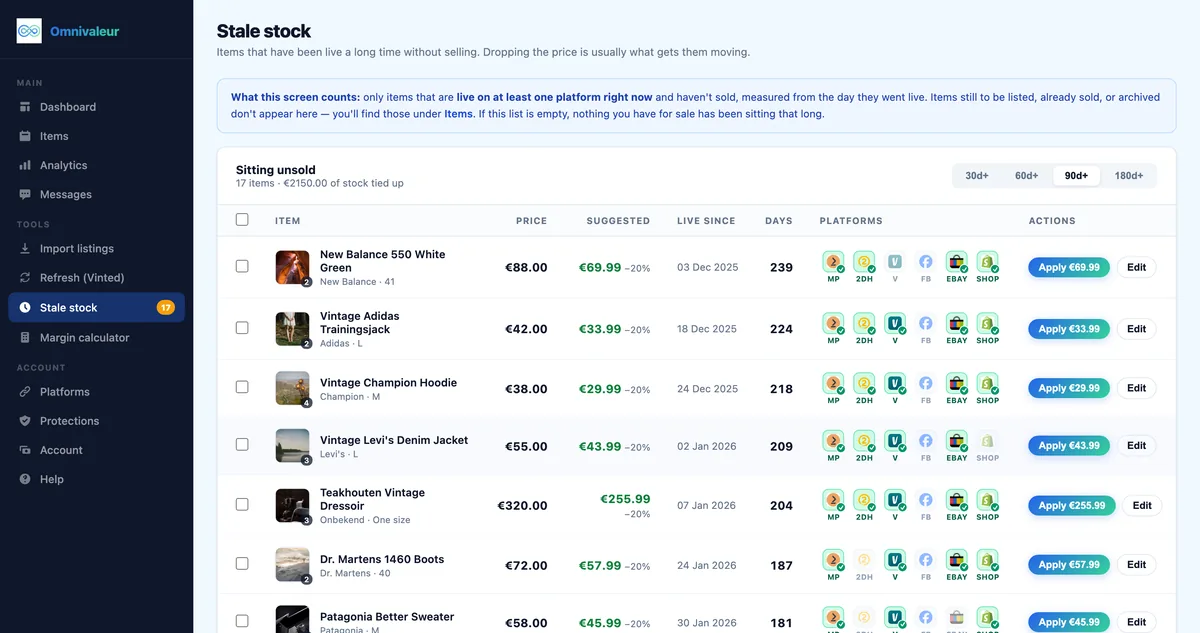
Additionally, Omnivaleur's stale-stock view flags listings that have been sitting unsold, so slow inventory surfaces instead of sinking down the list. This gives you direct visibility over aging merchandise, allowing you to discount older items strategically before year-end accounting closes.
4. Know when to register with the Dutch Chamber of Commerce
If your Vinted operations move beyond occasional weekend thrift flips into regular sourcing with recurring monthly profit, take the step to register an enterprise (eenmanszaak) at the Chamber of Commerce (KvK). Legitimate business registration opens valuable entrepreneur deductions, such as the small businesses scheme (Kleineondernemersregeling or KOR) for VAT exemption, and allows you to deduct expenses like shipping packaging, photography equipment, and cross-listing software from your taxable income.
Selling through multiple storefronts becomes far simpler once your accounting structure is sound. Match your sales schedule to peak buyer activity using our analysis of the best time to post on Vinted, keep your receipts organized, and treat DAC7 reports as routine administrative confirmations rather than an operational obstacle.
Keep reading
Stop copying listings by hand
Omnivaleur publishes your item to every platform at once and syncs stock automatically when something sells.
Start free trial