Margin Scheme VAT for Second Hand Goods: The 2026 Reseller Guide

Under the margin scheme for VAT on second hand goods, registered businesses calculate VAT exclusively on their gross profit margin—the difference between purchase and selling price—rather than the total retail price. Applicable only when sourcing from private individuals or non-VAT entities, the scheme prevents unfair double taxation across European marketplaces.
Key takeaways
- You only pay VAT on the gross profit margin, never the total sale price.
- Eligible inventory must be purchased from private individuals or businesses not charging input VAT.
- You cannot display VAT amounts separately on buyer-facing retail invoices under this special arrangement.
- Global accounting allows you to aggregate monthly purchases and sales across low-value items.
- Cross-border sales within the EU carry strict documentation rules under standard intra-Community legislation.
If you purchase a vintage jacket from an individual on Marktplaats for €50 and resell it for €120, standard Value Added Tax rules would normally demand you pay 21% VAT on the entire €120. That would wipe out €20.83 of your earnings immediately, taxing value that was already taxed when the garment was originally sold at retail years ago. The margin scheme eliminates this penalty entirely.
Instead of taxing your turnover, the special margin arrangement taxes only your gross profit. In that jacket transaction, your margin is €70, meaning the VAT owed drops to roughly €12.15. For any independent merchant operating on platforms like Marktplaats, 2dehands, Vinted, or eBay, understanding these regulations makes the difference between running a profitable venture and losing your operational margins to the tax office. When scaling your enterprise, knowing when reselling becomes a business under KVK rules ensures you register your commercial activities before tax authorities penalize your operations.
What is the margin scheme for VAT on second hand goods?
The margin scheme is an optional European tax mechanism designed specifically for dealers trading in movable physical property that has already entered the commercial consumption cycle. Standard sales tax assumes you bought an item wholesale, claimed back the input VAT you paid to your distributor, and then charged output VAT to the final consumer. When sourcing pre-owned inventory, that chain breaks.
Private citizens cannot provide commercial VAT invoices. When you acquire items from estate clearouts, thrift shops, or local private sellers, zero input tax is deductible. If the state forced you to charge regular sales tax on your full resale price, the product would suffer double taxation. Under the margin rules set out by EU VAT rules for online sellers, authorities permit qualifying enterprises to treat the VAT component as embedded strictly inside the realized gross margin.
This regime covers four primary categories: standard second-hand goods (clothing, consumer electronics, tools, furniture), works of art, collectors' items (such as numismatic coins or vintage toys), and antiques older than 100 years. If you alter, refine, or transform the core character of an acquired item, it no longer qualifies as an intact second-hand good. Minor repairs, polishing, cleaning, and testing are permitted maintenance tasks that keep the item firmly within margin classification.
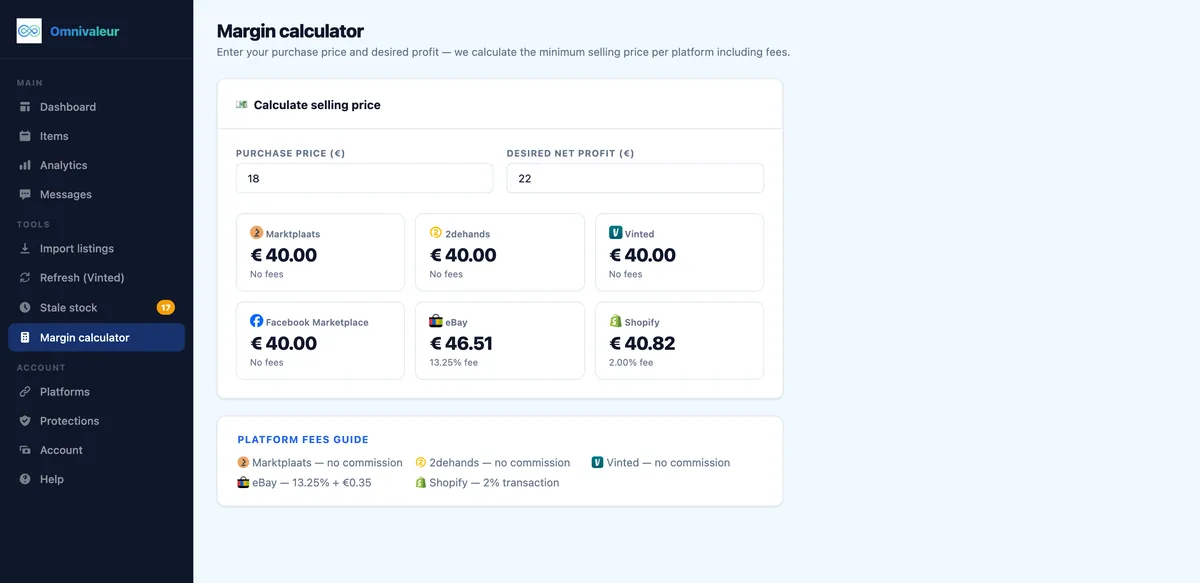
Which goods qualify for the margin scheme and what sources are eligible?
Eligibility depends entirely on where and from whom you acquired the inventory. You cannot simply decide to apply the scheme to any used merchandise; your source documentation must prove that no prior dealer claimed an input tax deduction on that specific purchase.
The acquisition must originate from one of these qualifying counterparties:
- A private consumer: Everyday people clearing out attics on Vinted, Facebook Marketplace, or Marktplaats.
- An exempt business: Organizations exempt from sales tax under national small business schemes (like the Dutch KOR or the Belgian small enterprise exemption).
- Another margin dealer: A commercial merchant who also sold the item to you under the margin scheme, clearly stating this status on their commercial invoice.
- A business that could not deduct VAT: A corporate entity selling capital equipment on which original input tax was legally non-deductible.
Conversely, inventory acquired from a standard VAT-registered wholesaler, distributor, liquidator, or business charging standard 21% input tax does not qualify. If you buy a pallet of customer returns from an online retailer who issues an invoice itemizing 21% sales tax, you must use standard VAT calculation methods. You reclaim the input tax via your quarterly filing, and you must charge regular output VAT on the full customer price when listing those goods.
Certain high-value commodities are explicitly excluded from standard second-hand margin rules across Europe. Precious metals (such as investment-grade gold bullion and unworked silver bars) and rough industrial precious stones are excluded because their value derives primarily from raw material weight rather than historical, artistic, or utilitarian merit. Standard second-hand luxury items, including watches and fine jewelry, remain fully eligible when bought from private consumers. Resellers managing diverse product lines should review specific guidelines for jewelry reselling workflows to accurately separate non-qualifying precious metals from qualifying second-hand jewelry pieces.
How do you calculate VAT under the individual and global margin methods?
Calculating margin tax requires understanding that the VAT amount is inside your gross profit rather than placed on top of it. You determine your gross margin by taking the final customer sales price (including any standard shipping fees paid by the buyer) and subtracting the initial purchase cost of the item.
Depending on the nature of your catalogue, tax administrations require one of two administrative calculation routes: the individual item method or the global accounting method.
The Individual Item Method
The individual item method applies to items with a purchase cost exceeding statutory thresholds (typically €500 or more in the Netherlands and Belgium), registered vehicles, and unique, trackable inventory such as serialized cameras or art. Under this rule, you calculate your margin for every single product independently.
Consider this step-by-step mathematical example using a standard 21% rate:
- Purchase price: You buy a professional vintage camera body from a collector for €600.
- Selling price: You clean the optics, test the shutter, and sell it on eBay for €950.
- Gross profit margin: €950 − €600 = €350.
- Embedded VAT extraction: Gross Margin × (Tax Rate / (100 + Tax Rate)). With a 21% rate, calculate: €350 × (21 / 121) = €60.74.
- Net gross profit: €350 − €60.74 = €289.26 retained operational profit.
What happens if you sell at a loss? Under the individual method, if you purchase an item for €800 and sell it for €700, your margin is negative (-€100). The VAT owed on that transaction is €0.00. Crucially, under the individual method, you cannot offset this €100 loss against a positive margin generated by a different item. The loss simply stands as an uncompensated operational deficit for sales tax purposes.
The Global Accounting Scheme (Globalisation)
Because item-by-item calculation is impractical for sellers turning over hundreds of lower-value products like used books, casual apparel, action figures, or housewares, tax authorities allow or mandate the global accounting scheme. This method allows you to bundle purchases and sales into aggregate quarterly pools.
Instead of tracking each tie, game disc, or coffee mug individually, you sum total qualifying margin acquisitions and total qualifying margin revenues over an entire accounting quarter:
| Accounting Metric | Quarterly Value | Tax Calculation Note |
|---|---|---|
| Total Q1 Margin Sales | €14,800.00 | Gross customer receipts for qualifying used goods |
| Total Q1 Margin Purchases | €8,200.00 | Direct stock acquisitions from private individuals |
| Net Quarterly Margin Pool | €6,600.00 | Aggregate taxable base (€14,800 − €8,200) |
| Quarterly Margin VAT (21/121) | €1,145.45 | Remitted via normal periodic sales tax return |
| Net Realized Margin Pool | €5,454.55 | Pre-expense operating gross profit retained |
The global accounting scheme handles losses much better. If you source heavily during a holiday clearout period and your total purchases exceed your total sales for that quarter (for instance, €10,000 in acquisitions against €7,000 in sales), you post a negative pool margin (-€3,000). You pay €0.00 in sales tax for that quarter, and you roll the €3,000 deficit forward to offset profits in the subsequent quarter.
To keep these acquisition pools accurate across several sales channels, inventory synchronization is non-negotiable. If you sell a collectible on Marktplaats, it must vanish instantly from 2dehands and Vinted to prevent accidental double-selling. Omnivaleur publishes to seven channels from one intake form: Marktplaats, 2dehands, Vinted, eBay, Shopify, WooCommerce and Facebook Marketplace (beta). Cross-listing in Omnivaleur runs one browser tab at a time on purpose: parallel publishing is what gets marketplace accounts rate-limited by platform security filters. Maintaining steady, sequential listing updates prevents the phantom sales and inventory discrepancies that disrupt your margin tax records.

What records and intake registers must resellers maintain?
The margin scheme places a heavy administrative burden on record-keeping. Because you are not paying tax on total turnover, auditors routinely inspect purchase receipts to verify that your reported stock prices are real.
You must maintain a specialized stock register containing:
- An assigned sequential stock reference number for each item (or aggregated batch under global accounting).
- The date of inventory acquisition.
- The full legal name, residential address, and signature of the private seller.
- A precise description of the physical property, including serial numbers, make, model, and physical condition.
- The exact acquisition price paid in euros.
- The payment method (bank transfer references are preferred; cash receipts require a countersigned cash acquisition voucher).
- The date of eventual sale and corresponding invoice number or platform checkout reference.
When you purchase inventory directly from private citizens via Marktplaats or yard sales, they will not supply an invoice. You must generate an inbrengverklaring (purchase receipt/intake statement) yourself. Have the seller sign this document alongside proof of payout. If tax authorities find items in your stock without intake paperwork, they will disallow the margin scheme for those pieces and retroactively assess full 21% sales tax on the entire retail turnover, accompanied by administrative penalties.
Your buyer-facing sales invoices also have strict legal parameters. You must never show VAT separately on an invoice issued under the margin scheme. Stating an itemized VAT amount on a margin invoice is illegal under European tax law. If you write "Item: €100, VAT 21%: €21, Total: €121", you owe that €21 directly to the government regardless of your actual margin, completely forfeiting your margin status. Instead, the document must state the total gross price and include an explicit statutory reference: "Special scheme — second-hand goods" (or the Dutch equivalent: "Bijzondere regeling — gebruikte goederen").
How does the margin scheme interact with platforms, DAC7, and cross-border trade?
Modern online selling rarely stays inside domestic borders. An apparel reseller in Utrecht routinely ships packages to Ghent, Antwerp, or Berlin. Applying margin rules across international borders requires close attention to destination rules and commercial classifications.
Under the European One Stop Shop (OSS) arrangements, standard Distance Selling rules do not treat margin goods the same as standard factory merchandise. When selling second-hand goods under the margin scheme directly to private consumers across the European Union, you generally calculate sales tax using your domestic home country margin rate. You do not register for destination VAT in France or Germany purely because of margin sales, provided you strictly apply the margin scheme to those shipments. However, you cannot treat international sales to private EU individuals as zero-rated intra-Community transactions.
Conversely, if you sell an item to a commercial entity in another EU state that demands an intra-Community zero-rated invoice, you must consciously choose to waive the margin scheme for that individual transaction. You then revert to standard European VAT procedures, verify the buyer's VAT ID, apply 0% intra-Community supply status, and report it on your recapitulative statement.
Meanwhile, the enforcement landscape has shifted dramatically under digital reporting directives. The DAC7 EU tax reporting framework forces digital intermediary platforms—including Vinted, eBay, 2dehands, and Marktplaats—to automatically transmit seller transaction totals and identification details to national revenue departments. For a detailed breakdown of the reporting thresholds, read the full guide on DAC7 Vinted reporting rules in the Netherlands.
This automated data exchange makes manual bookkeeping errors risky. The tax office now receives your raw platform gross receipts directly. If your periodic VAT declaration shows €20,000 in turnover with €800 paid in sales tax because of margin calculations, an automated flag may trigger if your return lacks the proper margin classification codes. You must explicitly register your sales under the dedicated margin boxes on your return (such as Section 1 on the Dutch aangifte omzetbelasting), demonstrating that your reported tax reflects profit margins rather than standard taxable turnover.
For cross-border commerce between the Low Countries, review our jurisdictional analysis of second-hand sales tax in Belgium, which outlines how Belgian enforcement differs slightly regarding physical retail logbooks and platform reporting. Ensuring parity across storefronts is essential, which is why merchants actively utilize workflows to cross-list from Marktplaats to 2dehands to maintain consistent inventory logs.
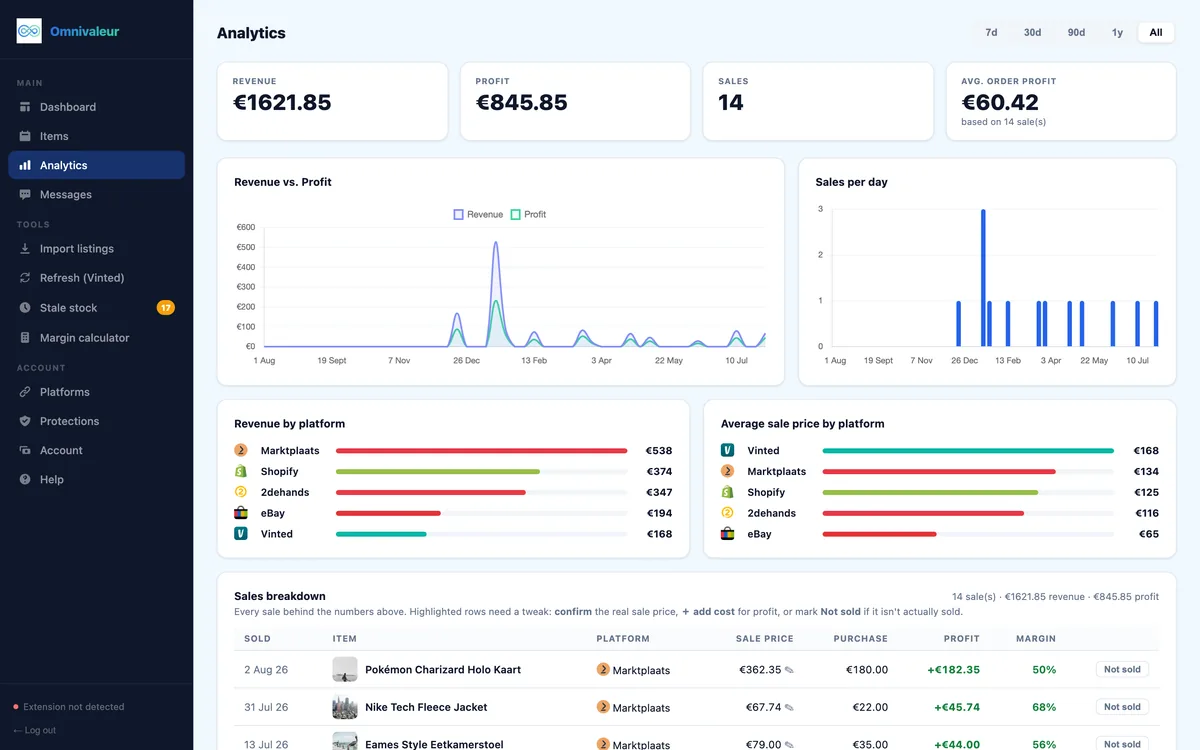
- ✓assign a sequential stock reference number to each item
- ✓record the full name and address of the private seller
- ✓generate an intake statement when buying without an invoice
- ✓keep bank transfer references or signed cash vouchers
- ✓never list separate vat amounts on buyer invoices
Can you choose to opt out of the margin scheme on specific sales?
Yes. The margin scheme is a right granted to merchants, not an inescapable restriction. You retain the legal power to opt out and apply standard sales tax rules on an individual item basis.
Why would a seller willingly pay standard VAT on the full sales price? The answer lies in Business-to-Business (B2B) transactions. Because a margin invoice cannot itemize VAT, a registered commercial buyer cannot reclaim any input tax from that purchase. If you sell a €1,500 professional workstation or heavy piece of machinery to another company, a margin receipt is unattractive to them. They prefer a standard invoice itemizing €1,239.67 net plus €260.33 deductible VAT, which they can reclaim on their business return.
When you opt out for a specific transaction, standard tax rules apply: you charge full sales tax on the total transaction, itemize it clearly on a compliant commercial invoice, and remit that amount to the state. However, opting out on a product does not prevent you from using the margin scheme for the rest of your consumer-facing second-hand inventory.
To help balance margin inventory against standard stock, review this structural comparison:
| Operational Metric | Standard VAT Scheme | Margin Scheme (Global / Individual) |
|---|---|---|
| Taxable Base | Gross retail price charged to customer | Profit margin only (Selling price minus Purchase price) |
| Input Tax on Sourced Stock | Fully deductible via tax filings | Zero deduction allowed on initial purchase price |
| Customer Invoicing | Must state VAT rate and euro amount explicitly | Strictly forbids displaying any VAT rate or amount |
| Loss Handling | Input tax reclaimed regardless of final sales profit | No tax due; losses aggregate only under global accounting |
| Attractiveness to B2B Buyers | High (corporate buyers reclaim the itemized input tax) | Low (corporate buyers cannot reclaim embedded margin VAT) |
| Eligible Sourcing Sources | Registered VAT businesses providing valid invoices | Private individuals, exempt small businesses, margin dealers |
What are the common pitfalls and mistakes resellers make?
Audits of second-hand dealers frequently reveal structural, costly errors. Tax inspectors focus heavily on second-hand merchants because calculating tax on profit margins creates tempting opportunities for non-compliance.
Avoid these common operational mistakes:
- Deducting repair and overhead expenses directly from the item margin: This is the most common error. If you purchase a broken watch for €100, spend €50 on spare parts, and sell it for €250, your taxable margin is €150 (€250 − €100), not €100. Spare parts, packaging materials, platform listing fees, and parcel postage are general business operating expenses. You reclaim the input VAT on those bills through normal business expense deductions; you cannot add them to the original purchase price to artificially depress your calculated gross margin. Read our breakdown on how to price second-hand items to build these overhead costs into your pricing model cleanly.
- Throwing away non-digital cash receipts: If you buy items at estate sales, yard sales, or markets for cash, you must retain signed intake statements. If an auditor inspects a €400 cash acquisition and you cannot produce a signed statement containing the seller's verified address details, that purchase price will be adjusted to €0. You will then owe 21% sales tax on the entire retail turnover of that item.
- Displaying VAT amounts on margin invoices: Adding an itemized VAT figure to an invoice marked as margin goods immediately forfeits your margin status for that sale. Under European law, if you write down a VAT amount, you must pay it to the tax office, while still remaining barred from claiming the stock purchase deduction.
- Mixing non-qualifying imports into the margin register: If you import used electronics, garments, or collectibles from outside the European Union (such as Japan or the United States), customs authorities will assess import VAT at the border. Because that import VAT is fully deductible on your business filings, the merchandise has now entered the standard commercial VAT circuit. You must sell those specific imported items under regular sales tax rules, not the second-hand margin scheme.
- Ignoring buyer return obligations: Remember that operating under the margin scheme does not change your consumer protection requirements. When selling online across European marketplaces, statutory distance-selling rules apply regardless of whether an item is vintage or brand-new. You must still comply with standard EU consumer rights, including the 14-day statutory return period for commercial sales, unless an item falls under specific hygiene or customization exemptions.
Running a compliant second-hand business requires keeping your sourcing documents clean, maintaining accurate intake logs, and separating margin inventory from regular stock across every marketplace you use. By setting up these processes early, you protect your business from surprise tax bills while keeping your margins intact across every channel you serve.
Frequently asked questions
Does the margin scheme apply to refurbished electronics and mobile phones?
How does the margin scheme affect my threshold for VAT registration?
What happens if I import second-hand inventory from the UK into the EU?
Can I apply the margin scheme if I buy second-hand items via online auctions?
Keep reading



Stop copying listings by hand
Omnivaleur publishes your item to every platform at once and syncs stock automatically when something sells.
Start free trial