How to Avoid Selling the Same Item Twice Across Marketplaces in 2026
You avoid selling the same item twice by shrinking the "gap" between a sale on one platform and its removal everywhere else — either by manually checking every listing at least twice a day, or by using cross-listing software that delists across Marktplaats, 2dehands, Vinted, eBay, Etsy and Shopify within seconds of a confirmed sale.
Key takeaways
- One physical item can carry 3-5 active listings at once, so every one of them needs its own delisting trigger, not just the platform where it sold.
- Marktplaats and 2dehands have no public sales API, which is why they're usually the slowest link in the delisting chain.
- A cancelled eBay sale still costs you the final value fee window and a strike against your defect rate, even when you refund instantly.
- Cloud-based cross-listing tools keep working while your laptop is off; browser extensions and manual tab-juggling do not.
- Reporting a cancelled or duplicate sale correctly matters for your DAC7 records, not just your seller rating.
Why do resellers end up selling the same item twice across marketplaces?
It almost never happens because someone is careless. It happens because of a gap — the window between the moment a buyer pays on Platform A and the moment your listing disappears from Platforms B, C and D. That window can be five seconds. It can also be six hours, if you're relying on manually logging into four apps between school pickup and dinner.
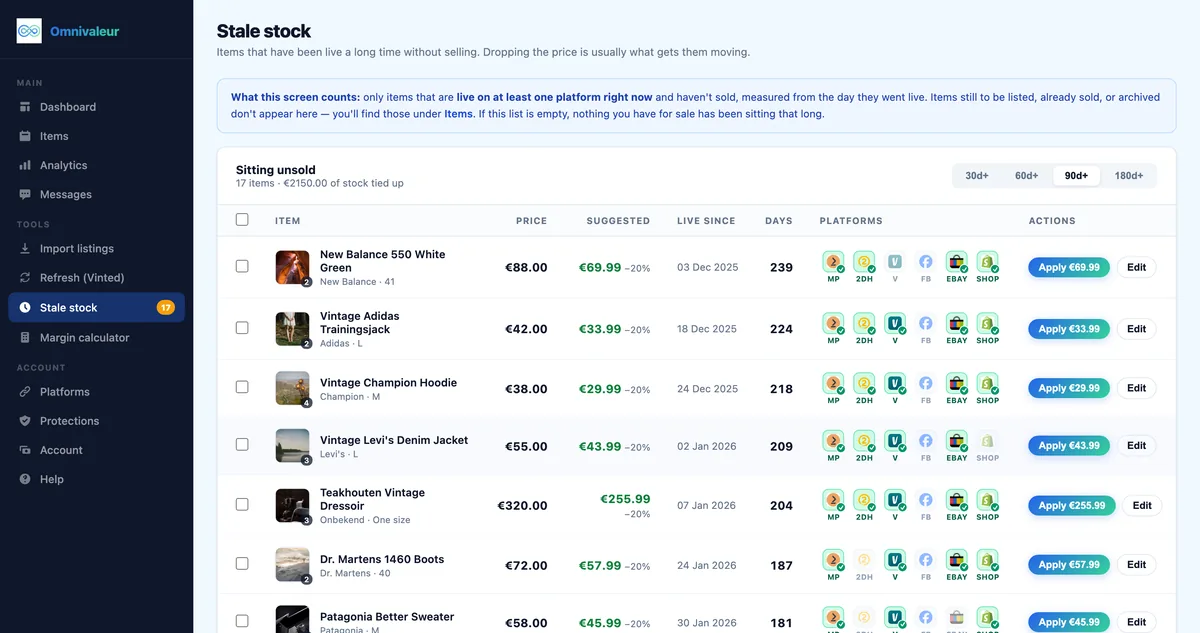
Cross-listing itself isn't the risk. Selling the same suede jacket to two different buyers is. If you list one item on Marktplaats and Vinted, on eBay, and maybe on Etsy too, you're not managing one listing anymore — you're managing three or four live copies of one physical object that can only be sold once. In an Omnivaleur account, a single item typically carries 3-5 active listings at once, and the software has to track each platform's sold/unsold status separately, because they don't talk to each other.
The gap widens for a few predictable reasons: you post a batch of 20 items late at night and don't check anything until morning; a marketplace's app doesn't push a sale notification fast enough; or you're simply juggling six tabs and one of them gets forgotten. None of that is unusual reseller behaviour in 2026 — it's the default state of anyone selling on more than one site without a system.
What counts as a duplicate listing on eBay, Vinted and Marktplaats in 2026?
"Duplicate listing" gets used loosely, but the platforms don't define it the same way, and the penalty depends on which rulebook you tripped over.
What is considered a duplicate listing on eBay?
eBay treats it as the same item, in the same condition, listed more than once at the same time by the same seller — including near-identical variations with slightly different titles or photos. It doesn't matter if the price differs. If the SKU is functionally the same object and both listings are live, eBay's system can flag it.
Can you list the same item in multiple categories on eBay?
No, not as two separate active listings. You can use eBay's Item Specifics or Variations feature to show the same product under attributes like size or colour within one listing, but running two standalone listings — one in "Vintage Cameras," one in "Collectibles" — for one physical unit breaks the policy even if the categories are different.
How does eBay enforce this in 2026?
Enforcement is mostly automated. eBay's detection compares titles, images, item specifics and seller ID; a match above a certain threshold gets one listing silently demoted in search, then removed if it persists. Repeated violations can trigger a selling limit reduction or a temporary restriction on new listings — the same mechanism used for spam accounts, just aimed at legitimate sellers who didn't clean up an old draft.
What should you do if you accidentally create a duplicate on eBay?
End the newer listing immediately rather than waiting for eBay to catch it. Ending it yourself, with the reason "listed by mistake," doesn't dent your account the way an automated removal does. If a buyer has already made an offer or started a purchase on the listing you're ending, message them first and redirect them to the surviving listing.
Vinted, Marktplaats and 2dehands: different rules, same risk
Vinted doesn't formally ban duplicates the way eBay does, but its algorithm downranks near-identical uploads, and buyers can report what looks like spam. Marktplaats and its sister site 2dehands are stricter about literal duplicate ads — posting the same item twice under two ads on the same account can get one pulled by moderation, separate from the double-sale risk. Since Marktplaats and 2dehands share the same ad pool for Dutch and Belgian markets, listing on both isn't a duplicate-content problem, but it doubles your exposure to the sync gap — see our Marktplaats to 2dehands cross-listing guide for how that specific pairing behaves.
What does a double sale actually cost you in euros?
Run the numbers on a realistic case: a vintage 50mm lens listed at €180 on both Marktplaats and eBay.
| Cost item | Marktplaats sale (kept) | eBay sale (cancelled) |
|---|---|---|
| Sale price | €180 | €180 (refunded) |
| Platform fee | €0 (private seller) | ~€23 final value fee, often non-refundable within the cancellation window |
| Payment processing | – | ~€3-5, frequently not returned |
| Buyer's shipping paid | €6.85 (kept, item ships) | €0 (item never ships) |
| Feedback / defect impact | None | Cancellation counts toward your seller-level "transaction defect rate" |
| Time cost | Normal | ~20-40 minutes: apology message, refund, defect appeal if disputed |
Add it up and a €180 lens can quietly cost you €25-30 in unrecoverable fees plus the reputational hit of a cancelled transaction, even though you technically got paid once and refunded once. Multiply that by a busy weekend where you're moving 15-20 items across five platforms, and one missed delisting is no longer a rounding error — it's the margin on two or three other sales.
How quickly does automatic delisting work when an item sells?
It depends entirely on whether the platform gives out an official sales API. eBay, Etsy and Shopify have one, so a confirmed sale can trigger a delist elsewhere within seconds to a couple of minutes. Vinted's sale confirmation is similarly fast once the buyer completes checkout. Marktplaats and 2dehands are the slow link: neither publishes a public sales API, so cross-listing tools have to detect a sold status through other signals, and that check typically runs on a short polling cycle rather than instantly. In practice that means most of the gap risk in a Dutch or Belgian reseller's stack sits specifically on Marktplaats and 2dehands, not on eBay or Etsy.
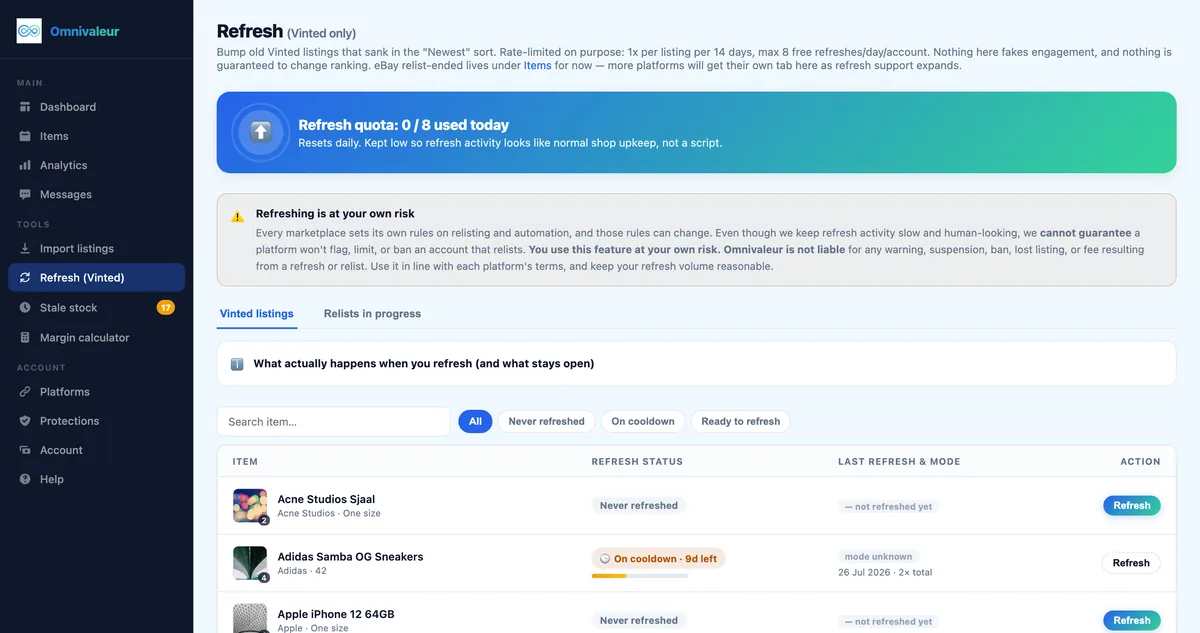
Omnivaleur publishes an item to all six marketplaces — Marktplaats, 2dehands, Vinted, eBay, Etsy and Shopify — from one intake form, and tracks each platform's status independently so a sale on the fast-syncing side (eBay, Etsy, Shopify, Vinted) triggers delisting everywhere without waiting for the slowest platform to confirm first.
Can you cross-list safely using only a mobile phone?
Yes, and most resellers do at least part of their workflow that way. Vinted, Marktplaats, 2dehands and eBay all have mature apps, and photographing, pricing and posting from a phone is normal. The risk isn't the phone itself — it's manual switching. Checking four separate apps for sold notifications while you're also cooking dinner or on the train is exactly where the gap opens.
What actually matters is whether your cross-listing method is app-native or cloud-based. A cloud tool with a mobile-friendly intake form lets you list once from your phone and still have the delisting happen server-side, even if you close the app two minutes later. If you're building a mobile-first workflow around clothing or footwear specifically, the Vinted reselling automation guide and the footwear cross-listing guide both cover phone-based intake in more depth.
Will an automated delisting tool ever pull a listing that hasn't actually sold?
Occasionally, yes — and it's worth knowing why before it happens to you. False positives usually come from one of three sources: a platform API returning a "sold" status for a returned or cancelled order before the reversal syncs back; a buyer starting checkout and abandoning it, which some marketplaces briefly flag as reserved; or a manual "mark as sold" click on one listing that the tool correctly propagates everywhere, even though you meant to test something.
Good software handles this with a short confirmation buffer rather than an instant, irreversible pull — waiting a beat for payment confirmation, not just an order-created event — and gives you a manual restore option if a sale is reversed. If you're comparing tools specifically on this point, it's worth checking how each one handles reversed sales before you commit; the Omnivaleur vs Vendoo comparison and the Omnivaleur vs Zenlister comparison both break down how each platform's delisting logic behaves around cancelled orders.
What happens to your listings if an item sells while your computer is off?
This is the single biggest gap between browser-extension tools and proper cloud SaaS, and it's rarely explained clearly. A browser extension that runs "in the background" of Chrome still needs Chrome open, your laptop awake, and often a specific tab loaded to fire its delisting script. Close the lid to catch a train, and the extension stops working — the sale on Vinted at 14:03 sits unsynced until you open your laptop again at 19:30.
A cloud-based service doesn't care whether your computer is on. The sale event happens on the marketplace's server, the cross-listing tool's server picks it up, and the delisting happens on the other marketplaces' servers — your device is never in that loop at all. If you sell part-time and only check your phone in the evening, this distinction is worth more than almost any other feature comparison, because it's the difference between a 20-minute gap and a 6-hour one.
- ✓Message the second buyer within the hour with a plain explanation that the item sold elsewhere
- ✓Cancel and refund immediately on the platform where you list second, don't wait for the buyer
- ✓Mark the item reserved or pull photos on all other platforms the moment the first sale happens
- ✓Set three fixed times daily to check every platform for sold flags instead of checking randomly
- ✓List in batches of 5-8 items across platforms, not 30 at once, to reduce exposure when first sale hits
- ✓Check Marktplaats and 2dehands first and hardest, since they lack a public sales API
What manual habits actually reduce duplicate sales if you're not automating yet?
Not every reseller is ready to pay for software, and a disciplined manual routine genuinely works below a certain volume — roughly 10-15 active listings across two platforms. Above that, the odds catch up with you.
- Batch your checks, don't drift into them. Set three fixed times a day (morning, lunch, evening) to open every platform and scan for "sold" flags, rather than checking randomly whenever you remember.
- Keep one master spreadsheet with a row per item and a column per platform, marked SOLD/LIVE/PENDING. It's low-tech, but it forces you to actually look at every platform every time you update it.
- List in small batches of 5-8 items rather than 30 at once. A big overnight upload across four platforms multiplies your exposure the moment the first one sells.
- Reserve, don't just refund. The moment something sells, immediately mark it "reserved" or pull the photos on every other platform before you even process payment or packaging.
- Watch the slow platforms harder. Since Marktplaats and 2dehands lack a public sales API, treat those two as your highest-risk pair and check them first, every time.
None of this scales past a certain point, which is why most resellers doing 20+ items a week end up automating the delisting step specifically, even if they keep photographing and describing items manually.
How should you handle it gracefully if you do sell the same item twice?
It will happen eventually, even with software running. Here's the sequence that keeps both buyers reasonably happy and keeps your account healthy:
- Message the second buyer within the hour. Speed matters more than the wording. Explain plainly that the item sold on another platform and you're cancelling with a full refund.
- Cancel and refund immediately, don't wait for the buyer to ask. On eBay and Etsy, an immediate seller-initiated cancellation with a clear reason code is treated far better than a buyer-filed complaint.
- Offer something small if you can — a discount code for a future purchase, or priority on a similar item you're about to list. It costs you little and defuses most frustration.
- Check your obligations. Under EU consumer protection rules, buyers generally have the right to a refund when a seller can't fulfil an order; see the Your Europe consumer shopping rights overview for what applies across the EU regardless of which marketplace the sale happened on.
- Log it for your own records. A cancelled sale that generated a payment and a refund can still show up in transaction reporting. If you're selling as part of your income and subject to DAC7 reporting, keep a note of the cancellation and refund date — see the Belastingdienst's DAC7 guidance for sellers or the European Commission's DAC7 overview if you're unsure how a refunded transaction is treated.
What you shouldn't do is ignore the message and hope the buyer forgets. Unrefunded duplicate sales are one of the fastest ways to pick up a payment dispute, and disputes hurt your account far more than an honest cancellation ever will.
Which method actually keeps you safest: manual tracking, a spreadsheet, or cross-listing software?
There's no single right answer for every seller, but the comparison is worth seeing side by side once volume climbs.
| Method | Typical sync gap | Works if your device is off | Best fit |
|---|---|---|---|
| Manual checking, no spreadsheet | Hours, sometimes overnight | No | Under 10 items live at once |
| Shared spreadsheet + fixed check times | 1-4 hours | No | 10-20 items, part-time selling |
| Browser extension cross-listing tool | Minutes, but only while browser is open | No | Desktop-heavy sellers, moderate volume |
| Cloud-based cross-listing software | Seconds to a few minutes, gated by the slowest platform's API | Yes | 20+ items, multi-platform, part-time and full-time alike |
The category that closes the gap fastest is cloud software, purely because it doesn't depend on you being at your desk when a sale lands. It's also the category where category-specific quirks matter — jewelry and watches, for example, tend to sell faster on high-intent platforms like Etsy than on general marketplaces, which changes how tight your delisting window needs to be. The jewelry reselling automation guide and vintage watch automation guide go into which platform combinations create the tightest gap for those categories specifically.
Timing your listings well also reduces how many items are simultaneously "at risk" of a double sale in the first place — fewer items live during peak buyer traffic means fewer chances for two buyers to hit checkout minutes apart. If you sell on Vinted, the best time to post on Vinted guide shows the windows where sales cluster, which is also exactly when your delisting speed matters most.
How does this look for someone selling across the Netherlands and Belgium specifically?
Dutch and Belgian resellers face a particular version of this problem because Marktplaats and 2dehands are effectively the same platform group serving two countries, while Vinted, eBay and Etsy pull in a different, more international buyer. That means an item posted domestically and cross-listed internationally can sell from either pool with very little warning — a Marktplaats buyer messaging on a Tuesday morning while an eBay.de buyer checks out five minutes later.
Shipping habits compound the risk. If you're used to bundling drop-offs — say, shipping a parcel via 2dehands once a week rather than daily — a duplicate sale sitting unnoticed for six days is a much bigger problem than one caught the same afternoon. The guide on shipping a parcel via 2dehands covers how to structure a shipping routine that doesn't leave sold items live for days at a time. And if you're cross-listing between 2dehands and Etsy for a more collector-focused audience, the 2dehands to Etsy cross-listing guide covers the specific sync behaviour for that pairing, since Etsy's sale confirmation is near-instant compared to 2dehands' polling-based detection.
What's the realistic bottom line for 2026?
Platforms keep tightening duplicate-listing enforcement year over year, not loosening it — eBay's automated detection has gotten more aggressive at flagging near-identical listings, and Vinted's spam-detection algorithm treats repeated near-copies more harshly than it did a couple of years ago. That trend makes the gap-closing problem slightly more urgent every year, not less.
None of this means cross-listing itself is risky. It means the sync step between "sold on Platform A" and "removed everywhere else" is the one part of the workflow you can't afford to do by memory once you're past a handful of listings. Whether you close that gap with a disciplined manual routine, a spreadsheet checked three times a day, or software that watches all six marketplaces at once, the principle is the same: shrink the window, and the double sales mostly stop happening on their own.
Frequently asked questions
Does Vinted charge me anything if I have to cancel a duplicate sale?
Can frequent cancellations from duplicate sales hurt my seller rating long-term?
How many items can I safely cross-list without any software at all?
Do I need to report a cancelled duplicate sale for tax purposes in the Netherlands?
Is listing the same item on both Marktplaats and 2dehands considered a duplicate listing?
Keep reading

Stop copying listings by hand
Omnivaleur publishes your item to every platform at once and syncs stock automatically when something sells.
Start free trial