Omnivaleur vs OneShop: Which Crosslisting Tool Wins in 2026?
Omnivaleur is built around European marketplaces — Marktplaats, 2dehands, Vinted, Etsy, eBay and Shopify — with automatic delisting when an item sells. OneShop started as a US-first tool for Poshmark, Mercari and Depop, with Vinted added later. Pick Omnivaleur if your business is EU-heavy; pick OneShop if you sell mostly on US platforms.
Key takeaways
- Omnivaleur was designed around EU marketplaces from day one, not added as an afterthought.
- OneShop's core strength remains US resale platforms like Poshmark and Mercari.
- Both tools automate relisting, but sync speed and delisting reliability differ across platforms.
- DAC7 reporting in 2026 makes multi-marketplace tracking a real factor, not just a nice-to-have.
- Neither tool "wins" outright — the right pick depends on where you actually sell.
If you're a European reseller comparing crosslisting software, the question usually isn't "which tool is better" in the abstract. It's "which tool was built for where I sell." That's the real difference between Omnivaleur and OneShop, and it shapes almost everything else in this comparison.
What is OneShop, and how does it actually differ from Omnivaleur?
OneShop emerged as a crosslisting and inventory tool aimed primarily at the US secondhand market — think Poshmark, Mercari, Depop, and eBay. It's a solid product in that context, with automation features that many American resellers rely on daily. Vinted support was added as the platform grew, which is worth acknowledging as a genuine strength: OneShop didn't ignore Europe, it expanded into it.
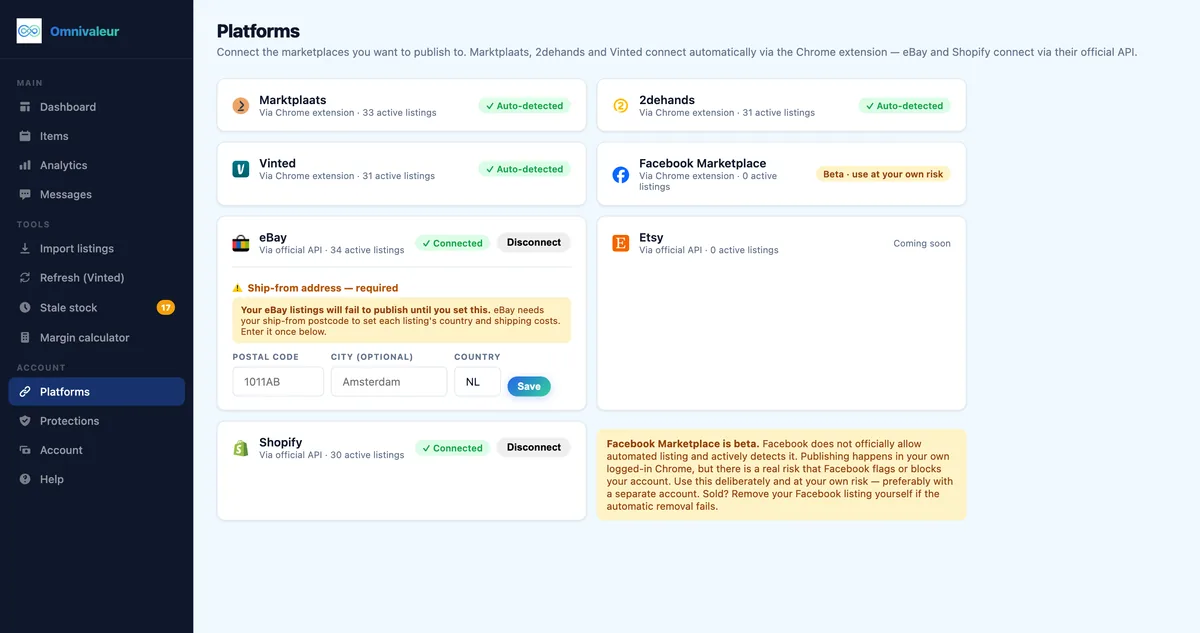
Omnivaleur takes the opposite starting point. It was built specifically for the European secondhand ecosystem — Marktplaats, 2dehands, Vinted, plus Etsy, eBay and Shopify for resellers who also run a shop-style storefront. That means the sync logic, category mapping, and language handling were designed around Dutch, Belgian and broader EU marketplace quirks from the start, not retrofitted onto a US-first codebase.
Neither approach is objectively wrong. It's a question of where your inventory actually lives.
Which marketplaces does each platform actually support in 2026?
This is the single biggest deciding factor for most resellers, and it's worth being precise about it rather than vague.
- Omnivaleur: Marktplaats, 2dehands, Vinted, eBay, Etsy, Shopify.
- OneShop: Poshmark, Mercari, Depop, eBay, Facebook Marketplace, and Vinted as a secondary/European addition.
If your listings are split between Marktplaats and Vinted — a common combo for Dutch and Belgian resellers — Omnivaleur's native handling of both is going to feel noticeably smoother than a tool where Vinted was bolted on after the fact. Conversely, if half your inventory sits on Poshmark and Mercari, OneShop's deeper US integrations make more sense for you.
How do the pricing plans compare?
Pricing in this space moves around often, so treat exact figures as a snapshot rather than gospel — always check each provider's current pricing page before committing.
| Feature | Omnivaleur | OneShop |
|---|---|---|
| Pricing model | Flat monthly subscription, scales with listing volume | Tiered subscription with a free/limited entry tier and paid plans by volume |
| EU marketplaces covered | Marktplaats, 2dehands, Vinted, Etsy, eBay, Shopify | Vinted (added), eBay |
| US marketplaces covered | eBay, Etsy, Shopify | Poshmark, Mercari, Depop, Facebook Marketplace, eBay |
| Auto-delisting on sale | Yes, across all connected platforms | Yes, primarily across US-first platforms; EU coverage depends on integration maturity |
| Setup time | Typically under 15 minutes for a first store connection | Comparable, standard OAuth-style connections |
| Support language | English and Dutch | English |
Neither company publishes identical plan structures, so a side-by-side euro comparison isn't reliable to print here — what matters more is which marketplaces are actually included in the tier you'd need to run your business.
Which tool is easier to set up and use day to day?
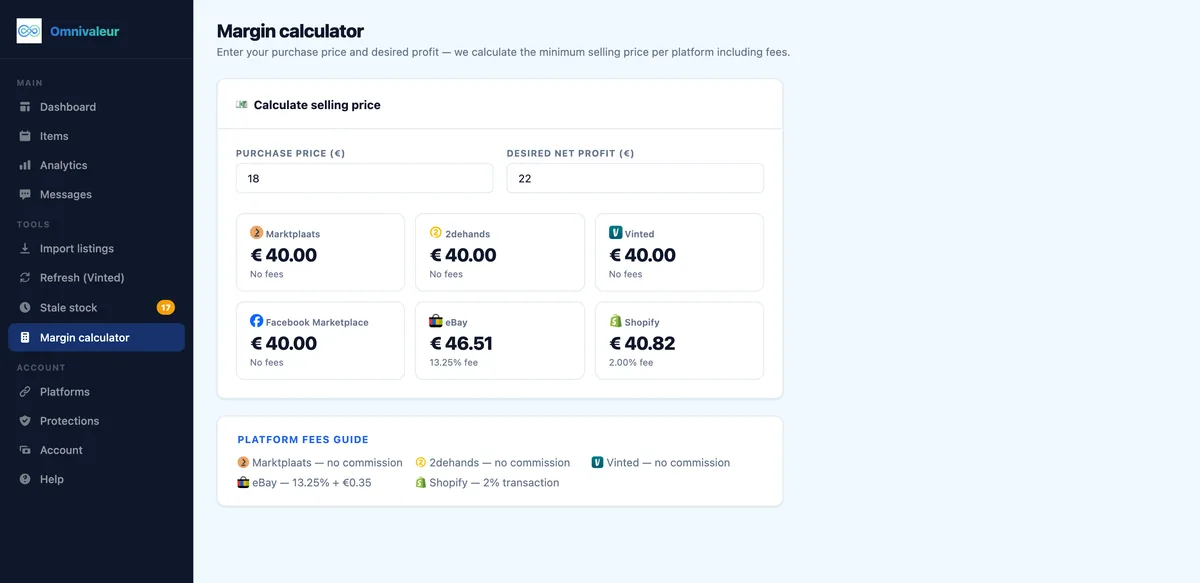
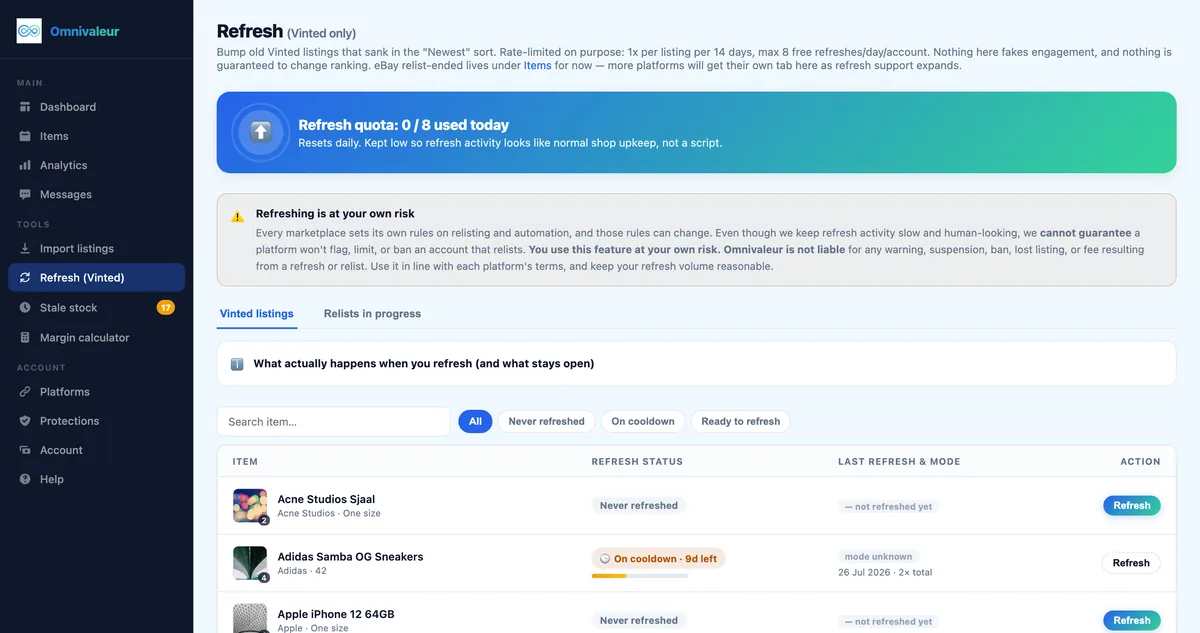
Setup for both tools follows the now-standard pattern: connect your marketplace accounts, import existing listings or create new ones, then let the software handle syncing. Omnivaleur's dashboard groups everything by item rather than by platform, which sounds minor but matters once you're managing 200+ active listings — you see one card per item with its status across every connected marketplace, instead of six separate tabs.
OneShop's interface leans on a more list-heavy layout, which some US resellers who came from Poshmark's own app find familiar and comfortable. That familiarity is a real advantage if you're already used to that visual language. If you're starting fresh from a European marketplace like Marktplaats, the item-centric view tends to require less mental translation.
Day-to-day, the difference that actually costs time is bulk editing. Being able to update price, description or photos across five marketplaces from a single edit screen — rather than opening each platform separately — is where automation tools earn their subscription fee. Both platforms support some version of this, though the depth of bulk-editing tools varies by which marketplaces you've connected.
How does each platform handle sync, delisting and relisting?
Sync speed is where crosslisting tools live or die. An item that sells on Vinted but stays live on Marktplaats for another six hours isn't a minor bug — it's a double-sale risk, a refund, and an annoyed buyer.
Omnivaleur checks for sold status and pushes delisting across connected marketplaces on a short polling cycle, aiming to keep the gap between "sold here" and "removed everywhere else" as tight as marketplace APIs allow. Relisting (bumping an item back to the top of search results after it's been sitting for a while) is handled per-marketplace rule, since Marktplaats, 2dehands, Vinted and eBay all have different conventions for how "freshness" affects visibility.
OneShop applies similar logic on its supported platforms, with sync behavior generally reported as strong on its core US integrations — which makes sense, given that's where the product matured first. How tightly that same sync speed holds up on Vinted specifically is harder to verify independently, and it's the kind of detail worth testing yourself with a small batch of listings before committing serious inventory to either tool.
- ✓List all the marketplaces where your inventory actually lives right now
- ✓Check which marketplaces each tool supports natively versus as add-ons
- ✓Test sync speed on both tools with a small batch of live listings
- ✓Confirm language support and EU-specific features match your needs
- ✓Review how each tool handles your highest-volume marketplace first
How well does each tool handle EU-specific marketplaces like Marktplaats, 2dehands and Vinted?
This is the section where the "built for Europe vs. expanded into Europe" distinction shows up most clearly.
Marktplaats and 2dehands have their own category structures, delivery-option settings, and pricing conventions (asking price vs. fixed price, bidding enabled or not) that don't map neatly onto US marketplace fields. A tool that started life mapping Poshmark categories to Mercari categories has to build a second, separate mapping layer for Dutch marketplaces — and that layer either gets full attention or it doesn't.
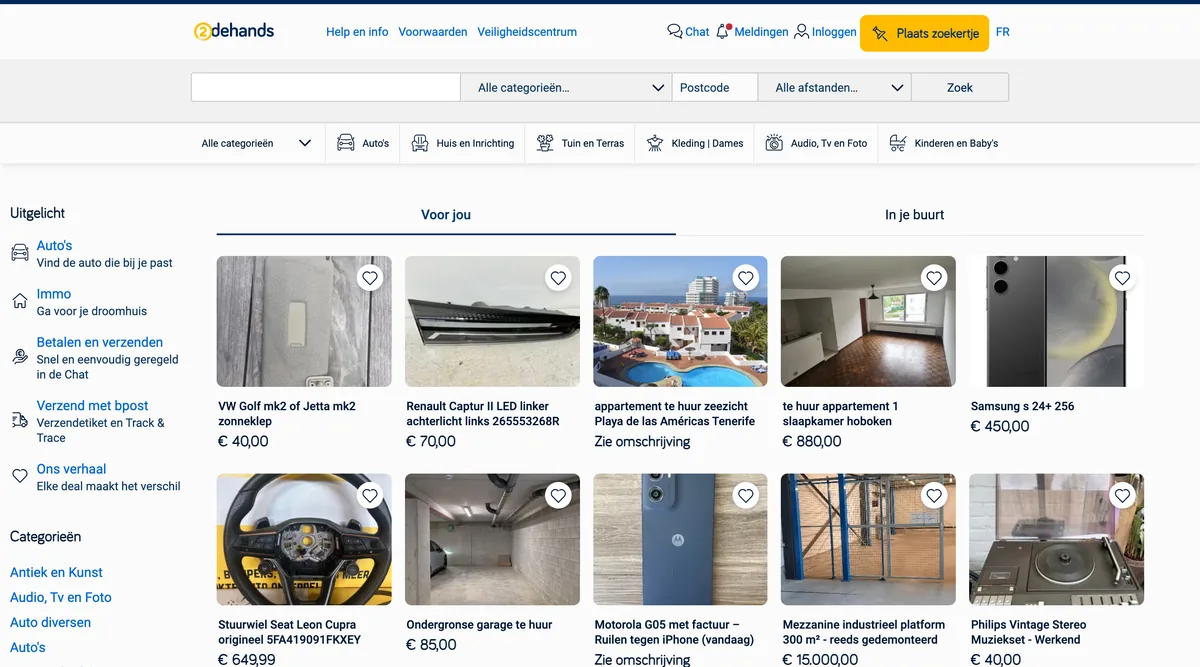
Omnivaleur's category and pricing logic was built against Marktplaats and 2dehands directly, including euro pricing formats and the shipping-option terminology both platforms use. For a deeper look at moving stock between these two Dutch marketplaces and Vinted specifically, see the Marktplaats to Vinted crosslisting guide.
Vinted itself also enforces its own listing and selling rules — item condition categories, prohibited items, and photo requirements are all spelled out in Vinted's official selling help section. Any crosslisting tool has to respect those rules automatically, or resellers end up with listings that get flagged or removed. Marktplaats runs its own separate policy set too, documented on the Marktplaats Help & Info portal, and a tool unfamiliar with those specifics risks generating listings that violate local rules without the seller noticing until it's too late.
If Vinted is your main volume driver alongside a US platform, the Vinted reselling automation approach is worth comparing directly against whichever tool you're testing, since Vinted-specific behavior varies more between tools than people expect.
What about customer support and reliability?
Support quality is genuinely hard to compare fairly without cherry-picking anecdotes, so this section stays deliberately general. Both tools offer standard SaaS support channels — email/ticket support being the baseline, with faster tiers sometimes gated behind higher-priced plans. Omnivaleur offers support in both English and Dutch, which matters if you're troubleshooting a Marktplaats-specific sync issue and want to describe it in your own language rather than translating technical terms on the fly.
Reliability, in the sense of uptime and API stability, depends heavily on how each marketplace's own API behaves — that's true industry-wide, not specific to either tool. eBay, for instance, publishes its own listing rules and API behavior expectations directly, which any integration has to keep up with as eBay's listing management documentation gets updated.
How does DAC7 tax reporting in 2026 factor into the choice?
This is the part most crosslisting comparisons skip entirely, and it's exactly the gap worth filling. Since DAC7 rules came into force, marketplaces operating in the EU are required to collect and report seller data once you cross certain sales thresholds — and in 2026 that reporting obligation is fully embedded into how Marktplaats, Vinted and other EU platforms operate, not a temporary rule anymore.
Concretely: once you sell roughly 30 items or earn around €2,000 in a calendar year on a single platform, that platform is obligated to report your sales data to tax authorities under DAC7. The official rules are laid out by the Belastingdienst's DAC7 information page for sellers, and the broader EU framework is explained on the European Commission's DAC7 overview.
Why does this matter for choosing between Omnivaleur and OneShop? Because if you're crosslisting the same items across six platforms, each platform sees only its own slice of your total sales — but the tax authority sees the whole picture once data gets reported. A tool with clean, item-level sales tracking across every connected marketplace makes it far easier to reconcile your own records against what each platform reports, instead of scrambling every January to piece together six separate sales histories. This is a genuinely underrated reason to pick a crosslisting tool with strong EU marketplace coverage if most of your DAC7-relevant sales happen on Marktplaats and Vinted.
Which platform is actually best for which type of reseller?
Neither tool is universally "better" — that's the honest answer, not a hedge.
Choose Omnivaleur if:
- Most of your inventory moves through Marktplaats, 2dehands, Vinted, or a mix of those with eBay and Etsy.
- You want support available in Dutch as well as English.
- You care about how a tool handles euro pricing, VAT-adjacent details, and EU-specific marketplace policies without extra translation work.
Choose OneShop if:
- The bulk of your sales happen on Poshmark, Mercari, Depop or Facebook Marketplace.
- You already know and like OneShop's interface from experience with US resale tools.
- Vinted is a secondary channel for you rather than your primary one.
If you're weighing multiple crosslisting tools rather than just these two, the Omnivaleur vs Vendoo comparison covers a similar decision from a different angle, and is worth reading if Vendoo is also on your shortlist. For readers who landed here via the Dutch version of this comparison, the equivalent page sits at /nl/vergelijking/omnivaleur-vs-oneshop.
The short version: match the tool to your marketplace mix, not the other way around. A crosslisting tool that's excellent on platforms you don't use isn't actually saving you anything.
Frequently asked questions
Can I use both Omnivaleur and OneShop at the same time?
Does OneShop support Marktplaats or 2dehands directly?
How long does it take to migrate existing listings from OneShop to Omnivaleur?
Keep reading
Stop copying listings by hand
Omnivaleur publishes your item to every platform at once and syncs stock automatically when something sells.
Start free trial