Belastingdienst Second Hand Selling Rules in the Netherlands for 2026
Selling second-hand goods in the Netherlands does not automatically trigger tax obligations. However, if you sell frequently for profit, cross the DAC7 threshold of 30 items or €2,000 in revenue, or exceed €20,000 turnover under the KOR scheme, the Belastingdienst classifies your activity as a business, requiring income tax, VAT, and KvK registration.
Key takeaways
- Occasional garage sales and wardrobe clear-outs remain completely tax-free under Dutch hobby rules.
- The DAC7 directive forces platforms like Marktplaats and Vinted to report high-volume sellers directly to the Belastingdienst.
- The 2026 small businesses scheme allows exemptions up to €20,000 in annual turnover if correctly registered.
- Professional resellers scaling operations across multiple channels should use inventory tracking to maintain accurate financial records.
- Ignoring tax obligations after crossing commercial thresholds risks retrospective assessments and administrative fines.
Navigating the tax landscape of second-hand reselling in the Netherlands feels like walking through a minefield. Many casual sellers believe that because their items are used, pre-owned, or already taxed at original purchase, any cash generated through platforms like Marktplaats or Vinted stays entirely tax-free. Unfortunately, the reality is far more nuanced. As online marketplaces mature, tax authorities across Europe have tightened the net. Understanding how the Belastingdienst treats second-hand sales separates profitable scaling from unexpected tax penalties.
Whether you clear out your attic twice a year or run a serious cross-listing operation spanning multiple European storefronts, the rules changed significantly. The introduction of strict reporting directives means the days of operating entirely under the radar are over. This guide breaks down the legal, tax, and operational frameworks governing second-hand sales in the Netherlands for 2026, ensuring your resale business remains fully compliant without sacrificing your profit margins.
When Does Selling Second-Hand Goods Make You an Entrepreneur for the Belastingdienst?
The single most important distinction the Dutch tax authority makes is whether your sales stem from a hobby or a commercial enterprise. The Belastingdienst does not rely on a single rigid formula, but rather evaluates a combination of indicators known as zelfstandig ondernemerschap. If you sell your old winter coat or a child's outgrown bicycle, you are engaging in personal asset management. No taxes apply, and no registration is required.
However, the moment you begin sourcing items specifically to flip them for a profit, the legal classification shifts immediately. Buying retro sneakers at thrift stores, sourcing vintage cameras at local markets, or acquiring designer clothing lots to flip on digital platforms transforms your hobby into a business. The Belastingdienst looks at factors such as:
- Profit intent: Do you consistently buy items below market value to resell them at a higher price?
- Time and effort: Do you spend substantial hours photographing, cleaning, packing, and shipping items weekly?
- Continuity: Are your sales ongoing and structured rather than sporadic clear-outs?
- External capital and scale: Do you use dedicated storage units, business accounts, or automation software to manage your inventory?
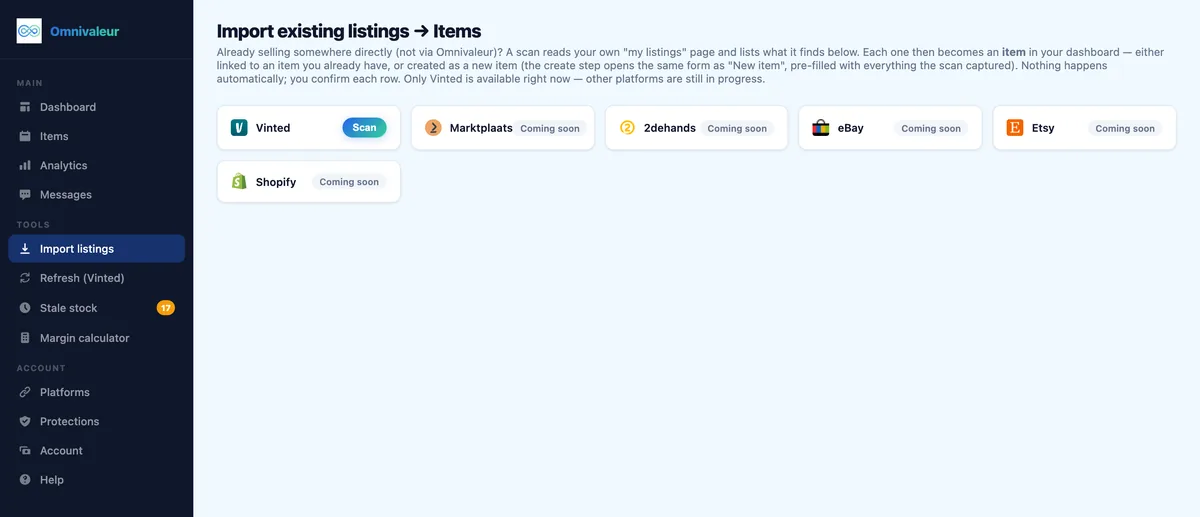
If you meet these criteria, you are legally considered an entrepreneur. This means you must register with the Chamber of Commerce (KvK) and evaluate whether your turnover crosses standard tax thresholds. Professional sellers scaling operations often utilize specialized inventory workflows, similar to those outlined in guides on how to organize inventory for reselling, to keep track of purchase costs versus selling prices for annual tax returns.
How Does the DAC7 Directive Expose Your Second-Hand Sales?
For years, private sellers enjoyed complete anonymity regarding their online transactions. Platforms acted as digital flea markets where cash or direct bank transfers changed hands without external reporting. The implementation of the DAC7 directive permanently altered this dynamic. Under European tax transparency laws, all digital platform operators based in the EU or facilitating transactions for EU sellers must automatically report user data to tax authorities if specific thresholds are met.
You trigger a DAC7 reporting flag if, within a single calendar year, your account meets either of these two criteria:
- You complete 30 or more sales transactions.
- Your total sales revenue reaches or exceeds €2,000.
Once you hit either threshold, the platform compiles your name, address, bank account details, transaction counts, and gross revenues, transmitting this data directly to the Dutch tax authorities. For a deeper breakdown of how this affects specific communities, review the DAC7 Vinted Reporting Rules in the Netherlands (2026) guide. It is vital to understand that DAC7 is not a new tax; rather, it is a reporting mechanism. The Belastingdienst receives this data and cross-references it against your income tax filings. If you report €0 in business income while platforms report thousands of euros in consistent sales, expect an automated inquiry.
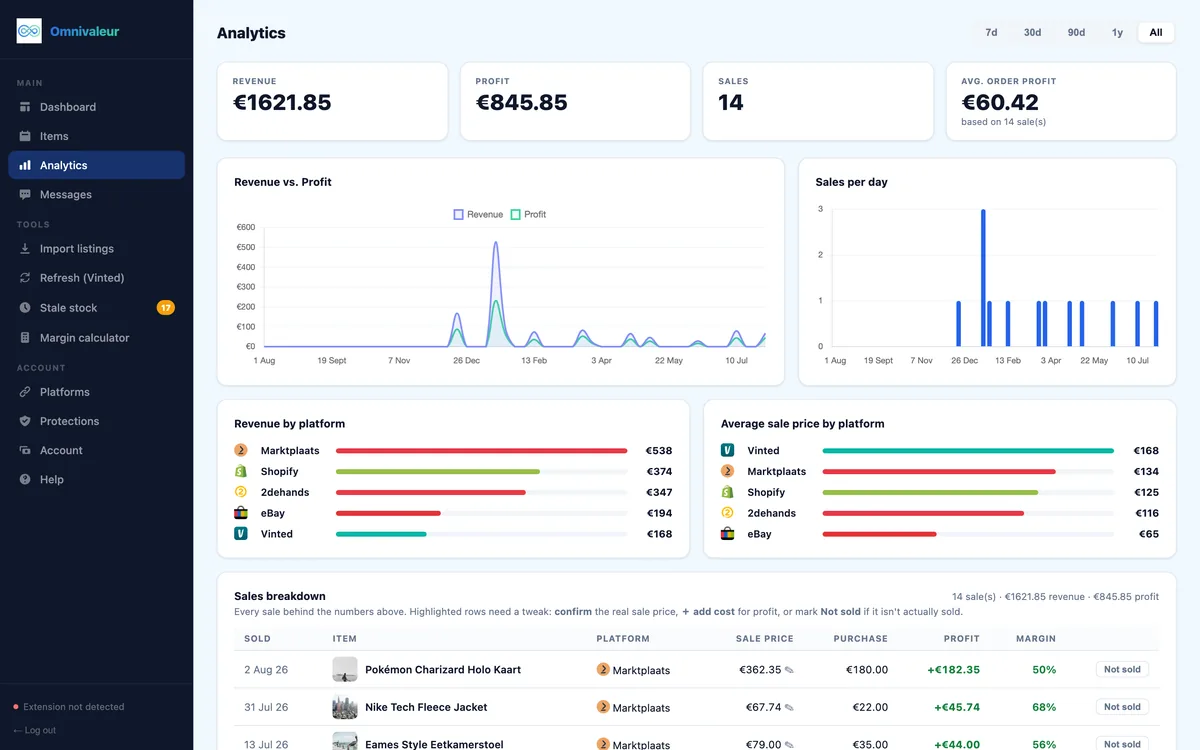
For cross-border sellers operating across multiple platforms, managing inventory becomes complex. A single item in Omnivaleur typically carries 3-5 active listings at once; the app tracks each platform's status separately. Because DAC7 aggregates data per platform, selling the same item across Marktplaats, Vinted, and eBay means your transaction counts accumulate rapidly on each site. Staying aware of your cumulative metrics prevents sudden automated flags from taking you by surprise.
What Are the VAT Obligations and the Role of the Small Businesses Scheme (KOR)?
Once the Belastingdienst classifies you as a commercial seller, Value Added Tax (VAT or Omzetbelasting) enters the picture. Standard commercial sales in the Netherlands carry a 21% VAT rate, which can decimate profit margins if not handled correctly. Fortunately, second-hand goods benefit from specialized tax mechanisms designed to prevent double taxation.
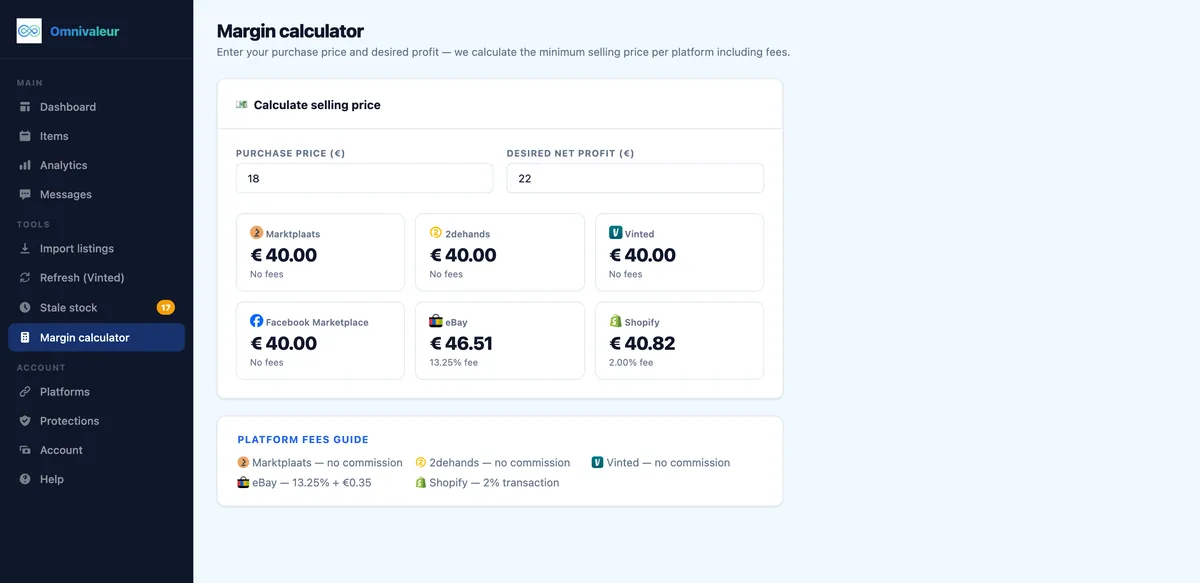
The primary tool for second-hand resellers is the margin scheme (margeregeling). Under this rule, you do not calculate VAT over the entire selling price of a used item. Instead, you calculate VAT solely over your gross profit margin—the difference between what you paid for the item and what you sold it for. If you acquire a vintage jacket for €20 and resell it for €50, your profit margin is €30. VAT is calculated exclusively on that €30 margin, rather than the full €50.
Furthermore, small-scale entrepreneurs can benefit from the KOR (Kleineondernemersregeling). The KOR is a Dutch VAT exemption scheme for businesses with an annual turnover under €20,000. If you register for the KOR:
- You do not charge VAT to your buyers.
- You do not file periodic VAT returns with the Belastingdienst.
- You cannot reclaim VAT on your business expenses or purchases.
While the KOR simplifies administrative burdens immensely, crossing the €20,000 annual turnover limit revokes your exemption immediately, requiring you to switch back to standard VAT or margin scheme accounting. To dive deeper into the mechanics of specialized taxation, consult the Margin Scheme VAT Second Hand Goods: 2026 Guide for detailed calculation models and bookkeeping requirements.
How Does Income Tax Apply to Second-Hand Reselling Profits?
Beyond VAT, any profits generated from commercial reselling form part of your taxable income under Box 1 (income from work and home) or Box 3 (savings and investments), depending on your legal setup. Many sellers mistakenly assume that if they avoid VAT via the KOR, they owe no other taxes. Income tax is entirely separate from VAT.
If the Belastingdienst deems your activities to be a business (resultaat uit overige werkzaamheden or income from an independent profession), you must declare your net profit on your annual income tax return. Net profit is calculated by taking your gross revenue and subtracting all legitimate business expenses:
- Platform fees, listing fees, and bumping costs.
- Shipping materials, tape, boxes, and printer ink.
- Sourcing costs (purchase price of the goods).
- A proportional share of your home office, internet, and phone expenses if used for business operations.
For official regulatory context regarding European tax transparency standards that empower these national audits, consult the official European Commission DAC7 overview. Maintaining clean receipts for every single sourced item is your best defense during a tax audit. Without proof of purchase price, the Belastingdienst may reject your margin scheme calculations entirely, taxing your entire revenue as pure profit.
Worked Example: Calculating VAT Under the Margin Scheme
To visualize how second-hand taxation works in practice, let us examine a concrete financial scenario for a Dutch reseller specializing in vintage electronics or curated fashion goods. Suppose you operate a registered sole proprietorship (eenmanszaak) and source a vintage camera body from a private seller at a local market for €150. You do not receive a VAT invoice because the previous owner was a private consumer.
You clean the camera, test its shutter, take professional studio photographs, and cross-list it across European marketplaces. Eventually, a buyer purchases the camera for €300.
- Gross Selling Price: €300
- Purchase Price (Sourcing Cost): €150
- Gross Profit Margin: €300 - €150 = €150
Because you apply the margin scheme, you calculate the VAT component embedded within that €150 profit margin using the standard 21% VAT fraction formula ($margin \times \frac{21}{121}$):
$$€150 \times \frac{21}{121} = €26.03$$Your actual VAT liability to the Belastingdienst for this specific transaction is €26.03. Your net profit after accounting for the purchase price and VAT becomes:
$$€300 - €150 - €26.03 = €123.97$$If you fail to apply the margin scheme correctly and treat the sale as a standard good without a purchase receipt, tax inspectors may demand 21% VAT over the entire €300 selling price (€52.07), cutting your earnings in half. Proper record-keeping is not optional; it dictates your survival as a profitable reseller.
- ✓check if your sourcing and sales frequency make you an entrepreneur
- ✓register your business with the chamber of commerce if needed
- ✓keep proof of purchase price for every single sourced item
- ✓apply the margin scheme to calculate vat only on your profit
- ✓declare net profit on your annual income tax return
What Are the Rules for Exporting and Importing Second-Hand Goods Within the EU?
Scaling a resale business naturally leads to international buyers. Platforms like Vinted and eBay inherently cross borders, exposing Dutch sellers to international shipping and intra-EU tax regulations. When you sell a margin scheme item to a private consumer residing in another EU member state (for example, a buyer in Germany or Belgium), specific distance selling and VAT rules apply.
Under the margin scheme, you generally tax the margin in the country where the goods are dispatched (the Netherlands), provided you remain under EU-wide distance selling thresholds or utilize appropriate Union One-Stop Shop (OSS) setups for regular commercial goods. However, second-hand goods, works of art, collectors' items, and antiques have special EU provisions. You cannot automatically apply the margin scheme if you import second-hand goods from outside the European Union without paying proper customs duties and import VAT upon arrival.
When shipping parcels across European borders, complying with consumer protection laws is equally critical. For consumer rights regarding returns, warranties, and cooling-off periods when selling to buyers across the EU, refer to the official Your Europe consumer shopping rights portal. Note that private second-hand sales between individuals often carry different statutory protections than sales conducted by registered commercial entities.
Managing multi-platform inventory across borders requires robust technical infrastructure. Omnivaleur's Vinted refresh tool caps itself at 8 free refreshes per day and states outright that no tool can guarantee a marketplace won't flag an account, making cautious, human-monitored automation essential for long-term account health. Automating your stock updates prevents accidental overselling when an item sells simultaneously on a Dutch marketplace and an international storefront.
What Are the Most Common Reseller Tax Mistakes to Avoid?
Tax audits of online resellers usually uncover recurring, preventable errors. Being aware of these traps keeps your business safe from retrospective tax assessments:
- Assuming no KvK means no tax: Many sellers believe that operating without a Chamber of Commerce number shields them from income tax obligations. The Belastingdienst taxes actual economic activity, regardless of whether you formally registered.
- Confusing turnover with profit: Mistakenly calculating income tax or VAT thresholds based on gross revenue rather than net profit margins leads to severe budgeting errors.
- Failing to track purchase receipts: Without signed receipts, purchase contracts, or digital invoices showing acquisition costs, the tax authority invalidates your margin scheme claims, taxing your gross revenue instead.
- Ignoring platform data aggregation: Believing that keeping sales under €2,000 on one platform protects you while running similar volumes across four other platforms. DAC7 data aggregates per user identity across the entire EU digital ecosystem.
Proactive financial organization eliminates these risks. Treat your reselling hobby like a micro-business the moment your sales transition from personal wardrobe reduction to systematic sourcing and flipping.
| Seller Category | DAC7 Reporting Trigger | KvK Registration Required? | VAT / Margin Scheme | Income Tax Obligation |
|---|---|---|---|---|
| Casual Hobby Seller | Reporting occurs if >30 items or >€2,000 | No | Not applicable (exempt) | None (personal asset management) |
| Micro-Reseller (KOR) | Triggered immediately upon threshold | Yes (Recommended/Required) | Exempt under €20,000 turnover | Declared under Box 1 / Resultaat uit overige werkzaamheden |
| Professional Reseller | Triggered immediately upon threshold | Yes | Mandatory margin scheme or standard VAT | Full business income tax filing |
Frequently asked questions
Do I need to pay tax if I sell my old clothes on Vinted occasionally?
What happens if I exceed the DAC7 limit of 30 sales or €2,000?
Can I use the margin scheme if I buy second-hand goods from private individuals without a receipt?
Is the €20,000 KOR threshold calculated per platform or for my total business?
What is the penalty if the Belastingdienst discovers undeclared reselling income?
Keep reading
Stop copying listings by hand
Omnivaleur publishes your item to every platform at once and syncs stock automatically when something sells.
Start free trial