Designer Clothing Reselling Automation in 2026: What Actually Works
Designer clothing reselling automation cross-lists authenticated luxury items across Vinted, eBay, Etsy, Marktplaats and Shopify from one dashboard, syncs stock so nothing double-sells, and adjusts pricing per platform. In 2026 the real bottleneck isn't listing speed — it's authentication, refresh limits and DAC7 tax reporting on higher-value items.
Key takeaways
- Designer items sell 10-20% below the original asking price on average, so profit tracking needs the confirmed sale price, not the listing price.
- Vinted's refresh tools cap out at 8 free refreshes a day, and no automation vendor can promise your account won't get flagged.
- eBay's Authenticity Guarantee and Vinted's brand verification now apply to most items over roughly €500, which changes how you need to photograph listings.
- Selling more than 30 items or over €2,000 in a calendar year triggers DAC7 reporting to tax authorities from the marketplace itself.
- Manually cross-listing one designer piece to five platforms takes 15-20 minutes; template-based automation cuts that to under 3 minutes.
Designer clothing behaves nothing like fast fashion once you try to automate it. A €12 H&M top and a €900 vintage Chanel jacket both need a listing, but only one of them can get your account suspended for a false authenticity claim, gets checked by buyers against serial numbers, and needs a completely different pricing logic per platform. Automation for designer resale means solving three specific problems: proving the item is real, pricing it correctly for each marketplace's fee structure and buyer base, and keeping stock in sync so a one-of-one piece never sells twice.
What makes designer clothing reselling different from regular reselling automation?
Volume resellers automate for speed. Designer resellers automate for accuracy, because the cost of a mistake is higher. List a fake description on a €15 sweater and worst case you get a refund request. List an unverifiable "authentic" Louis Vuitton bag and you risk a permanent ban, a chargeback, and a report to the platform's trust and safety team.
That changes what the automation actually needs to do well:
- Photo consistency across serial numbers, date codes, hardware stamps and interior tags — details fast fashion listings never need.
- Slower, deliberate pricing rather than aggressive undercutting, since designer buyers compare condition and provenance more than price alone.
- Stricter stock sync, because a single misplaced Gucci belt selling twice creates a far angrier buyer than a duplicate basic tee.
If you're building out a broader wardrobe of brands rather than pure luxury, the general playbook in Fashion Reselling Automation Platforms 2026 Guide still applies for sizing, seasonality and category-level pricing rules — designer resale just adds authentication and higher stakes on top.
Which marketplaces are actually worth cross-listing designer clothing to in 2026?
Not every platform is equally good for a €400 handbag or a €150 pair of designer jeans. Fee structure and buyer intent matter more here than in low-value reselling.
| Platform | Best for | Typical fee on designer item | Watch out for |
|---|---|---|---|
| Vinted | Mid-range designer (€50-€400) | Buyer pays protection fee, seller pays 0% | Refresh limits, brand verification checks on high-value tags |
| eBay | High-value, authenticated pieces | ~13% final value fee | Authenticity Guarantee holds shipment 1-2 extra days |
| Etsy | Vintage designer, curated pieces | 6.5% transaction fee + listing fee | Must genuinely qualify as vintage (20+ years) or handmade/curated |
| Marktplaats / 2dehands | Local pickup, bulky designer coats/boots | Free to list, paid boosts optional | No built-in buyer protection for high-value trades |
| Shopify | Your own authenticated inventory, repeat buyers | Payment processing only (~2%) | You own authentication liability entirely |
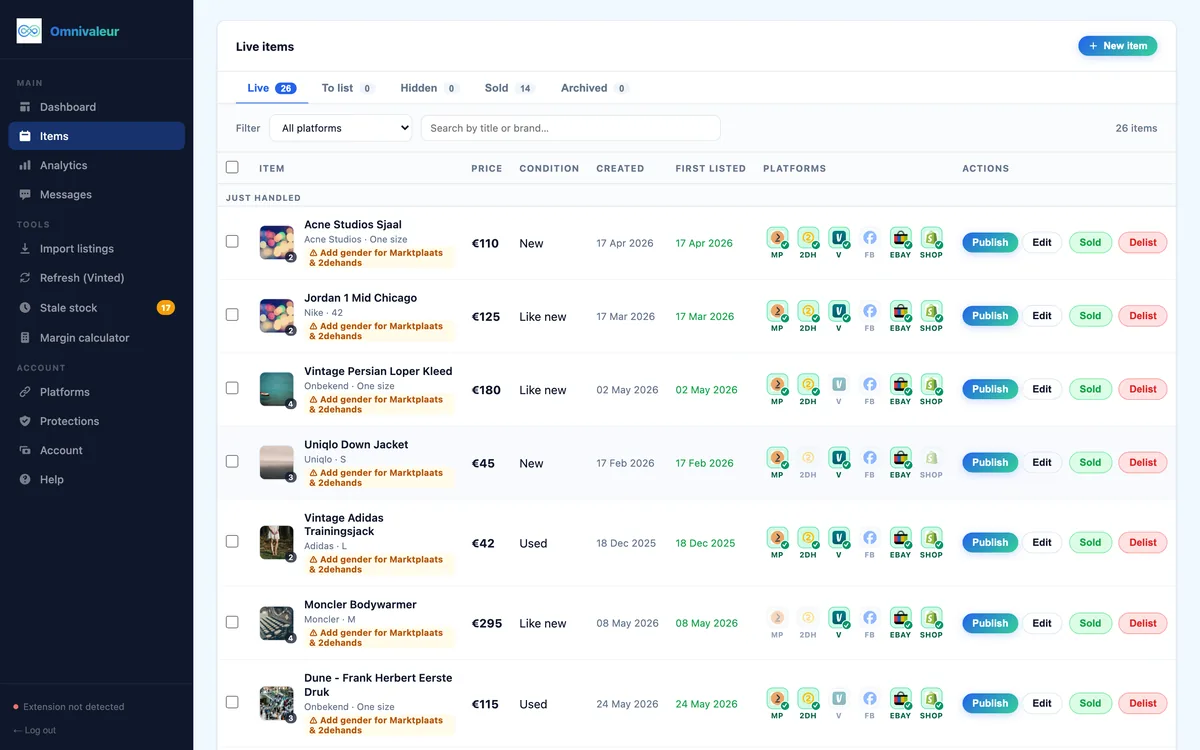
A common setup: source on Marktplaats and 2dehands, list the keepers on Vinted for volume, push anything over roughly €300 to eBay for the Authenticity Guarantee, and route genuinely vintage pieces to Etsy. If you're moving inventory the other direction, the walkthroughs in Marktplaats naar Vinted crosslisten and Marktplaats to eBay Crosslisting 2026 cover the platform-specific listing fields you need to map correctly the first time.
How do you avoid getting flagged for fake or counterfeit listings when automating designer clothing?
This is the part most generic reselling automation guides skip entirely, because it doesn't apply to them. It applies to you constantly.
Never let a template auto-fill the brand claim
Bulk listing tools that copy a title-description template across items are fine for basics. For designer pieces, every listing needs a manual check of the brand tag, font, stitching and serial number before it goes live. Automate the cross-listing step, never the authentication step.
Photograph the proof points every time
eBay's Authenticity Guarantee and Vinted's own verification checks both look for the same evidence: date codes, hardware engravings, stitch count on logo patches, and any authenticity card or dust bag included. Build this into your photo checklist before the item ever gets cross-listed, because retaking photos after a listing is live costs you ranking on most platforms.
Keep records for disputes
If a buyer or a platform challenges authenticity, you need the original purchase receipt, a prior authentication service report if you paid for one, or at minimum date-stamped photos from acquisition. Store this per SKU, not per batch — batch records don't hold up when a single item is disputed.
How should pricing automation handle high-value designer items differently from fast fashion?
Dynamic pricing bots that shave a few percent off stale fast-fashion listings every few days are a bad idea on designer inventory. A €600 jacket doesn't need a 5% weekly discount to move — it needs the right buyer to find it. Automated discounting on designer pieces usually just trains buyers to wait you out.
What actually works instead:
- Set a floor price per item based on recent comparable sales, not list price minus a percentage.
- Let automation adjust visibility (relisting, refreshing) rather than price, on anything over roughly €150.
- Track markdowns only after 45-60 days of no interest, and even then in 5-8% steps, not blanket weekly cuts.
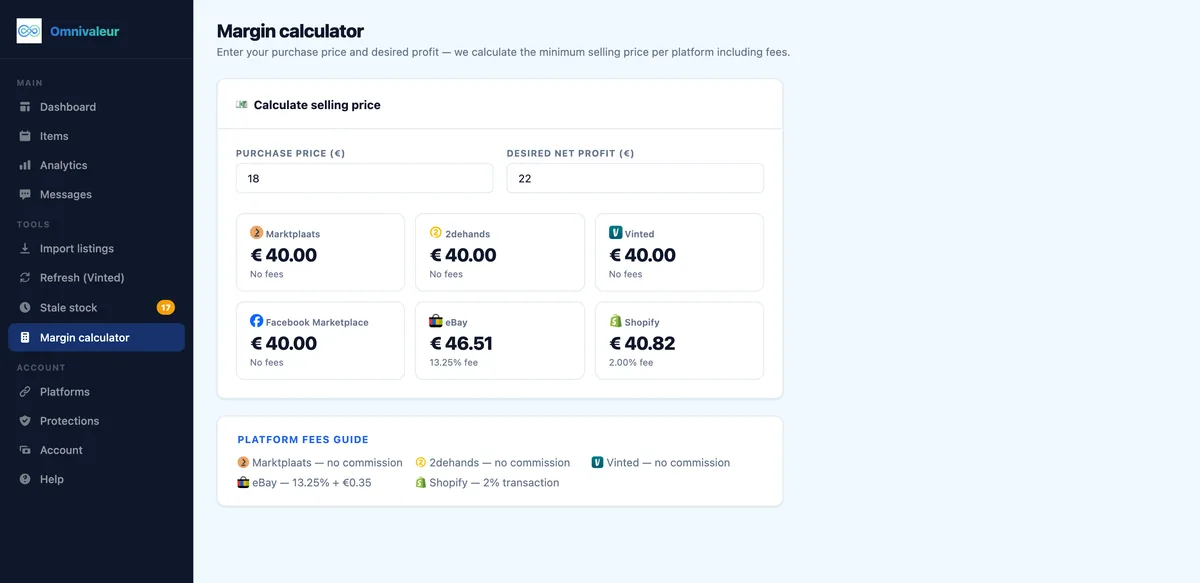
Profit tracking matters more here too. Omnivaleur's own analytics calculate profit from the sale price you confirm at checkout, not the original asking price — and on second-hand marketplaces those two numbers typically differ by 10-20%. If your spreadsheet is still using the listed price to estimate margin on designer goods, you're overstating profit on almost every sale, sometimes by €30-€80 on a single higher-value item.
How do you keep designer listings visible without risking your account?
Visibility algorithms on Vinted and Marktplaats reward recently-active listings. The tempting shortcut is to refresh or relist constantly. On designer inventory, where a suspended account can strand hundreds of euros in unsold stock, that shortcut carries more downside than upside.
Omnivaleur's Vinted refresh tool deliberately caps itself at 8 free refreshes per day, and it says plainly that no automation tool, from any vendor, can guarantee a marketplace won't flag your account for unusual activity. That's not a limitation to work around — it's the safe ceiling. Refreshing a €40 jumper 20 times a day is annoying if it backfires. Refreshing a €700 coat 20 times a day and losing the listing entirely is expensive.
A better pattern for designer stock specifically:
- Refresh your highest-value, slowest-moving items first, within the free daily cap.
- Rotate cover photos every couple of weeks instead of relying purely on refresh frequency.
- Cross-list to a second platform (eBay or Etsy) rather than over-refreshing on one, so a flag on one account doesn't take your whole inventory offline.
For sellers building a full cross-platform routine around Vinted specifically, Vinted Reselling Automation 2026 goes deeper into refresh cadence and account health signals.
- ✓Photograph proof points every time: date codes, hardware, stitches, tags before cross-listing goes live
- ✓Set a floor price based on recent comparable sales, not list price minus a percentage
- ✓Never let templates auto-fill the brand claim; manually check each item's authentication details first
- ✓Keep original purchase receipts and date-stamped photos per SKU for dispute records
- ✓Refresh highest-value items first within the 8 free daily cap, then rotate cover photos instead
- ✓Cross-list to a second platform rather than over-refreshing one account
What tax and reporting rules apply to designer resale income in 2026?
Designer resale pushes sellers past reporting thresholds faster than general secondhand selling, simply because item values are higher. Under DAC7, EU marketplaces including Vinted, Marktplaats/2dehands, eBay and Etsy have to report sellers who complete more than 30 transactions or earn over €2,000 in a calendar year to the relevant tax authority. Selling ten designer bags at €250 each already crosses that line — something a casual seller of basics might never hit.
This isn't optional platform paperwork; it's a legal reporting obligation on the marketplace's side, and the number gets shared with your national tax authority automatically. The Belastingdienst's DAC7 seller information page lays out exactly what gets reported for Dutch sellers, and the European Commission's DAC7 overview covers how this applies across the EU if you're selling from or into other member states.
Keep your real sale price (not asking price) recorded per item from day one — it's the number that matters for both margin tracking and the eventual tax picture, and reconstructing it months later from memory is a genuinely bad time.
What do returns and buyer protection rules mean for cross-border designer sales?
Selling a €500 coat to a buyer in another EU country adds a layer most fast-fashion resellers never deal with: cross-border consumer return rights. Under EU consumer protection rules, buyers generally have a 14-day right of withdrawal on distance sales from business sellers, though this treats casual private resale differently from a registered shop-style seller. The Your Europe consumer shopping rights guide breaks down when those rights apply and when they don't, which matters a lot if you're running designer resale as a semi-regular income stream rather than the occasional wardrobe clear-out.
Practically, that means:
- Document condition thoroughly before shipping, since disputes on high-value items are more likely to escalate than on €10 items.
- Use tracked shipping on anything over roughly €150 — most marketplace buyer protection schemes require it to pay out on a dispute.
- Know each platform's specific return window; eBay's Authenticity Guarantee items sometimes get an extended inspection period buyers don't get on regular listings.
Which tools are actually built for designer/luxury cross-listing versus general reselling automation?
Most cross-listing tools treat every category the same. A handful support brand-specific fields (date codes, condition grading scales, authenticity flags) that designer resale actually needs. Before picking a tool, check whether it lets you:
- Attach authentication notes or certificates per SKU, not just per listing description.
- Set per-platform pricing rules rather than one price pushed everywhere (a Chanel bag priced right for eBay is usually wrong for Vinted).
- Sync stock instantly across platforms so a unique piece is delisted everywhere the second it sells, not on the next sync cycle an hour later.
If you're comparing tools directly, the breakdowns in Omnivaleur vs Vendoo: Honest 2026 Comparison and Omnivaleur vs List Perfectly: Honest 2026 Comparison both cover how each platform handles per-category listing fields, which is where designer resellers usually hit friction first. If handbags specifically are your main category rather than clothing, Luxury Handbag Reselling Automation 2026 covers the authentication and photo-set workflow in more detail.
How long does designer clothing cross-listing actually take once it's automated?
Worked example: a single designer jacket, listed manually across Vinted, eBay, Etsy and Marktplaats, typically takes a reseller 15-20 minutes — separate photo uploads, rewritten descriptions per platform's field limits, manual price conversion, category selection four times over. With a template-based cross-listing setup, the same item takes under 3 minutes: one photo set, one base description edited per platform's tone, pricing rules applied automatically per marketplace fee structure, and stock sync handled the moment it sells anywhere.
Scale that across 40 designer pieces a month and the manual version costs roughly 10-13 hours; the automated version costs under 2 hours. That gap is the entire argument for automating this category — not speed for its own sake, but hours back for sourcing and authentication, which is where designer resale margin actually comes from.
Frequently asked questions
Can I cross-list the exact same designer item to Vinted and eBay at the same time without breaking either platform's rules?
Do I need a professional authentication service before listing designer items, or is my own inspection enough?
Should I price the same designer item differently on Vinted versus eBay?
How do I handle a buyer claiming a designer item isn't authentic after the sale?
Is designer clothing reselling automation worth it if I only sell a handful of items per month?
Keep reading

Stop copying listings by hand
Omnivaleur publishes your item to every platform at once and syncs stock automatically when something sells.
Start free trial