How to Organize Inventory for Reselling: The Complete 2026 Master Guide

To organize inventory for reselling, assign every item a unique alphanumeric SKU, store items in numbered clear plastic bins or heavy-duty shelving, and record the exact bin location in your listing data. When an item sells, locate it instantly by its storage code rather than searching through unsorted piles.
Key takeaways
- Assign every unique item a physical bin code and alphanumeric SKU at intake.
- Store items in sealed poly bags inside stackable, numbered plastic totes to protect against dust and odors.
- Use ABC analysis to place fast-moving, high-margin items at eye level near your packing station.
- Track listing statuses individually across marketplaces to eliminate double-selling when cross-listing stock.
- Audit physical inventory against digital listings on a rolling monthly cycle instead of one painful annual count.
Dumping bags of sourced stock in the spare bedroom works when you have twenty items. At two hundred items, you start misplacing sweaters. At five hundred, you miss daily shipping deadlines, waste half an hour hunting for a vintage camera that was already buried behind winter coats, and receive negative reviews for cancelled orders. Lost items equal lost money.
Organizing second-hand stock requires a completely different approach than running a standard retail warehouse. Traditional retailers purchase fifty identical t-shirts under one barcode. Resellers handle unique, one-of-a-kind products: different sizes, varied conditions, individual flaws, and mismatched brands. If you misplace one item, you cannot simply grab an identical replacement from the shelf. A clean physical storage layout paired with a disciplined digital tracking system transforms your reselling workflow from chaotic amateur rummaging into a predictable, scalable business.
What Is the Best Way to Organize Inventory for Reselling at Home?
The best method for home-based resellers is an alphanumeric bin-and-shelf storage system combined with individual protective packaging. You do not organize physical items by brand, color, or price. Organizing clothes by color looks pretty on social media, but it collapses the moment your inventory expands beyond two clothing racks. Instead, organize purely by static location codes.
When an item enters your workspace, you measure it, photograph it, clean it, pack it into a clear protective sleeve, and drop it into the next available container. The container code becomes part of the digital listing title or custom SKU field. When the sale notification pings on your phone, you check the code, walk directly to the bin, grab the item in fifteen seconds, and box it up.
The Bin, Shelf, and Bag System for Small Spaces
If you resell from an apartment, a basement, or a spare bedroom, vertical space is your greatest asset. Invest in industrial wire or steel shelving units rather than particle board bookcases that sag under load. Heavy-duty utility shelves measuring 180 cm high by 90 cm wide give you four to five tiers of deep, usable storage.
Pair those shelves with uniform, stackable clear plastic totes (60 to 80-liter capacities work best for clothing and mixed media). Clear containers let you visually confirm contents without unstacking half the room. For apparel, shoes, and small collectibles, fold each item neatly and place it into a self-sealing clear poly bag. This step does three jobs at once:
- It protects delicate fabrics from dust, pet hair, moisture, and moth damage.
- It keeps loose accessories, belts, cables, or detachable hoods permanently secured to the main item.
- It provides a flat, clean surface to stick a physical label displaying the inventory number.
Creating an Alphanumeric SKU System That Never Breaks
A stock keeping unit (SKU) is the unique fingerprint of an item in your business. Never make your SKU an unreadable, arbitrary sequence of ten random digits. Make it an informative code that tells you where the item sleeps and roughly what it is.
A standard four-part SKU convention looks like this: [Storage Unit]-[Container Number]-[Category Code]-[Sequential Item Number].
For example, take the SKU A-04-CLO-0128:
- A: Shelf Rack A (the physical shelving rack located on the left wall of your room).
- 04: Bin 04 (the fourth plastic tub on that rack).
- CLO: Clothing category (useful for quick visual cross-referencing during packing).
- 0128: The 128th item processed in your intake system.
If you sell shoes, assign a dedicated rack with a shoe-box numbering scheme such as SH-01 through SH-80. When an order arrives on eBay or Vinted, you do not search your memory for when you found the pair. You simply read SH-22 off the internal note, walk to shelf SH, pull box 22, and hand it to the packing table.
| Storage Method | Best Suited For | Space Efficiency | Setup Cost | Pick Speed |
|---|---|---|---|---|
| Clear Poly Bags in Numbered Bins | Clothing, plush toys, small textiles, accessories | High (compressible) | Low (€40-€80) | Under 30 seconds |
| Open Shelving with Segmented Cubes | Shoes, vintage cameras, boxed games, electronics | Moderate | Moderate (€90-€160) | Under 20 seconds |
| Hanging Garment Racks | Heavy winter coats, leather jackets, formal dresses | Low (takes floor space) | Moderate (€50-€100) | Under 15 seconds |
| Drawer Organizers / Akro-Mils Cabinets | Jewelry, trading cards, watch parts, coins | Very High (compact) | Low (€25-€50) | Under 10 seconds |
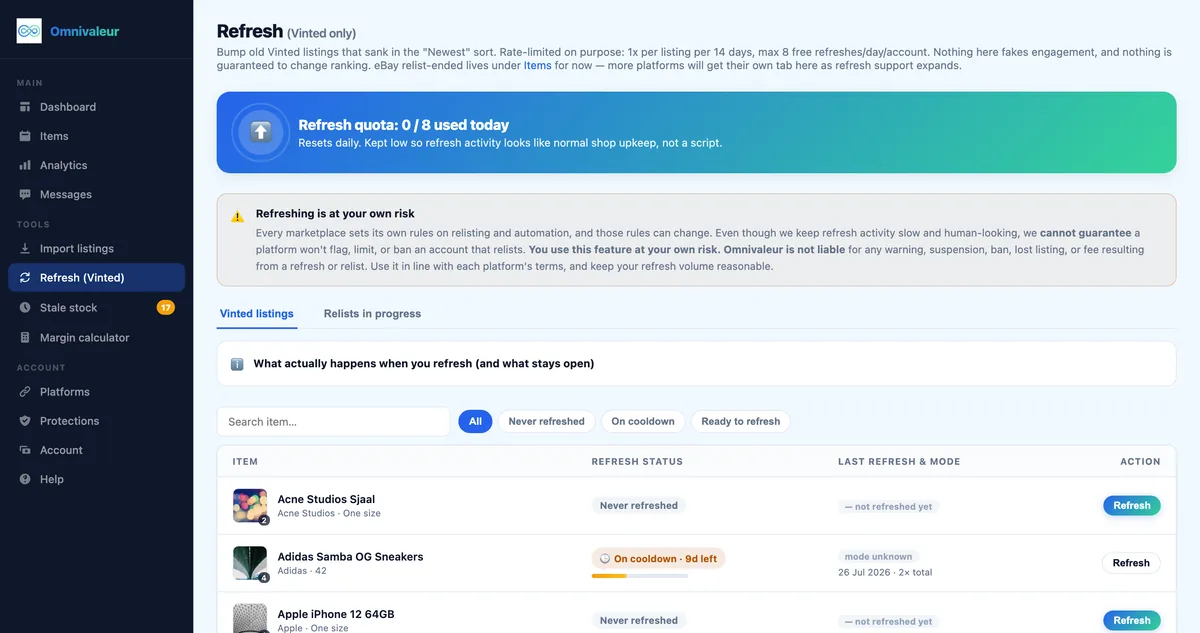
What Are the 3 Major Inventory Management Techniques and How Do Resellers Use Them?
Traditional logistics textbooks teach three core inventory management methodologies: First-In, First-Out (FIFO), Last-In, Last-Out (LIFO), and Just-In-Time (JIT). Many resellers ignore these concepts because they assume corporate supply-chain theory does not apply to a one-person secondhand venture. That is a mistake. Adapting these techniques directly cuts holding costs and prevents dead stock from devouring your working capital.
FIFO vs LIFO vs Just-in-Time for Vintage and Second-Hand Goods
First-In, First-Out (FIFO) means the oldest inventory you bought gets listed, promoted, and cleared out first. In secondhand resale, seasonal clothing and tech accessories rely heavily on FIFO. If you bought summer linen shirts in March, you must sell them before September arrives, or they become dead capital sitting on your shelves for nine months. FIFO forces you to price aggressively to exit aging inventory before its seasonal demand dries up.
Last-In, First-Out (LIFO) is rarely ideal for physical flow, but resellers occasionally encounter it when flipping high-demand, trending items. For example, if a specific shoe style or retro gaming console suddenly spikes in market value due to an internet trend, you want to push your newest acquisitions straight onto the market immediately at peak pricing, bypassing older backlogged drafts.
Just-In-Time (JIT) in reselling applies to your intake and consumables pipeline. Do not tie up €500 buying three thousand cardboard boxes in six different dimensions if you only ship thirty parcels a week. You lose valuable floor space that should hold sellable inventory. Keep a two-week safety stock of poly mailers, bubble wrap, and standardized parcel boxes. Replenish packing materials as your rolling seven-day volume demands.
ABC Analysis: Segmenting High-Turnover vs Long-Tail Items
ABC Analysis divides your stock into three distinct tiers based on revenue value and turnover velocity:
- A-Items (High Value, Fast Turnover): These represent roughly 20% of your total stock but generate 70% to 80% of your net profits. Think popular designer sneakers, high-end electronics, and sought-after vintage cameras. Give A-items prime real estate: eye-level shelves right next to your packing bench. Inspect them carefully and store them in padded containers.
- B-Items (Moderate Value, Steady Turnover): Everyday branded denim, mid-tier board games, and standard outerwear. These make up about 30% of your inventory and roughly 15% to 20% of profit. Store these in standard numbered plastic tubs on middle and lower shelf tiers.
- C-Items (Long-Tail, Low Margin): Hard-to-find vintage replacement parts, obscure books, or low-cost accessories. They account for 50% of your items but only 5% to 10% of revenue. Place these on top shelves, in deeper crawlspaces, or in high-density storage drawers. You do not need fast daily access to items that only sell once every six months.
How Do Resellers Differ from Traditional Retailers in Stock Management?
Retail stores and e-commerce brands place purchase orders for hundreds of identical items using Universal Product Codes (UPC) or European Article Numbers (EAN). Their inventory database simply counts: "Size M Blue T-Shirt: 42 units in stock." When a unit sells, the database drops the count to 41.
Resellers deal in extreme granularity. You rarely hold multiples of the same item. Even when you find three pairs of the identical Levi's 501 jeans in size 32/34, they are not interchangeable: pair one has subtle distressing on the hem, pair two has a washed-out vintage fade, and pair three has a spotless dark rinse. Each one requires its own photography set, its own condition notes, its own listing, and its own individual physical SKU.
Do Resellers Hold Physical Inventory?
Yes. Legitimate secondhand, vintage, and arbitrage sellers hold physical inventory in their possession. Unlike dropshippers who forward customer orders to third-party factories, an authentic reseller inspects, tests, photographs, packs, and ships goods directly. Holding stock gives you full control over product quality and dispatch times, which protects your seller rating on platforms like eBay and Marktplaats.
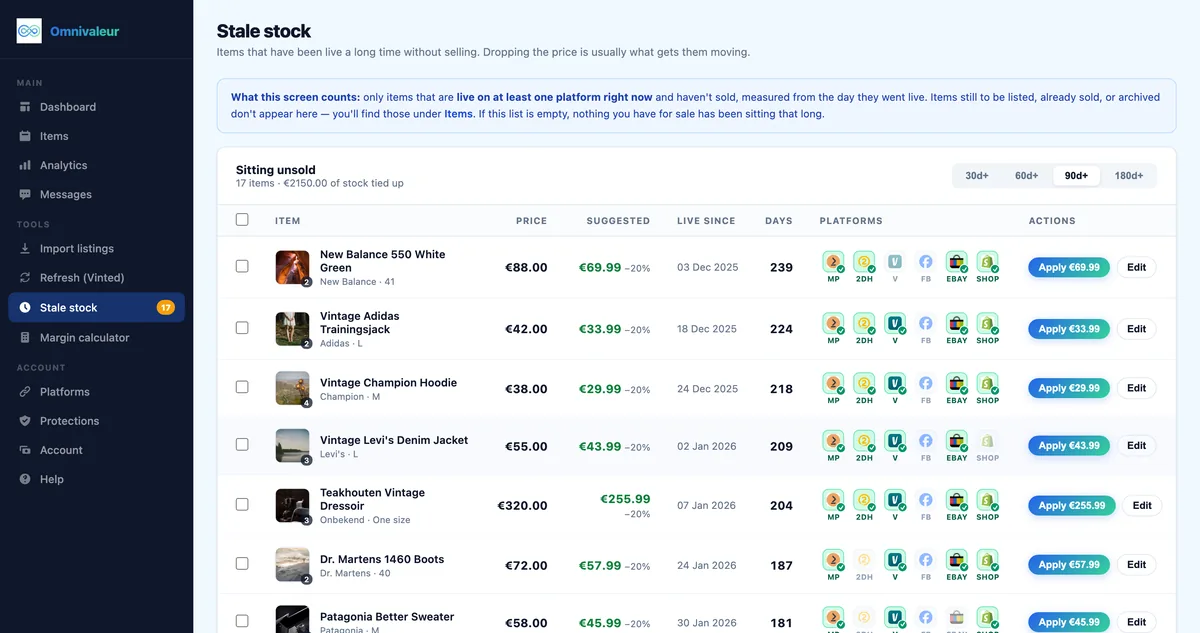
However, holding stock means accepting carrying costs. Every square meter of your storage space carries an implicit rental cost. If you let slow-moving €10 items sit in bins for two years, they choke your cash flow and block space that could hold fast-turning inventory bought during your sourcing trips. Knowing where to source items for second hand reselling is only half the battle; knowing when to liquidate stagnant stock via deep discounts keeps your operation liquid.
Margin Schemes, Single-SKU Lots, and European Tax Requirements
Operating a resale business across the European Union or the UK introduces specific administrative and inventory tracking requirements. You must be able to prove exactly what you paid for an individual secondhand item versus what you sold it for.
Under the European special margin scheme, registered commercial sellers do not pay value-added tax (VAT) on the full turnover price. Instead, you pay VAT solely on the gross profit margin generated between the acquisition price and the sale price. To claim this lawfully, your inventory tracking system must link every single sold SKU directly to a corresponding purchase receipt, auction invoice, or private purchase statement. Read our comprehensive breakdown of the margin scheme VAT second hand goods rules to structure your bookkeeping correctly.
Furthermore, under European transparency regulations, platforms automatically report seller transaction volumes to local tax authorities once you cross specific annual thresholds (typically 30 completed transactions or €2,000 in gross sales). Learn more directly from the European Commission DAC7 directive and review the Dutch tax agency guidelines on the Belastingdienst DAC7 seller information portal. If you run a formal operation, you should also understand when reselling becomes a business under KVK and tax rules so your physical inventory tracking matches your corporate filings.
How Do You Keep Track of Inventory Products Across Multiple Marketplaces?
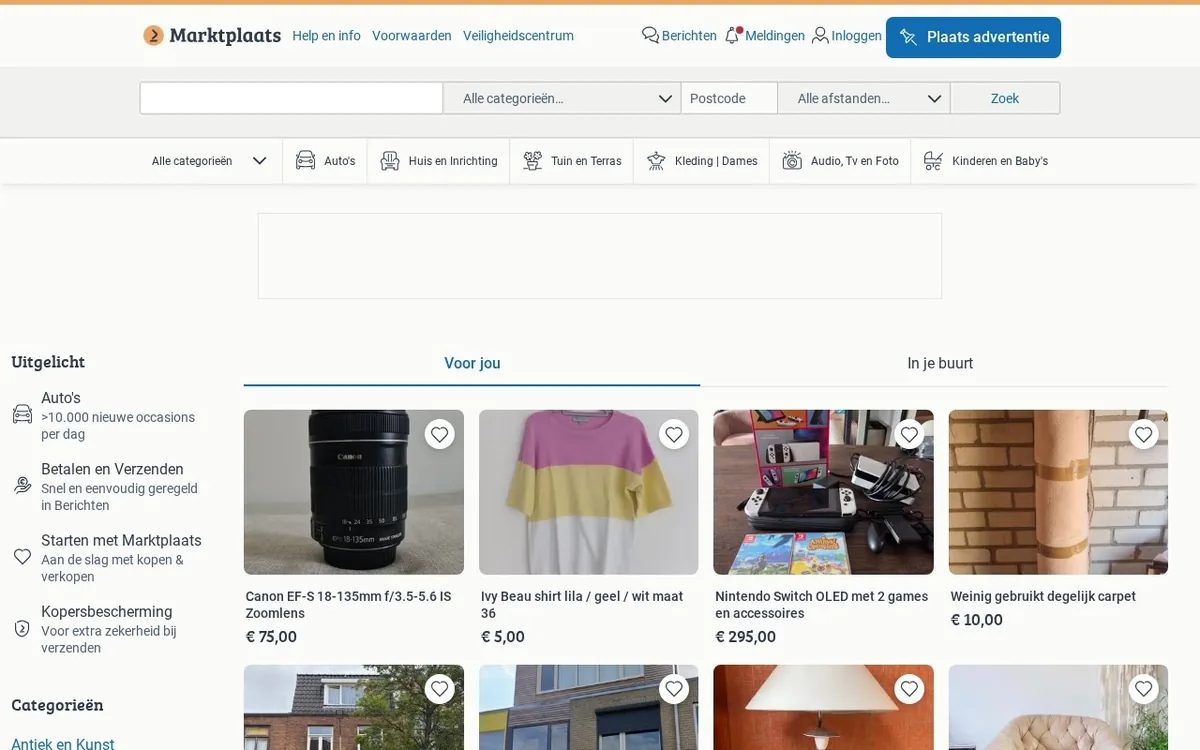
Cross-listing items across multiple marketplaces is the fastest way to increase sales velocity. If you list a designer jacket solely on Vinted, only Vinted users see it. If you list that exact same jacket on Marktplaats, 2dehands, eBay, and your own web store, your buyer pool expands dramatically. But multi-platform selling introduces the biggest operational risk in reselling: selling the same unique item twice.
The Double-Selling Trap: How Multi-Channel Resellers Sync Listings
Imagine selling a pair of vintage boots on eBay at 2:00 AM while you are asleep. At 6:30 AM, a buyer on Marktplaats purchases that same pair. By the time you wake up and check your notifications, you have accepted payment for two orders but only possess one pair of boots. You must cancel one order, damaging your seller metrics, risking marketplace penalties, and frustrating an eager customer.
Manual management breaks down once your active catalog exceeds one hundred multi-listed items. A single item in Omnivaleur typically carries 3-5 active listings at once; the app tracks each platform's status separately. When an item is marked as sold on one channel, you can instantly delist or update the status across your other connected accounts. This approach prevents double-selling and protects your seller ratings on every marketplace. For a detailed operational strategy on handling simultaneous platform orders, review our guide on how to avoid selling the same item twice.
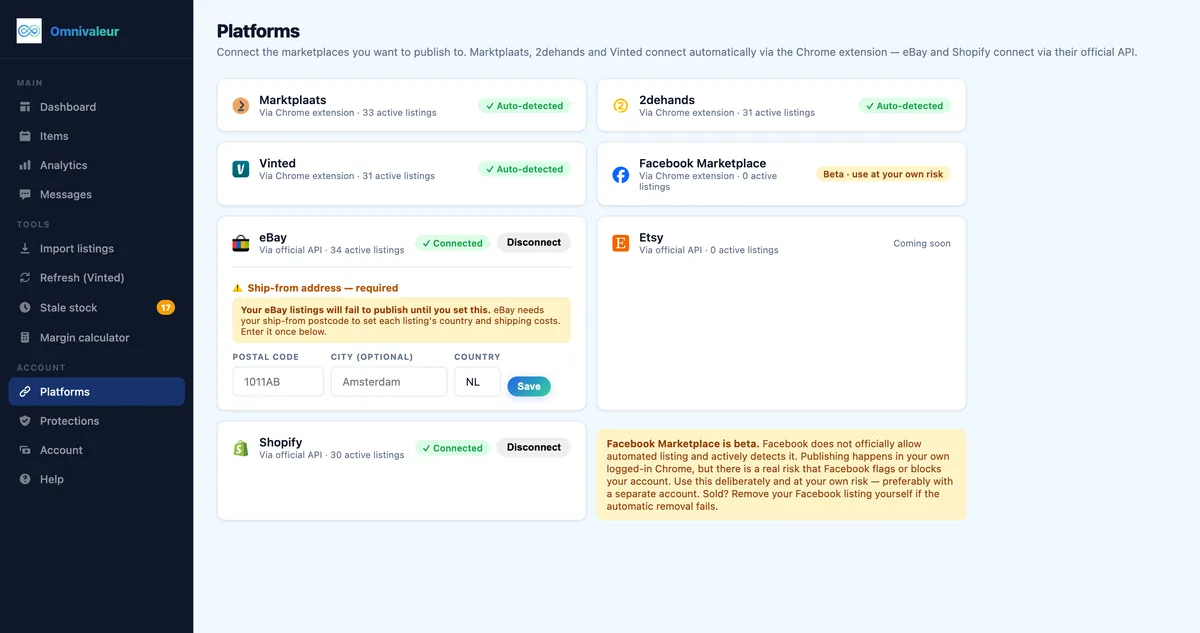
Omnivaleur publishes to seven channels from one intake form: Marktplaats, 2dehands, Vinted, eBay, Shopify, WooCommerce and Facebook Marketplace (beta). Instead of retyping titles, descriptions, measurements, and category selections seven times on your phone, you enter the product data once into the intake interface, set your inventory SKU, and distribute the listing across your selected selling channels in seconds.
Spreadsheets vs Dedicated Reseller Software
When starting, a free spreadsheet (Google Sheets or Microsoft Excel) is an acceptable starting point. A functional inventory spreadsheet requires the following columns:
- SKU / Item ID (e.g.,
B-12-SH-0044) - Acquisition Date (DD/MM/YYYY)
- Item Description (Brand, Model, Size, Condition)
- Purchase Location (Thrift shop, flea market, private lot)
- Cost of Goods Sold (COGS) (in €)
- Target List Price (in €)
- Storage Bin / Location (e.g., Bin B-12)
- Active Platforms (Checkboxes for eBay, Marktplaats, Vinted)
- Sold Date
- Sale Price (in €)
- Platform Fees & Shipping Paid (in €)
- Net Profit Margin (in €)
Spreadsheets, however, have major limitations. They do not automatically sync when an item sells. They do not format photos for specific platform aspect ratios. They require manual data entry for every transaction fee, and they are prone to human typo errors that can throw off your annual tax reports. As your inventory crosses 200 items, shifting to dedicated inventory tracking software becomes a necessity rather than a luxury.
| Feature / Capability | Manual Spreadsheet | Generic Warehouse WMS | Omnivaleur Reseller Tool |
|---|---|---|---|
| Cost | Free | €100 - €400 / month | Affordable monthly SaaS |
| One-of-a-Kind (1-of-1) SKU Support | Manual typing required | Poor (built for wholesale batches) | Native built-in architecture |
| European Marketplaces (Marktplaats, Vinted, 2dehands) | None (zero integration) | None (US/Enterprise focused) | Full native multi-channel publishing |
| Centralized Intake Form | No | Yes (complex) | Yes (streamlined for resellers) |
| Physical Storage Location Mapping | Manual column | Yes (complex barcode setup) | Yes (custom SKU & bin mapping) |
How Do Large Companies and Small Stores Manage Inventory Differently?
Large enterprise retailers rely on automated pallet racking, radio frequency identification (RFID) tags, robotic picking arms, and complex enterprise resource planning (ERP) suites like SAP or NetSuite. Every movement of a pallet through a dock door is automatically registered by radio sensors without a human picking up a pen.
Small independent stores and professional resellers cannot justify €50,000 warehouse automation systems. Yet small stores run circles around giant retailers in flexibility, sourcing agility, and localized product knowledge. Resellers manage inventory efficiently by stripping corporate logistics down to its bare essentials: clear labeling, compact physical zoning, and rapid cycle counts.
Enterprise Barcode Scanners vs Scaled Home Operations
Do you need an industrial handheld barcode scanner to organize 400 vintage garments at home? No. While a wireless handheld Bluetooth barcode scanner (costing around €30 on Amazon) is a fun upgrade, it is not required on day one.
A simple thermal label printer (such as a Rollo, Munbyn, or Dymo) is far more valuable. Use it to print 5x3 cm peel-and-stick labels displaying your item SKU, intake date, and product title. Affix that label to the exterior of the poly bag. When an order sells, your eyes can read the text immediately without scanning software. Once you scale past 1,000 active listings, you can add barcode generation to those labels and scan items directly into your shipping software with a simple USB scanner.
Auditing Reseller Stock Without Halting Operations
Big retail box stores shut down their stores for an entire weekend once a year to perform a painful full-store stocktake. Never do this in your reselling business. Shutting down means halting your sourcing, drafting, and shipping.
Instead, implement rolling cycle counts. Pick one shelf or four bins every Tuesday morning. Count the physical items in Bin A-01 through A-04, check that every item has its label, and verify that the items match your active listing database. If an item is in the bin but not listed online, it is dead capital earning nothing: list it immediately. If an item is marked as active in your digital inventory but missing from the bin, locate it or delist it before a buyer purchases it. By rotating through small batches weekly, you audit your entire inventory every two months without disrupting your daily routine.
- ✓Clean, measure, and take clear photos of your intake item
- ✓Seal the item into a clear poly bag to keep dust out
- ✓Stick a physical label on the bag with your custom code
- ✓Place the sealed bag into the next open numbered tub
- ✓Add the exact bin location code to your draft listing note
How Do You Organize Items to Sell on eBay, Marktplaats, and Vinted?
Different platforms attract different buyer expectations, shipping workflows, and return profiles. Organizing your inventory requires planning for how those items leave your building. European shoppers buying on regional marketplaces expect clean packaging and swift tracking updates, governed by transparent EU consumer shopping rights.
Platform-Specific Packaging, Dimensions, and Staging
When an item is listed on multiple platforms, its physical storage packaging should be platform-neutral. Do not seal an item inside a branded carrier envelope until the order is finalized. A buyer on Vinted might choose a Mondial Relay or Homerr pickup point, while an eBay buyer in the United States requires an international PostNL or DHL Express parcel.
Group your inventory bins roughly by package format requirements:
- Letterbox-friendly stock (Brievenbuspakje): Ties, thin t-shirts, small video games, jewelry, and lightweight scarves. Keep these in designated slim tote trays. They ship at low rates (€4.15 to €4.95 within the Netherlands via PostNL) and require minimal packing padding.
- Standard Boxed Parcels: Bulky winter coats, boots, coffee makers, and electronics. Store these near your box supplies. Learn how to print shipping labels on Marktplaats efficiently so you can slap labels onto standardized parcels without re-weighing boxes during morning fulfillment.
- Fragile / Irregular Collectibles: Glassware, vintage ceramics, and musical instruments. These require pre-wrapping in bubble wrap before entering physical storage bins to prevent accidental breakage during bin shifting.
Pre-Packing vs Post-Sale Packing: Which Saves More Money?
Resellers debate whether to pre-pack items immediately after photographing them or pack them only after the sale occurs.
Post-Sale Packing (Recommended for 90% of items):
You store the item in an open or unsealed poly bag inside its assigned bin. When it sells, you pull the item, inspect it one final time under good light, insert a thank-you slip, fold it into a shipping mailer or box, and apply the carrier shipping label. This method saves immense storage space because soft items compress tightly in bins without rigid cardboard boxes wasting shelf volume.
Pre-Packing (Box-and-Store):
You photograph a fragile vintage porcelain vase, wrap it in bubble wrap, pack it inside its final shipping box, seal the box with tape, write the SKU code BOX-402 on the outside with a marker, and record the exact packaged weight and dimensions in your listing. When the vase sells, you simply paste the shipping label over the box and ship it. Use pre-packing solely for fragile, odd-shaped, or delicate items that risk taking damage if handled repeatedly inside storage bins.
Why Are Shipping Delays Costing You Money and How Does Organization Fix It?
Shipping delays do not just produce unhappy buyers. On eBay, late dispatch marks decrease your seller level from Top Rated to Below Standard, slashing your search impressions and imposing an additional 5% penalty fee on final value fees. On Vinted, failing to scan a parcel within five business days triggers automatic order cancellation and leaves an automated one-star review on your profile. On Marktplaats, buyers lose patience and open dispute claims via buyer protection services.
The Five-Minute Pick-and-Pack Workflow
A properly organized inventory workspace allows you to fulfill ten orders in under twenty minutes. Set up your physical space in an assembly line flow:
- Print Batch: Print all packing slips and carrier labels simultaneously at your desk or packing bench.
- The Pick Run: Take a picking basket or rolling cart. Walk down your shelving units. Read the SKU off the order sheet (e.g., Bin
A-03, BinB-11, ShelfSH-04). Pull all items into the basket in one trip. Never walk back and forth across the room for individual parcels. - Verification & Pack: Bring the basket to your packing station. Match each physical item's SKU tag to the corresponding printed shipping label. Insert the item into the shipping envelope or box, tape securely, and apply the label.
- Drop-off Staging: Place finished parcels into dedicated outboxes segmented by carrier.
Carrier Sorting: DPD, PostNL, Mondial Relay, and DHL
European multi-channel sellers regularly juggle four or five different parcel couriers depending on marketplace defaults and buyer preferences. If your workspace has parcels scattered randomly near the front door, you will eventually hand a DPD parcel to a PostNL driver, delaying the delivery by over a week while the package bounces between depot facilities.
Create labeled sorting hampers or plastic crates near your exit door:
- Crate 1: PostNL / bpost (Standard domestic parcels and letterbox mailers)
- Crate 2: Mondial Relay / InPost (Vinted cross-border shipments to France, Spain, and Belgium)
- Crate 3: DHL eCommerce (Marktplaats and eBay parcels)
- Crate 4: DPD / UPS (Bulky or specialty marketplace items)
When packing is finished, every package sits inside its designated carrier crate. When you drive to the drop-off points, you grab the entire crate, hand it over to the service point clerk, ensure every barcode scans, and secure your drop-off receipts.
Worked Example: The Real Cost of Disorganized Inventory
Let us look at two resellers, both processing 200 items per month with an average sourcing cost of €6 per item and an average selling price of €35 per item. Learn how to price second-hand items to maintain these types of healthy margins.
Reseller A (Unorganized Pile System):
- Average time to locate an item: 12 minutes.
- Total time spent searching for 200 items: 40 hours per month.
- Lost items / cancelled sales per month: 5 items (5 x €35 = €175 in lost gross revenue).
- Account penalty fees / return friction: €40 per month.
- Total lost time and money: 40 hours of frustrating manual hunting plus €215 in direct losses.
Reseller B (SKU Bin System with Multi-Channel Tracking):
- Average time to locate an item: 45 seconds.
- Total time spent pulling 200 items: 2.5 hours per month.
- Lost items / cancelled sales per month: 0 items (€0 lost).
- Account health penalties: €0.
- Total time saved: 37.5 hours per month.
What is 37.5 hours of free time worth to an entrepreneur? If you value your sourcing labor at a modest €20 per hour, Reseller B saves €750 worth of labor every single month. More importantly, those 37.5 recovered hours can be spent at thrift stores, car boot sales, or wholesale auctions sourcing another 150 profitable items. Organization is not about being tidy for the sake of appearances; it is an engine that generates profit and protects your sanity as your reselling business expands.
Frequently asked questions
What should I do when an item cannot be found in its designated bin?
How do I store large or bulky items like winter coats and boots?
How often should I perform a complete inventory audit?
Can I reuse clean Amazon and retail boxes to store and ship resale inventory?
Keep reading


Stop copying listings by hand
Omnivaleur publishes your item to every platform at once and syncs stock automatically when something sells.
Start free trial