Vinted Clothing Reselling Automation in 2026: What Actually Works Without Getting Flagged
Vinted reselling automation in 2026 means using tools to bulk-list, cross-post to other marketplaces, auto-reprice and reshare items — but Vinted bans aggressive bots that fake activity. Safe automation focuses on listing and cross-listing, not spam. Combine it with DAC7 tax awareness, since platforms now report your sales to tax authorities.
Key takeaways
- Vinted allows listing and cross-listing automation but actively blocks bots that spam reshares or bump items
- DAC7 rules mean Vinted reports your sales data to tax authorities once you pass 30 sales or €2,000 per year
- Cross-listing to Marktplaats, eBay and 2dehands sells clothing 2-3x faster than staying on one platform
- Bulk-listing 50 items in one session is the biggest real time-saver, not fake engagement bots
- Duplicate-sale management is the number-one automation risk most guides ignore
Most "Vinted automation" guides push you toward reshare bots and auto-follow scripts. Skip those. In 2026 those are exactly the behaviours Vinted's selling rules flag, and accounts get restricted for it. The automation that actually moves clothing is boring: bulk listing, cross-posting and repricing. Let me walk you through what's safe, what's changed this year, and where the tools quietly let you down.
What kinds of Vinted automation are still allowed in 2026?
There's a hard line between listing automation and engagement automation. One is fine. One gets you banned.
Listing automation means importing your inventory, filling in titles, brands, sizes and prices, and pushing items live in bulk. Vinted has no problem with you drafting 40 listings in a spreadsheet and uploading them. That's just data entry done faster.
Engagement automation is the sketchy stuff: bots that auto-reshare your closet every hour, mass-follow other users hoping for follow-backs, or auto-send price offers to everyone who favourites an item. Vinted's spam detection got noticeably sharper through 2025. Reshare loops now trigger temporary posting limits.
- Safe: bulk drafting, cross-listing, scheduled single reshares, template descriptions
- Risky: auto-follow, mass offers, high-frequency reshare bots, view-inflation scripts
The tools marketed as "Vinted bots" often blur this. Read what they actually do before you trust your account to one.
Why does cross-listing beat single-platform automation for clothing?
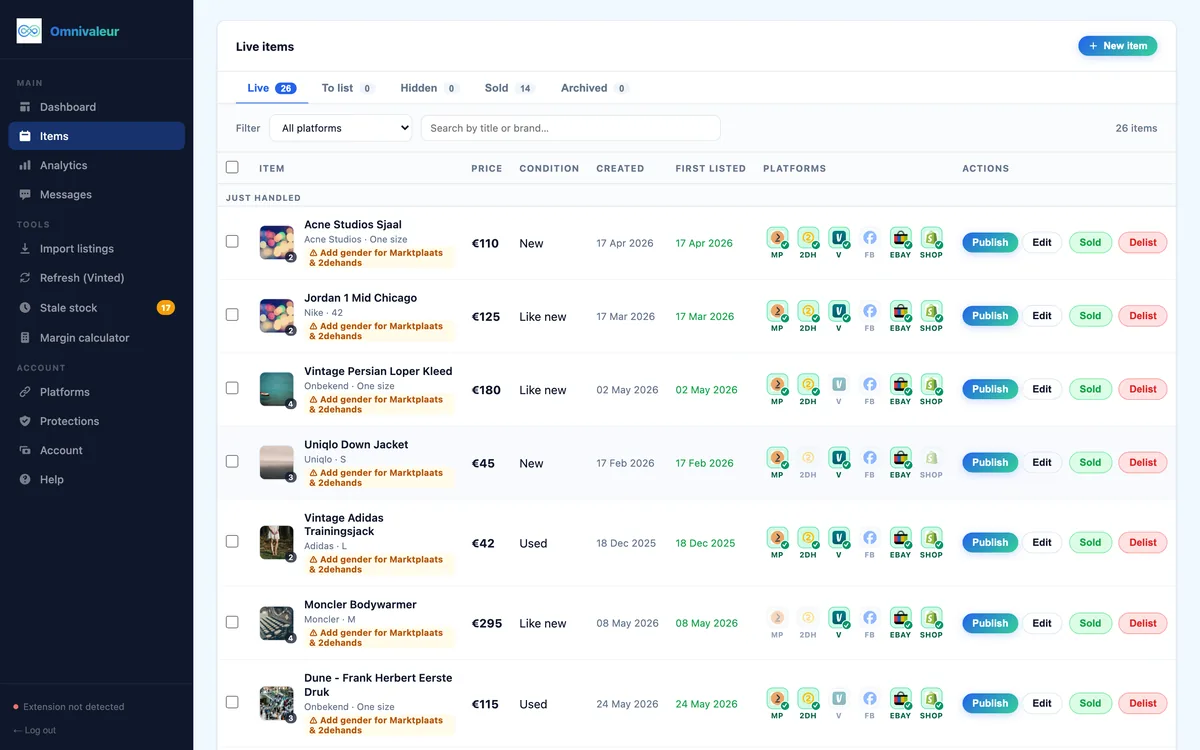
Here's the thing nobody in those top guides says clearly: automating harder on Vinted alone hits a ceiling. Your item competes with thousands of identical listings. The real speed comes from putting the same jacket in front of buyers on Marktplaats, eBay and 2dehands at the same time.
Different platforms, different buyers. A vintage Levi's jacket might sit dead on Vinted for six weeks and sell in three days on eBay to a collector. Clothing that's too "local" for Vinted's international shipping model often flies on Marktplaats with pickup.
This is where a cross-listing tool earns its keep more than any single-platform bot. If you're already selling secondhand elsewhere, our Marktplaats naar Vinted crosslisten 2026 guide shows exactly how to mirror inventory without retyping every field. Same logic applies to 2dehands naar Vinted crosslisten if you're Belgium-based.
Rough sell-through comparison by platform
| Platform | Best clothing type | Avg. days to sell | Buyer fees |
|---|---|---|---|
| Vinted | Fast fashion, brands under €40 | 18–30 | Buyer protection fee |
| eBay | Vintage, designer, collectible | 7–14 | Standard |
| Marktplaats | Bulk lots, local pickup, kids' wear | 10–20 | Low/none |
| 2dehands (BE) | Local secondhand, mid-brand | 12–22 | Low/none |
Those numbers shift with season and category. But the pattern holds: spreading listings shortens the average time to a sale.
How do you handle duplicate sales when one item lists on five platforms?
This is the pain point every "best Vinted bot" list ignores, and it's the one that actually bites resellers.
You list a coat on Vinted and eBay. It sells on both within the same hour. Now you've got two buyers, one coat, and one very awkward cancellation. Cancel on eBay and your defect rate climbs. Cancel on Vinted repeatedly and you risk restrictions.
Proper cross-listing automation solves this with auto-delist: when an item sells on one platform, the tool pulls it from the others within minutes. Manual cross-listing can't do that reliably — you'll always be too slow on a good day.
- Sell on Platform A
- Tool detects the sale via API or sync
- Listing auto-removes from B, C, D
- You ship one item, no oversell
If you're expanding from Vinted outward, the Vinted to eBay Crosslisting 2026 guide covers eBay's stricter listing and cancellation policies, which are documented in eBay's listing management help.
What does DAC7 mean for automated resellers in 2026?
Automation makes it easy to hit volumes that get you reported. You need to know the numbers.
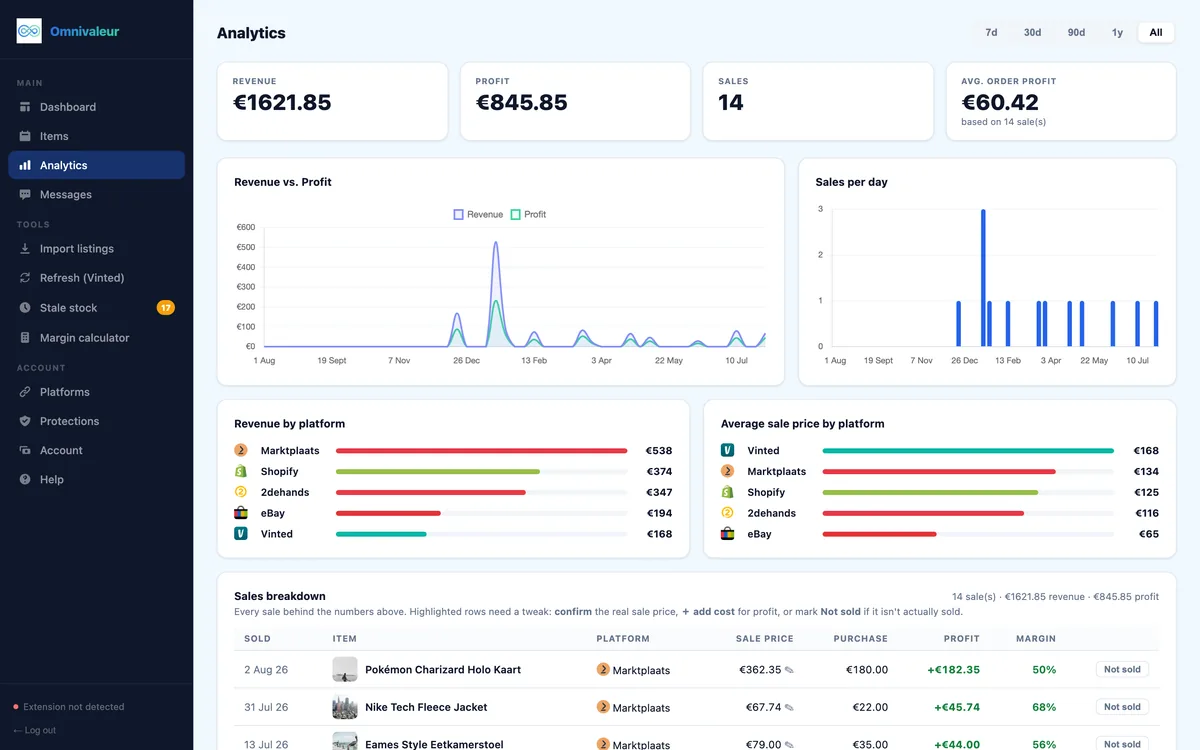
Under DAC7, marketplaces including Vinted, Marktplaats and eBay report seller data to tax authorities. The reporting threshold kicks in once you cross 30 sales or €2,000 in revenue per platform, per year. Below that, no report. Above it, the platform hands over your details.
The Dutch tax authority explains this plainly in its DAC7 information for sellers. The wider EU framework is set out by the European Commission's DAC7 overview.
What this means in practice:
- Being reported ≠ automatically owing tax. Selling your own old wardrobe usually isn't taxable.
- Buying to resell for profit is business activity, and that income is taxable.
- Automation blurs the line fast — scale enough and you're clearly a trader, not a declutterer.
Keep records. Export your sales data monthly. When automation pushes you past those thresholds across multiple platforms combined, you want clean numbers ready.
- ✓Photograph in batches of 30 items on a neutral background for consistency
- ✓Build listing templates with reusable description blocks per category
- ✓Bulk-draft listings and cross-list to Vinted, eBay, Marktplaats and 2dehands together
- ✓Enable auto-delist so items pull from all platforms when one sells
- ✓Reprice stale items 5–10% weekly instead of using reshare bots
- ✓Export your sales data monthly and track revenue per platform for DAC7
What are Vinted's actual listing limits when you automate?
People assume you can dump 500 items at once. You can't, not without friction.
Vinted doesn't publish a hard daily listing cap, but new accounts and sudden spikes trigger soft limits. If a fresh account posts 80 items in an hour, expect a temporary hold. Established accounts with sales history get far more room.
Practical rhythm that stays under the radar:
- New account: 10–15 listings a day for the first two weeks
- Warm account: 40–60 a day is generally fine
- Spread uploads across the day rather than one massive burst
The current rules and any account-specific limits are documented in the Vinted Help Centre. Check it before scaling — Vinted adjusts these quietly.
How do you set up a safe automation workflow step by step?
Here's the workflow I'd hand a colleague starting out.
- Photograph in batches. Shoot 30 items in one session on a neutral background. Consistency helps buyers and helps you later.
- Build listing templates. Write reusable description blocks per category — measurements, condition, material. Fill the variables per item.
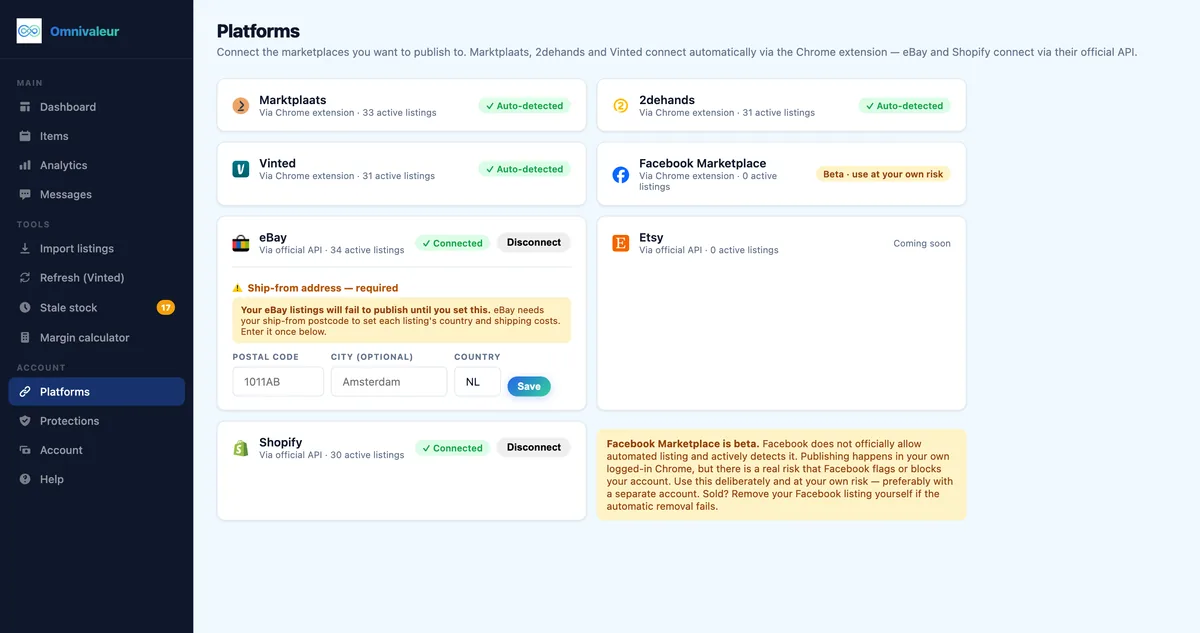
- Bulk-draft, then cross-list. Use a cross-listing tool to create the Vinted listing once and mirror it to eBay, Marktplaats and 2dehands.
- Enable auto-delist. Non-negotiable if you list the same item in more than one place.
- Reprice on a schedule, not constantly. Drop prices 5–10% weekly on stale items instead of hammering reshares.
- Track cross-platform revenue for DAC7. One combined view of what sold where.
Notice what's missing: no reshare bots, no follow farms. That's deliberate.
What should you look for in a Vinted automation tool in 2026?
The market's crowded with tools that promise engagement magic. Filter hard.
| Feature | Why it matters | Priority |
|---|---|---|
| Bulk listing import | The core time-saver | Essential |
| True cross-listing (multi-platform) | Doubles your buyer pool | Essential |
| Auto-delist on sale | Prevents oversell disasters | Essential |
| Scheduled repricing | Shifts stale stock quietly | Nice-to-have |
| Reshare/follow bots | Risk of account restriction | Avoid |
If a tool leads with "boost your views" and "auto-follow thousands," walk away. If it leads with listing, syncing and delisting across platforms, it respects the rules and your account.
One more thing worth knowing as a seller: buyers on EU marketplaces have protections you should be aware of, especially if you're trading at volume. The basics are laid out in Your Europe's consumer shopping rights. Once you're clearly a business seller, those rules apply to you.
Is automation worth it for a smaller reseller?
If you've got fewer than 20 items, no. The overhead isn't worth it. List by hand, learn what sells.
Past 50 active listings across two or more platforms, automation stops being optional. The manual cross-listing and delisting alone eats hours you don't have. That's the tipping point where a proper tool pays for itself in a week.
Start with cross-listing, add repricing later, and never touch the engagement bots. That's the sustainable version of this game in 2026.
Frequently asked questions
Can Vinted detect that I'm using automation software?
Will cross-listing to eBay and Marktplaats hurt my Vinted ranking?
How many sales trigger DAC7 reporting on Vinted?
What happens if the same item sells on two platforms at once?
Should I use one Vinted account or several for higher volume?
Do repricing bots count as banned automation on Vinted?
Keep reading
Stop copying listings by hand
Omnivaleur publishes your item to every platform at once and syncs stock automatically when something sells.
Start free trial