Return Rights on Second Hand Sales in the Netherlands: Complete 2026 Seller Guide
Under Dutch law, private individuals selling second-hand items have no obligation to accept returns or offer a 14-day cooling-off period, provided the item matches its description. However, commercial businesses selling used goods online must legally provide a 14-day statutory right of withdrawal and at least one year of legal warranty coverage.
Key takeaways
- Private peer-to-peer sellers do not owe buyers a 14-day right of withdrawal unless they misrepresent an item.
- Commercial online sellers must offer a mandatory 14-day return window, even on used and refurbished inventory.
- Sellers must cover return shipping costs if an item arrives defective or significantly different from the listing description.
- Platform buyer protection policies on Marktplaats and Vinted can enforce refunds regardless of statutory private-seller exemptions.
- Tracking accurate net sale prices protects your margins when managing inevitable platform disputes and forced returns.
If you sell pre-owned items online in the Netherlands, returns can quickly become a minefield. Many buyers assume that modern e-commerce standards apply across the board. They buy an item, change their mind, and demand an instant refund. As an independent seller, knowing where Dutch statutory law ends and platform policies begin determines whether you keep your profits or lose inventory to unwarranted refund claims.
The rules governing returns in 2026 depend on a single distinction: are you acting as a private individual clearing out personal possessions, or are you operating as a commercial enterprise? Dutch law treats these scenarios with fundamentally different legal frameworks. Mixing them up leads to costly chargebacks, negative reviews, and administrative headaches.
What Are the Legal Return Rights on Second Hand Sales in the Netherlands?
Dutch consumer protection rests primarily within Book 7 of the Dutch Civil Code (Burgerlijk Wetboek Boek 7). Under these statutes, consumers buying from businesses receive extensive protection. Transactions between two private citizens do not carry those same consumer privileges.
When a transaction takes place between two private individuals (Consumer-to-Consumer or C2C), the statutory 14-day right of withdrawal (herroepingsrecht) does not exist. A buyer cannot legally demand to return an item simply because it does not fit, looks slightly different in person, or because they no longer want it. All private sales are legally binding contracts upon agreement of price and delivery terms. The sale is considered final as long as the seller delivered what was promised.
Business-to-Consumer (B2C) sales operate under strict European directives codified in Dutch law. According to official EU consumer rights guidance, any business selling goods at a distance—including used, vintage, or refurbished stock—must grant consumers a minimum 14-calendar-day cooling-off period. The buyer may cancel the purchase without giving any reason whatsoever.
Even in private sales, sellers do not escape the rule of conformity (conformiteitseis under Article 7:17 BW). A sold item must possess the qualities that the buyer reasonably expected based on the agreement. If you sell an audio receiver described as fully working, and the right channel emits only static upon arrival, the buyer has legal grounds to declare a breach of contract. In that case, you must repair it, replace it, or accept a return and refund the purchase price.
When Does a Private Reseller Become a Commercial Seller Under Dutch Law?
Many online sellers start as hobbyists. Over time, sourcing thrift store bargains, estate sales, or clearing out collections turns into a consistent income stream. The transition from private individual to professional seller often happens without formal realization, yet Dutch authorities draw a sharp line.
The Dutch Chamber of Commerce (Kamer van Koophandel or KvK) and the Dutch Tax Administration evaluate commercial status using specific legal criteria:
- Intent to make a profit: Buying items with the explicit goal of selling them at a higher price constitutes business activity. Selling your personal childhood Nintendo collection is private; buying bulk consoles from flea markets to refurbish and flip is commercial.
- Frequency and regularity: Listing dozens of items each week establishes continuous economic participation rather than incidental household decluttering.
- Turnover and scale: Generating recurring revenue signals commercial enterprise, triggering statutory registration requirements.
Sellers must monitor how tax regulations interact with marketplace rules. Under European reporting requirements, online marketplaces automatically submit transaction volumes to the tax authorities. Review our comprehensive guide on Dutch second hand selling rules and tax guidance to see where the Belastingdienst sets thresholds. Furthermore, under EU directive rules detailed by the European Commission DAC7 framework, platforms report data once a user hits 30 transactions or €2,000 in gross sales within a calendar year.
The Belastingdienst DAC7 seller information confirms that reporting alone does not automatically classify you as a taxable business. However, if your transaction logs demonstrate systematic resale behavior, consumer protection courts will treat you as a professional merchant. If a judge or marketplace dispute team determines you act commercially, you are retroactively held to commercial standards—meaning every buyer you sold to within that period may claim an unnotified 14-day right of withdrawal, which can extend up to twelve months if you failed to inform them of their rights prior to purchase.
How Does the 14-Day Right of Withdrawal Work for Second-Hand Goods?
When selling commercially, the 14-day right of withdrawal applies to second-hand goods just as it does to brand-new products. The window starts the day after the buyer physically receives the parcel. During this period, the buyer has the legal right to inspect the goods.
Inspection Rights vs. Actual Usage
Buyers can inspect and test the item only to the extent necessary to establish its nature, characteristics, and functioning. In simple terms: a buyer can do with the item what they would reasonably be allowed to do in a physical shop.
For example, a buyer who purchases a used pair of designer boots may try them on indoors on a clean surface. They may not wear them on a night out and then return them. A customer purchasing a vintage mechanical watch may wind it and inspect its timekeeping; they cannot submerge it in water or wear it during daily manual labor.
If the buyer returns an item that shows signs of wear beyond basic inspection, you cannot reject the return entirely. Instead, Dutch law allows you to hold the consumer liable for depreciation (waardevermindering). You deduct an appropriate percentage from their refund. If a customer damages the patina on an antique leather bag by applying unauthorized conditioners, you can deduct the loss in market value before issuing the remaining funds.
Exceptions to the Statutory Return Window
Certain items are legally exempt from the 14-day right of withdrawal, provided you inform the buyer before the sale completes:
- Custom or personalized products: Second-hand items modified or altered specifically to the buyer's specifications (such as tailored clothing or custom-sized jewelry).
- Sealed hygiene products: Earphones, in-ear monitors, or specific personal grooming items where the hygienic seal was broken after delivery.
- Unsealed audio, video, or software: Classic vinyl records, CD box sets, or retro cartridge games originally delivered in sealed packaging that the customer unsealed.
- Perishable commodities: Items subject to rapid expiration or deterioration.
If you operate an independent webshop using Shopify or WooCommerce alongside your marketplace accounts, you must present a dedicated terms page detailing return windows, notification procedures, and who bears the cost of return postage. Failing to provide this required information explicitly before checkout automatically extends the buyer's return window by up to a full year under Article 7:46d BW.
Who Pays the Return Shipping Costs When an Item Is Returned or Defective?
Disputes over shipping costs cause friction in online reselling. The allocation of return postage costs depends on two factors: the reason for return and whether the seller complied with pre-contractual information duties.
| Return Scenario | Seller Type | Standard Return Shipping Payer | Original Outbound Shipping Refunded? |
|---|---|---|---|
| Buyer Remorse (Cooling-off) | Commercial (B2C) | Buyer (if notified prior to sale) | Yes (cheapest standard rate) |
| Buyer Remorse (Cooling-off) | Commercial (B2C) | Seller (if notification was omitted) | Yes (full standard rate) |
| Buyer Remorse | Private (C2C) | No legal right to return | Not applicable |
| Undisclosed Defect / Non-Conformity | Commercial (B2C) | Seller (must repair or replace) | Yes (full refund including shipping) |
| Undisclosed Defect / Non-Conformity | Private (C2C) | Seller (breach of contract) | Yes (restitution of paid amount) |
Return Postage for Buyer Remorse
If you are a commercial seller and a buyer returns an item simply because they changed their mind, the buyer must pay the return shipping costs—provided you stated clearly in your listing or webshop terms that return costs are the buyer's responsibility. If you forgot to include this disclaimer, Dutch law forces you to pay for the return shipment yourself.
When issuing a refund for buyer remorse, you must refund the original purchase price plus the standard outbound shipping cost the customer paid to receive the parcel. If the buyer selected an express or insured courier upgrade over your standard service, you only need to reimburse the standard baseline cost.
Return Postage for Defective or Non-Conforming Items
If the item arrives broken, defective, or materially distinct from your photographs and description, the rules change completely. Under Article 7:21 of the Dutch Civil Code, curing non-conformity must occur free of charge for the buyer. The seller must cover all transit costs incurred to inspect, repair, or return the defective item.
You cannot charge a "restocking fee" or deduct administrative handling costs on second-hand sales in the Netherlands. Any clause in your store policy attempting to shift non-conformity shipping fees onto the consumer is void under statutory Dutch law.
Transit Risk and Carrier Loss
Who carries the risk if a returned parcel gets lost by PostNL, DHL, or DPD? For commercial sales, the legal risk of return transit remains with the consumer until the parcel is physically handed over to the seller. The buyer must prove they shipped the item using valid tracking. If the parcel vanishes in transit and the buyer used their own uninspected shipping label, the buyer must seek compensation from the carrier; the seller is not obligated to refund an item that was never delivered.
However, if you as the seller provided a pre-paid return label generated through your own corporate carrier account, you are considered the contracting party with the courier. In that situation, the transit risk shifts back to you once the buyer drops the parcel off and secures a valid drop-off receipt.
- ✓Decide whether your selling activity classifies you as a business
- ✓Document and photograph every known defect before you list the item
- ✓State plainly in your terms that the buyer covers return shipping
- ✓Give buyers standard withdrawal details before they place an order
- ✓Deduct depreciation if a buyer returns an item in damaged condition
What Happens If a Second-Hand Item Has Undisclosed Defects or Arrives Damaged?
In the second-hand trade, condition is subjective. A vintage jacket described as "good vintage condition" might mean minor patina to the seller, but a buyer might view it as damaged. Managing this discrepancy requires understanding the legal tension between the buyer's duty to inspect (onderzoeksplicht) and the seller's duty to disclose (mededelingsplicht).
The Primacy of the Seller's Disclosure Duty
Under Dutch jurisprudence, the seller's duty to inform always supersedes the buyer's duty to investigate. If you know that a turntable has a loose audio jack or an intermittent hum, you must disclose it in the listing. You cannot argue that the buyer should have asked detailed questions about the wiring before making an offer.
If an undisclosed defect appears, the buyer has the legal right to demand remedy under Article 7:21 BW in the following hierarchy:
- Repair (herstel): The seller repairs the item at their own expense within a reasonable timeframe.
- Replacement (vervanging): If repair is impossible or disproportionately expensive, the seller provides an equivalent unit (often difficult with unique second-hand goods).
- Price Reduction or Rescission (ontbinding): If repair and replacement are impossible, the buyer can accept a partial refund to reflect the lower value, or dissolve the purchase agreement entirely for a full refund upon returning the item.
Burden of Proof in 2026
For commercial sales under modernized EU consumer rules, any defect that becomes apparent within twelve months of delivery is legally presumed to have existed at the time of delivery (unless the nature of the goods makes this presumption untenable, such as consumable items). The seller must prove the item was in working order when shipped.
For second-hand goods, commercial sellers and buyers can mutually agree to shorten this legal warranty period to a minimum of one year. You cannot reduce it to zero. If you sell refurbished electronics through your own web store or marketplace storefront, you must stand behind their basic functionality for at least twelve months unless specific flaws were explicitly documented and sold "as defective parts".
For private peer-to-peer transactions, no such twelve-month statutory presumption exists. The buyer carries the immediate burden of proof to show that the defect was present prior to shipping and was not caused by transit impact, user mishandling, or normal wear and tear commensurate with age.
How Do Return Rules Differ Across Marktplaats, Vinted, eBay, and Shopify?
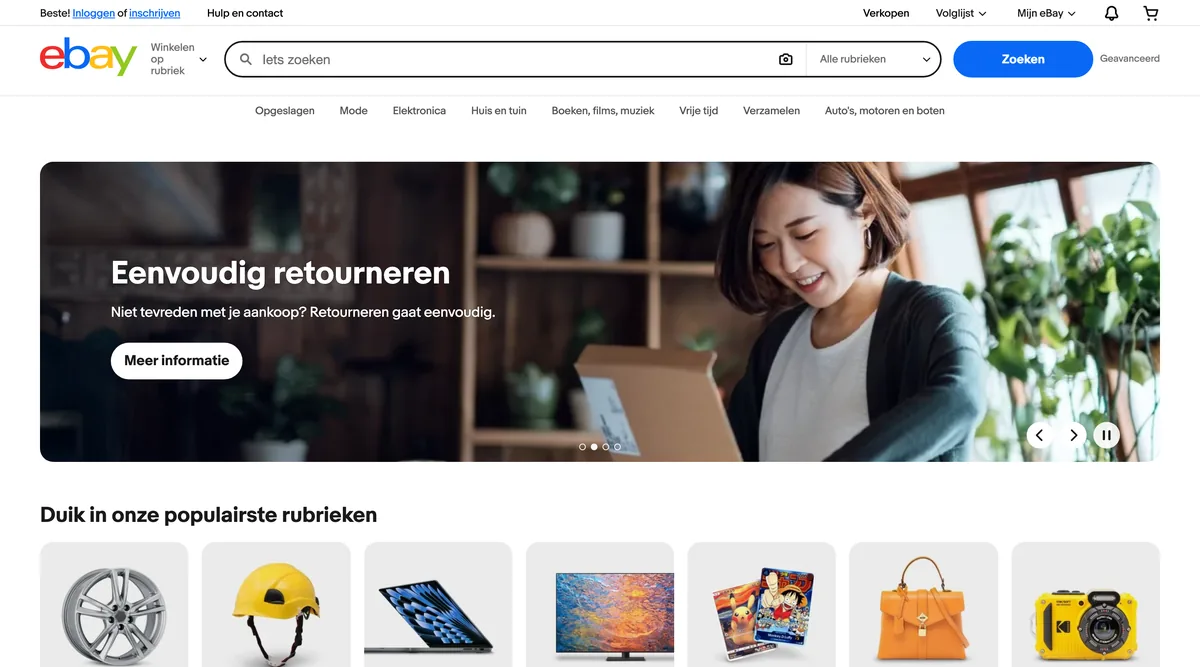
Legal statutes provide the baseline, but marketplaces impose their own binding terms of service. When you list inventory across multiple channels, you sign up for contrasting dispute resolution protocols. Here is how return obligations work in practice across leading Dutch and European channels.
| Platform | Private Seller Return Policy | Platform Buyer Protection System | Dispute Resolution Outcome |
|---|---|---|---|
| Marktplaats | No returns required by default | Kopersbescherming (optional for buyer) | Funds held via Online Payment Platform (OPP) until delivered and approved |
| Vinted | No returns for fit/taste; mandatory for SNAD | Buyer Protection Fee (mandatory for buyer) | Buyer has 48 hours after delivery to suspend payout and initiate claim |
| eBay | Configurable policy (can specify "No Returns") | eBay Money Back Guarantee (mandatory) | Overrides "No Returns" policy if item is not as described |
| Shopify | Must comply with full Dutch e-commerce law | Payment processors (Stripe, Mollie, PayPal) | Strict compliance; non-compliance risks immediate merchant account freezes |
Marktplaats: Standard Sales vs. Buyer Protection
Marktplaats operates predominantly as a classifieds board, but its integrated payment features altered private trading dynamics. When a buyer completes a transaction using bank transfers or cash on pickup, standard Dutch private contract rules apply. If you hand the item over in person, the buyer has the opportunity to inspect it on the spot; returns are virtually non-existent unless blatant fraud occurred.
When buyers use Kopersbescherming (Buyer Protection), payments are routed through an escrow intermediary (Online Payment Platform BV). If the buyer claims within seven days of shipment that the parcel never arrived or that the contents are damaged or fundamentally different, the payout is suspended. As a seller, if you cannot provide valid shipment tracking matching the buyer's address, Marktplaats refunds the buyer out of the escrowed funds.
To avoid lost-package disputes, ensure you generate trackable shipping labels properly. Review our step-by-step walkthrough on printing shipping labels on Marktplaats to ensure carrier drop-off scans are logged into the system automatically.
Vinted: 48-Hour Inspection Window
Vinted enforces its own strict ecosystem rules across Europe. Every transaction processed through the platform's internal checkout includes an obligatory Buyer Protection fee paid by the buyer. Buyers have exactly 48 hours from the tracking system's delivery confirmation to click "I have an issue" rather than "Everything is OK".
Vinted policy explicitly rejects returns based on sizing issues or personal preference, provided the listing correctly stated the tag size and measurements. If a buyer opens a claim for "Significantly Not As Described" (SNAD)—such as undisclosed stains, counterfeit markers, or unmentioned tears—Vinted requires the buyer to submit photographic evidence. If Vinted validates the claim, the buyer must ship the item back to the seller with tracking within five working days. The buyer pays return postage unless the seller voluntarily offers to cover it. Once tracking confirms delivery back to the seller, Vinted processes the refund.
For high-volume clothing and vintage sellers navigating these platforms alongside cross-border reporting rules, managing compliance becomes essential. Take a look at our breakdown of Vinted DAC7 thresholds in the Netherlands to understand where transaction thresholds trigger administrative notices.
eBay: The Money Back Guarantee Override
On eBay, even if a private seller sets their shop policy to "Seller does not accept returns," this setting only applies to buyer remorse. If the buyer files an "Item Not as Described" case under the eBay Money Back Guarantee, the platform's internal adjudication supersedes your settings. If the buyer demonstrates that an item is defective, damaged, or counterfeit, eBay forces the return. In these cases, eBay requires the seller to provide a pre-paid return shipping label within three business days. Failure to provide a label results in eBay refunding the buyer directly from your linked payout account, often allowing the buyer to keep the merchandise.
Shopify and Direct Webshops
Operating an independent direct-to-consumer store means you have no marketplace intermediary to buffer customer disputes. You must adhere to professional Dutch retail regulations. Every customer retains a 14-day right of withdrawal. Your site must display your KvK registration number, your BTW (VAT) identification number, and unambiguous terms regarding returns.
If you source second-hand goods via private individuals or clearance lots to sell via a direct storefront, you also need to manage fiscal rules like the margin scheme. Check our detailed guide on the VAT margin scheme for second-hand goods to properly account for purchase values versus sales margins without incorrectly billing standard VAT on returned items.
What Evidence and Records Should Resellers Keep to Protect Against Fraudulent Claims?
Fraudulent returns affect every category, including clothing swapping, serial number switching on vintage electronics, and malicious damage claims to secure partial refunds. Because marketplaces favor the buyer whenever evidence is ambiguous, you must build verifiable documentation before parcels leave your workstation.
To defend against illegitimate return requests, implement this operational verification routine:
- Photograph unique identifiers: Capture high-resolution images of serial numbers, internal production codes, brand labels, fabric care tags, and any natural imperfections (such as leather creasing or vintage crazing).
- Document packing procedures: For items valued over €100, record continuous, unedited video footage showing the item working (e.g., testing buttons, ports, lights), followed immediately by the item being packed and the shipping label affixed.
- Record exact parcel weight: Drop off parcels at staffed carrier points (PostNL, DHL ServicePoints) and collect an official physical drop-off receipt showing the weight registered on the retail scale. A weight disparity between the outbound parcel and a fraudulent return parcel serves as critical evidence in police and platform disputes.
- Use tamper-evident security tags: Attach branded or numbered tamper-evident zip-ties to visible portions of garments, luxury bags, or collectibles. State in your listing description: "Returns accepted within statutory limits only if the tamper-evident security seal remains attached and intact."
If you cross-list single-instance inventory across multiple platforms simultaneously, another operational hazard is double selling. If an item sells on Marktplaats and Vinted on the same day, canceling one order can earn you negative account penalties and buyer complaints. Read our practical advice on how to avoid selling the same item twice across separate marketplaces.
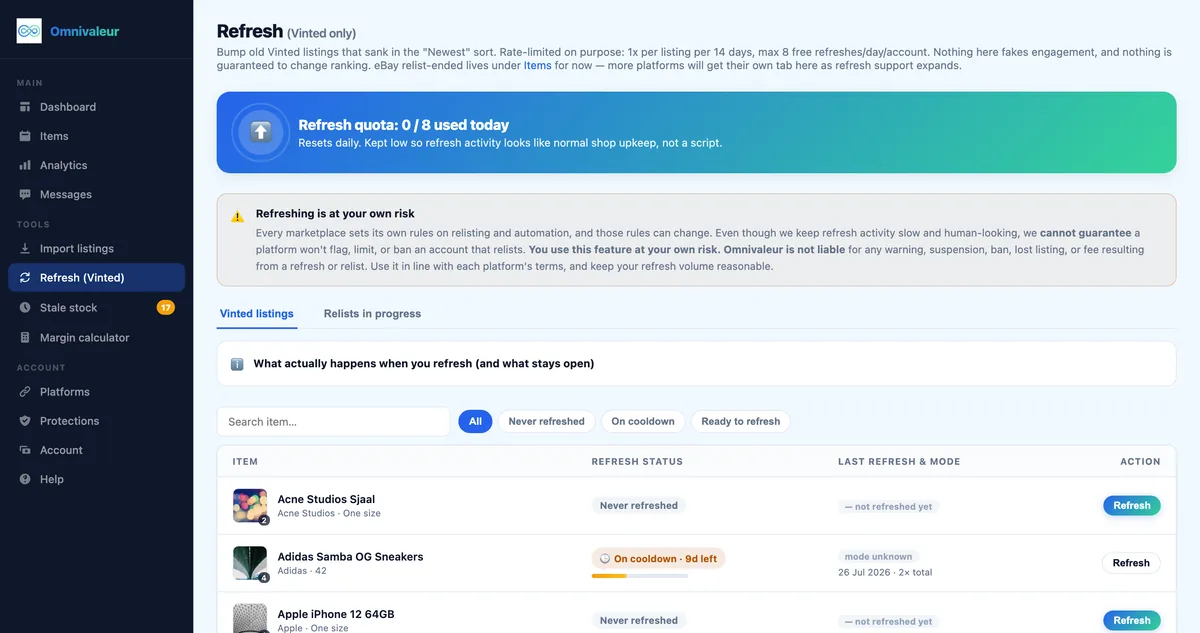
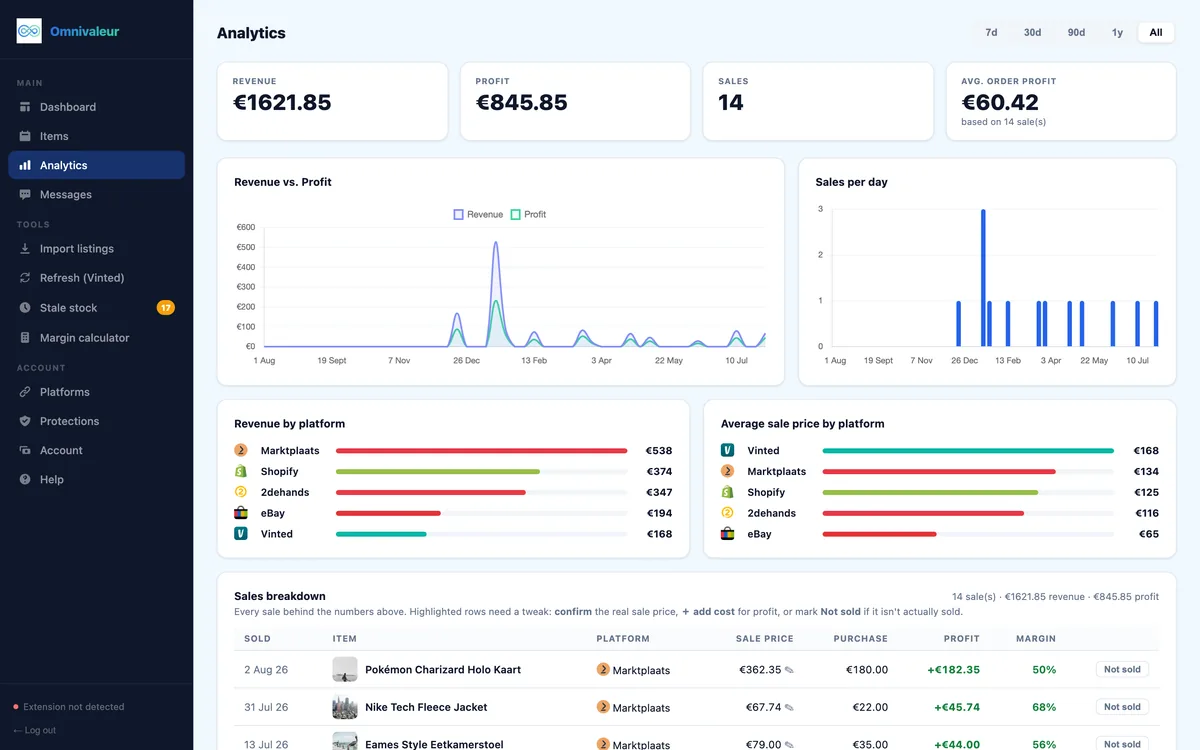
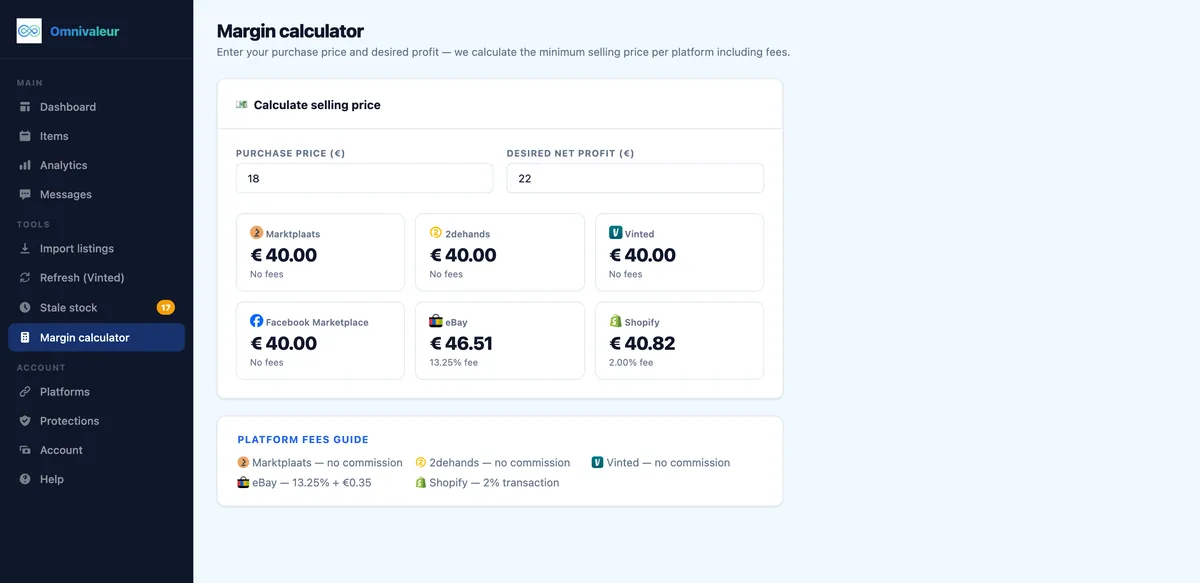
Omnivaleur's analytics calculate profit from the real sale price (which sellers confirm per sale), not the asking price — on second-hand marketplaces the two differ by roughly 10-20%. When buyers submit counter-offers, accept discounts, or request small partial compensations to settle minor cosmetic complaints, tracking real closing figures ensures you understand your true margins instead of relying on theoretical listing figures. Furthermore, Omnivaleur's stale-stock view flags listings that have been sitting unsold, so slow inventory surfaces instead of sinking down the list. Clearing stale inventory quickly mitigates the risk of holding aged stock that could face return disputes due to prolonged storage degradation.
How Do You Handle a Return Dispute Step by Step?
When an escalation happens, reacting defensively worsens the situation. Follow a structured legal and operational workflow to reach resolution without incurring unnecessary chargeback fees.
Step 1: Request Photographic and Video Proof
Ask the buyer politely to provide clear photos of the shipping box (exterior, label, interior padding) and detailed images of the reported flaw. Emphasize that packaging photos are mandatory to file a damage claim with the courier.
Step 2: Compare Against Sourcing and Pre-Shipment Records
Check the buyer's images against your original listing photos and pre-shipment records. Verify serial numbers, stitching patterns, and the exact location of marks. If the serial numbers do not match, notify the buyer calmly that the item displayed does not match the product dispatched from your facility.
Step 3: Determine Carrier Liability
If the item was crushed or shattered during transit, the issue is not product conformity—it is carrier transit damage. If you shipped via an insured service, initiate a damage investigation with PostNL, DHL, or DPD immediately. Note that couriers require packaging to be retained by the recipient for physical inspection.
Step 4: Offer Repair or Partial Settlement
If the item suffers from a minor flaw you missed during inspection, it is often commercially sensible to negotiate. Offering a 15% or 20% partial refund allows the customer to repair the item locally while avoiding two-way shipping costs that could eliminate your profit margin on the transaction entirely.
Step 5: Facilitate the Return
If full return is unavoidable, instruct the customer on safe repackaging. Require the use of a tracked and insured shipping method. Do not issue any refund until the parcel arrives back at your facility, you have opened it, and verified that the original merchandise was returned in the condition it was dispatched.
Step 6: Escalate to Formal Mediation If Necessary
If negotiations break down with an unreasonable buyer on an independent webshop transaction, consumers can turn to official ADR (Alternative Dispute Resolution) bodies such as De Geschillencommissie in the Netherlands or the European Online Dispute Resolution platform. For marketplace sales, the platform's support team acts as arbitrator. Present clear facts: tracking receipts, weight measurements, listing screenshots, and communication logs. Concrete documentation wins marketplace disputes.
Keep reading

Stop copying listings by hand
Omnivaleur publishes your item to every platform at once and syncs stock automatically when something sells.
Start free trial