Second-Hand Book Reselling Automation: The 2026 Reseller's Playbook
Second-hand book reselling automation is software that cross-lists your used-book inventory across Marktplaats, 2dehands, Vinted, eBay, Etsy and Shopify at once, syncs stock so a sold copy vanishes everywhere else, and tracks profit from the confirmed sale price rather than the asking price. For resellers moving 50+ books a week, it replaces manual relisting entirely.
Key takeaways
- Real sale price, not asking price, decides actual margin — and on second-hand marketplaces the two typically differ by 10-20%.
- Pre-1970 books without ISBN barcodes need a manual title/author/year lookup workflow, not a scan-and-list shortcut.
- Marktplaats, eBay, Etsy and Vinted each apply different fees and category rules to books in 2026 — check limits before bulk uploading.
- A stale-stock view catches books that have sat unsold for months, before they quietly drag down your account average.
- DAC7 reporting kicks in once you cross 30 sales or €2,000 in a calendar year, and it applies to second-hand books just like anything else.
Second-hand book reselling has a different rhythm than reselling sneakers or designer jackets. You don't source one item at a time — you source lots. A single house clearance, charity shop haul or boekenbeurs trip can hand you 80 to 300 books in an afternoon, with wildly inconsistent condition, no consistent barcode, and a huge spread in resale value per title. Automation for this niche isn't about listing faster in isolation. It's about triaging a pile fast, deciding what's worth photographing individually versus bundling, and not losing track of which copy sold where.
What makes second-hand book reselling different from general book reselling automation?
General book automation assumes a fairly clean input: a title, a barcode, a condition. Second-hand sourcing rarely gives you that cleanly. You'll pull books with names written inside covers, ex-library stamps, water stains on the bottom edge, missing dust jackets, or duplicate copies of the same paperback three times over. The workflow has to handle bulk intake first, then decide per-book whether it's a €2 charity-shop filler or a €40 out-of-print title worth its own listing.
That triage step is where most new resellers lose hours. Scanning barcodes speeds up the clean 70% of a lot. The other 30% — pre-1970 hardbacks, foreign editions, damaged spines — needs a slower manual pass. If you're coming from general trade paperbacks, the Used Book Reselling Automation 2026: Full Guide covers the baseline scanning workflow well. This page picks up where that one stops: the messy, mixed-condition, bulk-lot reality most second-hand resellers actually deal with.
Which marketplaces actually work for second-hand book resellers in 2026?
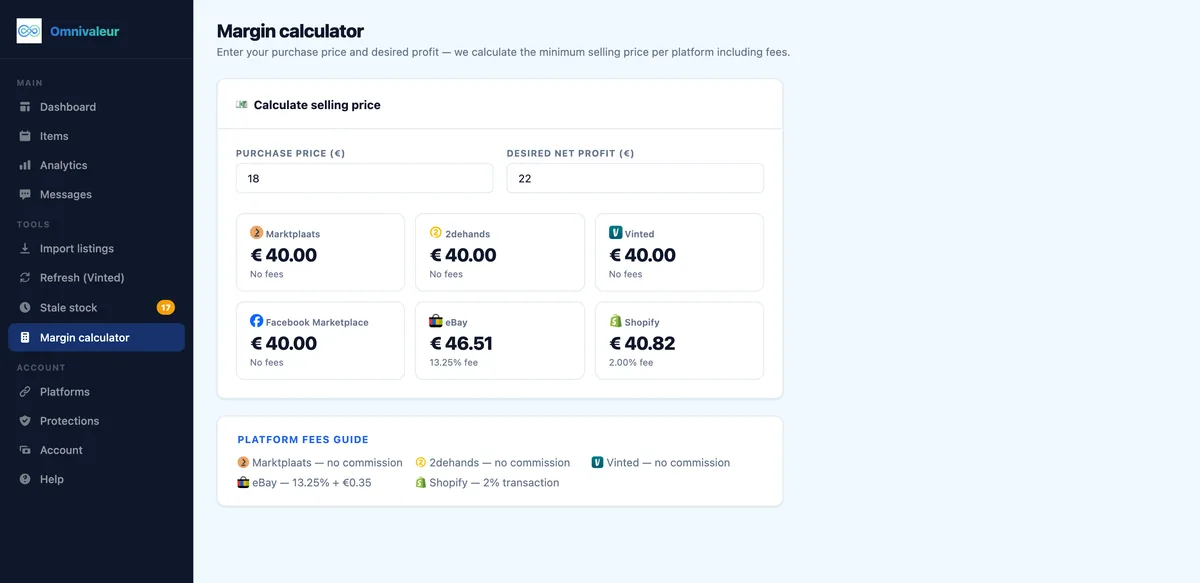
Not every platform treats books the same way, and the differences matter once you're listing hundreds of titles a month. Here's how the main five compare for a typical €10-15 used paperback in 2026:
| Platform | Fee on a €10 book | Category fit | Bulk-listing notes 2026 |
|---|---|---|---|
| Marktplaats / 2dehands | Free listing, no seller fee | Strong for domestic bulk lots and Dutch-language titles | No barcode requirement, but low search visibility for niche/English titles |
| eBay | ~12.8% final value fee + fixed cent fee | Best for common English titles with clean ISBNs | Requires item specifics (author, format, language) or listings get suppressed |
| Etsy | Listing fee ~€0.20 + ~6.5% transaction fee | Best for books over 20 years old marketed as vintage | Etsy's vintage policy requires the item to genuinely be 20+ years old — recent paperbacks get flagged |
| Vinted | No seller fee (buyer pays protection fee) | Decent for younger, casual buyers, weaker for antiquarian titles | Book category exists but is thin compared to clothing search traffic |
| Shopify | Transaction fee only if not using Shopify Payments | Best once you have a recognisable niche (rare, signed, first editions) | No marketplace search traffic — you bring your own buyers |
The practical pattern most resellers land on: common trade paperbacks go to eBay or Marktplaats, genuinely old or collectible copies go to Etsy, and Shopify becomes worthwhile only once you've built a reputation for a specific niche (first editions, illustrated children's books, poetry). If you're cross-listing between Dutch and international platforms, the Marktplaats to eBay Crosslisting 2026: Full Guide walks through the field-mapping differences in detail.
How do you handle books that don't have an ISBN barcode?
The ISBN standard only became universal from 1970 onward, and the 13-digit format buyers scan today only fully replaced the old 10-digit one around 2007. That means a meaningful share of the books in any second-hand lot — especially anything printed before 1970, foreign-language editions, or small-press runs — simply won't scan.
For these, the workflow has to fall back to a manual lookup: title, author, publisher and print year entered by hand, cross-checked against catalogue databases like WorldCat when the exact edition matters (book club editions vs. first editions can differ in value by 10x). Condition grading also shifts vocabulary here — antiquarian sellers use terms like Fine, Very Good, Good, Fair and Poor rather than the "like new / used / acceptable" scale common on eBay and Vinted, and buyers in this niche expect that vocabulary. The Vintage Book Reselling Automation 2026: Full Guide goes deeper into pricing pre-barcode stock if that's a growing share of your inventory.
What do second-hand books actually cost to ship across the EU in 2026?
Weight tiers matter more for books than almost any other category, because paper is dense and buyers expect cheap shipping on a €5-15 item. A single paperback under 350g typically ships as a light parcel domestically for €3-5 depending on courier. Cross a border — Netherlands to Germany or Belgium — and that same parcel often costs €1-2 more, plus customs paperwork if it heads outside the EU.
The math changes fast with bundling. Three paperbacks together might weigh 700g and ship for barely more than a single book, because you're paying for one packaging and label instead of three. Resellers who list books individually but ship them combined when a buyer orders more than one save real money — but only if your listing tool can merge orders automatically rather than forcing three separate labels.
Padded mailers add roughly €0.30-0.60 per parcel, small on paper but real at volume across hundreds of shipments a month. Buyers also have baseline delivery expectations under EU distance-selling rules once you're operating as a business seller rather than an occasional private one — worth reviewing via the Your Europe consumer rights overview if you're scaling past a hobby.
How do you price and track profit when the sale price rarely matches the asking price?
Here's the number most spreadsheet-based resellers get wrong: on second-hand marketplaces, the confirmed sale price and the original asking price differ by roughly 10-20%, because buyers negotiate, sellers accept lower offers to move stock, and Vinted/Marktplaats both encourage bargaining as a norm rather than an exception. A book listed at €15 that actually sells for €12 isn't a rounding error — across a few hundred books a month, that gap changes your real margin calculation entirely.
Most inventory spreadsheets calculate profit off the asking price because it's the only number they have on hand. Omnivaleur's analytics instead calculate profit from the real sale price, which sellers confirm per sale, precisely because that 10-20% gap is too large to ignore if you're deciding which sourcing trips are actually worth your time. Knowing your true margin per lot — not per listing — is what tells you whether a €40 charity-shop box of 60 books was a good buy or a break-even one.
Worth comparing tooling here too: if you're weighing Omnivaleur against other cross-listing software before committing, the Omnivaleur vs List Perfectly: Honest 2026 Comparison breaks down how profit tracking differs between the two.
How do you spot slow-moving inventory before it drags down your account?
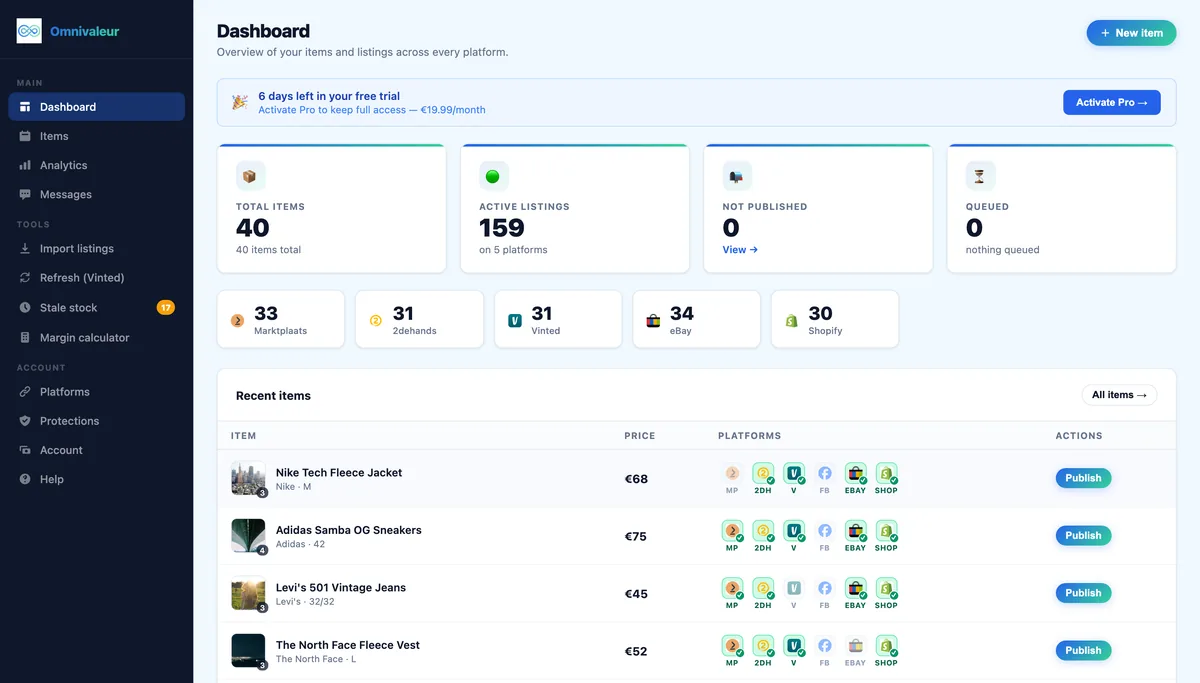
Books are unusually prone to sitting unsold. An obscure academic title, a damaged copy priced too optimistically, or a duplicate you already have three of on the shelf — all of these quietly sink toward the bottom of search results on every platform, invisible unless you go looking for them. Left alone for months, a shelf of dead stock does two things: it ties up storage space, and it drags down your average sell-through rate, which some platforms' algorithms use to decide how much visibility to give your newer listings.
Omnivaleur's stale-stock view exists specifically for this — it flags listings that have been sitting unsold for a set period, so slow inventory surfaces on a dashboard instead of sinking silently down the list. For a book reseller, that usually means a weekly ten-minute pass: reprice anything untouched for 60+ days, bundle three slow movers into a lot listing, or drop the ones genuinely not worth the shelf space to a donation pile.
If you're running the same discipline across other paper-based niches — postcards, ephemera, vintage posters — the underlying pattern repeats: slow stock needs a dashboard, not a memory. That's the same logic behind the Book Reselling Automation 2026: Best Tools & Setup guide's setup recommendations for larger multi-category resellers.
What legal and tax rules should second-hand book resellers know in 2026?
DAC7 remains the rule most resellers underestimate. Once you cross 30 sales or €2,000 in gross revenue on a single platform within a calendar year, that platform is obligated to report your sales data to tax authorities — and this applies to second-hand books exactly as it applies to clothing or electronics. Occasional sellers clearing out a personal shelf rarely hit either threshold. Anyone running a real book-flipping operation, even part-time, hits it within a few months.
The official guidance is worth reading directly rather than relying on forum summaries: the Belastingdienst's DAC7 information for sellers covers the Dutch-specific reporting mechanics, while the European Commission's DAC7 overview explains how the thresholds apply across EU member states more broadly. VAT margin schemes for second-hand goods add another layer if you're registered as a business — worth confirming with an accountant rather than guessing, since the margin scheme calculation differs from standard VAT invoicing.
Which automation workflow actually fits a second-hand book reseller's day?
A workable daily rhythm for someone processing 50-150 books a week looks something like this: photograph the lot in batches rather than one book at a time, run barcode scanning on the clean majority, manually enter title/author/year for the pre-1970 and foreign stragglers, then push everything to two or three platforms at once rather than choosing a single marketplace up front. Stock syncs automatically once one copy sells, so you're not manually delisting the same title from four places by hand.
Where this differs from clothing or electronics automation is the volume-to-value ratio. A reseller might list 40 books in the time it takes to list 10 pairs of sneakers, because condition photos matter less per-unit and pricing research is faster for common titles. The trade-off is thinner margins per item, which is exactly why tracking real sale price rather than asking price matters more here than in almost any other category — a 15% negotiation gap on a €40 jacket is noise, but the same gap across 200 books a month changes your monthly total meaningfully.
For resellers running books alongside another niche — vintage cameras, board games, vinyl — cross-listing software that handles multiple category templates in one dashboard saves the most time overall, since you're not relearning a separate tool's quirks for every product type you touch.
Frequently asked questions
Can you legally resell library discard books and ex-library stamped copies?
What should you do with duplicate or unsellable books from a bulk lot?
Do you need a VAT number to resell second-hand books as a side hustle in the EU?
How many books can automation realistically let you list per hour compared to doing it manually?
How should multi-volume sets or boxed sets be listed across different platforms?
Keep reading

Stop copying listings by hand
Omnivaleur publishes your item to every platform at once and syncs stock automatically when something sells.
Start free trial