Best Resylr Alternative in 2026: An Honest European Reseller Comparison
The best Resylr alternative for European resellers in 2026 is Omnivaleur if you sell across Benelux and international channels. While Resylr excels at UK-centric fashion platforms like Depop, Omnivaleur bridges local powerhouses like Marktplaats and 2dehands with Vinted, eBay, Shopify, and WooCommerce using safe, sequential tab-by-tab listing execution.
Key takeaways
- Resylr targets UK and European fashion-first marketplaces, whereas Omnivaleur connects local classifieds like Marktplaats and 2dehands directly to global platforms and standalone webshops.
- Omnivaleur publishes one browser tab at a time to prevent marketplace rate limits and bot detection triggers.
- Multi-channel expansion across seven integrated platforms helps mitigate platform-specific sales slumps and DAC7 reporting thresholds.
- Standalone e-commerce integration (Shopify and WooCommerce) provides an escape route from marketplace commission hikes and sudden policy changes.
- The right tool depends on your inventory mix: choose Resylr for pure Depop and fashion curation; choose Omnivaleur for mixed inventory spanning classifieds, fashion, and independent webshops.
If you have been managing an inventory of hundreds of vintage jackets, designer bags, or refurbished electronics, you already know the grind. Manually copy-pasting descriptions, adjusting prices across currencies, and re-uploading photos drains the hours you should spend sourcing. Tools like Resylr emerged to solve this exact bottleneck. Yet, as European reselling evolves in 2026, many operators find themselves hitting walls with their current software stack. Whether you run into missing local marketplace integrations, browser extension glitches, or inventory de-listing lag that causes double sales, looking for the best Resylr alternative is a natural step in scaling your operations.
Every tool in the inventory management and cross-listing ecosystem comes with distinct trade-offs. Resylr built a solid reputation, particularly for apparel sellers operating between the United Kingdom and continental Europe. However, European e-commerce is not a monolith. Selling vintage boots in Manchester involves an entirely different workflow, shipping carrier setup, and platform mix than selling mid-century furniture or collectibles across the Netherlands, Belgium, Germany, and France. To determine whether you need a different software engine, you must evaluate where your inventory actually moves, how each platform handles automation safety, and how your software handles changing EU compliance standards.
Why Are Resellers Looking for a Resylr Alternative in 2026?
Resylr carved out a respectable user base by providing cross-listing support across major apparel-heavy networks. If you are predominantly listing curated streetwear on platforms like Depop, Vinted, and eBay, Resylr delivers a clean user interface. The team behind it solved the foundational problem of copying product data without starting from scratch every single time. For fashion hobbyists and boutique vintage sellers focusing on Anglo-European fashion networks, it remains a capable tool.
However, serious European resellers operate in a broader marketplace ecosystem. The primary motivation driving sellers away from Resylr and toward alternatives centers on three operational friction points: localized marketplace coverage, standalone webshop synchronisation, and marketplace account security.
First, local European domestic giants are missing from many Anglo-centric listing engines. If you run a reselling business in the Benelux region, Marktplaats and 2dehands are not optional side channels; they represent the highest local margin channels with minimal commission overhead. A cross-lister that handles eBay and Depop but ignores Marktplaats forces you into a split workflow. You end up automating half your business while manually typing out listings for the other half, completely defeating the purpose of paying for automation software.
Second, as platforms increase their take rates, professional merchants are diversifying off third-party marketplaces. Relying entirely on hosted platforms leaves your business vulnerable to sudden account suspensions, algorithm shifts, or sudden fee hikes. Resellers want software that bridges the gap between third-party apps and self-hosted stores built on Shopify or WooCommerce. When your cross-listing app cannot push stock directly to your owned website, your operational overhead doubles.
Third, European sellers face heightened scrutiny from platform anti-bot systems. In 2026, marketplace algorithms on platforms like Vinted, Etsy, and eBay actively monitor request frequencies and browser signatures. Resellers are moving away from tools that rely on aggressive, unthrottled listing scripts in favor of systems that mirror organic human browsing patterns.
How Do Omnivaleur and Resylr Compare Side-by-Side?
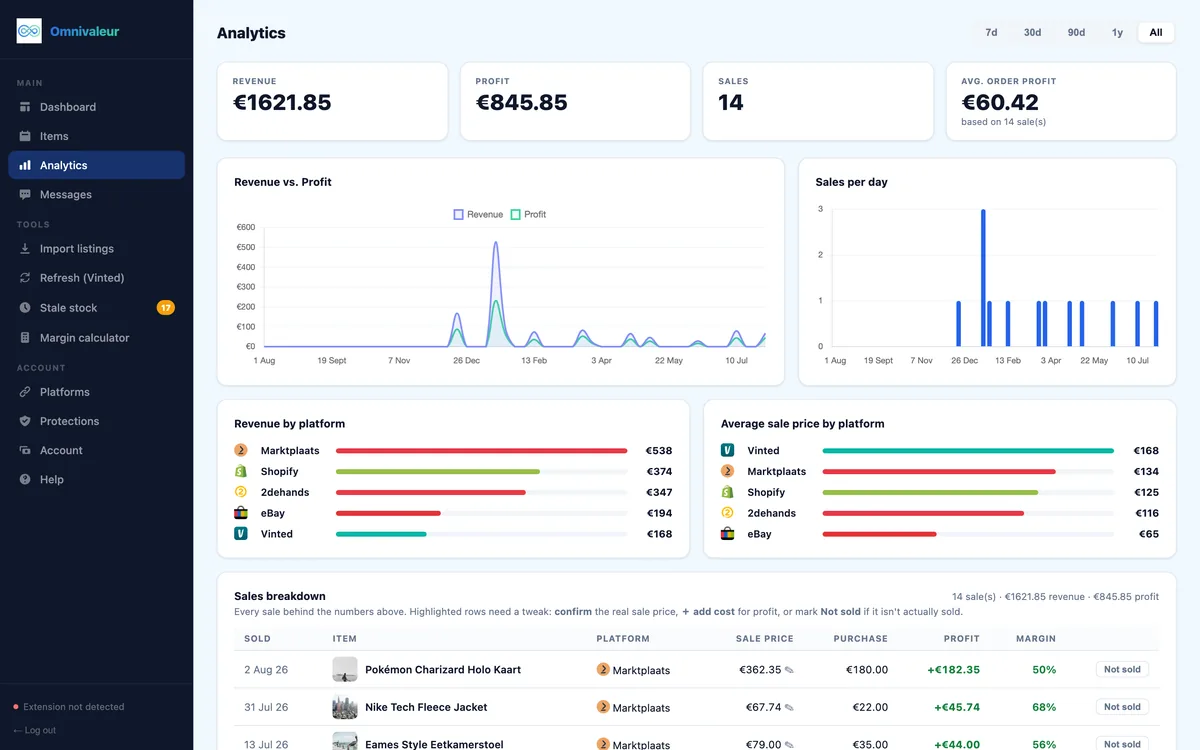
To make an informed business decision, you need a transparent overview of how both platforms stack up across practical day-to-day metrics. We believe in complete transparency: no single tool is universally superior for every seller profile. An apparel-only reseller in London has fundamentally different needs than an omnichannel merchant moving hard goods and collectibles across Amsterdam, Antwerp, and Berlin.
| Feature / Metric | Resylr | Omnivaleur |
|---|---|---|
| Core Target Audience | Fashion, vintage apparel, and streetwear resellers (UK & Western Europe) | Multi-category, omnichannel European merchants and Benelux cross-border sellers |
| Supported Marketplaces | Vinted, eBay, Depop, Etsy, Vestiaire Collective, Poshmark | Marktplaats, 2dehands, Vinted, eBay, Shopify, WooCommerce, Facebook Marketplace (beta) |
| Benelux Integration | No native Marktplaats or 2dehands workflow | Full native support for Marktplaats.nl and 2dehands.be / 2ememain.be |
| Owned E-commerce Sync | Limited / relies on manual export | Native two-way publishing to Shopify and WooCommerce stores |
| Listing Execution Architecture | Browser-based multi-platform form filling | Sequential single-tab execution designed to avoid bot detection rate limits |
| Inventory Management | Centralized catalogue with batch cross-listing | Centralized web intake form pushing to 7 channels simultaneously |
| Currency & Local Attributes | Primarily GBP/EUR with fashion sizing focus | EUR native, localized category mappings for NL/BE/DE markets |
| Primary Strength | Deep features for Depop sellers and fashion-specific metadata | Unmatched local classifieds reach combined with private webshop automation |
Acknowledge Resylr's genuine strength: if your inventory consists of 90% Y2K streetwear destined for Depop and Vestiaire Collective, Resylr provides specialized fashion tagging attributes that streamline that specific niche. However, if your business model includes a wider spectrum of items—such as consumer electronics, retro games, home decor, or designer accessories sold locally—the balance tips toward a broader multi-channel solution.
Which Platforms Are Supported Across Europe and the Benelux?
Marketplace fragmentation in Europe presents a unique challenge. In the United States, listing across eBay, Poshmark, and Mercari covers the vast majority of secondary market demand. In Europe, every border marks a change in buyer behavior, preferred payment methods, and platform dominance.
In the Netherlands, Marktplaats remains an absolute titan with millions of daily active visits. In Belgium, 2dehands (and its Francophone counterpart 2ememain) commands consumer attention. Meanwhile, Vinted dominates second-hand clothing across France, Spain, Italy, Belgium, and the Netherlands. If you want to scale a resilient business, your listing engine must reflect these geographical realities.
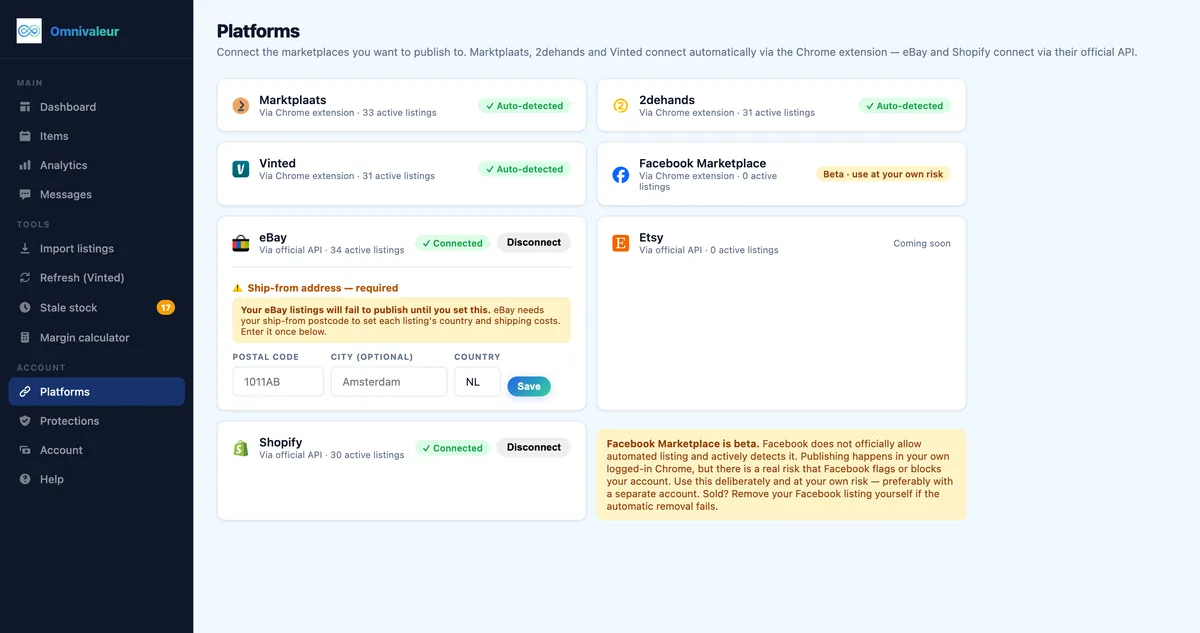
Omnivaleur publishes to seven channels from one intake form: Marktplaats, 2dehands, Vinted, eBay, Shopify, WooCommerce and Facebook Marketplace (beta). This allows a merchant to input an item once—complete with high-resolution photography, localized condition tags, dimensions, and weight tiers—and publish it across both domestic classified networks and international platforms without re-entering data.
Consider the practical workflow difference. Suppose you source a batch of vintage Scandinavian ceramics or designer leather bags. Selling these solely on Depop or Vinted limits your pool to casual buyers looking for budget fashion deals. By cross-listing that same piece to eBay, Marktplaats, and your personal Shopify store, you expose the product to local pickup buyers, international collectors, and direct webshop traffic. If you want to master this specific workflow between domestic sites, read our comprehensive guide on Marktplaats to 2dehands cross-listing.
Furthermore, running your own standalone storefront provides critical margin protection. Platforms like eBay and Vinted charge seller fees, buyer protection fees, or payment processing percentages that slice into your gross profits. Having the ability to route repeat customers to your independent WooCommerce or Shopify storefront while using marketplace listings as acquisition funnels is how European resellers build real equity. Resylr’s lack of direct e-commerce integration forces high-volume sellers to maintain two disjointed software setups.
How Do Sync Engines Prevent Account Bans and Shadowbans?
The single biggest fear of any professional reseller is waking up to an account suspension. When you manage active listings on Vinted, eBay, or Marktplaats, you operate on rented land. Marketplace security algorithms have advanced drastically. They no longer look just at IP addresses; they analyze browser fingerprints, DOM manipulation speeds, and request concurrency.
Many cross-listing tools attempt to speed up operations by triggering parallel background scripts. They launch automated scripts that inject data into five different browser tabs or send multiple API requests at the exact same millisecond. To platform security engines, this behavior immediately screams "automated bot." The result? Instant phone verification loops, shadowbans where your listings receive zero impressions, or outright account termination.
Cross-listing in Omnivaleur runs one browser tab at a time on purpose: parallel publishing is what gets marketplace accounts rate-limited. By processing tasks sequentially, the software mimics how an actual human operator works. It opens the designated platform tab, populates the fields, verifies image uploads, saves the listing state, and cleanly closes the task before progressing to the next channel. This controlled execution minimizes the risk of triggering behavioral anomaly detection systems.
Preventing double sales is another vital security component. If an item sells on Vinted at 2:00 PM while you are away from your packing desk, keeping that listing active on Marktplaats or eBay invites disaster. Canceling orders on eBay destroys your seller service metrics, quickly pushing your account into "Below Standard" status, which carries financial penalties and reduced search visibility. Using software with reliable multi-platform tracking helps you maintain a healthy account standing across every channel. For a deeper technical breakdown of mitigating this issue, review our strategies on how to avoid selling the same item twice.
- ✓evaluate where your actual inventory moves across different regions
- ✓check if your current software supports local domestic giants
- ✓calculate your monthly listing volume and potential labor hours saved
- ✓review your multi-platform tracking to prevent accidental double sales
- ✓verify your tax compliance records for european reporting standards
What Are the Pricing Models, Hidden Costs, and Real ROI?
Software expenses must be justified by cold, hard operational returns. When comparing Resylr against alternatives, you must calculate not just the monthly subscription cost, but also the listing limits, credit caps, and the labor hours recovered.
Listing software typically falls into one of two pricing structures: tier-capped credit models or flat-rate unlimited plans. Tier-capped models sound affordable when you list 20 items a month. However, once you scale to listing 200, 500, or 1,000 items, per-listing fees or tier upgrades quickly become an expensive tax on your growth.
Let us look at a realistic worked financial example for an active European reseller processing 150 items per month with an average selling price of €45 per item.
- Monthly Gross Revenue: 150 items × €45 = €6,750
- Manual Listing Time: Sourcing, photographing, and manually typing one listing across 3 platforms (e.g., Marktplaats, Vinted, eBay) takes approximately 12 minutes per item. For 150 items, that equals 1,800 minutes, or 30 full working hours spent solely on data entry.
- Automated Listing Time: Creating a centralized master listing and executing sequential multi-channel publishing takes approximately 3 minutes per item. For 150 items, that equals 450 minutes, or 7.5 working hours.
- Labor Hours Saved: 22.5 hours per month.
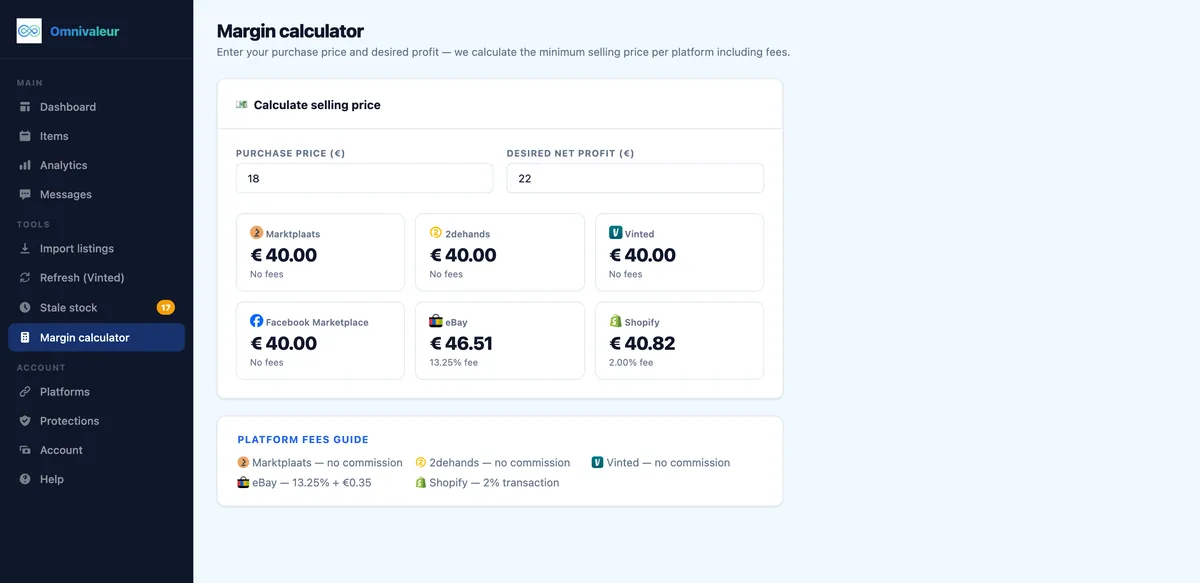
If you value your sourcing and operational time at a modest €25 per hour, saving 22.5 hours delivers an immediate monthly labor value return of €562.50. Against this benchmark, paying a predictable monthly software subscription of €30 to €60 represents an exceptionally high return on investment. The real financial drain occurs when your software fails to post to a platform where the item would have sold for 20% more, or when hidden listing fees erode your margin. If you sell heavily in the Netherlands, understanding domestic overhead is critical; read our breakdown of Marktplaats fees explained to ensure your unit economics stay firmly in the green.
How Do Tax Laws, DAC7, and Margin Scheme Rules Impact Reseller Software?
Operating a reselling business in the European Union in 2026 requires strict adherence to regulatory transparency. Two primary administrative frameworks govern how you run your business: the European Union's DAC7 directive and Margin Scheme VAT (Margeregeling in the Netherlands / Bijzondere regeling in Belgium).
Under the European Commission DAC7 directive, digital platforms operating within the EU are legally mandated to report seller data and transaction volumes to tax authorities. If you execute 30 or more transactions or generate over €2,000 in gross sales on any single platform within a calendar year, that platform reports your activity directly to your domestic revenue service, such as the Dutch Tax Administration (Belastingdienst DAC7 reporting). This rule applies across Vinted, eBay, Marktplaats, and 2dehands alike.
Many sellers make the catastrophic mistake of assuming that keeping their volume split across different tools hides their commercial activity. Tax authorities use integrated data-matching systems. Your cross-listing software must provide crystal-clear recordkeeping. Having a centralized repository of your inventory, purchase prices, listing dates, and actual sale prices is no longer just a productivity preference—it is your first line of defense during a tax audit.
Furthermore, professional resellers sourcing second-hand goods from private individuals operate under the VAT Margin Scheme. Under this rule, you do not pay standard 21% VAT on the entire sales price. Instead, you pay VAT only on the gross profit margin (the difference between the purchase price and the selling price). Understanding this tax structure is essential for accurate cash flow modeling; consult our full guide on Margin Scheme VAT for second-hand goods to structure your bookkeeping correctly.
When you expand to your own e-commerce shopfront via Shopify or WooCommerce, you must also respect standard EU consumer shopping rights, including mandatory 14-day return windows for commercial distance selling. A robust software engine lets you standardize descriptions, terms of service, and item condition declarations across both your private webshop and third-party marketplaces, ensuring total legal compliance across every jurisdiction.
What Is the Most Legitimate Reselling Stack for Beginners and High-Volume Sellers?
Resellers frequently ask foundational operational questions when restructuring their toolset. Let us address the most common concerns regarding legitimacy, legal structures, and software efficiency.
Is Reselling Stuff Illegal?
No, reselling items you legally purchase or own is entirely legal across Europe, the UK, and North America. Under the legal doctrine of exhaustion (first-sale doctrine in the US and EU trademark exhaustion principles), once an intellectual property owner sells a physical item within the European Economic Area, they exhaust their right to control the subsequent resale of that specific physical item.
However, reselling becomes illegal if you engage in specific unlawful practices: selling counterfeit or trademark-infringing goods, evading income tax or VAT, or failing to comply with consumer protection regulations. As long as you deal in authentic products, report your taxable income, and honor applicable consumer rights, reselling is a standard, fully legitimate commercial retail enterprise.
What Is the Most Legit Reselling Website?
There is no single "most legitimate" website; legitimacy depends on platform governance, buyer escrow systems, and seller protections. In 2026, the most reliable platforms for European merchants fall into specific categories:
- eBay: The global benchmark for collector protection, enterprise-grade seller tools, and international shipping integration through the Global Shipping Program / eBay International Shipping.
- Marktplaats & 2dehands: The premier domestic platforms for Benelux commerce, backed by integrated payment processing and localized buyer protection protocols.
- Vinted: The leading European marketplace for casual and vintage fashion, featuring mandatory escrow-style buyer protection that holds funds until delivery confirmation.
- Your Own Storefront (Shopify/WooCommerce): The ultimate legitimate channel. You own the customer relationship, set your own policies, pay no marketplace commissions, and build direct brand equity.
Do I Need a Business License to Resell?
In almost all European jurisdictions, the requirement to register as a business depends on intent rather than a fixed revenue threshold. If you occasionally sell personal clothing or clearing out your attic, you are categorized as a private seller. However, if you purchase items with the explicit intention of reselling them for a profit, tax authorities (such as the Dutch KVK or Belgian Crossroads Bank for Enterprises) classify you as an economic operator.
Once classified as an entrepreneur, you must obtain a business registration number, register for VAT (even if applying for small-business VAT exemptions like the Dutch KOR), and maintain proper double-entry accounting records. Starting clean with a registered business entity protects your personal assets and allows you to deduct software subscriptions, sourcing travel, packaging supplies, and equipment costs against your gross revenue.
What Is the Best Free Reseller App vs. a Paid Stack?
Beginners often search for free cross-listing solutions. While free smartphone apps and basic browser add-ons exist, they carry strict limitations. Free tools typically offer zero customer support, lack automated form mapping, cap your listings at 10 to 15 items, and often sell anonymized user sourcing data to third-party aggregators.
If you are testing the waters with fewer than 25 items in your wardrobe, free manual listing directly in native apps is the best approach. But the moment your active inventory exceeds 50 items, paying for professional automation software transitions from an "expense" to an indispensable business utility that buys back your time and prevents critical inventory sync errors.
Which Tool Should You Actually Choose for Your Business?
Choosing between Resylr and Omnivaleur comes down to an honest assessment of your business geography, your inventory niche, and your long-term growth channels.
Choose Resylr if:
- Your primary focus is the UK and French apparel market, with heavy reliance on platforms like Depop, Vestiaire Collective, and Poshmark.
- You do not sell on Benelux local classified platforms such as Marktplaats or 2dehands.
- You have no immediate plans to run a standalone, branded e-commerce store on Shopify or WooCommerce.
- Your product catalog consists almost exclusively of clothing, shoes, and lightweight accessories.
Choose Omnivaleur if:
- You operate in Continental Europe or target the Benelux region, where cross-listing from Marktplaats to Vinted, 2dehands, and eBay provides maximum sales velocity.
- You sell across varied categories, including vintage homeware, cameras, collectibles, electronics, and fashion.
- You run—or plan to launch—your own independent webshop using Shopify or WooCommerce to avoid high third-party commissions.
- You prioritize account safety via deliberate, sequential single-tab listing execution that protects your platform standing from anti-bot automation sweeps.
Scaling a modern reselling business requires treating your software stack like your packing station: it must be reliable, built for the specific items you handle, and structured to withstand heavy daily volume. Audit your sales channels from the past six months. Identify where your actual profits originated, calculate how many hours you lost to manual typing, and select the tool engineered for the platforms that drive your livelihood.
Frequently asked questions
Can I import my existing listings from Resylr into Omnivaleur?
How does sequential single-tab cross-listing protect my marketplace accounts?
Does cross-listing to multiple platforms complicate my DAC7 tax obligations?
Can I use Omnivaleur if I sell items that require local pickup rather than shipping?
What happens if an item sells on one platform while I am asleep?
Keep reading
Stop copying listings by hand
Omnivaleur publishes your item to every platform at once and syncs stock automatically when something sells.
Start free trial