How to Cross-List from Marktplaats to Etsy in 2026

Cross-listing from Marktplaats to Etsy expands a local Dutch customer base into a global market of vintage and craft buyers. To cross-list successfully, map eligible vintage inventory, recalculate pricing to cover international shipping and Etsy platform fees, and implement real-time inventory synchronization to eliminate double sales across platforms.
Key takeaways
- Etsy requires vintage goods to be at least 20 years old (2006 or earlier in 2026), excluding standard modern secondhand items listed on Marktplaats.
- Pricing strategies must reflect Etsy's higher transaction and processing fee structure compared to Marktplaats's classified model.
- Real-time inventory syncing protects seller metrics by immediately delisting items across channels when a local pickup or international sale occurs.
- Dutch tax authorities receive automated transaction data under EU DAC7 directives once a seller hits 30 sales or €2,000 in gross revenue on either platform.
Sourcing inventory in the Netherlands gives resellers access to a steady stream of mid-century design, European studio pottery, vintage Dutch industrial pieces, and rare collectibles. Selling these exclusively on Marktplaats keeps your customer pool limited to the Netherlands and Belgium. Cross-listing qualified items to Etsy unlocks a worldwide buyer pool willing to pay international market rates.
The operational models of these two platforms could not be more different. Marktplaats functions like a regional classifieds board built around direct communication, informal haggling, and cash or iDEAL settlement. Etsy operates as a curated global marketplace governed by strict search algorithms, automated payment processing, and mandatory seller performance metrics. Successfully moving inventory between them requires a clear understanding of catalog compliance, international logistics, fee structures, and inventory management.
Why Should You Sell on Both Marktplaats and Etsy?
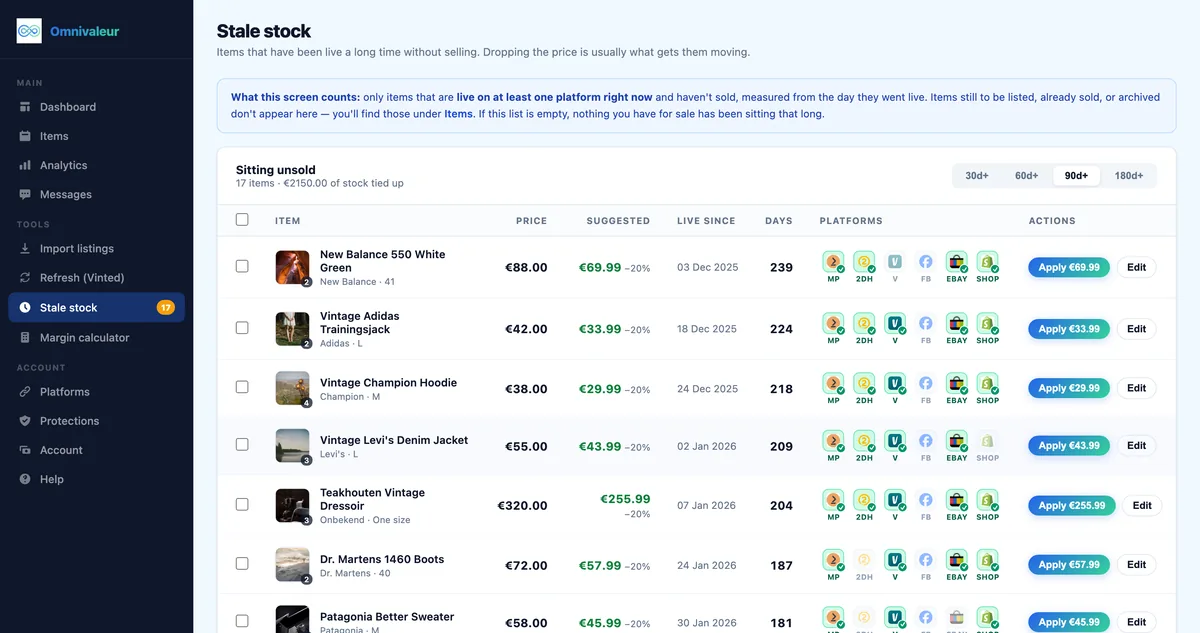
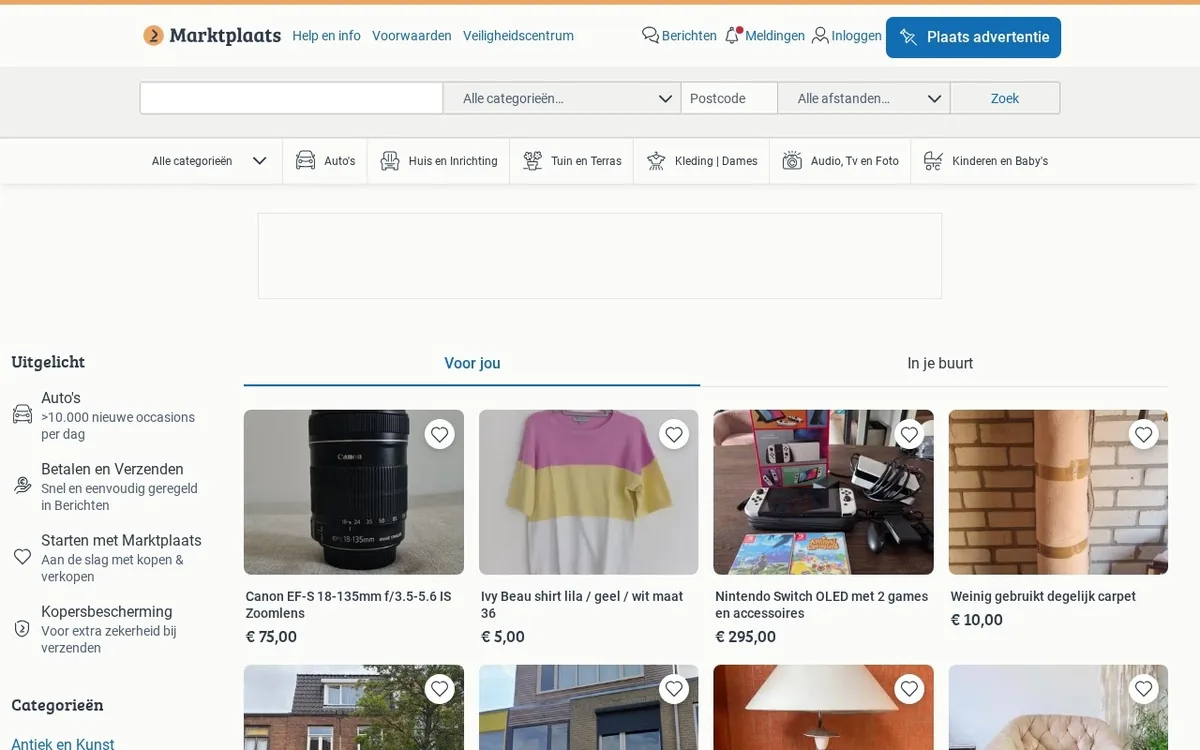
Marktplaats dominates the circular economy across the low countries. Millions of active Dutch and Flemish users browse the site daily, making it exceptional for fast cash flow, bulky items, and local buyers who prefer weekend collection. However, the domestic market has an inherent pricing ceiling. A Dutch shopper on Marktplaats frequently hunts for bargains, bargains aggressively through chat messages, and expects domestic shipping rates between €4.95 and €7.95 via PostNL or DHL.
Etsy changes the financial equation entirely. International collectors in the United States, the United Kingdom, Germany, and Japan routinely pay premium prices for authentic European goods. A vintage Brabantia postal scale might fetch €12 on Marktplaats after two weeks of lowball offers. That exact same scale listed on Etsy can sell for €55 to €75 to an interior designer in New York who appreciates mid-century industrial utility.
Listing on both platforms lets you balance turnover velocity with profit maximization. You test higher global valuations on Etsy while maintaining domestic liquidity on Marktplaats. If a piece takes longer to sell globally, your local listing remains active for regional buyers who want immediate delivery or local pickup. Running both channels simultaneously ensures your capital is never locked up in stagnant inventory.
Which Marktplaats Items Belong on Etsy?
Not everything listed on Marktplaats can or should be cross-listed to Etsy. Transferring your entire catalog without filtering will result in listing removals, fee waste, or outright account suspension. Etsy operates under strict catalog criteria laid out in the Etsy Seller Policy.
To qualify for Etsy, an item must fit into one of three specific buckets:
- Vintage Goods: The item must be at least 20 years old. In 2026, this means any manufactured item must date back to 2006 or earlier. Modern secondhand clothing from contemporary fast-fashion labels, recent electronic gadgets, and contemporary home goods are strictly banned.
- Handmade Items: Goods designed or produced directly by you. If you upcycle Marktplaats furniture, hand-restore vintage textiles, or craft original jewelry, these items qualify.
- Craft Supplies: Materials, tools, or ingredients specifically intended for use in the creation of a new finished product or for repairing vintage pieces.
Understanding these boundaries keeps your shop in good standing. Below is a breakdown of common Marktplaats categories and whether they translate safely to Etsy:
| Marktplaats Category | Etsy Eligibility | Resale Viability & Notes |
|---|---|---|
| Antiek en Kunst (Art & Antiques) | Fully Eligible | High demand. Dutch delftware, oil paintings, and Art Deco decorative objects command high premiums abroad. |
| Vintage Design Meubels (Furniture) | Eligible (if pre-2006) | High profit margins, but international crating and freight costs require calculated shipping profiles. |
| Modern Electronics (Audio, Phones) | Ineligible (unless 20+ years old) | Modern electronics violate Etsy policy. Vintage analog synthesizers, walkmans, and tube amps qualify. |
| Secondhand High-Street Clothing | Ineligible | Contemporary apparel belongs on local platforms. Only true vintage garments (Y2K and older) qualify for Etsy. |
| Verzamelen (Collectibles & Militaria) | Conditional | Eligible if vintage, but watch Etsy’s prohibited items list regarding real weapons, ivory, and sensitive historical militaria. |
| Auto-onderdelen (Car Parts) | Generally Ineligible | Modern auto accessories are banned. Rare vintage hood ornaments or classic car manuals (20+ years) pass as vintage ephemera. |
Before moving an item, verify its age. Document marks, stamps, tags, and patent numbers in your listing photos so Etsy’s automated audit filters do not flag your vintage items as mass-produced modern stock.
How Do Fees Compare Between Marktplaats and Etsy in 2026?
The economic models of the two platforms dictate completely different pricing tactics. While Marktplaats remains largely a low-fee, classifieds-driven environment, Etsy functions on a fee-per-event structure. For a granular analysis of domestic costs, review our guide on Marktplaats fees explained.
When selling on Etsy, fees accumulate at multiple stages of the transaction: listing, conversion, payment clearing, and off-site marketing. Understanding these deductions protects your net margin when establishing cross-channel pricing.
| Fee Type | Marktplaats (Standard Private/Pro) | Etsy (Netherlands-Based Seller) |
|---|---|---|
| Listing Fee | Free in most consumer categories (paid in Autos, Services, select Pro tiers) | $0.20 USD (approx. €0.19 EUR) per listing for a 4-month period or until sold |
| Transaction Fee | 0% standard classified sale | 6.5% of the total transaction value (item price + shipping charge) |
| Payment Processing | €0.40 per iDEAL payment request (via Online Betalen platform) | 4.0% + €0.30 per completed transaction for Dutch bank accounts |
| Regulatory Operating Fee | None | 0.32% on the total order value for sellers based in the Netherlands |
| Offsite Ads Fee | None (internal top-ad boosts optional) | 15% (optional for shops under $10,000 USD/year; mandatory 12% if over $10,000 USD) |
| Buyer Protection Fee | 4.5% + €0.40 (paid by the buyer, not the seller) | Included in seller transaction charges via Etsy Purchase Protection |
A Worked Example: Selling a €100 Vintage Item
Let us look at the actual numbers. Suppose you source a 1970s Dutch Raak lighting fixture for €25 at a flea market. You list it on Marktplaats for €100 with domestic shipping. A local buyer pays via an integrated payment link.
- Sale Price: €100.00
- Marktplaats Payment Link Fee: €0.40
- Domestic Shipping: Paid directly by buyer
- Your Net Profit on Marktplaats: €74.60 (€100 - €25 purchase - €0.40)
Now consider listing that exact lighting fixture on Etsy. Because it appeals to international collectors, you price it at €150 to reflect its global value, charging €35 for tracked shipping to the United States.
- Gross Income (Item + Shipping): €185.00
- Etsy Listing Fee: €0.19
- Transaction Fee (6.5% of €185.00): €12.03
- Payment Processing Fee (4% of €185.00 + €0.30): €7.70
- Regulatory Operating Fee (0.32% of €185.00): €0.59
- Actual PostNL International Tracked Shipping Cost: €32.50
- Your Net Profit on Etsy: €107.99 (€185.00 gross - €25 sourcing - €32.50 shipping - €20.51 Etsy fees - €0.19 listing)
Even though Etsy’s fees appear high at first glance, the global market value allows you to bank €33.39 more net profit on the exact same item. To dial in your margins across channels, use our proven playbook on how to price second-hand items.
How Does Inventory Sync Prevent Selling the Same Item Twice?
Operating across multiple platforms without unified inventory tracking is a recipe for operational failure. In a one-of-a-kind vintage business, double sales are catastrophic. If a Dutch buyer pays for a mid-century ceramic vase on Marktplaats and arranges Saturday collection, but an overseas customer buys the same item on Etsy two hours later, one party will be disappointed.
Canceling an Etsy order damages your shop standing. Etsy monitors cancellation rates, order defect rates, and dispatch timelines through its automated Service Level Standards. High cancellation percentages due to missing inventory will strip away your Star Seller badge and suppress your listings in Etsy search results. Repeated stockouts can lead to permanent account termination.
Manual delisting is slow and unreliable. Resellers cannot monitor their phones 24 hours a day to take down listings manually across time zones. When it is 3:00 AM in Amsterdam, shoppers in California and Sydney are actively browsing.
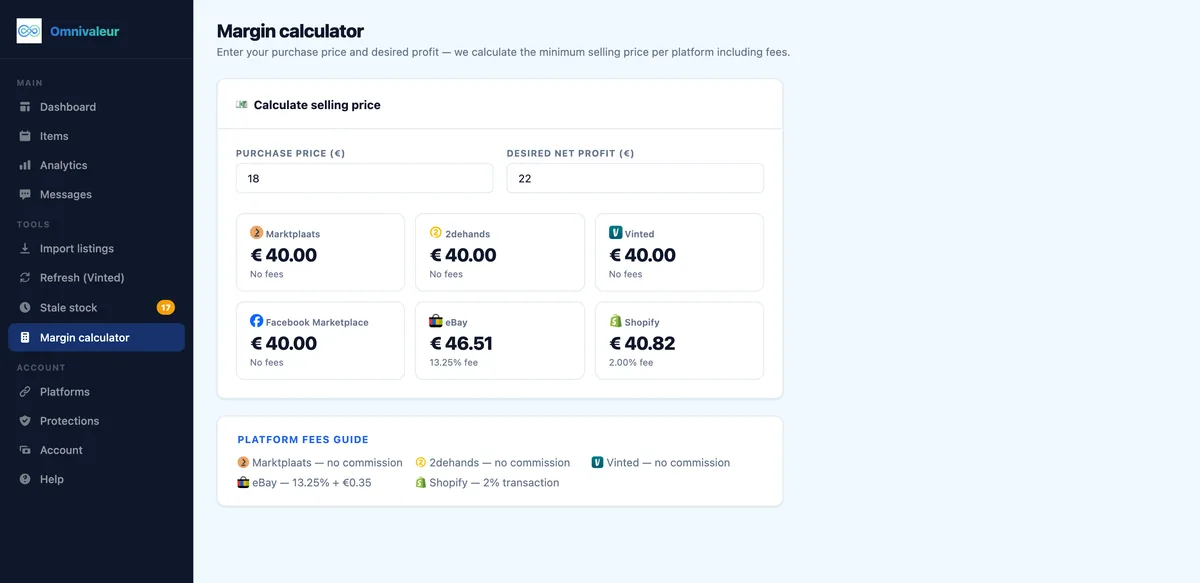
Modern cross-listing tools solve this through automated listing state tracking. A single item in Omnivaleur typically carries 3-5 active listings at once; the app tracks each platform's status separately. When an item is marked as sold on one channel, the central engine instantly updates inventory levels across all connected channels. Understanding these mechanics is essential for high-volume operations; read our detailed analysis on how to avoid selling the same item twice.
How Should You Handle Global Shipping from the Netherlands?
Shipping is the operational divide between Marktplaats and Etsy. On Marktplaats, shipping is dead simple. You create a PostNL or DHL parcel label through the Marktplaats app, drop the package at a neighborhood parcel point, and the integrated track-and-trace code updates the buyer automatically. The package travels within the Netherlands or to Belgium within 24 to 48 hours without customs paperwork.
Etsy requires an international export strategy. Your packages will clear customs, navigate air transit, and pass into foreign domestic postal networks like USPS, Royal Mail, or Canada Post.
Packaging and Transit Times
International parcels endure rough mechanical sorting and pressurized cargo holds. Double-boxing fragile ceramics, wrapping glassware in generous layers of honeycomb paper or bubble wrap, and reinforcing corners with heavy-duty kraft tape are mandatory practices. Factor transit time into your Etsy shipping profiles. A PostNL standard international parcel takes 5 to 12 business days to reach major US metropolitan centers, but rural areas or holiday customs backlogs can stretch this to 20 days. Under-promising and over-delivering on delivery windows prevents unwarranted customer claims.
Customs Documentation and HS Tariff Codes
Every shipment sent outside the European Union requires a CN22 or CN23 customs declaration. PostNL lets you generate these digitally via their business portal or retail counter terminals. You must include:
- An accurate description of contents (write "Vintage decorative ceramic bowl, 1978" rather than generic "Gift" or "Home decor").
- The exact sale value in euros. Undervaluing goods to help the buyer dodge import duties violates international trade law and invalidates insurance coverage.
- The precise Harmonized System (HS) tariff code. For example, antique works of art over 100 years old use code 9706.00, while vintage ceramic tableware falls under 6912.00. Incorrect HS codes result in border processing delays or unexpected customs clearance fees for your buyer.
European Packaging Compliance (EPR and LUCID)
Cross-listing to European buyers on Etsy brings legal obligations under Extended Producer Responsibility (EPR) regulations. When shipping packages to Germany, Dutch sellers must register with the German LUCID packaging register and license their carton and filling materials through a dual system partner. France enforces similar EPR registration for packaging and textile goods. Failure to comply can result in Etsy restricting your shop from receiving orders placed by buyers in those countries.
What Are the Real Differences in Search Discovery and SEO?
The mechanics of how buyers find your items diverge significantly between these two platforms. Marktplaats operates on a recency-biased classified search engine, whereas Etsy runs a multi-layered semantic algorithm called Etsy Search.
Marktplaats Search Behavior
Marktplaats discovery is heavily chronological. When you publish an item, it sits at the absolute top of search results for its chosen category. Over the next 48 hours, newer listings push your item down the results list. While keyword matching matters, discovery on Marktplaats is driven by:
- Frequent relisting or paid bumps to maintain page-one visibility.
- Broad titles containing high-frequency Dutch search terms (e.g., "Vintage design lamp jaren 70 space age").
- Geographic filtering, as many buyers limit searches to a 10 km to 25 km radius around their postal code for easy pickup.
Etsy Search Engine Optimization (Etsy Search)
Etsy does not operate chronologically. A listing created eight months ago can consistently outrank an item published ten minutes ago. Etsy's ranking process evaluates multiple distinct layers:
- Query Matching: Etsy examines your listing title, 13 tag slots, category attributes, and the initial lines of your description. Every single tag should use multi-word phrases that real shoppers type (long-tail keywords like "mid century desk lamp" instead of single words like "lamp").
- Listing Quality Score: The algorithm tracks how users interact with your listing when it appears in search. If your listing boasts a high click-through rate (CTR), strong favoriting rate, and consistent conversions, Etsy pushes it higher across search terms.
- Shop Health and Customer Service: Shops maintaining 5-star reviews, transparent return policies, and on-time dispatches receive algorithmic preference.
- Contextual Relevance: Etsy personalizes results based on a shopper's past browsing patterns, geographic location, and local shipping competitiveness.
When cross-listing, you cannot simply copy and paste short, conversational Marktplaats descriptions into Etsy. A Marktplaats title like "Mooie oude lamp zgan ophalen" must be transformed for Etsy into "Vintage 1970s Industrial Desk Lamp, Mid Century Dutch Task Light, Adjustable Bauhaus Counterbalance Office Lamp" to capture international search queries.
What Are the 2026 Tax and DAC7 Compliance Rules for Dutch Resellers?
Selling across both Marktplaats and Etsy places your operations directly under European Union transparency directives. Under the EU DAC7 framework, both platforms are legally mandated to gather, verify, and transmit seller identification and financial data to tax authorities. Detailed Dutch requirements are maintained directly by the Belastingdienst DAC7 portal, with broader European frameworks outlined by the European Commission DAC7 overview.
The automatic reporting trigger applies equally across Marktplaats and Etsy if, within a single calendar year on a single platform, you achieve either of the following:
- Complete 30 or more transactions of goods.
- Generate €2,000 or more in gross sales revenue (before deductions of platform fees and shipping costs).
Once you cross either threshold on Marktplaats or Etsy, the platform will request your Citizen Service Number (BSN) or your Chamber of Commerce (KVK) commercial registration number, along with your verified bank details. This information is shared annually with the Dutch Belastingdienst.
Triggering DAC7 does not automatically mean you owe income tax or value-added tax (BTW). If you periodically sell items from your personal household at a loss compared to their original purchase prices, that activity is classified as private wealth management and remains non-taxable. However, if you purchase items at flea markets, thrift stores, or estate sales with the clear intention of reselling them for a profit, the Belastingdienst classifies your earnings as taxable business profit or taxable income from other work (resultaat uit overige werkzaamheden). Sellers scaling their cross-listing should review our comprehensive guide on DAC7 reporting rules.
The VAT Margin Scheme (Margeregeling)
Professional vintage resellers in the Netherlands utilize the VAT Margin Scheme (Margeregeling). Under this rule, you do not calculate 21% VAT on the entire selling price of second-hand goods sourced without VAT. Instead, you only remit 21% VAT on your gross profit margin (the difference between the acquisition cost and the final selling price). When setting prices on Etsy, ensure your accounting software properly segregates margin-scheme items from standard VAT goods to maintain compliant reporting.
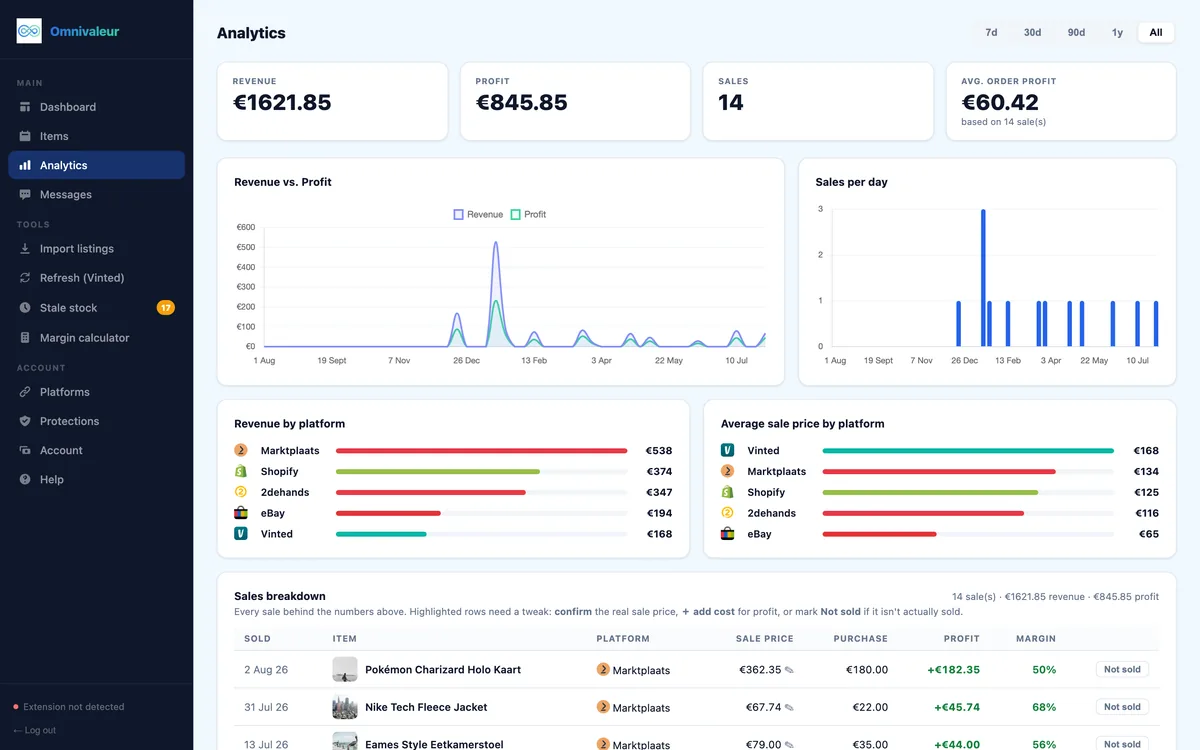
- ✓Check that your item is at least twenty years old for etsy
- ✓Photograph marks and maker tags to prove the item is vintage
- ✓Calculate a higher international price to cover export and platform fees
- ✓Set up shipping profiles that account for longer overseas transit times
- ✓Add the right hs tariff code to digital customs forms for postnl
- ✓Remove the item immediately on the other channel once it sells
What Cross-Listing Workflow Saves Resellers the Most Time?
Manual data entry across platforms kills hourly profitability. Creating a listing on Marktplaats, re-uploading the images to Etsy, manually rewriting title keywords, filling out Etsy's 13 tag boxes, and setting up international shipping profiles can consume 15 minutes per item. If you process 50 items a week, that equates to over 12 hours of purely administrative computer work.
An efficient cross-listing setup follows an optimized staging workflow:
- Source and Catalog: Photograph items against a clean, neutral background using a consistent aspect ratio (4:3 or square). High-resolution images benefit both Etsy's zoom function and Marktplaats desktop viewers. Measure dimensions and weight immediately during staging.
- Initial Master Listing: Build the primary item profile. Include vital metadata: year of manufacture, materials, brand or studio marks, flaws, and packaged weight.
- Category and Attribute Mapping: Map the product to Marktplaats categories (for example, Antiek en Kunst > Design meubels) and connect it simultaneously to Etsy’s granular taxonomy (e.g., Home & Living > Lighting > Table Lamps).
- Pricing Rules: Apply dynamic markups. Your cross-listing system should automatically calculate a higher base price on Etsy to cover platform overhead and currency exchange buffers, while keeping the Marktplaats listing set to a competitive local figure.
- Publish and Synchronize: Push listings across both channels simultaneously. A centralized inventory engine tracks the active status on each site. If a buyer snaps up the piece on Marktplaats, the tool automatically removes or marks the listing as sold on Etsy.
Resellers who run high-volume businesses also frequently expand beyond these two portals, routing stock simultaneously to platforms covered in our Marktplaats to eBay crosslisting guide.
Which Cross-Listing Tool Fits European Marketplaces in 2026?
Many cross-listing apps were engineered exclusively for the North American market, prioritizing platforms like Poshmark, Mercari, and Depop. European sellers operating from the Netherlands need direct integrations with continental platforms like Marktplaats, 2dehands, and Vinted, alongside global engines like Etsy and eBay.
Several software options exist for managing cross-channel listings:
- Sell The Flip: A platform focused primarily on US marketplace integrations. While it manages general inventory well, it lacks native integration with Dutch classified networks like Marktplaats.
- List Perfectly: A longstanding catalog manager popular with American clothing resellers. It requires running desktop browser sessions to facilitate manual listing transfers, but it does not support Marktplaats automation.
- Vendoo: A polished multi-channel tool offering inventory metrics and background delisting for US marketplaces. However, it does not support native European platforms like Marktplaats or 2dehands, limiting its utility for Benelux-based sellers.
- Crosslist: A web-based tool that supports listing form population on select European and US platforms. For a head-to-head comparison of features and execution, read our analysis of Omnivaleur vs Crosslist.
- Omnivaleur: Engineered specifically for European and cross-border sellers. It bridges domestic platforms (Marktplaats, 2dehands, Vinted) with global marketplaces (Etsy, eBay, Shopify, WooCommerce) while maintaining synchronized stock counts.
Platform security remains an essential factor when picking software. Aggressive automation scripts that flood marketplaces with rapid requests run the risk of account restrictions. Omnivaleur's Vinted refresh tool caps itself at 8 free refreshes per day and states outright that no tool can guarantee a marketplace won't flag an account. Operating within safe, human-paced automation boundaries protects your seller standing across every connected channel.
What Are the Best Practices for Managing Returns and Buyer Protection?
Cross-listing items across borders creates divergent buyer protection frameworks that sellers must navigate professionally. The rules governing a dispute on Marktplaats differ entirely from an Etsy case.
On Marktplaats, transactions between private individuals are governed by standard civil contract rules. If you sell as a consumer, you are not legally required to accept returns simply because the buyer experienced change-of-mind. However, if the buyer used the integrated Kopersbescherming (Buyer Protection) feature, Marktplaats's escrow service holds funds until the customer confirms receipt. If an item arrives broken due to inadequate packaging, the buyer protection team can step in and reverse payment if the seller cannot prove proper transit packaging.
Etsy operates under strict consumer regulations. If you operate an Etsy shop as a registered business entity selling to European Union consumers, you are legally bound by EU Distance Selling directives, which provide buyers a statutory 14-day right of withdrawal. These rights are detailed under the official Your Europe consumer rights framework. You must clearly post your return policy, contact details, and registered address on your shop storefront.
For international buyers in the US or Canada, the statutory EU 14-day return rule does not apply automatically unless you choose to accept international returns in your shop settings. However, all Etsy buyers are protected by the Etsy Purchase Protection program. If an order under $250 USD is lost in transit or arrives damaged, Etsy will cover the buyer refund without penalizing your account balance, provided you dispatched the parcel on time with valid tracking and proof of shipping.
Document every step of your fulfillment process. Keep track-and-trace receipts, take photos of packages showing legible address and customs declarations, and always archive weight receipts provided at the PostNL counter. This documentation serves as indisputable evidence in the rare event of a platform dispute.
Frequently asked questions
Can I use the exact same photos on both Marktplaats and Etsy?
How do I handle language barriers when cross-listing Dutch descriptions to Etsy?
What happens if an item sells locally on Marktplaats for cash?
Do I need a registered KVK number to sell on both Marktplaats and Etsy?
Can I cross-list handmade items from Marktplaats to Etsy?
Keep reading


Stop copying listings by hand
Omnivaleur publishes your item to every platform at once and syncs stock automatically when something sells.
Start free trial