2dehands to Etsy Crosslisting in 2026: The Complete Guide

Cross-listing from 2dehands to Etsy means republishing the same item on both platforms, but only if it fits Etsy's rules: handmade, vintage (20+ years old), or craft supplies. General secondhand goods on 2dehands — furniture, electronics, kids' clothes — usually don't qualify for Etsy without a rewrite of the listing category and description.
Key takeaways
- Etsy only accepts handmade, genuinely vintage (20+ years), or craft supply items, so not every 2dehands listing transfers over
- 2dehands is largely local-pickup while Etsy expects shipping profiles and often buyers abroad, which changes your cost math
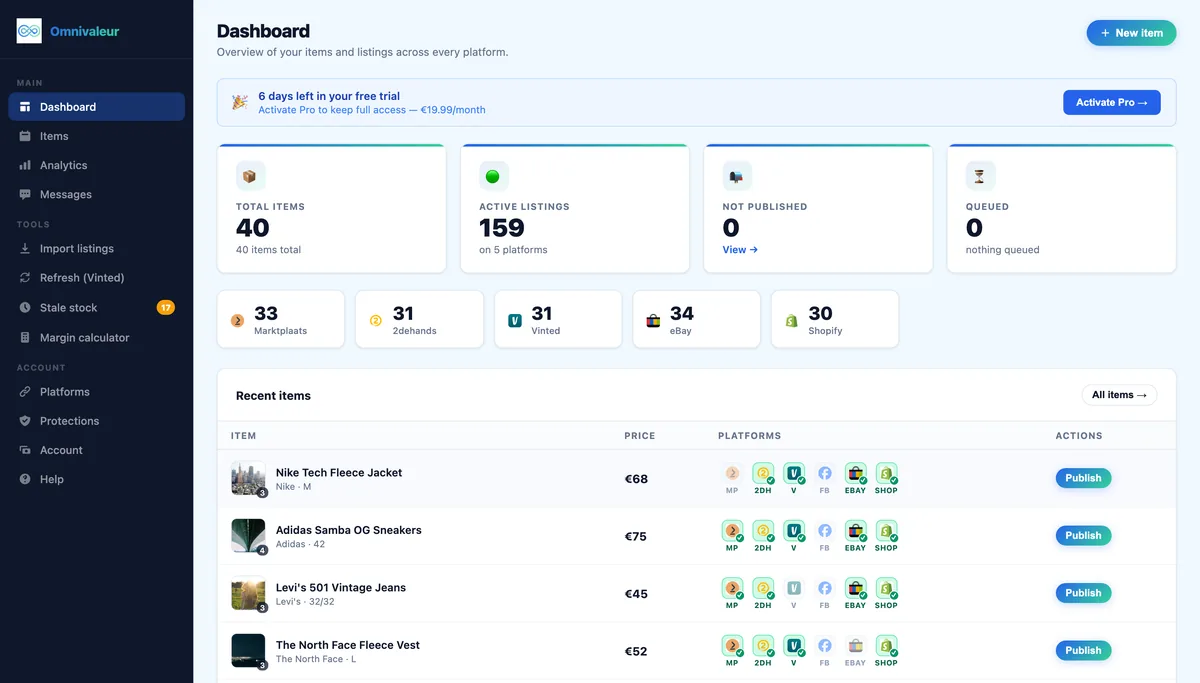
- A single cross-listed item typically runs 3-5 active listings at once inside Omnivaleur, with per-platform status tracked separately
- DAC7 reporting can apply once you cross a transaction or income threshold, even when selling across two different marketplaces
- Etsy charges a 0.20 USD listing fee plus transaction and payment fees on top of whatever 2dehands charges you (usually nothing)
2dehands and Etsy sit at opposite ends of the resale spectrum. One is a Belgian classifieds board where a fridge and a football card get the same treatment. The other is a curated marketplace with strict content rules and buyers who expect a story, not just a price. Cross-listing between them works, but only for a slice of what you actually sell on 2dehands.
Why would you cross-list from 2dehands to Etsy in the first place?
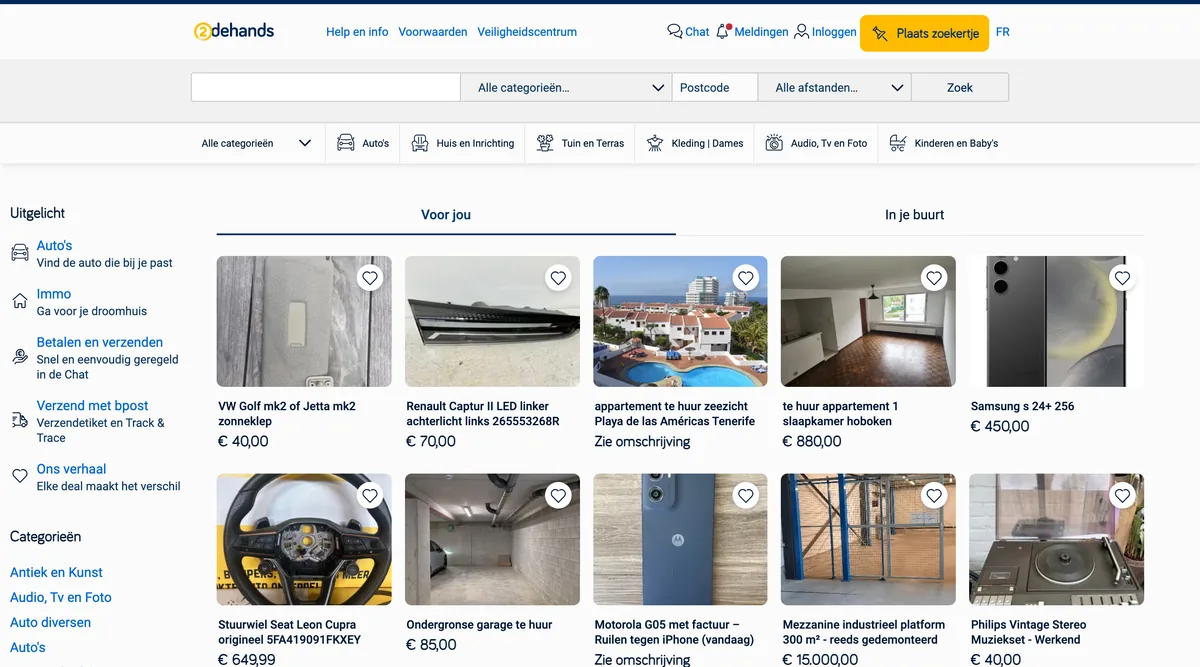
Most 2dehands sellers move to Etsy for one reason: reach. 2dehands traffic is almost entirely Belgian and Dutch-speaking, local, and price-sensitive. Etsy pulls in buyers from the US, UK, Germany, and beyond, many of whom will pay a premium for vintage or handmade goods they can't find locally. If you're sitting on genuinely old furniture, vintage textiles, handmade ceramics, or craft supplies that move slowly on 2dehands because the local buyer pool is small, Etsy widens that pool considerably.
The catch is that Etsy isn't a general marketplace. It enforces content rules that 2dehands simply doesn't have. A used lawnmower, a kids' bike, a stack of secondhand paperbacks in Dutch — none of that belongs on Etsy, and Etsy's own seller policy is explicit about what gets flagged or removed. Before you cross-list anything, run it through that filter first.
Which 2dehands items are Etsy actually allowed to sell in 2026?
Etsy still enforces three categories in 2026, unchanged from prior years but more strictly moderated after several rounds of anti-reseller crackdowns: handmade goods, vintage items aged 20 years or more, and craft supplies. That third bucket — craft supplies — is the one most 2dehands sellers overlook. Fabric remnants, buttons, vintage sewing patterns, leftover yarn, or tools for crafting all qualify, and they're often sitting unsold on 2dehands precisely because local demand for niche craft materials is thin.
Here's the practical breakdown:
| 2dehands category | Etsy-eligible? | Notes |
|---|---|---|
| Vintage furniture (pre-2006) | Yes | Must genuinely be 20+ years old, not just "retro style" |
| Handmade jewelry or ceramics | Yes | You must be the maker, or clearly label it as a curated vintage find |
| Modern electronics, appliances | No | Etsy will remove these; not vintage, not handmade |
| Craft supplies, fabric, buttons | Yes | Underused category, low competition on 2dehands, decent margin on Etsy |
| Kids' clothing, toys (modern) | No | Unless clearly vintage (20+ years) with proof |
| Vintage clothing, accessories | Yes | Overlaps heavily with what already sells on Vinted |
If a big chunk of your 2dehands inventory is vintage furniture or collectible items, it's worth reading our dedicated notes on vintage furniture reselling automation and on collectibles reselling automation, since both cover Etsy-specific photo and description conventions in more depth than a general cross-listing guide can.
What are the real costs of listing on both platforms at once?
2dehands listings are free for private sellers, with paid boosts optional. Etsy is never free. Every listing costs 0.20 USD to publish (renews every four months or on sale), plus a 6.5% transaction fee and a payment processing fee that varies by country — typically around 4% plus a fixed amount per order for EU sellers. Add currency conversion if you're pricing in EUR but a US buyer pays in USD.
Run the numbers on a €45 vintage item. On 2dehands, you keep close to the full amount minus any optional boost fee. On Etsy, after the 0.20 listing fee, 6.5% transaction fee (~€2.93), and roughly 4% + €0.25 payment processing (~€2.05), you net closer to €39.60 before shipping costs. That's not a reason to avoid Etsy — a Belgian antiques dealer paying €15 for the same item locally would never match Etsy's US buyer pricing — but it changes how you should price a cross-listed item versus how you'd price it purely for the 2dehands audience.
One detail people miss: Etsy fees renew per listing, per sale, regardless of what happens on 2dehands. If the item sells on 2dehands first, you still owe Etsy nothing until it sells there too — but you do need to pull the Etsy listing fast, or you risk a double sale. That's the exact problem cross-listing software is built to solve.
How do shipping and pickup rules differ between 2dehands and Etsy?
2dehands defaults to local pickup. Most listings never touch a shipping label. Etsy assumes the opposite: buyers expect a shipping profile with a price, a processing time, and often international options. If you're used to writing "pickup only, Antwerp area" on 2dehands, you'll need to rebuild that entire section for Etsy — carrier, weight, package dimensions, and estimated delivery windows per country.
This is where a lot of cross-listing attempts stall. Sellers copy the photos and title over to Etsy but forget the shipping profile, and the listing sits invisible in Etsy's search because incomplete listings rank poorly. If you've already built a shipping workflow for another platform combo, the logic largely transfers — our Marktplaats to Etsy crosslisting guide walks through the same shipping-profile setup in more detail, since Marktplaats and 2dehands share the same parent company and near-identical listing structure.
Weight matters more on Etsy than on 2dehands too. A heavy vintage side table that costs nothing to hand over locally can cost €60-90 to ship internationally. Factor that into your Etsy price before you list, not after the first order comes in.
Does DAC7 tax reporting apply when you cross-list to Etsy?
Yes, and this catches casual sellers off guard. Under DAC7 rules, online marketplaces across the EU — including Etsy — must report seller activity to tax authorities once you hit 30 transactions or €2,000 in sales within a calendar year, whichever comes first. Etsy reports its side; 2dehands has its own reporting obligations under the same regulation, detailed in its help center.
The threshold is per platform, not combined, which sounds like good news until you realize it means your total resale income across 2dehands and Etsy can be reported twice, from two different marketplaces, to the same tax office. Keep your own running total across both platforms rather than assuming neither will flag you. If you're also active on other EU marketplaces, the same logic applies — check the general EU consumer and seller rights overview for how this interacts with buyer protections too, since Etsy and 2dehands handle returns and disputes differently.
How does Omnivaleur handle 2dehands to Etsy cross-listing automatically?
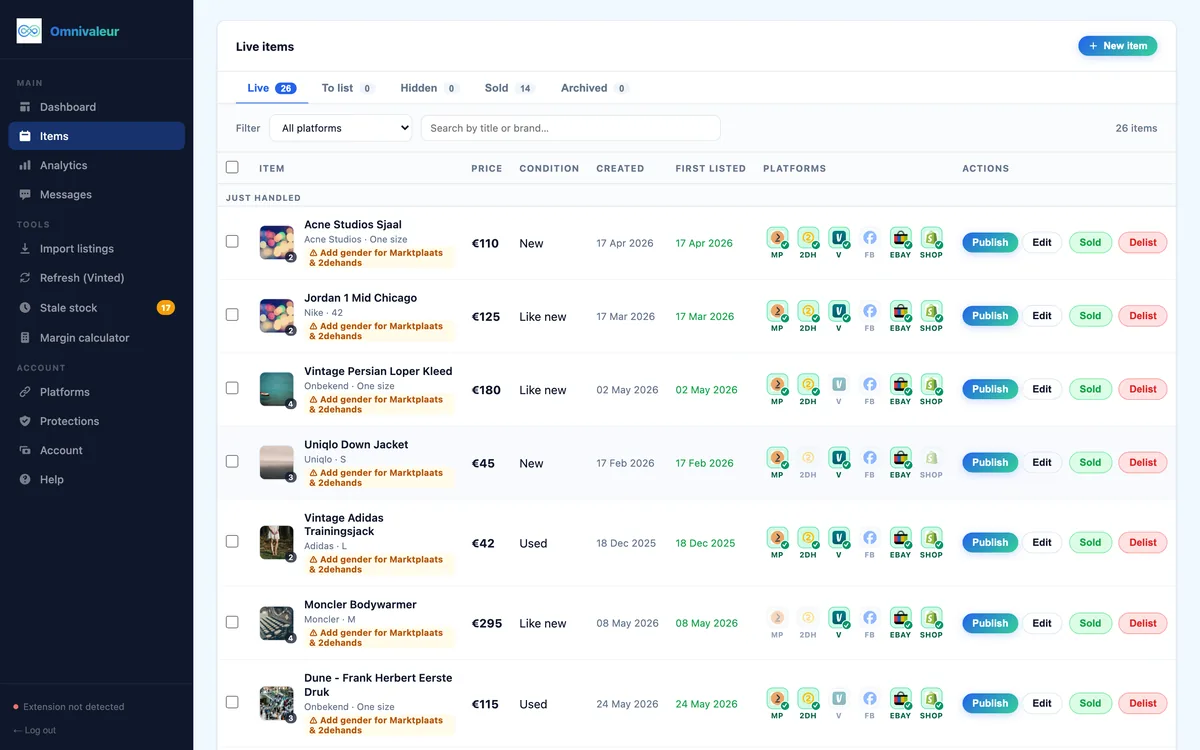
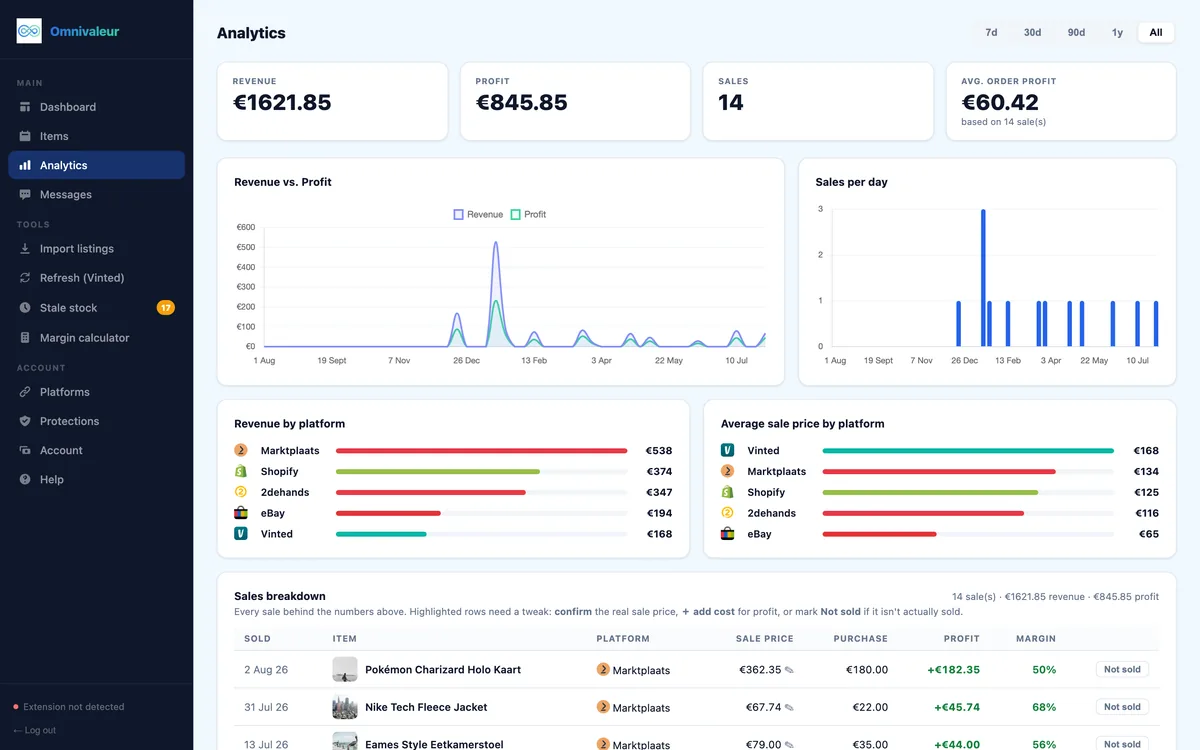
Manually rebuilding a listing for Etsy — new category, new shipping profile, new tags, new fee math — takes 10-15 minutes per item if you do it carefully. Omnivaleur cuts that down by pulling the photos, price, and description from your 2dehands listing and mapping them into Etsy's required fields, flagging anything that doesn't fit Etsy's category rules before you publish rather than after Etsy removes it.
Under the hood, each item you manage typically carries between 3 and 5 active listings at once — 2dehands, Etsy, and whichever other platforms you're running, like Vinted or eBay. Omnivaleur tracks the status of each one separately, so when the item sells on 2dehands, the Etsy listing gets pulled (or marked sold) automatically instead of sitting live and inviting a second buyer.
If you're managing a Vinted-heavy inventory alongside 2dehands and want the refresh mechanics that keep listings visible without tripping platform limits, it's worth knowing that Omnivaleur's Vinted refresh tool caps itself at 8 free refreshes per day, and the tool is upfront that no automation can promise a marketplace won't flag an account for aggressive refreshing. That same caution applies to Etsy: automation speeds up the boring parts, but it doesn't override a platform's own moderation.
For sellers running the reverse combo, our 2dehands to Vinted crosslisting guide and 2dehands to eBay crosslisting guide cover the platform-specific quirks for those destinations, which differ from Etsy's handmade/vintage restrictions in almost every respect.
What mistakes do resellers make when moving from 2dehands to Etsy?
The most common one: listing something that isn't actually vintage. "Vintage-style" or "retro-look" furniture bought new five years ago gets removed by Etsy's moderation team, and repeated violations can get an account suspended. Etsy checks age claims more actively in 2026 than it did a few years back, partly in response to reseller complaints about the marketplace filling up with mislabeled modern goods.
A second mistake is pricing the Etsy listing the same as the 2dehands one. Given the fee stack — listing fee, transaction fee, payment processing, plus shipping the 2dehands version never needed — a straight price copy usually means you're losing money on every Etsy sale. Build the fees into the price before publishing, not as an afterthought.
Third: forgetting tags and category depth. 2dehands search is forgiving; a vague title still surfaces in local search. Etsy's search algorithm rewards specific, keyword-rich titles and thirteen filled tag slots. A listing titled "Old lamp" on 2dehands needs to become something like "Mid-Century Danish Teak Table Lamp, 1960s Vintage Lighting" on Etsy, with matching tags, or it simply won't surface for buyers searching those terms.
Finally, sellers running multiple platforms at once — 2dehands, Vinted, Etsy, sometimes Shopify too — often lose track of which listing is live where. That's less a strategy problem than a spreadsheet problem, and it's exactly what tools built for this compare on: our Omnivaleur vs Vendoo comparison breaks down how different cross-listing platforms handle that sync challenge across marketplace combos like this one.
Is it worth automating this combo, or should you just do it manually?
If you're moving one or two vintage pieces a month, manual cross-listing is fine. Copy the photos, rewrite the description for Etsy's audience, set a shipping profile, done. The math changes once you're running 20+ dual-listed items, because the manual overhead is category checking, fee recalculation, shipping profile setup, and sold-item cleanup — repeated every single time, across two platforms with completely different rules.
Automation earns its keep at that volume, not because it writes better descriptions than you would, but because it stops the two most expensive mistakes: selling the same item twice, and listing something Etsy will remove anyway. Both cost real time and, in Etsy's case, can cost account standing too.
Frequently asked questions
Can I sell the exact same photos on 2dehands and Etsy without editing them?
Does Etsy allow Belgian sellers without a registered business?
What happens if an item sells on both 2dehands and Etsy at the same time?
Can craft supplies from 2dehands realistically sell on Etsy?
Do I need separate Etsy and 2dehands accounts, or can I link them?
Keep reading



Stop copying listings by hand
Omnivaleur publishes your item to every platform at once and syncs stock automatically when something sells.
Start free trial