How Many Listings Do You Need to Make Sales in 2026?

To generate consistent daily sales, most second-hand resellers need between 150 and 250 active listings, maintaining a 0.5% to 1% daily sell-through rate. While 30 to 50 listings can trigger sporadic weekly sales, daily revenue requires constant replenishment, active cross-listing across multiple marketplaces, and weeding out stagnant inventory.
Key takeaways
- Sporadic sales start around 30 to 50 active items, but reliable daily income requires a rolling catalog of 150 to 300 quality listings.
- Your daily sales volume depends strictly on your sell-through rate, which typically sits between 0.5% and 1.5% for general second-hand merchandise.
- Cross-listing multiplies your digital footprint so that 100 physical items generate 300 to 500 active channel listings without buying more stock.
- Listing frequency matters as much as total volume because platform search algorithms prioritize active sellers who publish fresh inventory daily.
- Exceeding 30 sales or €2,000 in gross revenue triggers mandatory DAC7 platform reporting across all European marketplaces.
How Many Listings Do You Actually Need to Make Your First Sale?
You can make your first sale with a single listing. If you list a pristine pair of Salomon XT-6 sneakers or a vintage Bauhaus lamp priced 20% below market value, it will often sell within hours. But one lucky transaction does not build a sustainable reselling business. Beginners constantly ask: how many listings do you need to make sales consistently?
The baseline reality for European resellers working across platforms like Vinted, Marktplaats, eBay, and Etsy is grounded in mathematical probability. If your shop contains fewer than 30 active items, you sit squarely in the dead zone. At this stage, your catalog lacks the depth required to feed marketplace recommendation engines, your store generates almost no organic search impressions, and buyer browsing sessions end immediately because you offer nothing to bundle.
Between 30 and 50 listings, you will start seeing first signs of life. You might close one or two sales per week. To hit the milestone of one sale every single day, you generally need between 150 and 250 active, well-optimized listings, assuming your inventory matches seasonal demand and fair market pricing. If your catalog holds 200 items and you maintain a modest 0.5% daily sell-through rate, you will average exactly one sale per day.
The journey from an empty account to predictable revenue breaks down into four operational milestones:
- 0 to 30 listings (The Testing Phase): Search algorithms have zero statistical data regarding your fulfillment reliability, return rates, or messaging response speed. Sales are sporadic, unpredictable, and largely driven by extreme pricing discounts or hyper-niche search queries.
- 31 to 100 listings (The Traction Phase): Buyers who land on one listing begin clicking into your profile to view other items. You start receiving occasional bundle offers. Expect 2 to 5 sales per week if you publish new stock regularly.
- 101 to 250 listings (The Consistency Phase): You hit algorithmic escape velocity. Search engines treat your store as an active merchant rather than a casual closet clearer. At this tier, daily sales become normal across general second-hand categories.
- 251 to 500+ listings (The Full-Time Reseller Phase): Compound catalog effects take over. Repeat buyers emerge, daily order packing becomes a fixed routine, and multi-platform distribution yields multiple orders every morning.
Does Having More Listings Really Increase Sales, or Is Quantity a Trap?
Having more listings increases sales only when each item maintains baseline commercial demand. Simply stacking junk in your digital storefront does not force buyers to spend money. In fact, flooding your profile with 400 unwanted, poorly photographed garments can depress your algorithmic reach.
Marketplace search engines rely heavily on engagement signals: click-through rates, favorite saves, message inquiries, and conversion rates. When you upload 200 items that attract zero clicks and zero saves over a 60-day window, platforms like eBay and Vinted classify your entire account as low-relevance inventory. That drags down the visibility of your high-demand items.
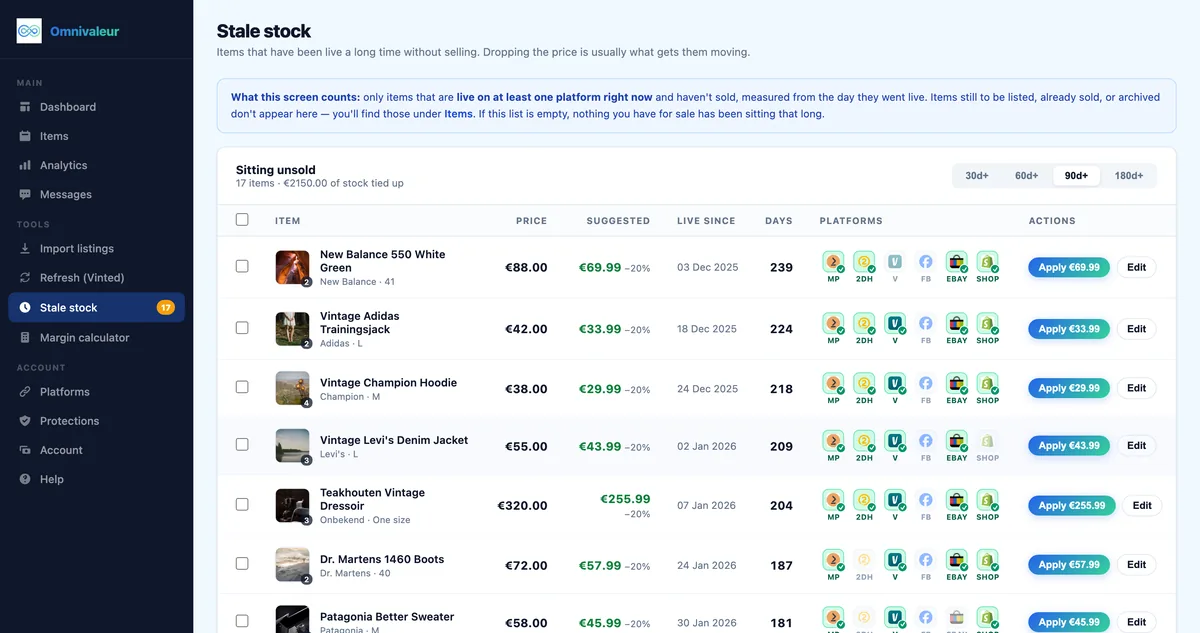
The sweet spot lies in catalog velocity. Reselling is not a static museum display; it is a pipeline. If you have 300 items listed, but 250 of them have lingered untouched for nine months, your functional inventory is only 50 items. You cannot expect the daily volume of a 300-item store when five-sixths of your stock is commercially dead.
Before sourcing additional stock, evaluate your current catalog using this simple diagnostic framework:
| Catalog Size | Expected Weekly Sales (0.75% Daily STR) | Primary Algorithmic Bottleneck | Recommended Action Step |
|---|---|---|---|
| 1–30 items | 0–1 sales | Insufficient catalog footprint; low buyer trust | Source aggressively; hit 50 listings before optimizing |
| 31–100 items | 2–5 sales | Inconsistent listing habits; narrow category reach | Establish a daily routine of 3–5 fresh listings |
| 101–250 items | 5–13 sales | Stagnant inventory dragging down account health | Review items older than 60 days; drop prices or delist |
| 251–500 items | 13–26 sales | Fulfillment overhead and single-channel dependency | Expand to multiple marketplaces; automate cross-listing |
| 500+ items | 26–50+ sales | Physical inventory organization and storage caps | Implement SKU bin systems and standardized listing templates |
If you want to understand how top operators keep their sourcing costs low while scaling their catalogs to these levels, study our breakdown on where to source items for second hand reselling.
What Is the Exact Mathematics Behind Reseller Sell-Through Rates?
To predict how many listings you need to hit specific financial targets, you must master the Sell-Through Rate (STR). Without calculating your STR, guessing listing targets is pure fiction. Sell-through rate measures the percentage of your active inventory that sells within a given period, usually calculated monthly or daily.
Here is the monthly formula: Monthly STR = (Total Items Sold in Month / Total Active Listings) × 100
To convert this into daily planning: Daily Sales = Total Active Listings × (Daily STR / 100)
In the European second-hand trade, daily sell-through rates vary dramatically by category. Understanding these baseline averages allows you to tailor your inventory targets to your specific niche:
- High-Velocity Goods (1.5% to 3.0% daily STR): Modern trending streetwear, hype sneakers, current-generation gaming consoles, and popular smartphones. A reseller focusing on fast-moving streetwear needs only 50 to 80 active listings to generate 1 to 2 sales daily. Learn more about operating in this sector with our guide to streetwear reselling automation.
- Standard Second-Hand Fashion (0.5% to 1.0% daily STR): Mid-tier vintage garments, branded denim, outerwear, everyday knitwear, and standard women's apparel on Vinted. To achieve 2 consistent sales per day, you must maintain 200 to 400 active listings.
- Long-Tail & Collectibles (0.1% to 0.4% daily STR): Obsolete electronics, vintage analog cameras, rare art prints, antique porcelain, and specialty board games. These items yield exceptional profit margins—frequently 60% to 80% net—but demand patience. A vintage art dealer needs 600 to 1,000 active listings to produce 1 to 2 sales per day. For detailed workflows in long-tail categories, read our manual on vintage art and prints reselling automation.
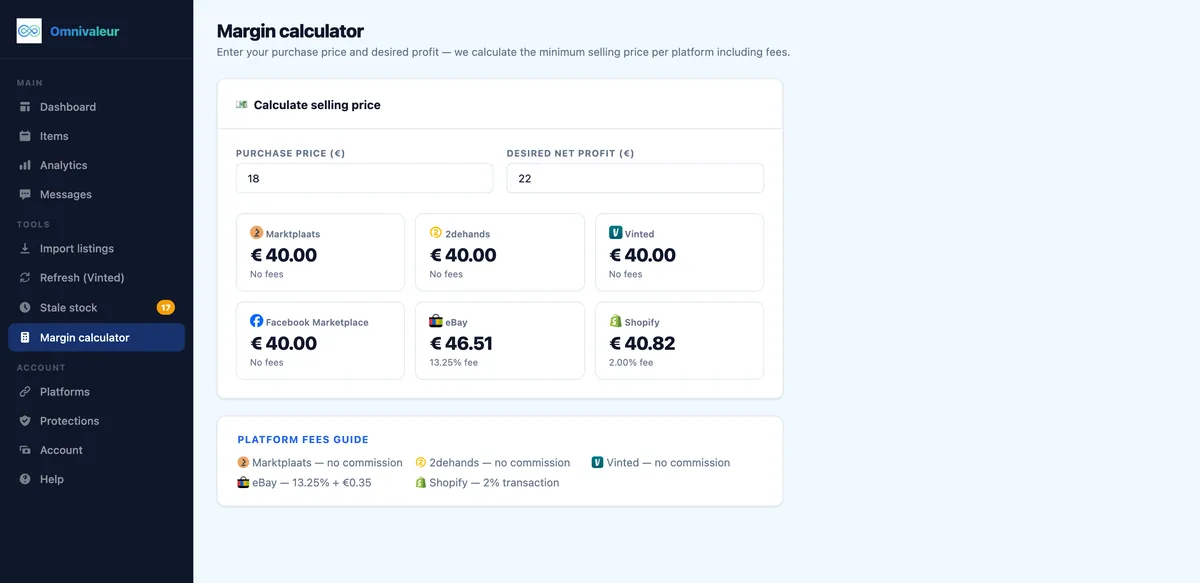
Let us run a concrete financial example. Suppose your goal is to earn €1,500 in net profit every month. You sell mid-tier vintage clothing. Your average selling price (ASP) is €35, your average cost of goods sold (COGS) is €10, and platform and shipping fees consume roughly €5 per item. Your net profit per unit sold is €20.
To generate €1,500 net profit, you must complete 75 sales per month (€1,500 / €20). That equals 2.5 sales per day. If your catalog achieves an industry-standard daily STR of 0.8%, how many listings do you need? You divide your required daily sales by your daily STR: 2.5 / 0.008 = 312.5. You must maintain roughly 315 active, live listings in your store every single day to hit that €1,500 target.
How Does Cross-Listing Change the Total Listing Calculation?
Most sellers calculate listing targets assuming they only sell on one platform. If you only list on Vinted, you bear 100% of the platform's localized audience limitations. But when you cross-list your inventory across Marktplaats, 2dehands, eBay, and Etsy, the mathematical relationship between physical stock and digital sales changes completely.
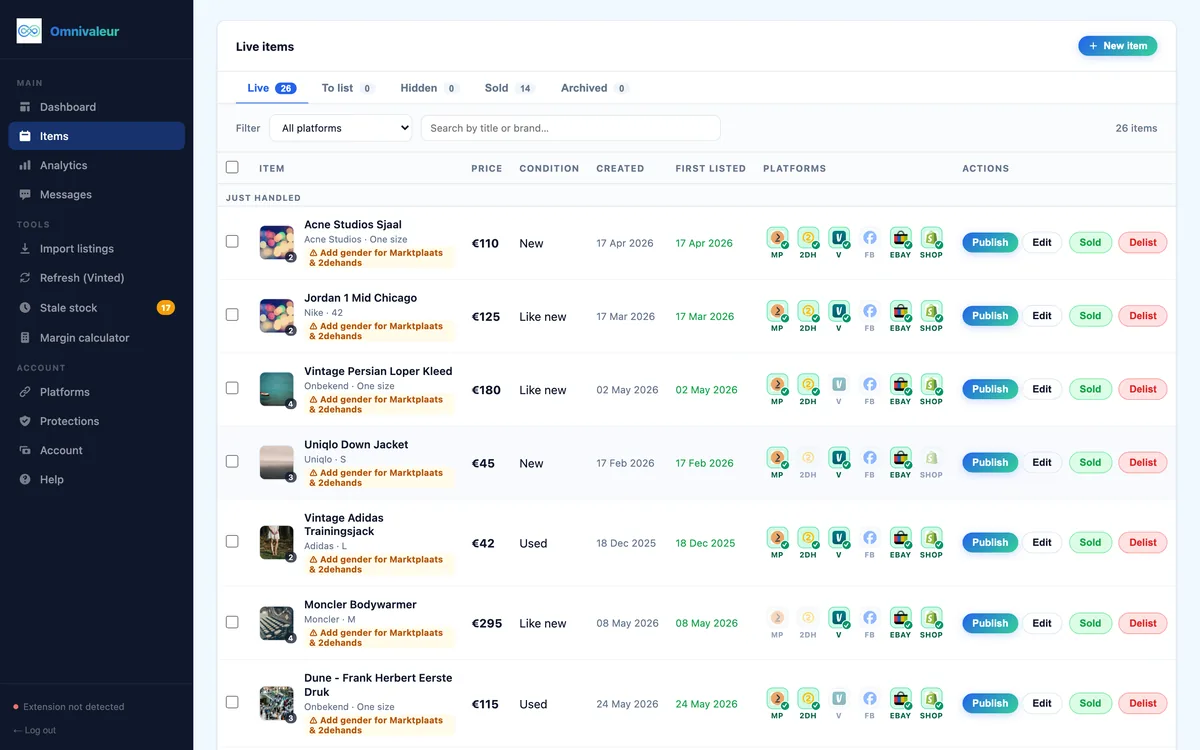
A single item in Omnivaleur typically carries 3-5 active listings at once; the app tracks each platform's status separately. This operational multiplier transforms your inventory capacity. Instead of needing to buy, measure, photograph, and store 300 physical garments in your home or warehouse to achieve 300 digital impressions, you can hold 80 physical items and project 320 live listings across four distinct marketplaces.
Consider the structural audience differences in the Benelux and European markets:
- Marktplaats: The undisputed powerhouse in the Netherlands for furniture, electronics, tools, and local pickup items. Dutch buyers often prefer direct bank transfers via iDEAL and straightforward domestic parcel services.
- Vinted: Hyper-efficient for lightweight clothing, low-to-mid-tier footwear, and fashion accessories across France, Belgium, the Netherlands, Spain, and Italy. Integrated, buyer-paid shipping labels eliminate packaging guesswork.
- 2dehands: Essential for reaching Flemish and Wallonian buyers in Belgium. Heavy items and localized tools often sell faster here than on Dutch boards.
- eBay & Etsy: Unlocks international buyers across Germany, the UK, and North America willing to pay premium prices for rare collectibles, retro tech, and authentic vintage wear.
When you syndicate one item across three marketplaces, you triple the surface area of your inventory. A vintage leather jacket sitting forgotten on Vinted for four weeks might sell within forty-eight hours when mirrored to Marktplaats or eBay, where a different demographic searches with higher purchasing power. Managing multiple storefronts manually creates fulfillment risks, making it vital to implement safeguards; see our guide on how to avoid selling the same item twice.
Why Does Listing Frequency Matter More Than Absolute Shop Size?
A static catalog of 300 listings almost always loses to a dynamic catalog of 150 listings that receives 5 fresh uploads every morning. Resellers often make the mistake of batch-listing 150 items over a single weekend and then doing nothing for an entire month. By week three, their sales flatline.
Marketplace search algorithms prioritize fresh activity. When you publish a new listing, several positive mechanisms trigger simultaneously:
- The Freshness Boost: Platforms like Vinted and Marktplaats temporarily rank newly published items near the top of chronological search filters and category feeds.
- Profile Influx: Browsing buyers who discover your new listing frequently tap through to inspect your entire wardrobe or store profile, triggering secondary views and saves on older items.
- Seller Activity Scoring: Search engines reward accounts that log in, respond to chats, print shipping slips, and upload data daily. Inactive stores get pushed down search rankings to prevent buyers from purchasing items from dormant sellers.
Rather than dropping 35 items on Sunday afternoon, hold those drafts and post 5 items each day at peak browsing hours. To time your posts for maximum algorithmic lift, consult our data-backed analysis on the best time to post on Vinted.
What should you do when listings grow stale? If an item sits for 60 to 90 days with numerous favorites but no buyer, simply leaving it alone guarantees diminishing returns. Many sellers turn to automated refreshes or relisting. Keep your expectations realistic: Omnivaleur's Vinted refresh tool caps itself at 8 free refreshes per day and states outright that no tool can guarantee a marketplace won't flag an account. Aggressive, round-the-clock bot activity will trigger spam filters. Smart catalog management favors controlled, steady listing rhythms over hyperactive automated spamming. For deeper mechanics, review our tactical guide on relisting vs bumping second hand goods.
- ✓Source until you hit 50 listings before tweaking details
- ✓Post three to five fresh listings every single day
- ✓Drop prices or relist any items that sit longer than 60 days
- ✓Cross-list your existing stock across several marketplaces
How Do European Tax Thresholds and DAC7 Impact Catalog Scaling?
As you scale your listing count to achieve daily sales, you must account for European compliance regulations. You cannot scale a catalog to 400 active listings without understanding the statutory reporting lines enforced across the European Union.
Under the European Council Directive known as DAC7, digital platforms including Vinted, Marktplaats, eBay, and Etsy must automatically report seller transaction data to national tax authorities. According to official documentation from the European Commission DAC7 overview, platforms are legally mandated to share your details once you exceed either of two specific triggers within a single calendar year:
- You execute 30 or more completed sales transactions on a single platform.
- Your gross sales proceeds exceed €2,000 on that platform, regardless of item count.
In the Netherlands, the Dutch Tax Administration monitors these digital reports closely; you can review the exact operational definitions on the Belastingdienst DAC7 seller guidelines. Crossing the DAC7 threshold does not automatically mean you owe income tax; selling your personal, used wardrobe at a loss is generally non-taxable hobby activity. However, if your catalog holds 300 curated garments purchased specifically to resell for profit, tax authorities will classify your activity as an enterprise.
Furthermore, professional sellers operating digital stores must uphold standard statutory consumer protections. When selling commercially to EU citizens, you must honor the rules outlined by Your Europe consumer shopping rights, including the standard 14-day right of withdrawal for distant sales, unless specific statutory exemptions apply to your goods.
How Can You Create and Maintain 200+ Listings Without Burning Out?
Solo resellers who attempt to build a 200-item inventory by doing everything sequentially—sourcing one piece, washing it, photographing it, writing a description, posting it to Vinted, and repeating—burn out within two months. Building a consistent inventory requires batch processing and dedicated organizational infrastructure.
Professional inventory management relies on four distinct workflow cycles:
1. Batch Photography and Measurement
Never photograph items one by one. Accumulate 15 to 25 sourced items, prep them with a handheld steamer, set up your lighting rig, and shoot all of them in a single 90-minute session. Standardize your photo angles: front full shot, brand tag, fabric content label, defect close-up, and back shot. Lay a measuring tape across the chest (pit-to-pit) and length for apparel; this eliminates 80% of repetitive buyer inquiries.
2. The Physical SKU and Bin System
When you have 40 listings, you can remember that the green Ralph Lauren knit is folded in the second drawer under your bed. When you hold 350 listings, finding that knit can take 45 minutes of frantic searching while the delivery courier waits outside. Implement numbered transparent storage totes (Bin A, Bin B, Bin C) and assign every garment an adhesive barcode or numbered polybag tag (e.g., SKU-A104). Note the SKU inside your listing's private notes or description footer.
3. Multi-Channel Syndication
Manually retyping descriptions, re-uploading photos, and setting shipping parameters across three separate apps wastes hundreds of operational hours. Professional sellers draft an item once and push it across their active platforms using software designed for multichannel sync. Instead of choosing between Marktplaats or Vinted, you operate across both simultaneously.
4. Ruthless Catalog Pruning
Catalog size is an asset; catalog deadweight is a liability. Every 30 days, review all listings older than 90 days with low engagement. Apply a progressive discount schedule: drop the price by 15%, bundle stagnant items into mystery lots, or delist them entirely to donate to charity and clear physical bin space for fresher, higher-margin goods.
Keep reading



Stop copying listings by hand
Omnivaleur publishes your item to every platform at once and syncs stock automatically when something sells.
Start free trial