Vintage Art and Prints Reselling Automation: The 2026 Reseller's Guide
Vintage art and prints reselling automation means listing original art, lithographs, engravings and limited-edition prints across Marktplaats, 2dehands, Vinted, eBay, Etsy and Shopify from one tool instead of six. Omnivaleur publishes from a single intake form and tracks each platform's status separately, saving resellers several hours a week on repetitive relisting.
Key takeaways
- Etsy only allows items labeled "vintage" if they're 20 years or older — mislabel a print and you risk a takedown.
- Omnivaleur pushes one intake form to Marktplaats, 2dehands, Vinted, eBay, Etsy and Shopify at once.
- A single art or print listing typically runs 3-5 active marketplace listings simultaneously, each tracked separately for status and sales.
- DAC7 tax reporting applies once a seller hits 30 transactions or €2,000 in sales on an EU platform in a calendar year.
- Fragile packaging and condition disclosure cause more buyer disputes for art resellers than almost any other category.
Vintage art and prints don't behave like clothing or electronics on resale platforms. A lithograph from 1974 needs different disclosure than a signed screenprint from 2021 labeled "vintage style." Buyers on Etsy expect age verification. Buyers on eBay expect condition grading close to what auction houses use. Buyers on Vinted mostly want cheap decor, fast. Automating cross-listing for this category means solving all three expectations from one workflow, not copy-pasting the same 40-word description everywhere and hoping nobody notices.
What does "vintage art and prints reselling automation" actually mean in 2026?
It means one intake — photos, dimensions, medium, edition number, condition notes — gets turned into platform-specific listings without you retyping anything. You upload once. The tool reformats titles, adjusts category taxonomy, and republishes to each marketplace's rules. For art and prints specifically, that reformatting matters more than for most categories: Etsy wants "vintage" tagged only on items 20+ years old, eBay wants a clear "Art Style" and "Type" field, and Marktplaats buyers barely read descriptions at all — they scan the first photo and the price.
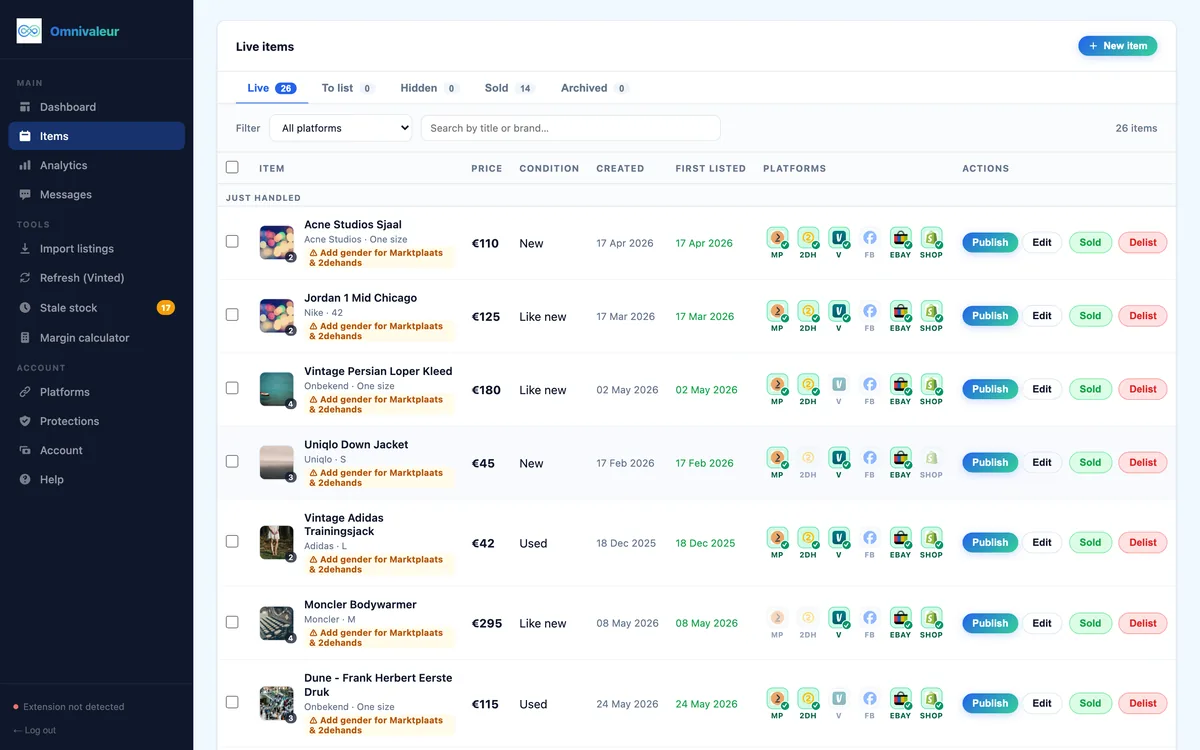
In practice, most sellers in this niche run three to five active channels per item. A framed 1968 exhibition poster print might sit on Etsy (collector audience), eBay (international art buyers), and 2dehands (local pickup, avoids shipping a fragile frame). Omnivaleur publishes to six marketplaces from one intake form — Marktplaats, 2dehands, Vinted, eBay, Etsy and Shopify — and a single item typically carries 3-5 active listings at once, with the app tracking each platform's status separately so you know instantly which one sold first.
Which platforms should you actually list vintage art and prints on?
Not all six are equally good for this category. Here's how they stack up in 2026:
| Platform | Best for | Typical fee | Notes for art/prints |
|---|---|---|---|
| Etsy | Signed/numbered prints, mid-century originals | 6.5% + ~3% payment processing | Requires genuine 20+ year age for "vintage" tag |
| eBay | Auction-style rare or contested-value pieces | ~10-13% final value fee | Good for provenance disputes; strong buyer protection draws collectors |
| Vinted | Cheap decor prints, poster reproductions | Buyer pays service fee, seller free | Weak fit for anything over ~€60; audience skews low-price |
| Marktplaats | Local pickup, framed/fragile pieces | Free for private sellers | Avoids courier damage on glass frames |
| 2dehands | Belgian equivalent audience | Free for private sellers | Same fragile-item logic as Marktplaats |
| Shopify | Your own brand, repeat collectors | Subscription + payment processor fee | No marketplace fee cut; better margins on higher-value pieces |
If you're serious about the poster and print side of this category specifically, our Vintage Poster Reselling Automation 2026 guide goes deeper into framing photography and poster-specific pricing tiers. Ephemera resellers — postcards, letters, small paper pieces that overlap heavily with print collecting — should check the automation guide for vintage postcards and ephemera too, since the photography and condition-grading rules are nearly identical.
How does Etsy's "vintage" rule affect art and print listings?
Etsy defines vintage as 20 years old or older at the time of listing. That threshold moves every year — in 2026, anything made after roughly 2006 no longer legally qualifies. This trips up a lot of resellers who buy a mixed lot at an estate sale and assume everything paper-based counts as vintage automatically. It doesn't. A 2010 gallery reproduction print is not vintage on Etsy no matter how faded the paper looks.
Practically: keep a dated record for anything you tag as vintage — an auction catalog reference, a gallery stamp date, a publisher's mark. Etsy can and does remove listings that get reported for mislabeling, and repeated violations affect your shop's search ranking. If you cross-list the same piece to eBay and Marktplaats, the "vintage" word doesn't carry legal weight there, but buyers still expect you to be accurate — a wrong date in the title is one of the fastest ways to trigger a return request.
What are the real risks of manual cross-listing for art resellers?
Three failure modes show up constantly in this niche:
- Double-sold originals. Because art pieces are usually one-of-a-kind (unlike clothing sizes), selling the same physical piece on two platforms without syncing is worse here than in almost any other reseller category. You can't just relist a duplicate — you have to refund and apologize.
- Condition mismatch. A crease visible in one photo but not disclosed in the text leads to disputes. Art buyers examine surface condition closely — foxing, toning, tears, fading — and they escalate disputes faster than clothing buyers do.
- Wrong measurements. Frame size vs. image size vs. paper size get confused constantly when retyping listings by hand across platforms with different required fields.
Manual relisting across five platforms for one item takes roughly 25-35 minutes if done carefully with unique descriptions per platform. Multiply that by 40 active pieces and you're spending most of a working day just on republishing, before you've even sourced anything new.
How do DAC7 tax reporting rules affect art and print resellers in the EU?
DAC7 requires online platforms operating in the EU to report seller income once you cross 30 transactions or €2,000 in sales within a calendar year. Art and print resellers hit that threshold fast if they're moving multiple low-value prints per week rather than a handful of expensive originals — 30 transactions of €15 posters adds up to just €450, but the transaction count alone triggers reporting.
Marktplaats, Vinted, eBay and Etsy all fall under these rules and will collect your tax ID details once thresholds are approached. The Belastingdienst's DAC7 information page for sellers covers exactly what gets reported for Dutch-based resellers, and the European Commission's DAC7 overview explains the EU-wide framework if you sell across borders. Keep a running spreadsheet of gross sales per platform per year — it saves a scramble every January.
Separately, buyers across the EU are protected under standard consumer rules regardless of which platform they bought through. The Your Europe consumer shopping rights page is worth reading if you sell to private EU buyers, since return-window expectations differ from what many resellers assume for "used" or "vintage" goods.

How should you photograph, grade and price vintage art and prints for multiple marketplaces?
Photography for this category needs more discipline than clothing. Buyers can't touch the paper, so they lean entirely on your images to judge age-related wear.
- Shoot flat, in natural diffused light — no flash, which blows out toning and foxing detail buyers actually want to see.
- Include a raking-light shot at an angle to reveal creases, tears, or warping invisible in a straight-on photo.
- Photograph the back — publisher stamps, gallery labels, framer's tape, and old price stickers are all authentication clues collectors look for.
- Grade condition consistently. Use a simple scale: Mint, Excellent, Good, Fair, Poor — and describe the specific flaw, not just the grade word.
- Price by comparable sold listings, not asking prices. eBay's sold-listings filter and Etsy's "sold" tab (visible on some third-party tools) are more accurate than active listings, which are often overpriced and sitting unsold for months.
Once you've got the photo set and grading done, that same content block should populate every platform automatically rather than being retyped per site — which is the entire point of running cross-listing software instead of five browser tabs.
How does Omnivaleur automate cross-listing for vintage art and print resellers?
You fill in one intake form — photos, medium, dimensions, edition details, condition grade, price — and Omnivaleur reformats that into platform-appropriate listings for Marktplaats, 2dehands, Vinted, eBay, Etsy and Shopify. Sold on one platform? The others get pulled or marked sold automatically, which matters enormously in a category where every piece is unique and a double sale means an awkward refund conversation with a collector.
Each listing's status is tracked separately inside the app, so if your eBay listing gets a question about frame dimensions while the Etsy version sits untouched, you can answer without hunting across six open tabs. If you're weighing tools, our comparison guides for Omnivaleur vs List Perfectly and Omnivaleur vs OneShop break down pricing tiers and feature gaps specifically for resellers juggling five-plus active listings per item.
Resellers who mix categories — vintage vinyl covers with original art sleeves, or old books with illustrated plates — often run the same workflow across adjacent niches. The Vintage Book Reselling Automation guide and the Vinyl Record Reselling Automation guide cover the overlap in condition grading and cross-platform pricing logic if that's part of your inventory too.
What shipping and packaging rules should art resellers follow across marketplaces?
Fragile shipping is where art resellers lose the most money on returns. A few numbers worth knowing for 2026:
- Framed pieces over roughly A2 size (42 x 59.4cm) rarely ship economically — local pickup via Marktplaats or 2dehands is usually the better call, both financially and for damage risk.
- Unframed prints should ship flat in rigid mailers, not rolled tubes, unless the paper stock is specifically archival and tolerant of rolling — most 1960s-1980s offset prints are not.
- eBay and Etsy both offer seller-paid insurance options above certain declared values; for anything over roughly €150, insure it. Disputes over "damaged in transit" claims are common enough in this category that insurance pays for itself within a handful of shipments.
- Vinted's built-in shipping labels are convenient but the size limits are tight — check package dimensions before committing a large flat print to a Vinted sale, since oversized parcels get rejected at drop-off points.
Packaging cost should get baked into your price, not treated as an afterthought subtracted from margin after the sale. Resellers who track this per platform tend to find Marktplaats and 2dehands quietly more profitable per hour once shipping labor and materials are counted, even though the buyer pool is smaller than eBay's.
How do you decide which pieces are worth cross-listing at all?
Not every print justifies five simultaneous listings. A €12 poster reproduction bought at a flea market for €2 barely covers the time cost of five-platform listing, insurance, and packaging. Reserve full six-platform distribution for pieces above roughly €40-50 in expected resale value, where the extra exposure genuinely moves the needle on sale speed. For lower-value bulk lots, two platforms — typically Vinted for speed and Marktplaats for local pickup — often perform close to as well as five, with a fraction of the listing effort.
A rough rule some resellers in this space use: if the item would sell within a week on your strongest single platform anyway, don't bother cross-listing it across all six. Save the full automation workflow for pieces sitting in inventory longer than 30 days, or ones with genuine provenance value where the right collector might be on eBay rather than Etsy.
Frequently asked questions
Can you sell reproduction art prints as "vintage" if the original artwork is old but the print itself is recent?
How do you handle authentication questions for unsigned prints from unknown publishers?
What happens if a framed piece arrives with broken glass — who's responsible?
Is it worth listing the same art print on both Etsy and eBay, or does that count as duplicate content?
Do vintage frames themselves have separate resale value from the art inside them?
Keep reading


Stop copying listings by hand
Omnivaleur publishes your item to every platform at once and syncs stock automatically when something sells.
Start free trial