Relisting vs Bumping Second Hand: The Complete 2026 Reseller Visibility Guide

Relisting deletes a stale listing and publishes a brand-new post for free, resetting algorithm freshness. Bumping pays a marketplace fee (€1.15 to €3.50) to artificially boost the existing listing for three to seven days. Relisting works best for stale stock; bumping suits urgent sales on hot items.
Key takeaways
- Bumping pays platforms for temporary search visibility, whereas relisting resets algorithmic organic rank without upfront costs.
- Re-uploading duplicate photos on Vinted without metadata changes triggers automated spam detection and shadowbans.
- Marktplaats and 2dehands charge higher bump fees that often erode margins on inventory priced under €30.
- Cross-listing across multiple European platforms generates more views than paying to bump an uncompetitive item repeatedly.
Every European reseller encounters the wall of stale inventory. You source a solid vintage jacket or a collectible board game, photograph it, write an accurate description, and price it fairly. Two weeks later, the listing sits at the bottom of the feed with zero favorites and single-digit impressions. You face two choices: pay the platform to bump the item, or manually delete and relist it from scratch.
Choosing between relisting and bumping dictates your profit margins and how algorithms treat your account. If you bump too often, micro-fees consume your margins. If you relist carelessly, platform bots flag your account for duplicate spam. Let us dissect how both methods function behind the scenes across major second-hand marketplaces in 2026.
What is the mechanical difference between relisting and bumping?
The primary difference lies in database indexing and financial cost. When you pay for a bump—such as an "Item Spotlight" or "Bump" on Vinted, or an "Omhoogplaatsen" on Marktplaats and 2dehands—the marketplace retains your original listing ID, favorite count, and historical engagement data. The database simply flags your item with a temporary promotional priority tag. For three to seven days, the search engine injects your listing into top feed positions and sponsored slots for users searching related keywords.
Relisting, by contrast, creates an entirely new database record. You delete or archive the existing listing and publish an independent product entry. This action assigns a brand-new timestamp, a fresh URL, and a clean slate. The platform algorithm treats the item as newly listed stock, pushing it directly into the "Newest" feeds without charging promotional fees.
Bumping buys temporary visibility for an established, aging listing. Relisting exploits algorithmic freshness by resetting the item's digital lifecycle. Neither approach fixes fundamentally flawed listings with poor lighting or unrealistic pricing, but both give competitive items a second chance at buyer discovery.
What does bumping cost across European marketplaces?
Paid bumping costs vary wildly depending on the platform, item category, and listing value. Micro-fees accumulate rapidly when applied across a growing inventory backlog. Here is a breakdown of what bumping costs on primary European second-hand platforms:
| Marketplace | Feature Name | Average Cost (EUR) | Duration | Best Suited For |
|---|---|---|---|---|
| Vinted | Standard Bump / Spotlight | €1.15 – €1.95 (Bump) / €6.95 (Wardrobe Spotlight) | 3 days (Bump) / 7 days (Spotlight) | Mid-to-high demand clothing priced over €25 |
| Marktplaats | Omhoogplaatsen / Dagtopper | €1.99 – €3.50 per bump | 1 day push (Omhoogplaatsen) / 24 hrs top spot | High-value local pickup items, furniture, tools |
| 2dehands | Omhoogbieden / Topadvertentie | €1.50 – €3.00 per action | Variable based on category competitiveness | Regional sales in Flanders, electronics, bikes |
| eBay (DE/NL/FR) | Promoted Listings Standard | Cost-per-sale (typically 2% to 12% ad fee) | Entire listing duration until sold | Long-tail items, collectibles, international buyers |
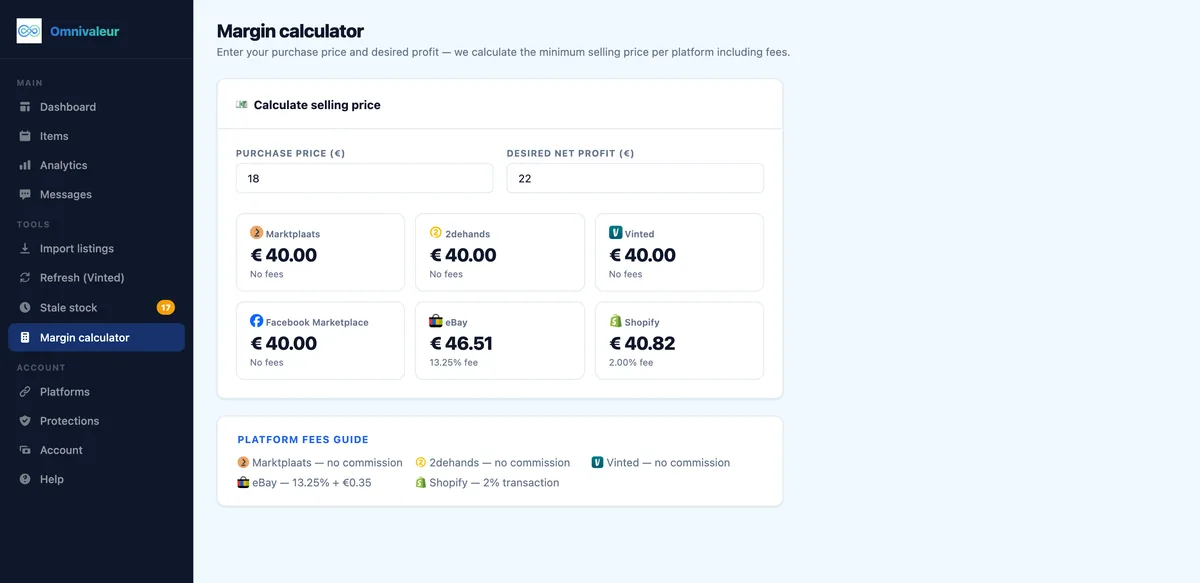
On Vinted, a three-day bump on a €12 t-shirt costs €1.15. That single bump consumes nearly 10% of your gross sales price. If the item requires two rounds of bumping before selling, your promotional cost reaches €2.30. Factoring in packaging materials and your initial sourcing outlay, your net profit collapses. Calculating unit economics before deploying paid boosts is critical, as detailed in our guide on how to price second-hand items.
Marktplaats and 2dehands operate on fee models where promotional costs scale higher in commercial categories. Using paid bumps on lower-margin items rarely generates a positive return on investment. Resellers who track their books realize quickly that paid bumps should be reserved for inventory carrying substantial profit cushions.
When is bumping worth your money, and when is it a waste?
Bumping functions as an accelerator, not a cure. If a listing failed to attract favorites, views, or offers over four weeks, pushing it to the top of the feed will not compel buyers to purchase it. Bumping an unattractive listing merely broadcasts bad photos and high prices to more shoppers faster.
Pay to bump an item only under these specific operational conditions:
- High existing interest: The item has accumulated 15 or more favorites, but no browser has pulled the trigger. A bump pushes the listing back into those watchers' active feeds and alerts them that the item is gaining renewed traction.
- Time-sensitive seasonal demand: You hold winter coats in early November, festival wear in June, or holiday gifts two weeks before Christmas. The selling window is narrow, making immediate search visibility worth the micro-fee.
- High average order value: On a designer handbag priced at €180, an investment of €1.95 for a bump represents barely 1% of the sale value. If that placement accelerates inventory turnover by two weeks, the capital efficiency justifies the cost.
- Wardrobe Spotlights during sourcing drops: On Vinted, activating a 7-day Wardrobe Spotlight (€6.95) works exceptionally well right after uploading 20 to 30 curated pieces. It exposes your entire closet to matching buyers who purchase multi-item bundles.
Conversely, bumping proves wasteful on commodity items with high competition. Do not bump basic fast-fashion basics, widely available mass-market books, or items priced below €20. For stock in those brackets, paid promotions systematically erase your margins. To master baseline view generation without paying platforms, review the operational steps in how to get more views on Vinted.
Can relisting get your marketplace accounts banned or shadowbanned?
Yes. Aggressive, unmanaged relisting triggers automated anti-spam algorithms on modern marketplaces. Platforms prefer that sellers pay for visibility boosts rather than recycling listings for free. As a result, engineering teams implement systems designed to catch automated or repetitive listing recreation.
Vinted operates strict duplicate-detection algorithms. When you upload photos matching the exact pixel dimensions, EXIF data, or visual hash of an item deleted five minutes prior, the algorithm flags the new upload as duplicate spam. The consequences range from silent algorithmic suppression—a "shadowban" where impressions drop to near zero—to temporary account suspensions. To understand platform account health, you must respect marketplace policies as thoroughly as statutory compliance like DAC7 tax reporting EU rules or domestic guidelines from the Belastingdienst DAC7 seller guidelines.
To relist safely without triggering account flags, adhere to this operational protocol:
- Wait before deleting: Allow a stale listing to sit for at least 21 to 30 days before recycling it. Never delete and recreate a listing within 48 hours.
- Retake or modify product photos: Crop the main image slightly, adjust brightness or contrast by 3-5%, or swap the lead image for an alternate angle. Changing the visual framing prevents hash-matching algorithms from identifying identical images.
- Rewrite the listing title and description: Rephrase your copy. If your title was "Vintage Levi's 501 Jeans Blue W32", rewrite it as "Levi's 501 Straight Leg Denim W32 L32 Vintage Blue Wash". Update keywords to capture missed search queries.
- Adjust your price point: Relisting at the exact same uncompetitive price yields identical results. Lower the price by 5-10%, or increase it slightly if you intend to send aggressive private offers to new likers.
- ✓wait at least twenty-one to thirty days before deleting a stale listing
- ✓crop the main image slightly or adjust contrast by three to five percent
- ✓rewrite the product title and description with new keywords
- ✓lower the price by five to ten percent or adjust for private offers
- ✓publish during high-traffic evening periods between nineteen and twenty-one thirty
How long does manual relisting take versus multi-channel automation?
Manual relisting is labor-intensive. For an individual item, the workflow requires locating original image files on your phone or desktop, downloading existing descriptions, deleting the old marketplace post, cropping photos to alter image metadata, uploading the media, selecting categories and attributes, and publishing. Done properly, this process consumes four to seven minutes per item.
If your inventory holds 150 items across your workspace, recycling a third of that catalog manually every month demands 3.5 to 6 hours of repetitive data entry. That is operational time stolen directly from sourcing, product preparation, or order fulfillment.
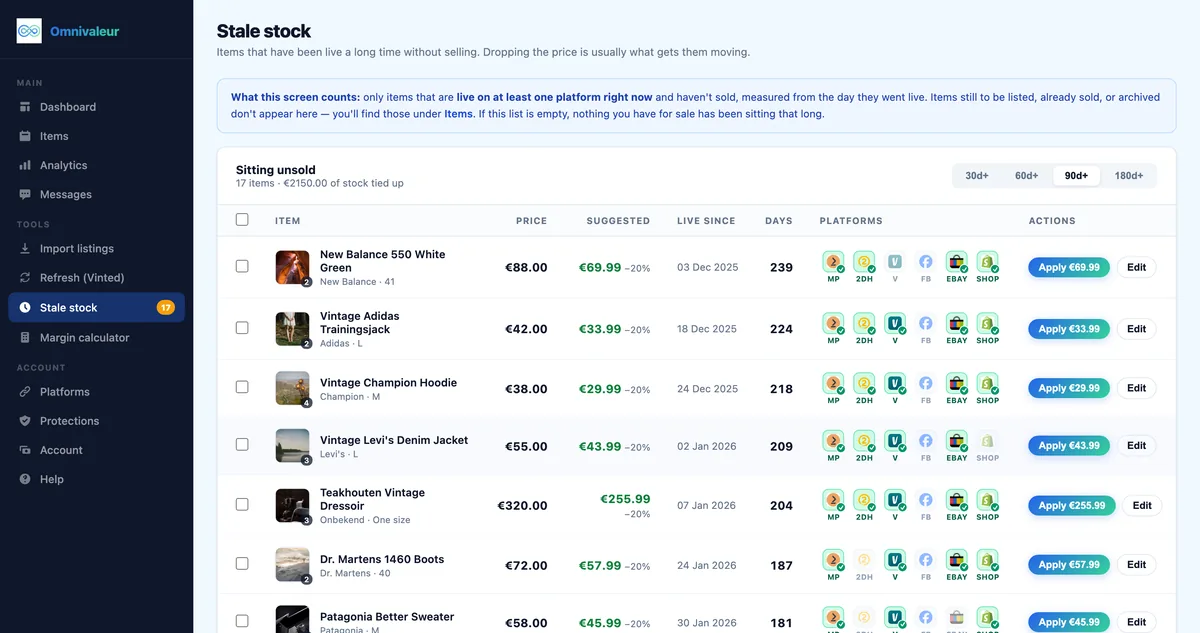
Smart operators eliminate manual entry by maintaining centralized product records. Omnivaleur publishes to seven channels from one intake form: Marktplaats, 2dehands, Vinted, eBay, Shopify, WooCommerce and Facebook Marketplace (beta). Instead of cycling visibility on a single platform, you distribute products across separate buyer networks simultaneously.
A single item in Omnivaleur typically carries 3-5 active listings at once; the app tracks each platform's status separately. When a listing grows stale on one channel, you can delist and refresh that channel's record in seconds without retyping titles, attributes, or pricing structures from scratch.
How do algorithms rank fresh listings versus bumped posts?
Search algorithms on modern second-hand platforms balance two opposing forces: buyer relevance and marketplace monetization. Understanding their mechanics allows you to manipulate rank strategically.
The algorithmic life cycle of a fresh listing
When an item is first created, marketplace algorithms grant it an initial discovery test. On platforms like Vinted, Depop, and eBay, new items are pushed into recent feeds and real-time category searches for 24 to 72 hours. The platform monitors initial engagement closely: click-through rates (CTR) from search results, image expansions, favorite counts, and message inquiries.
If users demonstrate immediate interest, the algorithm prolongs elevated rank. If users scroll past without engaging, the listing drops down the chronological and relevance indexes. By week three, organic discovery falls off a cliff. Relisting resets this evaluation cycle entirely, offering a second chance to catch active buyers during peak evening shopping hours.
How paid bumps interact with the ranking index
Paid bumps do not improve listing quality; they force placement. When you buy a bump on Marktplaats or Vinted, your item bypasses normal algorithmic testing and appears in dedicated promotional positions or top-of-page feeds. However, search engines remain conversion-focused. If your bumped listing receives thousands of impressions but zero clicks, modern algorithms note the poor engagement and lower its secondary organic visibility once the promotional period expires.
Bumping works best when applied to items that already possess compelling visual presentation and market-aligned pricing. If your photography is substandard, relisting with improved imagery outperforms paid bumps every single time. Resellers moving high volumes of apparel can review our tactical manual on how to photograph clothes for Vinted to optimize CTR before spending ad money.
What is the ideal workflow to revive stale second-hand stock?
Rather than guessing whether to bump or relist, implement an objective decision tree. Evaluate your aging inventory every 14 days using this systematic framework:
- Day 1 to 14 (The Launch Window): Publish the listing across your core channels. Ensure descriptions contain precise brand, size, and condition metadata. Send direct discount offers to any user who favorites the item within 48 hours.
- Day 15 to 21 (The Evaluation Stage): Audit the listing metrics:
- Scenario A (High views/favorites, no sale): Send a targeted public price reduction of at least 10%. All current likers receive an automated platform notification. If the item carries a high margin (over €40 profit), purchase a 3-day paid bump right after dropping the price.
- Scenario B (Zero favorites, low views): The listing missed the algorithm. Do not spend money bumping this post. Flag it for relisting.
- Day 30 (The Complete Refresh):
- Delete the stale listing from the platform entirely.
- Retake the cover photo under clean lighting or crop existing photos to clear file signatures.
- Check competitor prices to ensure market alignment.
- Relist during high-traffic evening periods (Sunday to Thursday, 19:00 to 21:30 CET).
- Day 45+ (Multi-Channel Cross-Listing): If an item fails to sell on Vinted despite a relist, migrate it to a different audience. An item languishing on Vinted may find an immediate buyer on Marktplaats or eBay, where older demographics look for specific models. Learn how to bridge these ecosystems in our tutorial on Marktplaats to Vinted cross-listing.
How does cross-listing outperform both bumping and relisting?
Resellers often lock themselves into an artificial dilemma: should I pay Vinted €1.50 to bump this jacket, or take five minutes to relist it? Both choices limit the item to one localized pool of shoppers.
Cross-listing bypasses that limitation entirely. When you expand beyond a single app, you gain visibility across multiple European buying habits. Vinted dominates casual fashion across France, the Netherlands, Belgium, and Italy. Marktplaats controls Dutch domestic household goods. 2dehands serves Flemish Belgian trade. eBay opens doors to international collectors in Germany, the UK, and the United States who pay premium rates for niche inventory.
Expanding across these platforms instantly multiplies impressions without paying recurring bump fees. A vintage leather jacket sitting unnoticed on Vinted for three weeks can sell within 48 hours when syndicated to Marktplaats and eBay. When managing multi-platform stock, keeping inventory synchronized is essential to prevent operational mishaps; review our standard operating procedure on how to avoid selling the same item twice.
Every commercial transaction across the EU must also respect clear operational boundaries, including standard statutory EU consumer rights. Understanding return policies and commercial thresholds protects your business longevity across all channels. If you are scaling beyond casual personal clearing, check our tax analysis on when reselling becomes a business under KVK rules.
Instead of constantly fighting algorithm drop-offs on one platform, build a resilient multi-channel workflow. Relist smart, bump sparingly on premium inventory, and let multi-platform syndication do the heavy lifting for your store visibility.
Frequently asked questions
Does dropping the price on a stale listing act like a bump?
Should I delete all stale listings at the same time before relisting?
What happens to existing item favorites when I relist an item?
Can I use third-party listing tools without violating platform terms?
Keep reading


Stop copying listings by hand
Omnivaleur publishes your item to every platform at once and syncs stock automatically when something sells.
Start free trial