
Dutch law gives no fixed warranty period for second-hand goods. Private sellers (Marktplaats, Vinted) owe no statutory guarantee at all. Business sellers must meet a "reasonable expectation" standard based on price, age and description — shorter than new goods, but not zero. Belgium, by contrast, fixes this at a one-year minimum.
Key takeaways
- Private sellers on Marktplaats and Vinted owe no legal guarantee, only honesty about known defects
- Business sellers must meet Dutch law's "reasonable expectation" test, which has no fixed number of months
- The burden of proof flips to the seller for the first 12 months after delivery, business sales only
- Belgium requires a minimum one-year guarantee on second-hand goods even when the seller shortens it
- Selling regularly on Marktplaats or Vinted can tip you into "business seller" status, triggering full consumer law
Dutch consumer law does not hand second-hand goods a fixed warranty clock the way France or Belgium do. Instead it runs on a flexible yardstick called redelijke verwachting — reasonable expectation. A €40 phone case lasting three weeks is fine. A €450 laptop dying after two weeks probably isn't, if a business sold it to you. Whether any guarantee applies at all starts with one question: was the seller private, or acting as a business?
What does the Dutch "legal guarantee" on second-hand goods actually require?
Article 7:17 of the Dutch Civil Code (Burgerlijk Wetboek) says a delivered item must match what the buyer could reasonably expect, given the price paid, the item's age, and anything the seller said about its condition. There is no "2 years" or "1 year" written into Dutch law for second-hand goods sold by a business — unlike the headline figure most people remember from EU consumer rights guidance, which covers new goods by default.
For used items the expectation scales down automatically. A judge (or, in practice, the Geschillencommissie or a small-claims court) looks at:
- The price paid relative to the new retail price
- The item's age and typical lifespan for that category
- What the listing said — "works perfectly" sets a higher bar than "sold for parts, untested"
- Wear that's visible or reasonably expected at that age
Worked example: a business sells a 4-year-old DSLR camera for €300, original retail €900. A shutter failure after six weeks is still within reasonable expectation — the buyer paid a third of the price, shutters have mileage limits, and six weeks is short. A screen that won't turn on at all, on day one, almost certainly isn't reasonable, regardless of price. The test is about fitness for ordinary use, not about hitting a specific month count.
Does a private seller on Marktplaats or Vinted have to give any guarantee at all?
No. Dutch consumer protection law (consumentenkoop, Article 7:5 BW) only applies when the seller is acting as a business (a "handelaar") and the buyer is a private consumer. A private-to-private sale — the overwhelming majority of listings on Marktplaats and Vinted — sits outside that framework entirely. The seller's only real obligation is not to lie. If you know the washing machine leaks and you don't mention it, the buyer can go after you for misrepresentation or error (dwaling) under general contract law, not under consumer guarantee rules.
That distinction matters practically for returns too. There is no statutory right to return a working-as-described item just because the buyer changed their mind — our deep dive on return rights for second-hand sales in the Netherlands covers exactly where buyers do and don't get their money back from a private seller.
Platform-level buyer protection schemes (Marktplaats Veilig Betalen, Vinted's buyer protection fee) are separate from all of this. They're contractual refund promises from the platform, not legal guarantees from you as seller — worth understanding before you assume a chargeback means you broke the law. Our guide to how Marktplaats buyer protection actually pays out breaks down the fee split and refund triggers.
When does a casual reseller become a "dealer" who owes the full legal guarantee?
This is the trap most resellers hit without noticing. Dutch law doesn't require a KvK registration number to turn you into a "handelaar" for consumer-law purposes — it looks at behaviour. Selling regularly, buying stock specifically to resell, running multiple active listings, or offering the same category of item repeatedly all push you toward commercial seller status, even on a personal Marktplaats or Vinted account.
There's no single bright line in the civil code, but two numbers give you a practical early-warning signal. DAC7 — the EU tax transparency rule platforms now apply — reports a seller to the Belastingdienst once they hit 30 transactions or €2,000 in sales in a calendar year. That threshold doesn't legally define "dealer" status under consumer law, but in practice the two overlap heavily: if you're structured enough to trip DAC7 reporting, a court is likely to view you as commercial too. Our breakdown of the 30 sales / €2,000 DAC7 threshold on Vinted walks through exactly how that reporting works.
Once you cross into business-seller territory, the consequences aren't just the guarantee obligation — you also owe VAT handling, proper invoicing, and in most cases the margin scheme for used goods. We've covered that separately in the VAT margin scheme guide for second-hand goods and the broader Belastingdienst rules for second-hand selling. If you're a side-hustle reseller moving 40+ items a month across three or four accounts, assume the full consumer guarantee obligation applies to you, not the private-seller exemption.
Who has to prove the fault was there at the time of sale?
This is the single most misunderstood part of warranty law, and it only applies to business sales. Under the EU Sale of Goods Directive, implemented in Dutch law, a defect that shows up within 12 months of delivery is presumed to have existed at the moment of sale. The business seller has to prove otherwise if they want to deny the claim. That 12-month window replaced the older 6-month presumption as part of the 2022 EU reform, and it applies equally to new and second-hand goods sold by a trader.
After those first 12 months, the burden flips back to the buyer — they have to show the fault was already present, which is far harder once an item has been used for over a year.
In a private sale, none of this presumption exists at any point. The buyer always carries the burden of proving the seller knew about and concealed a defect, or that the item was materially different from the listing. That's a meaningfully higher bar, and it's one reason private-seller disputes rarely end up in court — the cost of proving it usually exceeds the item's value.
Can a seller exclude the guarantee by writing "sold as seen"?
For a business selling to a consumer: no. Dutch law treats conformity rights as something a trader cannot simply disclaim with boilerplate text. "Sold as seen," "no returns," or "no guarantee" clauses have no legal force against a consumer buyer when the seller is acting commercially — these are consumer-protection rights, not contract terms either party can opt out of.
What a business can do, legitimately, is lower the buyer's reasonable expectation through an accurate, detailed description. Writing "screen has a 2cm crack, battery holds 60% of original capacity" doesn't exclude the guarantee — it narrows what "reasonable" means for that specific item, which is a completely different legal mechanism with the same practical effect: fewer successful claims, because the buyer knew exactly what they were getting.
For a private seller, the picture flips. "Sold as seen" disclaimers are generally enforceable, because private sales were never covered by the consumer-protection layer in the first place. The one thing a disclaimer can't protect against is a defect the seller actually knew about and hid — that's a different legal claim (bedrog/dwaling), and no amount of "as seen" text in the listing fixes it.
- ✓Take dated photos of the item including any visible wear or damage at listing time
- ✓Write an accurate condition description that matches what the item actually shows
- ✓Note the original retail price if you know it, for the reasonable-expectation argument
- ✓Keep the listing text archived so you can prove what you wrote if a dispute arises
- ✓Check if you're crossing into business-seller territory based on transaction volume
Do these guarantee rules apply to auctions and bidding sites?
Partly, and it depends on who's actually selling. Dutch law explicitly carves out judicial and execution auctions (openbare veilingen run by a deurwaarder or in bankruptcy proceedings) from consumer guarantee rules entirely — buyers there accept the item exactly as found, no recourse.
Online bidding platforms are murkier. If the platform is acting purely as an intermediary for a private seller's item, the sale is still private-to-private underneath, and the private-seller rules above apply. If the platform itself takes ownership, inspects, authenticates and resells (common with some collectibles and watch auction houses), that's a business transaction and the full guarantee framework kicks in. Always check the platform's seller-of-record terms before assuming "it was an auction" exempts anyone from anything — it usually doesn't, by itself.
How does the Dutch rule compare with Belgium, France and the UK?
Resellers shipping across borders — which is most of you, once you cross-list on eBay or Etsy alongside Marktplaats — need to know these differ meaningfully by country.
| Country | Private seller guarantee | Business guarantee on used goods | Burden-of-proof window | Can seller shorten it? |
|---|---|---|---|---|
| Netherlands | None (honesty duty only) | "Reasonable expectation" — no fixed period | 12 months | N/A — it's expectation-based, not a fixed term to shorten |
| Belgium | None | Standard 2 years, can be reduced to a 1-year minimum for second-hand if stated clearly | 12 months | Yes, down to 1 year, no further |
| France | None | 2 years (légal de conformité), auctions treated separately | 24 months | No reduction allowed for used goods bought from a trader |
| UK | None | Satisfactory quality standard; 30-day short-term right to reject, then repair/replace, 6-month presumption, claims up to 6 years | 6 months | Cannot be excluded for consumer sales |
The practical takeaway: the Netherlands is the most flexible jurisdiction here for business sellers, because there's no fixed floor like Belgium's one year. But "flexible" cuts both ways — a Dutch court can also decide a fairly short guarantee window was unreasonable if the price and description didn't justify an early failure. Belgium's bright-line one-year rule is actually easier to plan around if you sell into both markets, which is one more reason to keep separate, clearly worded return policies per platform. Our guide to Belgian tax rules for Vinted sellers covers the tax side of selling across that border.
What can a buyer actually do when a second-hand item turns out faulty?
Two scenarios, two very different outcomes.
Private sale example: a buyer pays €450 for a used MacBook on Marktplaats. The screen fails two weeks later. No statutory guarantee exists. Their options: prove the seller knew and hid the defect (hard, unless there's chat evidence), negotiate directly, or escalate through Marktplaats's own buyer protection if the transaction went through Veilig Betalen — which is a platform policy, not a legal entitlement.
Business sale example: a buyer pays €300 for a six-year-old DSLR from a registered second-hand dealer trading via an eBay shop account. Original retail was €900 and the listing said "fully functional, light wear." The shutter mechanism fails after five weeks. Because it's within the first 12 months, the burden is on the dealer to prove the fault wasn't present at sale — a tough argument for a camera that worked fine in the test shots the dealer photographed for the listing. The buyer can demand repair, replacement, or a proportional refund, in that order under Dutch remedy hierarchy.
If you're the one operating as that business seller, the practical lesson is to price and describe conservatively. Overstating condition ("fully functional") when you only mean "turned on and took a photo" sets an expectation you then have to defend.
What should resellers document and track to avoid disputes in 2026?
Paper trail beats memory, every time a dispute reaches the Geschillencommissie or small-claims stage. Keep, at minimum:
- Dated photos of the item at listing time, including any flaws mentioned in the text
- The original listing text, archived, not just edited later
- Price paid vs. known new retail price, for the reasonable-expectation argument
- Shipping confirmation and delivery date, since the 12-month clock runs from delivery
- Any buyer messages acknowledging condition before purchase
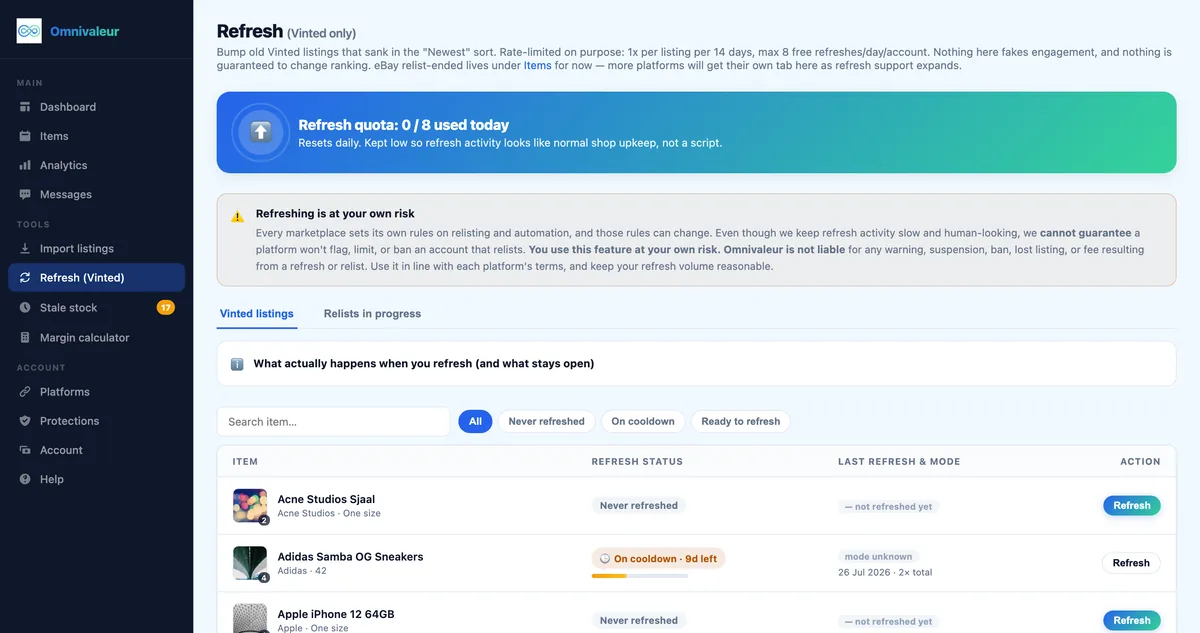
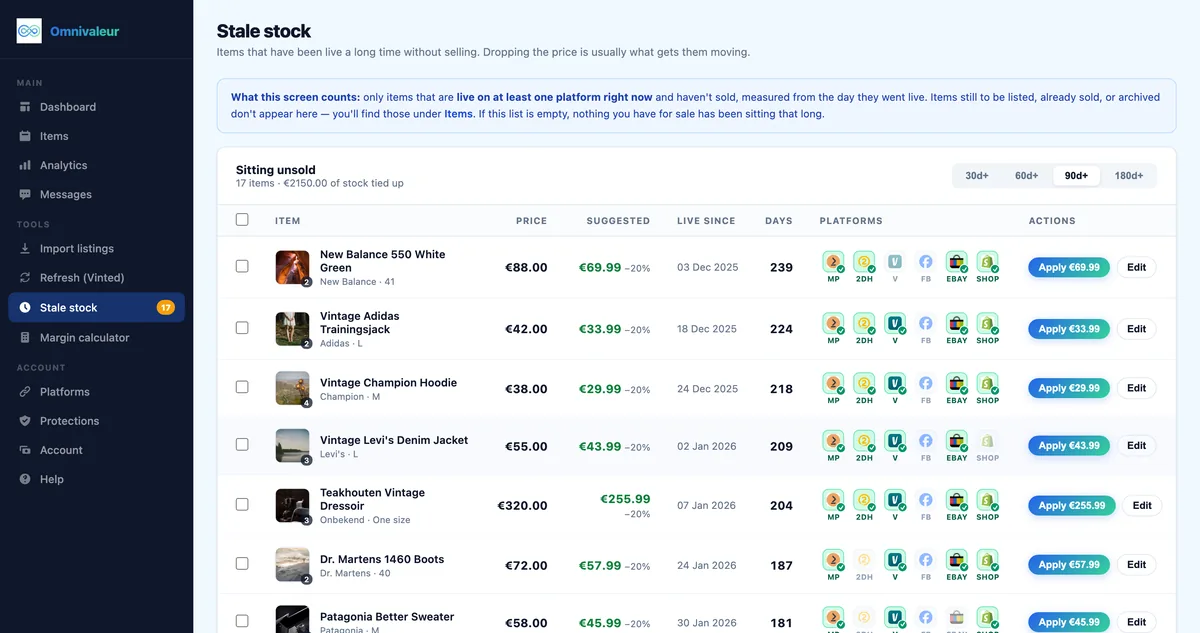
This record-keeping gets harder once you're running the same inventory across four or five marketplaces at once, because an item's "age in stock" and condition notes can drift between listings if you're updating them manually. Omnivaleur's stale-stock view flags listings that have been sitting unsold for a while, so an old description you forgot to update doesn't quietly sit at the bottom of your Vinted feed contradicting what you wrote on eBay three months later. It surfaces slow inventory instead of letting it sink, which is exactly where mismatched condition claims tend to hide.
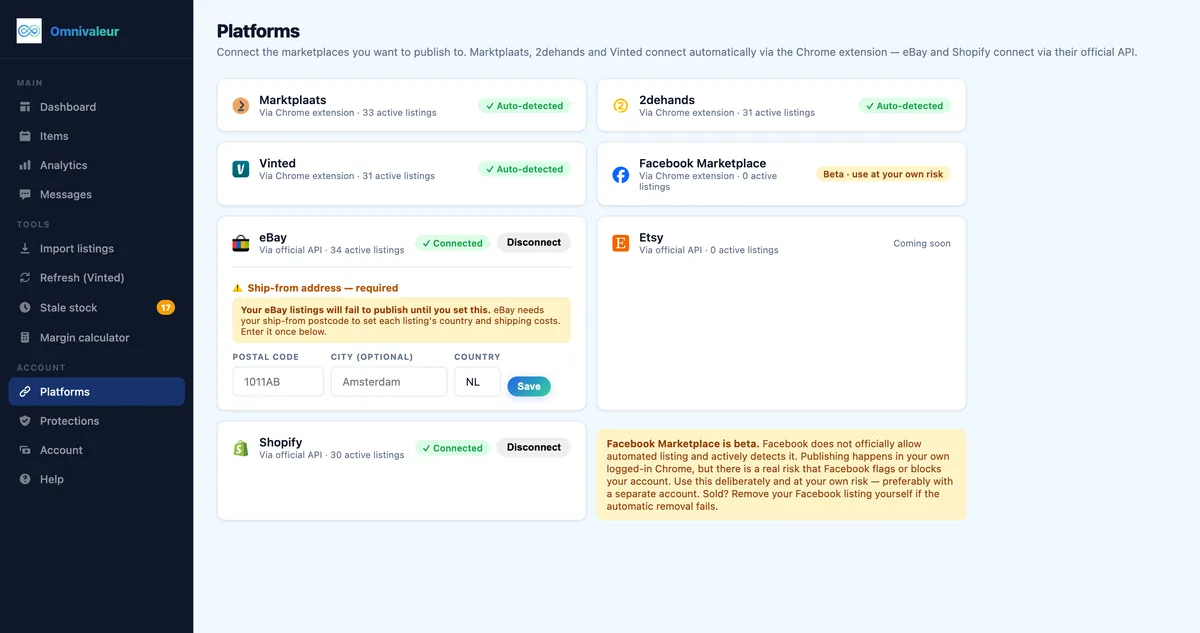
Cross-listing itself introduces its own risk if done carelessly: publishing the same item to five platforms simultaneously, with slightly different auto-generated condition text on each, is how sellers end up contradicting themselves in a dispute. Omnivaleur deliberately runs cross-listing one browser tab at a time rather than publishing in parallel — partly because parallel publishing is what gets marketplace accounts rate-limited, and partly because it forces a single, consistent source of truth for each listing's condition and price rather than five slightly different copies racing out the door.
If you're scaling past a handful of listings a week, it's also worth reviewing which Marktplaats fees actually apply in 2026, since fee structure and guarantee obligations tend to get reviewed by sellers at the same moment — usually right after their first dispute.
None of this replaces legal advice for a genuinely contested claim. For EU-wide consumer rights questions beyond the Netherlands specifically, the Your Europe consumer shopping guidance is the baseline reference, and for the tax side of frequent selling, the European Commission's DAC7 overview explains how the reporting obligation works across member states, not just in the Netherlands.
Frequently asked questions
Does Vinted's buyer protection replace the legal guarantee I owe as a seller?
What happens if I sell a faulty item and genuinely didn't know it was faulty?
Does using the VAT margin scheme change my warranty obligations?
Is it worth taking a €60 second-hand item to small claims court over a warranty dispute?
How long should I keep sales records after a transaction closes?
Keep reading


Stop copying listings by hand
Omnivaleur publishes your item to every platform at once and syncs stock automatically when something sells.
Start free trial