Vintage Clothing Reselling Automation Platforms Compared for 2026
Vintage clothing reselling automation platforms let you cross-list garments across Vinted, Marktplaats, eBay, Etsy and Shopify from one dashboard, syncing photos, era details and stock. In 2026 the strongest ones respect each marketplace's refresh limits, Etsy's 20-year vintage rule, and track profit from real sale price rather than asking price.
Key takeaways
- Etsy only allows the "vintage" tag on items genuinely 20+ years old, and mislabeled listings can get pulled
- Vinted refresh tools that promise unlimited relists are the ones most likely to get an account flagged
- Omnivaleur caps its own Vinted refresh tool at 8 free refreshes a day precisely because no tool can guarantee safety
- DAC7 reporting kicks in once a seller crosses 30 transactions or €2,000 in a calendar year on any EU platform
- Profit dashboards that use asking price instead of confirmed sale price overstate margins by roughly 10-20% on secondhand marketplaces
Vintage clothing resale runs on volume and detail at the same time, which is exactly what breaks most generic listing tools. You're not just moving stock — you're dating a 1970s Levi's tag, describing a moth hole honestly, and deciding whether a piece even qualifies as "vintage" on the marketplace you're posting to. A platform built for this niche needs to handle both the speed and the nuance, not just push the same title to five sites.
What Makes a Platform Built for Vintage Clothing Resellers Different?
A generic cross-listing tool duplicates a listing. A vintage-aware one adjusts it. That means separate category mapping for "vintage" versus "used" tags, condition fields that go beyond "good/fair/poor" into fade, pilling, and repair history, and photo handling that keeps label close-ups intact since buyers use them to verify decade and authenticity.
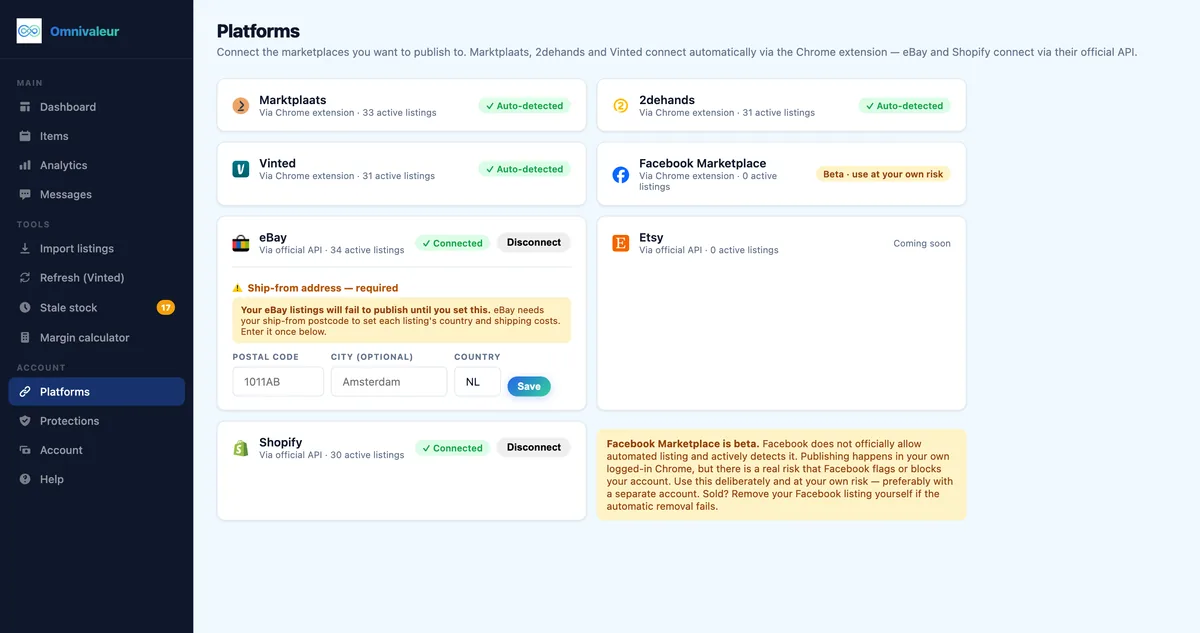
Most vintage resellers run three to five channels at once: Vinted for volume, Etsy for the vintage-specific buyer, eBay for rarer pieces, Marktplaats or 2dehands for local bulky lots, and sometimes a Shopify store for their own brand. Our broader fashion reselling automation platforms guide covers the category as a whole; this page zooms into what changes when the stock is specifically vintage rather than fast fashion or designer resale.
Which 2026 Marketplace Rules Affect Vintage Clothing Cross-Listers Most?
Three rule changes matter more for vintage sellers than for the average reseller this year.
- Etsy's vintage age threshold stays fixed at 20 years. A 2006 band tee is not vintage yet in 2026 — it's just old. List it as vintage and Etsy can deactivate it.
- Vinted keeps tightening automated relisting. Bots that refresh dozens of times an hour trigger review far faster than they did two years ago.
- DAC7 reporting thresholds are unchanged but enforcement is stricter. Marketplaces now report seller data to tax authorities more consistently across the EU, per the European Commission's DAC7 overview.
None of these are new concepts, but the gap between resellers who track them and those who don't gets more expensive every year — a suspended Vinted account mid-season or a delisted vintage batch on Etsy costs real revenue, not just admin time.
How Do Vinted's Refresh and Relist Limits Affect Vintage Sellers in 2026?
Vintage inventory sits longer than fast-fashion resale on average, since buyers are pickier about fit and era. That makes refreshing old listings tempting — bump them back to the top of search instead of relisting from scratch. But refresh tools are exactly the feature Vinted watches closest.
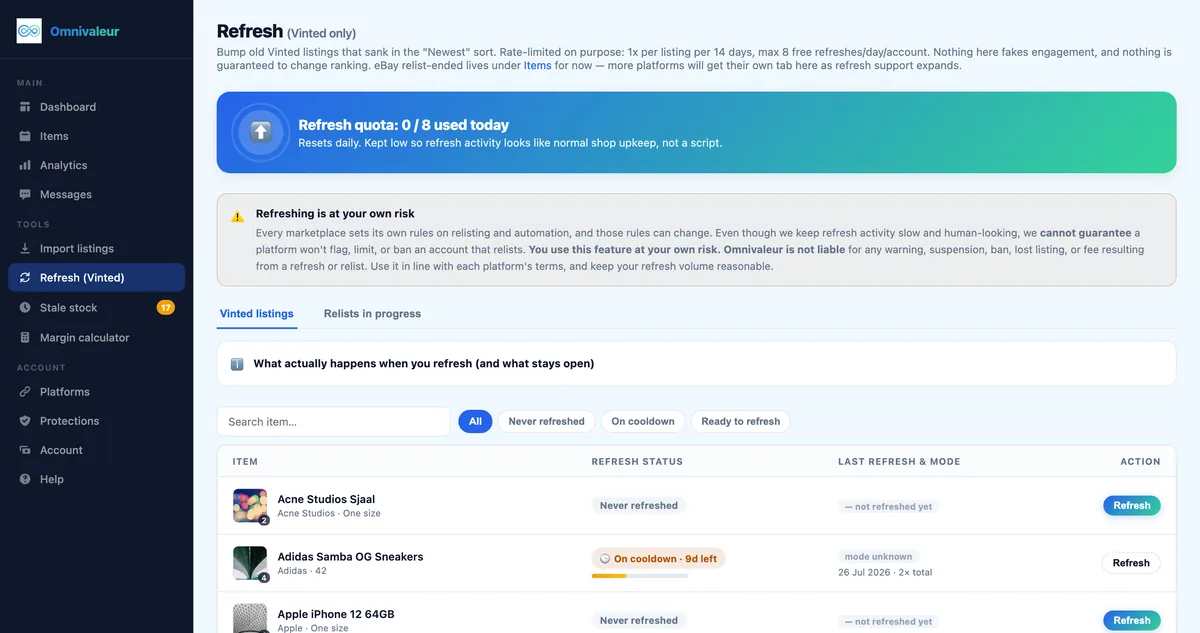
Omnivaleur's own refresh tool caps out at 8 free refreshes per day, and we say plainly that no automation tool, ours included, can guarantee an account won't get flagged for refresh activity. That's not a limitation we're hiding — it's the honest ceiling. Any platform promising "unlimited safe refreshes" is either overselling or hasn't been tested against Vinted's current detection since it tightened in 2025.
If you're running vintage inventory heavily on Vinted specifically, our dedicated Vinted reselling automation guide breaks down safer relisting cadences by category and how photo-only versus full-listing refreshes are treated differently.
A worked example
Say you have 60 vintage pieces live on Vinted. Refreshing all 60 daily with a bot is the fastest route to a review flag. Spreading 8 refreshes a day across your slowest-moving stock — the pieces sitting past 30 days — keeps activity inside normal seller behavior and still gives every item a boost roughly once a week.
Why Does Etsy's Vintage Rule Complicate Cross-Listing Automation?
Etsy defines vintage strictly: the item must be at least 20 years old at the time of listing, full stop. That's a moving target — a garment from 2006 becomes eligible in 2026, not before. A cross-listing tool that pulls the same category tag across all marketplaces will either mislabel Etsy listings or strip the vintage tag everywhere, losing you the search visibility vintage buyers specifically filter for.
The workaround is manual category overrides per platform, or a tool that lets you flag "vintage-eligible" stock separately from general "secondhand" stock. If you sell on both Vinted and Etsy from the same inventory, the Vinted to Etsy crosslisting guide walks through mapping categories so the same jacket doesn't get miscategorized on one side.
How Should Vintage Resellers Track Real Profit Instead of Asking Price?
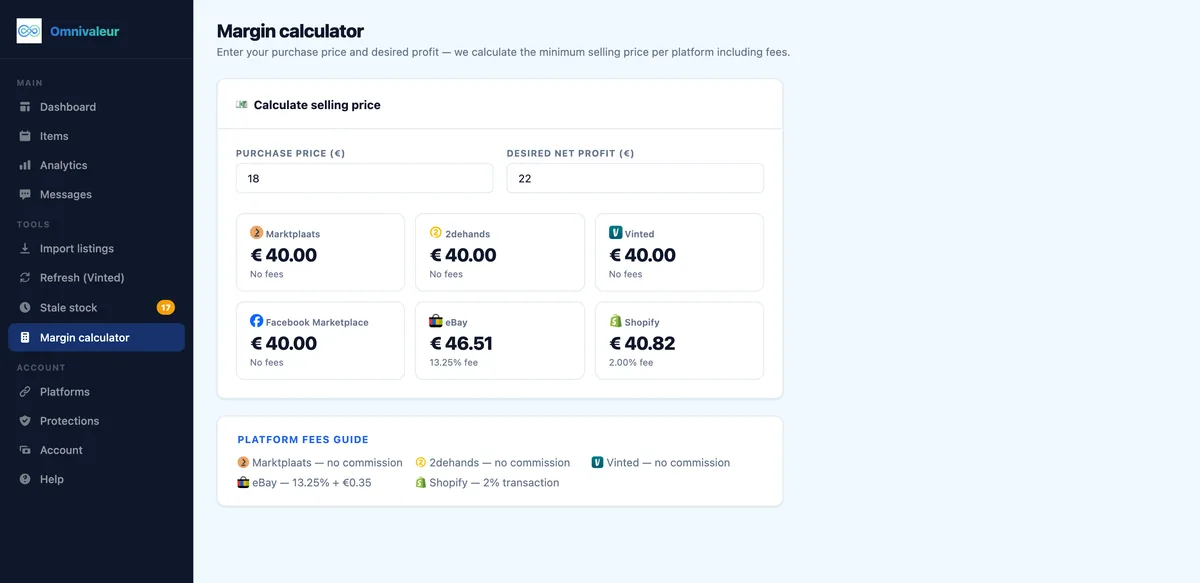
This is the metric most vintage resellers get wrong, and it's not a small gap. On secondhand marketplaces, the price a buyer actually pays typically lands 10-20% below the original asking price once negotiation, bundle discounts, and offer-based sales are factored in. A dashboard that calculates margin from your listed price rather than the confirmed sale price will consistently overstate how profitable your vintage business actually is.
Omnivaleur's analytics only calculate profit from the real sale price — the number you confirm when the item actually sells, not the number it was listed at. For a vintage reseller running dozens of negotiated sales a week, that difference compounds fast. If your spreadsheet says you made €2,400 profit this month based on asking prices, the real figure after negotiated discounts could realistically sit closer to €2,000-€2,150.
This matters even more for higher-ticket vintage — think 90s designer denim or archival pieces — where negotiation swings are larger in absolute terms. Our designer clothing reselling automation guide covers profit tracking for that higher end of the vintage/designer overlap in more depth.
Quick profit tracking checklist
- Confirm the actual sale price per item, not the listed price, before it hits your margin report
- Factor in marketplace fees separately per channel — Vinted's buyer protection fee lands on the buyer, but eBay and Etsy fees come out of your side
- Track shipping cost per item, not an average — vintage coats and vintage scarves have wildly different shipping economics
- Recalculate cost basis for lots and bundles rather than splitting evenly, since one piece in a bundle usually carries most of the resale value
- ✓Start with cross-listing sync across your main channels before adding refresh tools
- ✓Map categories separately per platform so Etsy's 20-year vintage rule doesn't strip tags on Vinted
- ✓Confirm actual sale price from each completed transaction, not your listed asking price
- ✓Track shipping cost per item type since vintage coats and scarves have different economics
- ✓Keep per-platform sales logs for DAC7 reporting since thresholds trigger independently on each marketplace
What Does DAC7 Mean for Vintage Clothing Resellers Specifically?
DAC7 requires online marketplaces to report seller income and transaction counts to tax authorities once a seller crosses 30 transactions or €2,000 in a calendar year on that platform, whichever comes first. For a vintage reseller cross-listing the same items across Vinted, Marktplaats and eBay, that threshold gets hit independently on each platform — meaning your Vinted account might trigger reporting while your Marktplaats account hasn't, even with identical revenue split across both.
The Belastingdienst's DAC7 information for sellers lays out the Dutch-specific reporting mechanics, and the European Commission's overview linked above covers how it applies across the EU generally. Practically, this means a vintage reseller running four or five channels should keep per-platform sales logs, not just one combined total — because that's how the marketplaces themselves are reporting you.
It's also worth knowing that DAC7 reporting doesn't automatically mean you owe more tax. It's a transparency mechanism, not a new tax. But undeclared income that used to slip through the cracks on casual Vinted sales is now visible to tax authorities in a way it wasn't a few years ago, so treating vintage reselling as a documented side business — even a small one — is the safer approach heading into 2026.
How Do You Choose an Automation Platform for a Vintage Wardrobe Business?
Match the platform to how your stock actually moves, not to the longest feature list.
| Feature | Why it matters for vintage clothing |
|---|---|
| Per-platform category mapping | Keeps Etsy's 20-year vintage rule separate from Vinted's general secondhand tags |
| Rate-limited refresh tools | Prevents relist activity that reads as bot behavior on Vinted |
| Real sale price profit tracking | Avoids overstated margins caused by negotiated discounts |
| Bundle and lot support | Vintage sellers frequently move multi-item lots that need separate cost logic |
| Multi-marketplace inventory sync | Stops double-sales when the same coat is live on three channels at once |
If you're comparing named tools directly rather than features, our head-to-head pages against Vendoo and against List Perfectly cover pricing tiers and refresh behavior specifically, which is usually the deciding factor for vintage sellers running high listing counts.
Volume tier examples
A reseller with under 50 active vintage listings usually does fine on a free or low-tier plan with manual refresh scheduling. Past 150 active listings across three or more marketplaces, automated cross-listing and rate-limited refresh tools stop being a convenience and start being the only realistic way to keep stock in sync without spending two hours a day copy-pasting.
Sellers who also run a local pickup channel — bulky vintage coats, for instance, where shipping cost eats the margin — often pair Marktplaats with Vinted for national reach. The Marktplaats to Vinted crosslisting guide covers that specific pairing, including how condition descriptions need adjusting between the two audiences.
What Consumer Protection Rules Apply When Selling Vintage Clothing Cross-Border?
Vintage clothing sold across EU borders — a French buyer purchasing from a Dutch seller on Vinted, for example — falls under standard EU consumer protection even on secondhand marketplaces. Buyers retain rights around accurate item descriptions and, depending on the platform's own policies, distance-selling withdrawal periods for certain transaction types. The Your Europe consumer shopping rights page is a useful reference if a buyer disputes an item's condition or claimed era.
For vintage specifically, this makes accurate condition and age descriptions more than a nice-to-have. Claiming an item is from the 1960s when it's a 1980s reproduction isn't just a marketplace policy risk — it can become a consumer complaint with real refund obligations attached.
What Should a Beginner Vintage Reseller Automate First?
Start with cross-listing sync before touching refresh tools or pricing automation. Getting the same accurate listing — photos, measurements, era, condition — onto two or three marketplaces correctly is worth more early on than squeezing extra visibility out of aggressive relisting. Once your listing workflow is solid, layer in profit tracking so you know which marketplace and which decade of stock actually earns you money, not just which one moves fastest.
A common beginner mistake is treating all vintage stock the same across channels. A 1970s band tee might sell in hours on Vinted but sit for months on Etsy without the right SEO keywords in the title — decade, brand, fabric, fit. Automation handles the posting; it doesn't write the vintage-specific copy for you, at least not well, so budget time for that even after your tech stack is sorted.
Frequently asked questions
Can I sell the same vintage item as "vintage" on Etsy but just "used" on Vinted?
Do vintage clothing platforms handle multi-item lot listings well?
How do I know if a vintage piece is old enough for Etsy's vintage category?
Does automating vintage listings increase the risk of account suspension?
Should I price vintage clothing the same across every marketplace?
Keep reading

Stop copying listings by hand
Omnivaleur publishes your item to every platform at once and syncs stock automatically when something sells.
Start free trial