Clothing Reselling Automation Tools for 2026: What Actually Works
Clothing reselling automation tools cross-list items across Vinted, Marktplaats, eBay, Etsy and Shopify, sync size and color variants, auto-delist sold stock, and calculate profit from the confirmed sale price. In 2026, the strongest tools also flag aging inventory and export DAC7-ready sales data, cutting weekly listing work by 5-10 hours for apparel resellers.
Key takeaways
- Clothing automation tools save apparel resellers 5-10 hours a week compared to manual cross-listing.
- Vinted, Marktplaats and eBay each enforce different clothing listing limits in 2026, so tools need per-platform tracking built in.
- Profit tracking only means something if it's based on the confirmed sale price, since asking price and final price differ by 10-20% on second-hand marketplaces.
- DAC7 reporting applies once a seller crosses 30 sales or €2,000 a year, and good tools export that data without extra spreadsheet work.
- Stale-stock alerts matter more for clothing than for most other resale categories, because seasonal apparel loses value fast.
Clothing resellers deal with a category almost no other reseller has to worry about: variants. A single hoodie can exist as five sizes, three colors and two condition grades, and every one of those combinations needs its own listing data on every platform. Generic listing software treats a t-shirt like a lamp. Clothing reselling automation tools don't — they're built around size charts, condition tags, and the fact that a Vinted closet behaves nothing like an eBay store.
What makes a tool "built for clothing" instead of just multichannel software?
Most cross-listing platforms advertise generic multichannel sync: post once, appear everywhere. That's fine for a single-SKU product. Clothing breaks that model fast. A real clothing automation tool needs three things a generic tool usually skips:
- Variant-aware templates — one item description, but size, color and measurement fields that map correctly to each marketplace's own taxonomy (Vinted's size dropdown isn't Marktplaats's free-text field isn't eBay's item specifics).
- Condition standardization — "very good" on Vinted, "gently used" on Etsy vintage listings, and eBay's own condition IDs all need to describe the same physical garment without contradicting each other.
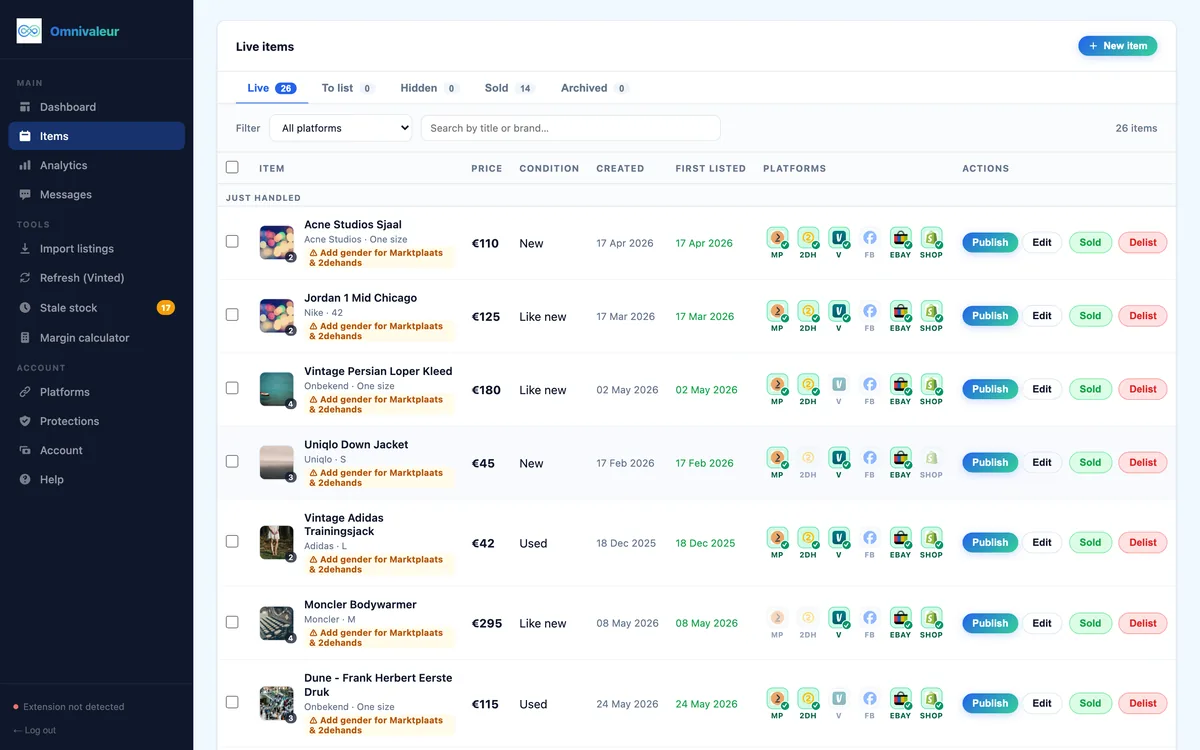
- Auto-delisting on sale — the moment a hoodie sells on Marktplaats, every duplicate listing on Vinted and eBay needs to disappear within minutes, not hours, or you're apologizing to a second buyer.
If a tool doesn't handle those three cleanly, it's a spreadsheet with a nicer interface, not a clothing automation platform. For resellers working specifically in higher-value apparel, the Designer Clothing Reselling Automation Guide 2026 goes deeper into authentication fields and brand-specific templates that general clothing tools often skip.
Which clothing-specific listing limits and rules changed for 2026?
Marketplace rules shift every year, and clothing gets hit harder than most categories because it's the highest-volume item type on most of them. Here's where things stand heading into 2026:
| Platform | Clothing-specific rule in 2026 | Why it matters for automation |
|---|---|---|
| Vinted | Closet-level throttling on bulk uploads within short time windows | Tools need to pace uploads instead of firing 50 listings at once |
| Marktplaats / 2dehands | Category-specific required fields (size, brand, material) for apparel ads | Missing fields get ads deprioritized in search, so mapping has to be exact |
| eBay | Mandatory item specifics (size, color, department) for clothing listings to qualify for best-match ranking | Manual listers often skip fields; automation should force them |
| Etsy | Vintage clothing must be genuinely 20+ years old to use the vintage category tag | Wrong tagging risks takedowns on cross-listed vintage pieces |
| Shopify | Variant cap of 100 combinations per product | Large size/color runs need to be split into multiple products, which manual sellers often get wrong |
None of these rules are dramatic on their own. Stacked across five platforms and fifty active listings, though, they're exactly the kind of detail that eats an evening if you're doing it by hand every week.
How do automation tools handle apparel variants like size, color and condition?
This is the part where clothing separates from everything else Omnivaleur's competitors write about. A vinyl record or a vintage camera has one condition and one price. A clothing lot has a matrix. The better tools store a single "master listing" per garment, then generate platform-specific child listings that pull size, color and condition from that master without you re-typing anything.
Practically, that means when you list a jacket in size M, size L and size XL, you're not creating three separate drafts. You create one item record with three size rows, and the tool spins out the correct format for Vinted's dropdown, Marktplaats's free-text field, and eBay's item specifics automatically. When one size sells, only that row gets pulled — the other sizes stay live everywhere else.
Condition mapping works the same way behind the scenes. You tag an item once as, say, "good, light pilling, no stains," and the tool translates that into the closest matching condition label per platform instead of forcing you to remember five different condition vocabularies.
What does clothing reselling automation actually save in hours and euros?
Resellers doing 20-40 clothing listings a week typically spend 3-5 minutes per item on manual cross-listing: photos, description, size fields, pricing, posting to each platform separately. At 30 listings a week, that's 90-150 minutes just on the listing step, before you've touched customer messages or delisting sold items.
Automation compresses that to one upload with variant handling built in, cutting the weekly time closer to 30-45 minutes for the same volume — a realistic 5-10 hour weekly saving once relisting and delisting are included.
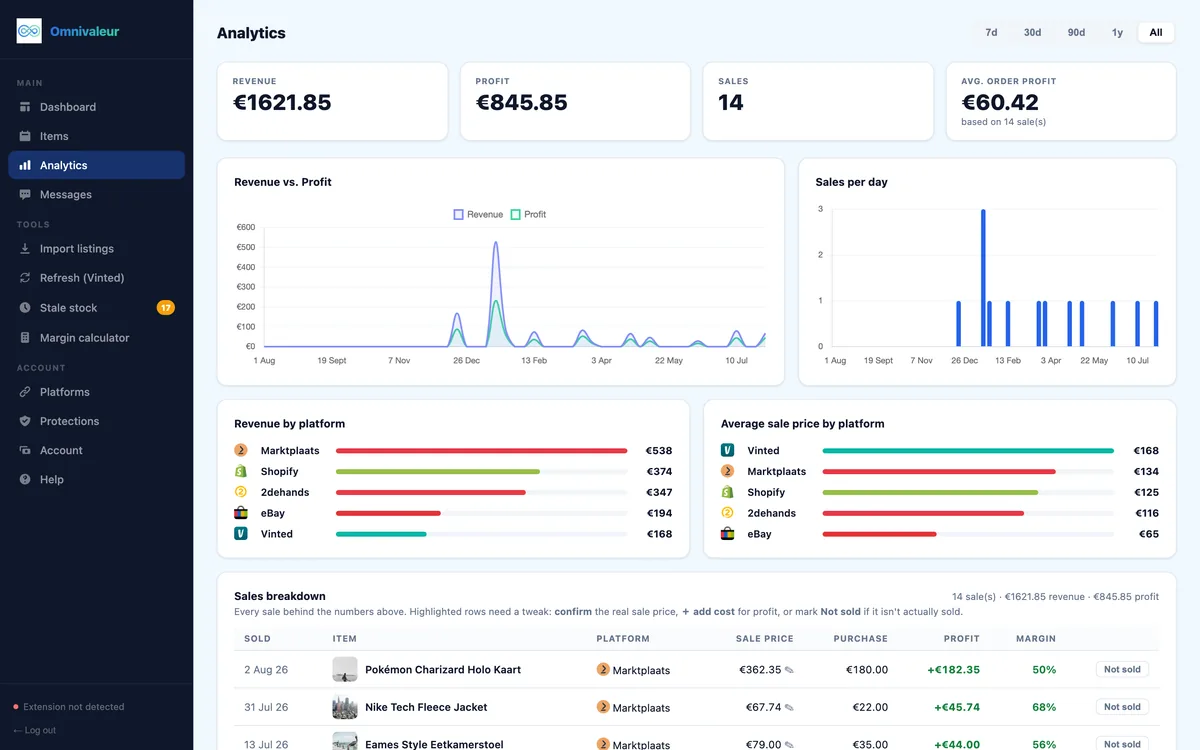
The money side is less visible but arguably more important. Omnivaleur calculates profit from the real, confirmed sale price that the seller marks per transaction, not the original asking price — and on second-hand marketplaces those two numbers typically diverge by 10-20% once negotiation, bundle discounts and platform promotions are factored in. A dashboard built around asking price will overstate your margin on almost every sale. That gap compounds fast if you're tracking profitability across 200+ items a month.
Which automation features matter most for cross-border EU clothing resellers?
Selling clothing across Dutch, Belgian, German and UK buyers adds friction that domestic-only sellers never see: size conversions (EU 38 vs UK 10 vs US 6), shipping cost tiers, and returns handling under different consumer protection rules. The EU's consumer shopping rights guidance spells out return windows that apply regardless of which marketplace processed the sale, which matters if you're cross-listing the same jacket to buyers in three countries at once.
For resellers moving stock between Dutch and international platforms specifically, two workflows come up constantly: shifting inventory from Marktplaats to Vinted for younger buyers, and pushing 2dehands stock onto Vinted for cross-border reach. Both are covered step by step in the Marktplaats to Vinted Crosslisting 2026 guide and the 2dehands to Vinted Crosslisting 2026 Guide, including the size-format mismatches that trip up manual sellers first.
Sneaker crossover deserves a separate mention, since footwear sits in a strange middle ground between "clothing" and its own resale ecosystem with authentication requirements. If sneakers make up a chunk of your inventory, the Best Sneaker Reselling Automation Platforms 2026 guide covers the size-grid quirks specific to that category.
- ✓Map your size, color and condition fields to each platform's taxonomy before uploading
- ✓Set up one master listing per garment, let the tool generate platform variants
- ✓Enable auto-delisting so sold items disappear from all platforms within minutes
- ✓Track real sale price, not asking price, for accurate profit per transaction
- ✓Flag stale stock regularly to avoid items buried under newer listings
- ✓Adjust condition language to match each platform's tone before publishing
How does DAC7 tax reporting affect clothing resellers specifically?
DAC7 requires marketplaces operating in the EU to report seller data to tax authorities once a seller crosses 30 transactions or €2,000 in sales within a calendar year — thresholds explained in detail by the Belastingdienst's DAC7 information for sellers and the European Commission's DAC7 overview. Clothing resellers hit that 30-transaction line faster than almost any other category, because individual items sell for less, which means more transactions to reach the same revenue.
A reseller doing 40 clothing sales a month across Vinted and Marktplaats crosses the 30-transaction threshold in less than a month. That's not a warning sign, it's just how the math works for apparel at volume — but it means your records need to be clean from day one rather than reconstructed later. Tools that log sale price, platform, and date per transaction as it happens make that reporting exercise a non-event instead of a January scramble.
How do you avoid the most common automation mistakes when reselling clothing at volume?
Three mistakes show up repeatedly once resellers scale past 50 active clothing listings:
- Ignoring stale stock. A size M in a color that isn't trending can sit unsold for months while newer listings bury it lower in your dashboard. Omnivaleur's stale-stock view flags exactly those listings that have been sitting unsold, so slow inventory surfaces at the top instead of quietly sinking to the bottom of a 300-item list.
- Trusting asking price as profit. Covered above, but worth repeating: if your profit tracker doesn't ask "what did this actually sell for," your margin numbers are fiction by 10-20%.
- Copy-pasting condition notes across platforms without adjusting language. Etsy buyers expect vintage-specific vocabulary; eBay buyers expect condition codes; Vinted buyers respond to casual, honest phrasing. A tool that lets one condition tag auto-translate into each platform's tone saves the awkward mismatch of a "flawless vintage piece" listing that also says "some wear, see photos" underneath.
Vintage clothing specifically has its own quirks worth flagging separately — the Vintage Clothing Reselling Automation Platforms 2026 Guide covers age verification and category tagging in more depth than a general clothing workflow needs to. If you're weighing which software to commit budget to, the Omnivaleur vs List Perfectly Honest 2026 Comparison breaks down pricing and feature gaps side by side rather than in marketing language.
Resellers starting from thrift and charity-shop sourcing face a slightly different problem: high volume, low unit price, and huge variance in condition. That workflow is walked through separately in the Thrift Store Reselling Automation 2026 Full Setup Guide, which pairs well with everything above if sourcing is your bottleneck rather than listing.
Clothing reselling automation isn't about listing faster for the sake of speed. It's about not losing money to bad variant mapping, not missing a DAC7 threshold you didn't track, and not letting three unsold hoodies from last winter quietly cost you shelf space and cash flow. Get the size and condition data structured once, and every platform after that is just a formatting problem, not a re-listing job.
Frequently asked questions
Do I need a different automation tool for clothing than for general secondhand items?
Can automation tools handle both new and secondhand clothing listings together?
How do returns work when a clothing item is cross-listed and sold on a different platform than expected?
Is it worth automating clothing reselling if I only list a handful of items per week?
Do clothing automation tools handle seasonal price adjustments automatically?
Keep reading

Stop copying listings by hand
Omnivaleur publishes your item to every platform at once and syncs stock automatically when something sells.
Start free trial