Vintage Decor Reselling Automation in 2026: Cross-List Without the Breakage
Vintage decor reselling automation means listing a lamp, mirror or ceramic piece once and pushing it automatically to Marktplaats, 2dehands, eBay, Etsy and Shopify, with stock synced so a sold item disappears everywhere else within minutes. Vinted stays limited for decor because of size and category rules.
Key takeaways
- Vinted's Home category rejects most large or fragile decor, so treat Marktplaats, 2dehands, eBay, Etsy and Shopify as your real decor channels.
- Etsy only lets you tag an item "vintage" if it's genuinely 20 years or older, which covers most mid-century and retro decor.
- DAC7 reporting triggers once a seller hits 30 transactions or €2,000 on a single platform in a calendar year, across the whole EU.
- Omnivaleur's stale-stock view flags decor listings sitting unsold instead of letting slow inventory quietly sink to the bottom of the list.
- Cross-listing one tab at a time, on purpose, keeps marketplace accounts under the radar instead of triggering rate-limit flags.
Vintage decor is a strange category to sell. A brass floor lamp, a set of Scandinavian ceramic vases, a gilded wall mirror — none of it fits neatly into the boxes marketplaces built for clothing or electronics. That mismatch is exactly why decor resellers lose more time than sneaker or clothing flippers on the same manual cross-listing work. Automation closes that gap, but only if you understand which platforms actually want breakable, oversized, one-of-a-kind items in the first place.
What Actually Counts as "Vintage Decor" for Cross-Listing Purposes?
Marketplaces disagree on the word "vintage," and that disagreement matters for your listings. Etsy has a strict rule: an item must be at least 20 years old to carry the vintage label. A 2006 lava lamp qualifies in 2026; a 2010 IKEA mirror does not, no matter how "retro" it looks. Get this wrong and Etsy can suppress or remove the listing.
Marktplaats and 2dehands don't enforce an age rule at all — "vintage" there is just a search term buyers type in, not a category gate. eBay sits in between: it has a dedicated Antiques & Vintage hub but doesn't police the 20-year threshold as tightly as Etsy does. That inconsistency is one reason decor resellers who also handle other niches, like the ones running a vintage camera reselling automation setup or a vintage book reselling automation workflow, keep separate title templates per platform rather than reusing one description everywhere.
Which Marketplaces Actually Want Your Vintage Decor in 2026?
Not every marketplace in your cross-listing stack is worth the listing fee for decor specifically. Here's how the six main ones actually behave for a category built on breakables and odd dimensions.
| Platform | Decor fit | Key restriction in 2026 | Typical fee |
|---|---|---|---|
| Marktplaats | Strong — local pickup avoids shipping breakage | Business sellers pay a listing fee tier introduced for high-volume accounts | Free for private, tiered for pro |
| 2dehands | Strong — same local-pickup logic as Marktplaats | Mirrors Marktplaats rules for Belgian sellers | Free for private, tiered for pro |
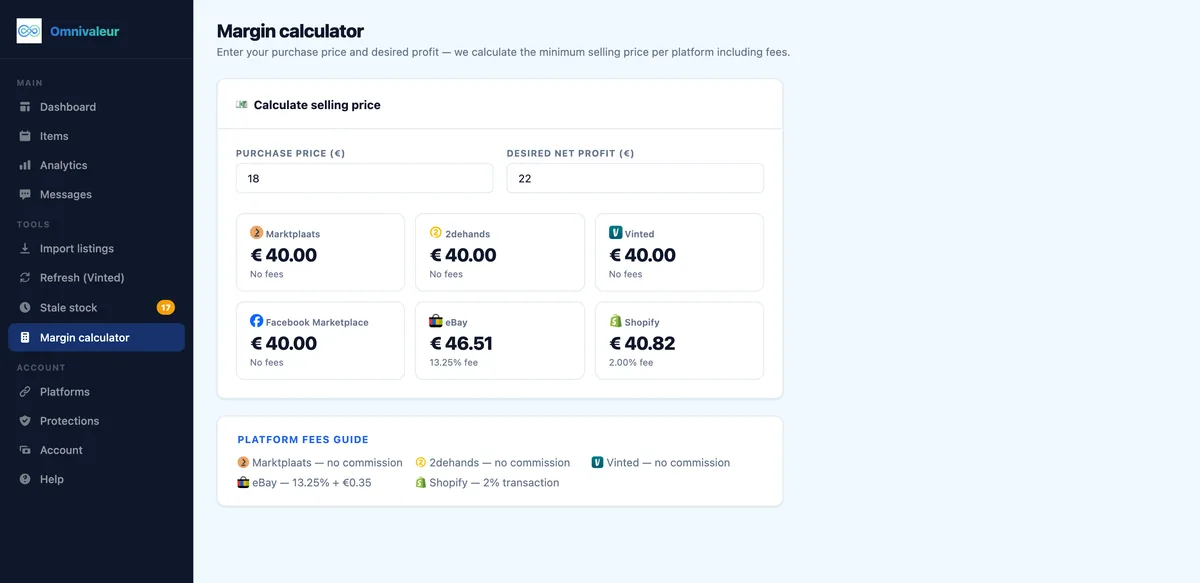
| Vinted | Weak — Home category exists but caps size and excludes electrical items | No candles, no large furniture, limited to small decorative pieces | Buyer pays protection fee, seller pays nothing |
| eBay | Good — dedicated Antiques & Vintage hub, works for shipped items | Final value fee runs around 13% in the Home & Garden category | ~13% final value fee |
| Etsy | Excellent — buyers actively search "vintage decor" | 20-year age rule enforced, must be tagged correctly | $0.20 listing + 6.5% transaction fee |
| Shopify | Good for building a repeat-buyer decor brand | No marketplace discovery, you drive your own traffic | Monthly plan + payment processing |
Notice Vinted sits at the bottom for decor. It was built for clothing, and even though the platform added a Home category, it still caps package dimensions and bans a long list of electrical or flammable items — no vintage lamps with original wiring, no candle holders sold with wax included. If your stock leans heavily fragile-and-large, budget your cross-listing effort toward Marktplaats, 2dehands, eBay, Etsy and Shopify, and treat Vinted as a bonus channel for the small, safely-shippable pieces only.
How Do Shipping and Breakage Risk Change Your Automation Strategy?
Clothing resellers fold a shirt into a poly mailer and move on. Decor resellers can't do that with a ceramic bowl or a framed mirror. This changes three things about how you should run cross-listing software.
- Local-only flags: Set items over a certain weight or fragility as pickup-only on Marktplaats and 2dehands, and shipped-only on eBay and Etsy where you control packaging cost in the price.
- Price padding for insurance: A €40 mirror that costs €12 to ship safely and insure needs a different base price than the same €40 item picked up locally. Build that margin into your listing templates before you cross-list, not after a claim.
- Photo proof at packing time: Photograph the item packed, before sealing the box. Under the EU's consumer shopping rights, buyers can often dispute condition on arrival, and a packing photo settles most disputes in your favor within minutes instead of days of back-and-forth.
This is also where cross-listing speed genuinely matters less than people assume. A vintage decor reseller doesn't need five simultaneous browser tabs blasting a listing everywhere at once. Omnivaleur runs cross-listing one tab at a time on purpose — publishing in parallel is exactly what gets marketplace accounts rate-limited or temporarily locked, and a locked eBay account mid-sale on a fragile item is a worse outcome than a listing that goes live 90 seconds later than it could have.
What 2026 Fee and Policy Changes Should Decor Resellers Know About?
A few platform changes landed or tightened heading into 2026 that specifically hit the decor category harder than clothing or electronics:
- Marktplaats business-seller tiers. Sellers moving more than a set number of listings per month now sit in a paid tier rather than the free private-seller bracket. If you're scaling decor past a hobby, check your account status before you get flagged for reclassification.
- eBay's Home & Garden fee structure. The final value fee for this category sits close to 13%, higher than several clothing categories, which erodes margin fast on lower-priced decor items under €25.
- Etsy's stricter vintage tagging enforcement. Automated checks now flag listings tagged "vintage" without a clear age indication in the title or description, so add the decade or era explicitly ("1970s ceramic vase," not just "vintage vase").
These changes echo what's happened in adjacent niches too — resellers running collectibles reselling automation workflows have seen similar tightening on authenticity and age claims, and the lesson carries over directly to decor.
How Does DAC7 Tax Reporting Affect Vintage Decor Sellers?
If you're cross-listing decor across multiple platforms and actually making money at it, DAC7 applies to you whether you've heard of it or not. Under the EU-wide rule, a marketplace must report your sales data to tax authorities once you hit 30 transactions or €2,000 in a calendar year on that single platform. That threshold applies per platform, not combined — so a reseller who does 25 sales on Marktplaats and 25 on eBay might not trigger reporting on either individually, but should still track total income honestly.
The Belastingdienst's DAC7 guidance for sellers spells out exactly what data platforms collect — your name, address, tax ID and bank details — and the European Commission's DAC7 overview covers how this applies uniformly across EU member states. For decor resellers specifically, this matters more than it sounds: decor items often sell for higher average prices than fast fashion, so you can hit the €2,000 threshold on far fewer transactions. Ten €200 mirrors gets you there just as fast as forty €50 t-shirts.

How Can Automation Handle Slow-Moving Decor Inventory?
Decor sells slower than clothing, on average. A vintage jacket might move in two weeks; a specific brass wall sconce might sit for three months waiting for the right buyer who has that exact gap on their wall. That's not a sign you priced it wrong — it's the nature of the category. But it does mean your cross-listing tool needs to surface stale stock actively instead of letting it disappear into page four of your listings.
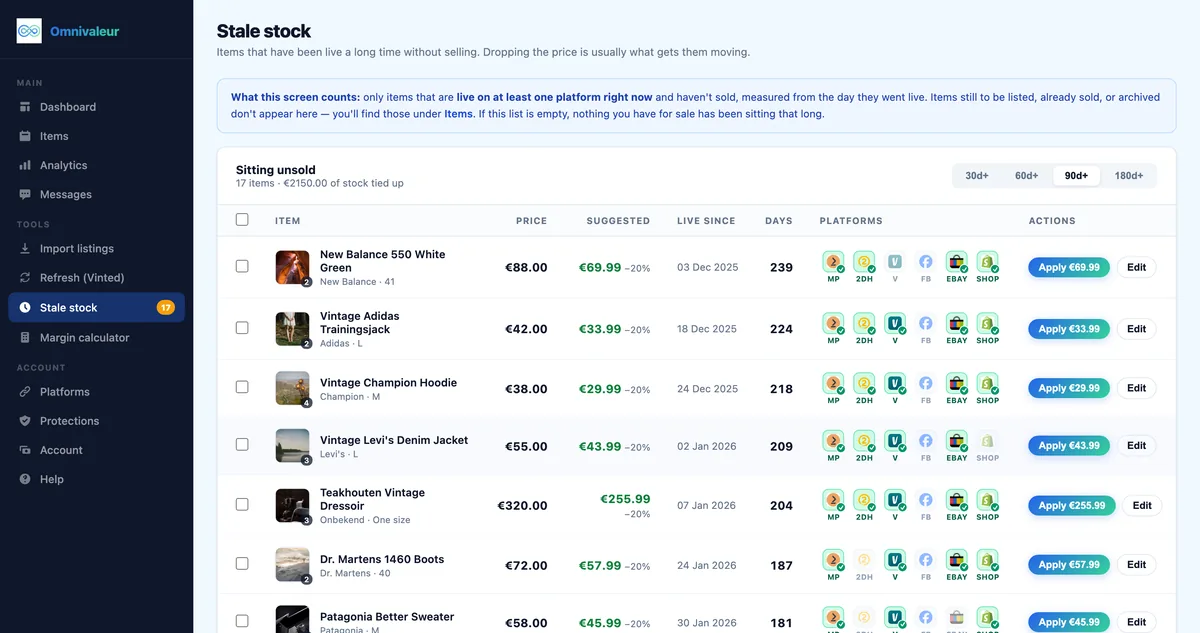
This is where Omnivaleur's stale-stock view earns its keep specifically for decor sellers: it flags listings that have been sitting unsold for a set stretch, so a lamp that's been live for 80 days without a single message shows up front and center instead of quietly sinking down the list where you forget it exists. From there you can reprice, reshoot the photos, or move it to a platform where decor performs better — Etsy and eBay tend to outperform Vinted for anything past "small trinket" size.
Compare this to how the tooling landscape handles clothing-heavy portfolios, covered in depth in the vintage clothing reselling automation platforms guide — clothing turnover metrics don't map cleanly onto decor, which is exactly why a stale-stock view matters more here than in fast fashion.
What Listing Details Matter Most When Cross-Listing Decor Photos and Descriptions?
Decor buyers shop differently than clothing buyers. Nobody's checking a size chart. They're checking whether a mirror fits an 80cm gap, whether a vase's chip is visible from the front, whether the lamp's cord is original or replaced. Your cross-listing templates need to answer those questions without the buyer messaging you first.
- Measurements in the first three lines. Height, width, depth — not buried at the bottom of a long description.
- Condition photos of every flaw. A hairline crack photographed clearly sells better than a flaw discovered after delivery and disputed.
- Era and origin stated plainly. "1960s West German ceramic" sells faster and ranks better in search than "cool retro vase."
- Weight for shipping-sensitive platforms. eBay and Etsy buyers calculate total cost including shipping before they click buy — hide that number and you lose the sale to a competitor who states it upfront.
If you're weighing which cross-listing tool handles this kind of detail-heavy template work best, the comparison in Omnivaleur vs List Perfectly: Honest 2026 Comparison breaks down how each platform handles custom fields for measurements and condition notes, which matters more for decor than for almost any other category. The same goes for sellers weighing Omnivaleur vs OneShop before committing to a stack.
Once your templates are solid, expanding into adjacent marketplaces gets simpler. A reseller moving stock from a Belgian classifieds account onto Etsy's global audience, for instance, can follow the same logic laid out in the 2dehands to Etsy Crosslisting 2026 guide — decor travels well internationally precisely because a mid-century Danish vase doesn't need a size conversion chart the way a pair of jeans does.
What Should a First-Month Decor Cross-Listing Workflow Look Like?
Start with 15-20 items, not your entire storage unit. Photograph everything with the same lighting setup so batch-editing doesn't turn into a full afternoon per item. Write your master listing on whichever platform has the strictest rules — usually Etsy, because of the vintage age requirement — then let the cross-listing tool adapt title length and category mapping for the others.
Set pickup-only rules for anything over roughly 5kg or with glass components wider than 30cm. Ship everything else, padded generously, with the packed photo taken before sealing. Check your stale-stock flags weekly rather than daily — decor doesn't move fast enough for daily checks to tell you anything new, and checking too often just wastes time you could spend sourcing.
Frequently asked questions
How do I price fragile vintage decor without racing to the bottom across platforms?
Can I use different photos for the same decor item on different platforms?
Who's liable if a vintage decor item breaks in shipping?
Do I need to register as a business to sell vintage decor at scale in the EU?
How many platforms should a solo decor reseller actually run at once?
Keep reading


Stop copying listings by hand
Omnivaleur publishes your item to every platform at once and syncs stock automatically when something sells.
Start free trial