Vintage Jewelry Reselling Automation: The Complete 2026 Cross-Listing Guide
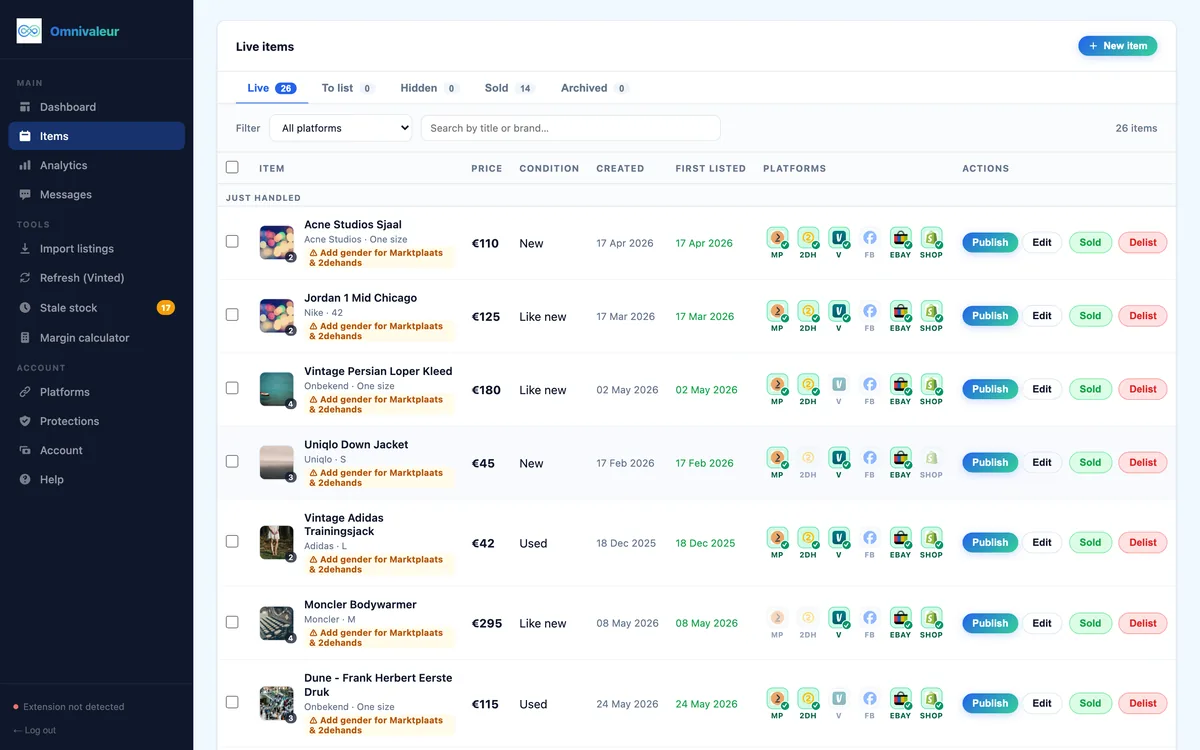
Vintage jewelry reselling automation means using one tool to publish a single item to Marktplaats, 2dehands, Vinted, eBay, Etsy and Shopify at once, then syncing stock and price when it sells anywhere. A typical piece runs 3-5 active listings simultaneously, each tracked separately by platform status.
Key takeaways
- A single jewelry item usually needs 3-5 active listings running at the same time to sell fast
- Etsy still requires an item to be at least 20 years old to legally qualify as "vintage" in its own category rules
- Vinted's refresh tools cap free bumps at 8 per day, and no automation tool can promise a marketplace won't flag the account
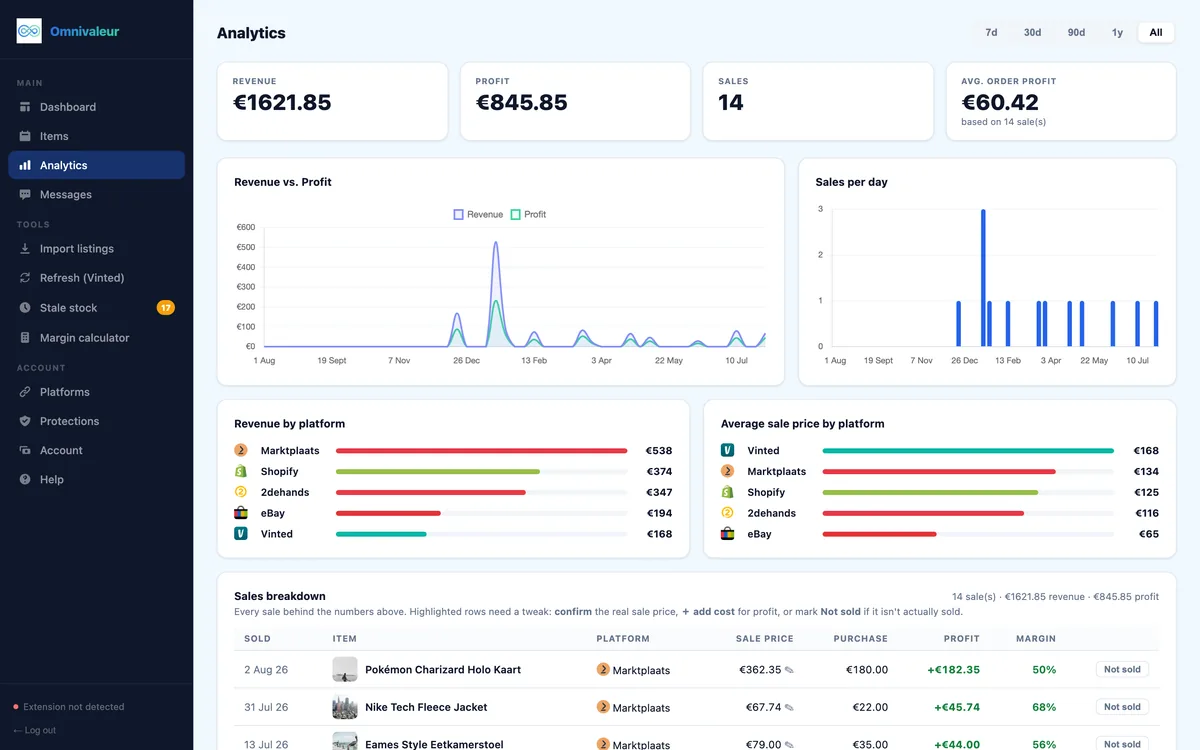
- DAC7 reporting kicks in once a seller crosses 30 sales or €2,000 in a calendar year, jewelry included
- Hallmark and material fields differ per platform, so copy-paste titles alone will not pass Etsy or eBay category checks
Jewelry sells differently than clothing. A ring photographs in four angles instead of one flat lay, its condition depends on a hallmark you can barely read, and buyers on Etsy expect an actual manufacture date, not a vague "vintage vibe." That's the gap in most reselling-automation advice written for clothes and sneakers: it never mentions what happens when the item is 2cm wide and made of silver.
What Does "Vintage Jewelry Reselling Automation" Actually Mean in 2026?
In practice, it means three things working together: one photo set feeding multiple marketplaces, one inventory count that updates everywhere an item sells, and one dashboard showing which platform actually moved the piece. It is not a bot that "finds" jewelry for you — the tools that promise fully automated vintage buying rarely account for authentication, and jewelry is one of the categories where a wrong material claim gets a listing pulled fast.
What changed by 2026 is the rulebook. eBay tightened its Authenticity Guarantee scope for fine jewelry over €500. Etsy pushed sellers harder on proving genuine vintage status. Vinted expanded its accessories category but kept jewelry buyer protection fees separate from clothing. None of that shows up in generic "best reselling software" round-ups built around CRM tools like Zoho or Upwork freelancers — those solve outsourcing, not compliance.
How Many Listings Does One Piece of Jewelry Need Across Marketplaces?
More than resellers assume. A single vintage brooch or Art Deco ring typically carries 3-5 active listings at once across Marktplaats, 2dehands, Vinted, eBay and Etsy — and a decent cross-listing app tracks the status of each one separately, so you know instantly that the Etsy listing is live, the eBay one needs a category fix, and Vinted already sold the piece.
That number isn't arbitrary. Jewelry buyers browse by platform habit: Dutch buyers default to Marktplaats and 2dehands for local pickup on anything with real gold or silver content, Vinted buyers skew younger and cheaper, eBay pulls in international collectors searching by hallmark or maker's mark, and Etsy buyers specifically filter for "vintage" tags. Listing on only one platform means missing three of those four buyer habits entirely.
For sellers running a broader vintage business, the same logic applies to vintage clothing reselling automation platforms and to designer clothing reselling automation — jewelry just compresses the cycle because pieces are smaller, cheaper to ship, and sell faster once visible everywhere.
What Are Etsy's Vintage Rules for Jewelry Sellers in 2026?
Etsy still enforces its 20-year rule: an item must be at least 20 years old at the time of listing to sit in the Vintage category. A 2006 costume necklace qualifies in 2026; a 2010 piece does not, no matter how "retro" it looks. Sellers who mislabel items risk a category strike, and repeated strikes affect shop visibility in Etsy search.
Etsy also asks for a manufacture decade in the item details, which most cross-listing tools don't pull automatically from a Marktplaats or eBay draft. That field has to be filled manually, at least once, per item template. It's small, but it's the single most common reason vintage jewelry listings get flagged for review on Etsy.
Practical checklist before publishing to Etsy
- Confirm the manufacture decade (not just "vintage" as a description word)
- Use the exact metal terminology Etsy recognizes: sterling silver, gold-filled, gold-plated — not "silver-toned"
- Include at least one macro photo of the hallmark or maker's mark, even if blurry
- Separate "vintage" from "antique" (Etsy defines antique as 100+ years old)
How Do Vinted's Refresh Limits Affect Jewelry Sellers?
Vinted rewards fresh listings in its algorithm, so sellers bump items to push them back to the top of search. Omnivaleur's Vinted refresh tool caps itself at 8 free refreshes per day, and states outright that no tool — theirs included — can guarantee Vinted won't flag an account for aggressive refreshing. That's an honest limit worth knowing before you build a jewelry-heavy Vinted strategy around bumping fifty items a day; Vinted's own anti-spam detection doesn't care whether the refreshing is manual or automated.
For jewelry specifically, refreshing matters less than photo quality. A ring or pendant buried on page 6 of Vinted search rarely gets found by refresh alone — better lighting and a cleaner background move the needle more than a daily bump ever will.
Do You Need to Report Vintage Jewelry Sales for Tax Purposes?
Possibly, yes. Under DAC7, EU marketplaces must report seller activity to tax authorities once a seller crosses 30 sales or €2,000 in a calendar year on that platform — jewelry counts the same as clothing or electronics. The Belastingdienst's DAC7 seller information page lays out exactly what data platforms collect, and the European Commission's DAC7 overview covers how the rule applies across all EU member states, not just the Netherlands.
Jewelry sellers hit that threshold faster than clothing sellers because average sale prices are higher — a handful of gold pieces can cross €2,000 well before 30 transactions. Keep receipts for what you paid at flea markets or estate sales; if a platform ever asks for cost basis, you'll want it on hand rather than reconstructed from memory. Buyers, meanwhile, retain standard protections under EU consumer shopping rights, including return windows that apply differently on marketplace sales versus private Marktplaats listings — worth mentioning in your listing description to cut down on disputes.
Which Marketplaces Are Actually Worth Cross-Listing Vintage Jewelry To?
Not every platform earns its place in a jewelry seller's rotation. Here's how the six main options compare in 2026:
| Platform | Typical fee | Best jewelry fit | Buyer type |
|---|---|---|---|
| Marktplaats | Free listing, optional paid boost | Local pickup, higher-value gold/silver | Dutch, cautious of shipping fragile items |
| 2dehands | Free listing, optional paid boost | Belgian equivalent, same buyer logic | Belgian, local pickup preferred |
| Vinted | No seller fee, buyer pays protection fee | Costume and fashion jewelry under €40 | Younger, price-sensitive |
| eBay | ~12-13% final value fee on jewelry | Signed pieces, hallmark collectors | International, search by maker's mark |
| Etsy | 6.5% transaction fee + $0.20 listing fee | Verified vintage, 20+ years old | Buyers actively searching "vintage" |
| Shopify | Monthly subscription, no per-sale cut | Own branded jewelry storefront | Repeat customers, brand builders |
Notice that no single platform covers every buyer type. That's the entire argument for cross-listing rather than picking one marketplace and hoping. If your business already spans Marktplaats to eBay cross-listing, adding jewelry as a category is mostly a matter of setting the right templates once — the workflow doesn't change.
Sellers coming from Vinted often want to push their better costume pieces to Etsy once they're confident about age and materials; that move follows the same pattern covered in the Vinted to Etsy cross-listing guide, just with jewelry-specific fields swapped in for clothing sizes.
How Should You Handle Hallmarks, Materials and Authenticity Data Across Platforms?
Every platform asks a slightly different question about the same physical object. Marktplaats wants a plain-language description. eBay wants a structured "Metal" and "Metal Purity" field pulled from item specifics. Etsy wants a materials tag list. If you fill those in by hand on five sites, you'll eventually contradict yourself — calling something "925 silver" on eBay and "silver-plated" on Etsy, which is exactly the kind of inconsistency that triggers buyer disputes.
The fix is building one master description with every fact you can verify: hallmark reading, approximate weight, any visible maker's mark, closure type, and stone identification if you're confident about it (or "unverified" if you're not — never guess on gemstone authenticity). A cross-listing tool that maps that master template into each platform's specific fields saves the rewrite, and it means the eBay listing and the Etsy listing describe the exact same object, just formatted for each site's rules.
Where jewelry differs from designer clothing automation
Clothing automation leans heavily on size charts and brand tags. Jewelry automation leans on measurements (ring size, chain length in cm) and material claims that carry legal weight — calling something "gold" when it's gold-plated is a returns problem, not a cosmetic one. Anyone running both categories side by side, similar to the workflow in the jewelry reselling automation guide, will notice the templates need separate logic even inside the same tool.
What Packaging and Shipping Problems Are Unique to Jewelry Resale?
Small items create their own headaches. A ring shipped in a padded envelope instead of a small box is the single biggest cause of "item damaged in transit" claims on eBay for jewelry sellers — clasps bend, stones loosen, chains tangle. Insurance thresholds matter too: most carriers won't automatically cover items over roughly €500 without declared value, so pieces above that line need tracked, insured shipping regardless of which platform sold them.
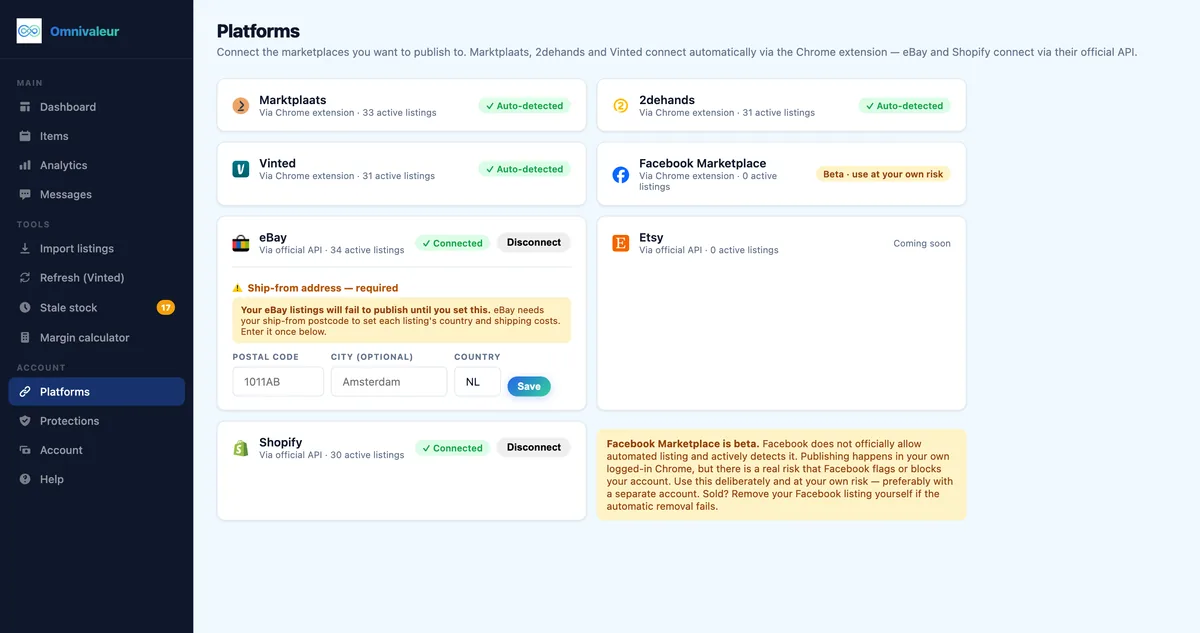
Cross-border shipping adds another layer. A Dutch seller shipping a vintage brooch to a German eBay buyer deals with different customs-free thresholds than one shipping the same item to a UK buyer post-Brexit. Etsy buyers, being used to a "handmade and vintage" marketplace, tend to expect more detailed tracking information than a typical Marktplaats buyer picking up locally — build that expectation gap into your shipping templates rather than using one generic note across all five platforms.
Weighing packaged jewelry accurately also avoids a common surprise: postal scales round up, and a padded envelope with bubble wrap often crosses into the next weight bracket. Sellers who quote flat shipping without checking this lose margin on every single order, which adds up fast when average sale prices sit around €25-60 for costume jewelry.
How Does Vintage Jewelry Compare to Other Automated Reselling Niches?
Jewelry sits in an odd spot between low-effort clothing flips and high-effort collectible categories like cameras or vinyl. It ships cheap, photographs fast once you have a lightbox, and sells across a wider buyer age range than sneakers or gaming gear. But it also carries more compliance risk per item than, say, tool and equipment reselling, because material and age claims are checkable and disputable in a way a used drill rarely is.
If you're deciding where to expand a resale business in 2026, jewelry is worth adding specifically because it cross-lists well with existing vintage clothing inventory — the same buyer who wants a 1970s dress often wants the matching costume necklace, and listing both from one photo session saves real time.
How Do You Choose a Cross-Listing Tool for Jewelry Specifically?
Not every general reselling tool handles small-item categories well. Before committing, check whether the tool supports custom material and hallmark fields, whether it maps ring size or chain length correctly into eBay and Etsy item specifics, and whether its refresh or relist feature explains its own limits honestly rather than promising unlimited safe bumping. Comparisons like Omnivaleur vs List Perfectly are worth reading for exactly this reason — the differences show up in the small-category details, not the headline feature list.
Frequently Asked Questions
See below.
Frequently asked questions
Can vintage jewelry automation tools verify if a stone is real or a synthetic replica?
Does Vinted charge sellers a fee for jewelry listings the way eBay does?
How do I photograph small jewelry items well enough for automated cross-listing?
What happens if the same jewelry piece sells on two platforms at once?
Is it worth listing vintage jewelry on Shopify instead of only marketplaces?
Keep reading
Stop copying listings by hand
Omnivaleur publishes your item to every platform at once and syncs stock automatically when something sells.
Start free trial