Tool and Equipment Reselling Automation: The Complete 2026 Guide
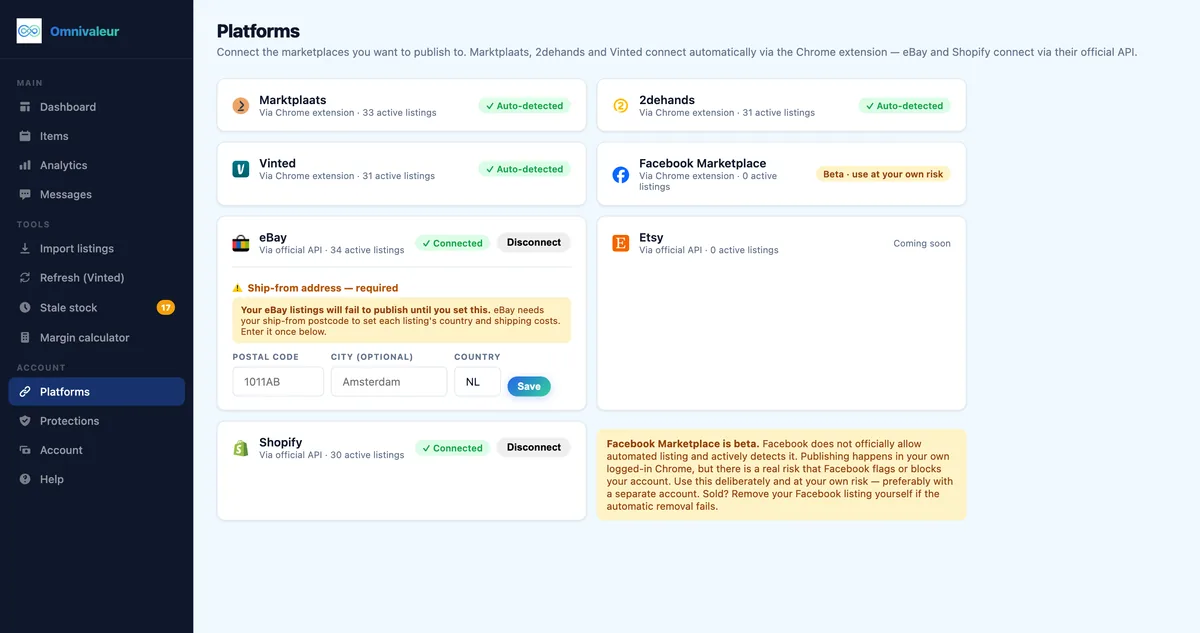
Tool and equipment reselling automation means using software like cross-list to list drills, mowers, generators and hand tools once and push them to Marktplaats, 2dehands, eBay, Vinted, Etsy and Shopify simultaneously — syncing stock, price and sold status so a hammer set sold on eBay disappears from Marktplaats within minutes, not hours.
Key takeaways
- A single tool listing typically runs on 3-5 platforms at once, each tracked separately by status
- Battery-powered tools face shipping restrictions on eBay and Etsy that Marktplaats and 2dehands don't enforce
- DAC7 rules mean any reseller over 30 sold items or €2,000 a year gets reported to Dutch tax authorities automatically
- Free Vinted refresh tools cap out around 8 uses per day — anything claiming unlimited refreshes is lying
- Heavy or bulky equipment changes your shipping math enough to make local-pickup platforms worth prioritizing
Selling used power tools, ladders, generators and garden equipment is not the same business as selling t-shirts. Weight matters. Batteries matter. Certification labels matter. Most reselling automation guides written in 2025 skip all of that and talk about AI photo editing instead. This one doesn't.
What makes tool and equipment reselling different from clothing or collectibles automation?
Three things: weight, hazard classification, and buyer trust. A cordless drill with a lithium battery can't ship the same way a sweater does. A used circular saw needs a condition description that actually protects you legally if the blade guard is missing. And buyers searching for tools care more about whether something still works than whether the photos are pretty.
That changes your automation priorities. Instead of obsessing over auto-generated descriptions, a tool reseller needs a system that:
- Flags which platforms allow battery-powered or fuel-powered items before you accidentally get a listing pulled
- Keeps local-pickup-only listings (heavy items) separate from shippable ones
- Tracks serial numbers or model numbers across marketplaces for warranty and counterfeit disputes
- Syncs sold status instantly so you're never explaining to two buyers why the same air compressor sold twice
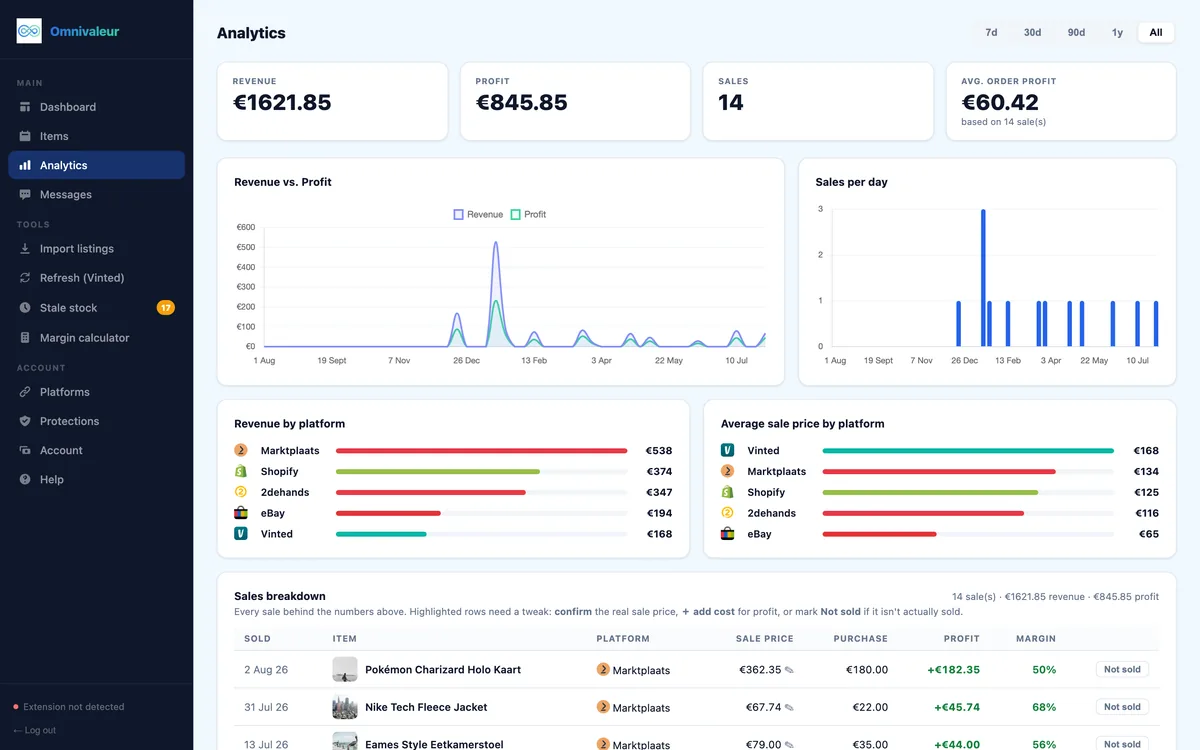
With Omnivaleur, a single tool typically carries 3-5 active listings at once, and the app tracks each platform's status independently — so a leaf blower can be "active" on Marktplaats, "sold" on 2dehands, and "pending pickup" on eBay all at the same moment, without you touching a spreadsheet.
Which platforms actually restrict power tool and battery shipping in 2026?
This is the gap most reselling automation articles miss entirely. Not every marketplace treats lithium batteries or fuel residue the same way.
| Platform | Battery-powered tools | Fuel/gas equipment | Local pickup preferred |
|---|---|---|---|
| Marktplaats | Allowed, no shipping label required | Allowed for local pickup | Yes, default culture |
| 2dehands | Allowed, no shipping label required | Allowed for local pickup | Yes, default culture |
| eBay | Allowed with declared lithium content, carrier limits apply | Prohibited if fuel/oil residue present | Optional |
| Vinted | Generally discouraged, category not built for it | Not supported | Not applicable |
| Etsy | Allowed only for vintage/handmade tool categories | Case by case, rarely approved | No |
| Shopify | Seller sets own policy and carrier account | Seller sets own policy | Depends on store setup |
In practice this means a cordless power tool goes to eBay, Marktplaats and 2dehands, while a petrol lawnmower gets listed as local-pickup-only on Marktplaats and 2dehands and skipped on Etsy and Vinted entirely. Automation only helps if it knows this — a generic crosslisting tool that blasts every item to every platform will get your gas trimmer listing removed and possibly trigger a review flag on your account.
If you're weighing shipping and platform fit across niches more broadly, the electronics reselling automation platforms guide covers similar hazard-labeling issues for anything with a battery inside.
How do you price used tools and equipment when condition varies so much?
Clothing sizing is standardized. Tool condition isn't. A drill that "works fine" could be missing a chuck key, have a cracked housing, or run at 70% of its original torque. Automated pricing tools trained on fashion resale data are useless here.
Instead, build your own condition tiers and let automation apply pricing rules on top of them, not instead of them:
- Tested and working, complete with accessories — price at 55-65% of current retail for tools under 3 years old
- Tested and working, missing accessories — subtract €10-25 depending on what's missing (case, charger, bits)
- Untested, sold as-is — price at 30-40% of retail, and say "untested" in the title, not buried in the description
- For parts or repair — flat €10-30 depending on brand, regardless of original price
Once you've tiered a batch, letting software auto-adjust price by 5-10% every 7-10 days if a listing hasn't sold works fine for tier 1 and 2 items. Don't auto-discount untested or parts-only tools — buyers in that tier are already price-anchored low, and further discounts just signal "even more broken than described."
What does DAC7 mean for someone reselling tools as a side income in 2026?
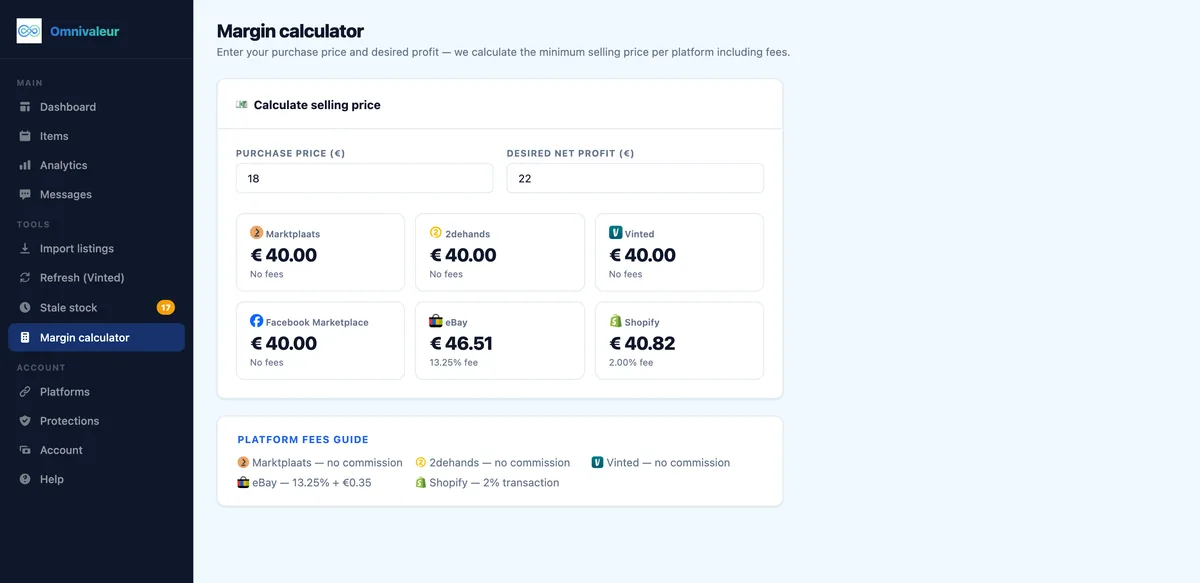
If you sell more than 30 items or earn over €2,000 in a calendar year through an online marketplace, that marketplace is legally required to report your sales data to tax authorities under EU rules. This isn't a Marktplaats quirk — it applies across the EU under the European Commission's DAC7 framework, and in the Netherlands specifically the Belastingdienst DAC7 seller information page spells out exactly what gets reported.
Tool resellers hit these thresholds faster than clothing resellers, because average sale prices are higher. Ten sold power tools at €150 each already clears €2,000. That doesn't automatically mean you owe tax — occasional private sales of used personal items are usually not taxable income — but it does mean your name, address and sales totals get shared automatically. Keep a simple log of what you paid for each tool and what you sold it for. If you're audited later, "I bought it at a flea market for €40 and sold it for €90" is a much easier conversation with a paper trail than without one.
Cross-border buyers also have protections worth knowing before a dispute happens — the Your Europe consumer rights overview is the plain-language version of what EU buyers can demand from you as a seller, including return rights on certain online sales.
How much manual work does automation actually remove for equipment resellers?
Take a realistic week: you source 12 items at an estate sale or auction — a mix of hand tools, a pressure washer, two drills, a ladder, and a box of miscellaneous sockets. Manually, that's roughly:
- 25-40 minutes per item writing descriptions and uploading photos to 3+ platforms separately
- 5-10 minutes per sale manually delisting from every other platform
- 10-15 minutes per week manually refreshing stale Vinted listings so they don't drop in search
Across 12 items that's 5-8 hours of pure listing work, plus ongoing delisting and refreshing. Automation collapses the listing step into one upload that fans out to every connected platform, and handles delisting the moment one channel shows "sold." The refresh piece has a hard limit worth knowing: Omnivaleur's Vinted refresh tool caps itself at 8 free refreshes per day, and it says plainly that no tool can guarantee a marketplace won't flag an account for aggressive refreshing. Anyone promising unlimited automatic refreshes is either overselling the feature or risking your account for you.
For fashion-adjacent resellers who also move Vinted-heavy inventory, the Vinted reselling automation guide goes deeper on refresh limits and how Vinted's algorithm actually treats bumped listings.
- ✓Check which platforms allow battery-powered and fuel-powered items to avoid automatic listing pulls
- ✓Sort your inventory into weight tiers and decide local pickup versus shippable for each item
- ✓Build your condition tiers and pricing rules instead of relying on generic fashion resale formulas
- ✓Test that your automation tool can exclude specific platforms per listing before going live
- ✓Verify the tool tracks sold status separately per platform so you don't accidentally double-sell
- ✓Include exact model numbers in titles and photograph condition clearly before uploading anywhere
Should you sell heavy equipment locally or ship it, and how does that change your automation setup?
A cordless drill ships fine in a small box for €4-7. A table saw or generator does not — courier costs for anything over 20kg regularly hit €25-45 within the Netherlands alone, before you even consider international shipping. That cost eats most of your margin on a €120 sale.
The practical rule: anything over roughly 15kg or with dimensions that won't fit a standard parcel gets listed local-pickup-only on Marktplaats and 2dehands, and either skipped on eBay/Etsy or listed with a shipping surcharge built into the price. Automation tools that let you set per-listing shipping rules per platform save real money here — you don't want the same flat €6 shipping fee applied to both a screwdriver set and a 40kg air compressor.
If you're building a cross-platform strategy specifically around heavier secondhand goods moving from Dutch marketplaces to international ones, the Marktplaats to eBay crosslisting guide covers shipping tier setup in more detail, and the 2dehands to Vinted crosslisting guide is useful if you're moving smaller hand tools and accessories into fashion-adjacent secondhand audiences.
What should you check before picking automation software for a tool reselling business?
Not every crosslisting tool built for clothing resale handles hazard categories, weight-based shipping rules, or condition tiering well. Before committing, check:
- Does it let you exclude specific platforms per listing (so a gas-powered item never accidentally hits Vinted or Etsy)?
- Can you set different shipping costs by weight tier, not just a flat rate per platform?
- Does it track sold status per platform separately, so a multi-listing item never gets accidentally double-sold?
- Does it disclose real limits (like refresh caps) instead of vague "unlimited automation" marketing?
If you're comparing named tools rather than building a workflow from scratch, the Omnivaleur vs Vendoo comparison and the Omnivaleur vs List Perfectly comparison both break down how each platform handles multi-marketplace sync, which matters more for equipment resellers than for clothing sellers because the cost of a listing error is higher — a €300 generator mistake stings more than a €15 t-shirt mistake.
Resellers running mixed inventory — say, tools plus vintage electronics or collectibles picked up at the same estate sales — often find category-specific playbooks useful alongside the general workflow. The collectibles reselling automation guide and the vintage camera reselling automation guide both apply the same condition-tiering logic described above, just tuned for different buyer expectations.
What are the most common mistakes tool resellers make when they first automate?
Four show up constantly:
- Listing hazardous items on every connected platform by default. Automation tools fan out to all connected marketplaces unless you tell them not to. A can of two-stroke fuel mix photographed next to your chainsaw for scale has gotten listings pulled on Etsy before — keep flammable items out of frame and out of fashion-oriented platforms.
- Skipping model numbers in the title. Tool buyers search by exact model far more than clothing buyers search by brand alone. "DeWalt drill" undersells; "DeWalt DCD host 796 18V drill, no battery" gets found.
- Ignoring platform-specific condition language. "Used" means something different to an eBay buyer than to a Marktplaats buyer. Spell out function-tested status explicitly rather than relying on a star rating.
- Treating refresh tools as unlimited. As covered above, free refresh allowances are capped for a reason. Respect the limit rather than trying to script around it.
None of these are automation failures exactly — they're setup failures. The software does what you configure it to do. Getting the configuration right the first week saves months of cleanup later, especially once your account has enough sales history that platforms start paying closer attention to pattern changes.
Frequently asked questions
Can you cross-list a tool with a rechargeable battery to every marketplace without issues?
Do I need to disclose CE certification or safety marks when reselling used power tools?
How do warranty transfers work when reselling tools bought secondhand?
Is it worth listing bulky garden equipment like mowers on Shopify instead of just marketplaces?
How do I handle a tool that sells on two platforms at once by mistake?
Keep reading


Stop copying listings by hand
Omnivaleur publishes your item to every platform at once and syncs stock automatically when something sells.
Start free trial