You need a KvK number once reselling stops being incidental: regular buying-to-resell, a profit motive, and structured activity (consistent listings, branding, sourcing trips). There's no fixed euro trigger for KvK itself, but the Belastingdienst looks at frequency and intent — and DAC7 already reports sellers at 30 sales or €2,000 per year on one platform.
Key takeaways
- There is no single euro amount that legally forces KvK registration — it's based on frequency, independence and profit intent
- DAC7 platform reporting kicks in at 30 sales or €2,000 per calendar year, which is a separate rule from the KvK business test
- KvK registration costs a one-time fee and gives you a VAT number, needed once you buy-to-resell structurally
- Selling your own old belongings occasionally stays hobby activity even above €2,000
- Belgium uses different thresholds and a different registration body, so don't copy NL rules across the border
Clearing out your own closet on Marktplaats is not a business. Buying ten jackets at a thrift store every month to flip on Vinted is. The line between the two is what the Dutch Chamber of Commerce (KvK) and the Belastingdienst actually test — and it's less about a specific euro number than most reseller forums claim.
What exactly is a KvK number and why does it matter for resellers?
The KvK number is your registration with the Dutch Chamber of Commerce, required the moment you run an "onderneming" — a business — under Dutch law. It's separate from your BSN (citizen number) and separate from a VAT number, though registering at the KvK usually triggers a VAT number automatically for sole traders (eenmanszaak).
For a reseller this matters for three concrete reasons. First, without it you can't legally invoice business buyers or claim costs. Second, platforms increasingly ask sellers to confirm their status for tax reporting. Third, if the Belastingdienst decides retroactively that you were running a business without registering, you can face a back-dated assessment plus penalties — more on that below.
- ✓Ask yourself if your accounts across platforms look like a home clearout or a small shop
- ✓Count your sales per platform — if you hit 30 or more on one channel in a year, DAC7 reporting starts
- ✓Calculate whether your margins justify the registration cost and admin burden
- ✓If you're over the line, register at KvK and apply for the margin scheme for second-hand goods
- ✓Set up separate invoicing and track all business costs for deduction
When does casual selling turn into a business in the eyes of Dutch tax rules?
The Belastingdienst uses a cluster of criteria, not one single number. You're generally seen as an entrepreneur when most of the following apply:
- Regularity — you list and sell items on an ongoing basis, not as a one-off clearout.
- Profit intention — you buy specifically to resell at a markup, rather than selling things you already owned.
- Independence — you source, price and ship without being employed to do it.
- More than incidental — a handful of sales a year is incidental; weekly sourcing trips are not.
- Investment of time and capital — you spend real hours and money building stock, not just offloading unused items.
Selling your childhood LEGO collection once, even for €1,500, stays a private sale. Buying LEGO sets at retail every month specifically to resell for a profit, even in small batches, is a business — regardless of whether total turnover crosses any particular threshold that year.
A quick self-test
Ask yourself: if a tax inspector saw my Marktplaats, Vinted and eBay accounts side by side, would it look like I'm clearing out a home, or running a small shop? If the honest answer is "shop," you're already past the point of needing to register.
Is there a euro threshold that forces you to register with the KvK?
No fixed legal euro amount exists for KvK registration specifically — this is the part most guides get wrong. The KvK and Belastingdienst apply the qualitative criteria above. That said, in practice, resellers who hit certain volume levels almost always meet those criteria anyway, which is why euro figures still show up in every conversation about this.
| Situation | Example | KvK needed? |
|---|---|---|
| One-off clearout | Selling old furniture after a move, €600 total | No |
| Occasional flip | Reselling 3–4 personal items a year | Usually no |
| Regular sourcing | Buying at thrift stores weekly to resell on Vinted | Yes |
| Multi-platform operation | Listing stock across Marktplaats, eBay and Shopify | Yes |
| Side hustle under €1,000/year, irregular | A few flips here and there, no fixed pattern | Grey area — document your intent |
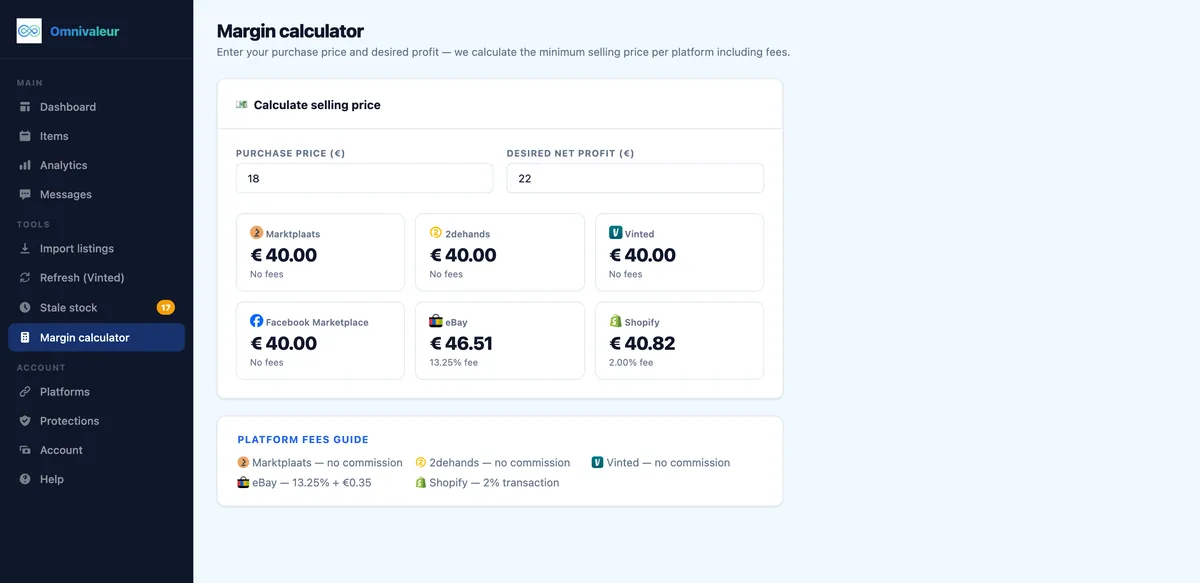
If you're calculating whether your margins even justify formalising the activity, run the numbers properly first — see our guide on how to calculate profit margin reselling before you decide it's worth registering.
How does the DAC7 reporting threshold affect your KvK decision?
DAC7 is an EU tax transparency rule, not a KvK rule, but the two collide for resellers because platforms now report seller activity automatically. Under DAC7, Marktplaats, Vinted, eBay and similar platforms must report any seller who hits 30 sales transactions or €2,000 in revenue within a calendar year, per platform, to the Belastingdienst. The EU-wide framework is described by the European Commission.
Crossing the DAC7 threshold doesn't automatically mean you need a KvK number. It means the tax office now has your sales data and can ask questions if your pattern looks like a business. In practice, a lot of resellers who were quietly over the line for years get a letter the year after they cross 30 sales on one platform — and that's often the trigger that finally pushes them to register. We've broken down exactly how the count works, including whether bundles and returns count toward it, in our DAC7 Vinted reporting guide.
Here's the practical edge case nobody mentions: the 30-sale/€2,000 threshold is per platform, not combined. A seller doing 25 sales on Marktplaats and 20 on Vinted stays under DAC7 reporting on both individually, while clearly running a business in total. DAC7 is a reporting trigger, not a legal definition of "business" — the Belastingdienst's own criteria still apply on top.
What does it actually cost to register, and what do you get in return?
Registering a sole trader (eenmanszaak) at the KvK costs a one-time fee, typically in the €75–€80 range as of 2026, paid once at registration. In return you get:
- A KvK number, usable for invoices, business bank accounts and supplier accounts.
- A VAT (BTW) number, automatically generated for most sole traders.
- Access to the Kleineondernemersregeling (KOR) — the small business VAT scheme — if your annual turnover stays under €20,000, letting you skip charging VAT altogether.
- Legitimate access to the margin scheme for second-hand goods, which lets you pay VAT only on your profit margin instead of the full sale price — a significant difference when you're reselling used electronics, furniture or clothing bought from private sellers without VAT invoices.
- The ability to deduct genuine business costs: packaging, shipping labels, platform fees, even a portion of travel to source stock.
None of this is free admin for its own sake. A reseller flipping €15,000 a year in secondhand electronics saves real money through the margin scheme compared to paying VAT on full sale prices — often hundreds of euros annually, depending on margins.
What happens if you keep reselling without a KvK number?
The Belastingdienst can reconstruct your activity retroactively using bank statements, platform data under DAC7, and your own listing history. If they decide you were running an unregistered business, you can face:
- A backdated income tax assessment on profits from prior years, sometimes going back up to five years.
- VAT assessed retroactively if your turnover should have required registration.
- Administrative fines on top of the back taxes, calculated as a percentage of the amount owed.
- Loss of the margin scheme benefit for the unregistered period, meaning full VAT exposure on past sales.
The most common trigger for an inspection isn't a tip-off — it's a pattern across platforms that DAC7 data makes visible. If you've been cross-listing the same sourcing habits across Marktplaats, Vinted and eBay for two years without registering, that's exactly the profile DAC7 was built to surface.
How do VAT and the margin scheme fit in once you're registered?
Once you have a KvK and VAT number, you choose between normal VAT accounting and the margin scheme (margeregeling), which applies specifically to second-hand goods bought from private individuals without a VAT invoice. Under the margin scheme, you calculate VAT only on the difference between your purchase price and sale price — not the full sale price.
Worked example: you buy a used camera for €150 from a private seller, no invoice, and resell it for €280. Under the margin scheme, VAT (21%) is calculated only on the €130 margin, roughly €22.57, rather than on the full €280. That's the difference between a scheme built for secondhand trading and standard VAT rules built for new goods. Our full breakdown is in the margin scheme VAT guide — and if you're sourcing cameras specifically, it pairs well with the vintage camera reselling automation guide for the sourcing side.
Below the KOR threshold of €20,000 annual turnover, you can also opt out of charging VAT entirely, which simplifies bookkeeping a lot for smaller resellers but means you can't reclaim VAT on business purchases either.
How is this different in Belgium?
Belgian rules run on a separate track. There's no KvK equivalent exactly — Belgium uses the Kruispuntbank van Ondernemingen (KBO/BCE) for business registration, with its own thresholds and VAT exemption rules that differ from the Dutch KOR. If you're selling across the border on Vinted or Marktplaats-adjacent platforms, don't assume Dutch thresholds apply to a Belgian seller. We cover the Belgian-specific numbers in our Belgian tax rules for Vinted sellers guide.
What should you do once your reselling actually becomes a business?
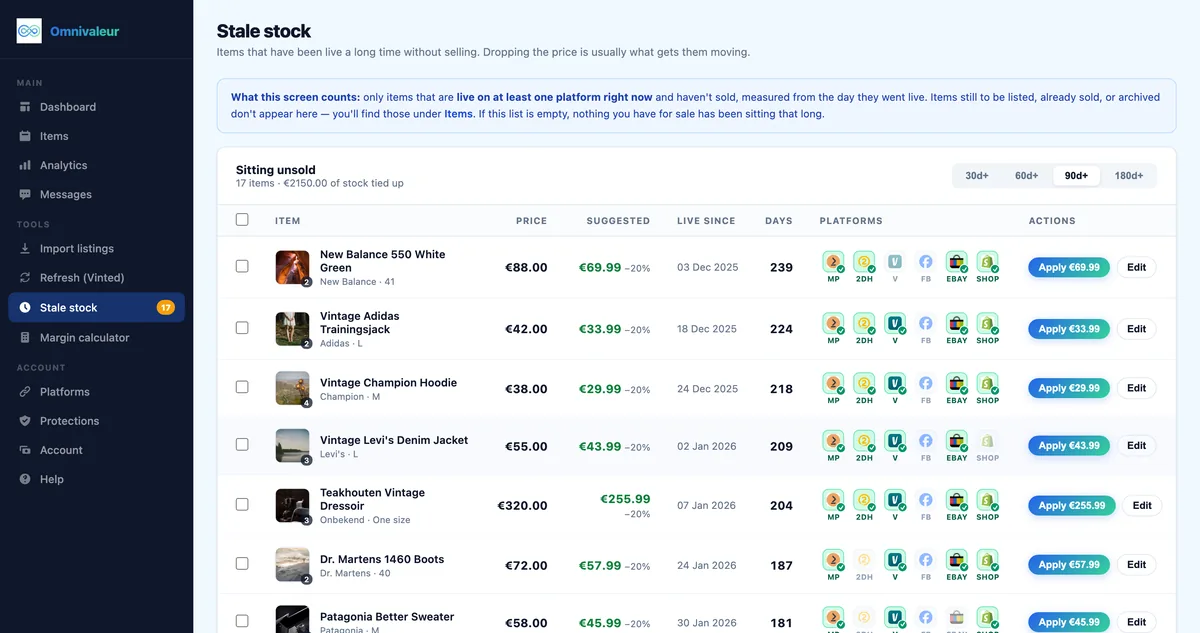
Once you've registered, the operational bottleneck shifts from "am I legal" to "can I actually scale without getting flagged by the platforms themselves." This is where most registered resellers hit a second, less obvious problem: listing the same item manually on five or six marketplaces eats hours, and posting too fast across platforms in parallel gets accounts rate-limited or temporarily restricted.
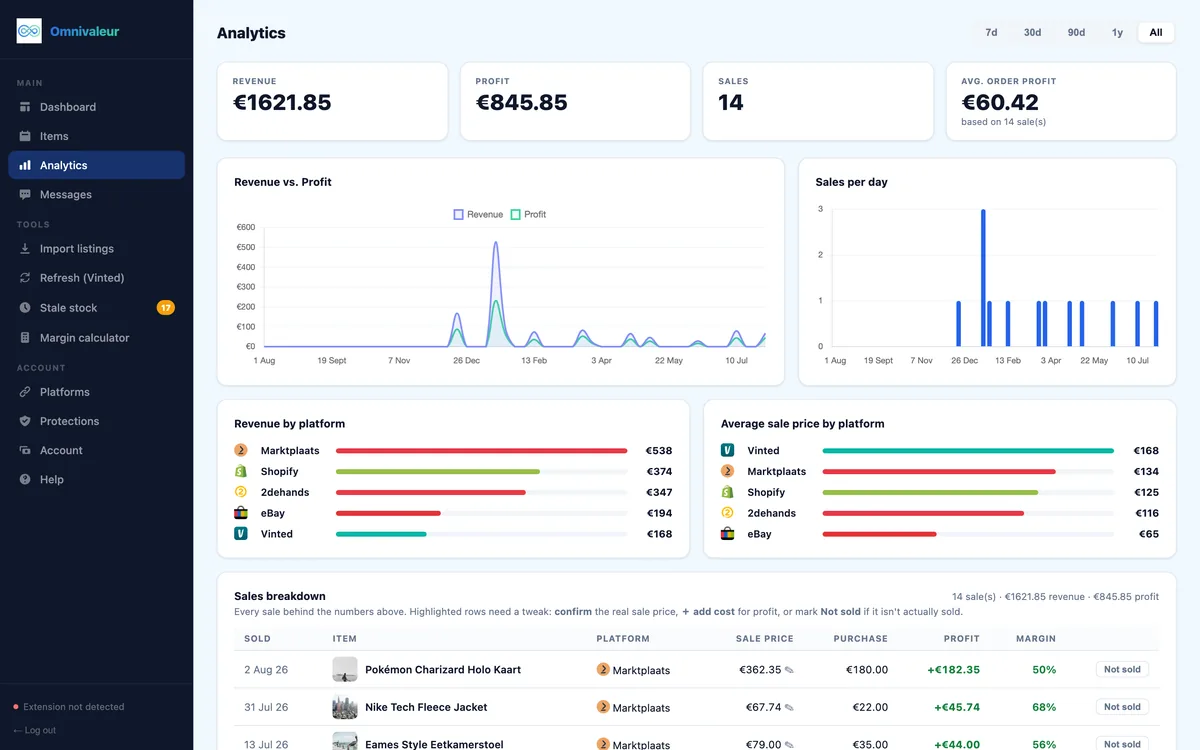
That's a deliberate design choice in how Omnivaleur handles cross-listing: it publishes to seven channels from one intake form — Marktplaats, 2dehands, Vinted, eBay, Shopify, WooCommerce and Facebook Marketplace (beta) — but it runs one browser tab at a time on purpose, because parallel publishing is exactly what gets marketplace accounts rate-limited. For a newly registered business trying to look credible and consistent across platforms, that matters more than raw speed.
It's also worth understanding your buyer-side obligations once you're a registered seller, not a private one — formal businesses face different return and warranty rules than private sellers under Dutch consumer law, detailed in our guide on legal warranty on second-hand goods in the Netherlands, and backed by the EU-wide framework at Your Europe's consumer rights overview.
Finally, don't overlook the smaller cost lines that add up once you're running this as a registered operation — shipping labels, listing fees, platform cuts. Our Marktplaats fees breakdown is a good starting point for working out what's actually deductible once you're invoicing as a business.
Frequently asked questions
Can I register with the KvK and still sell as a hobby on the side?
Does selling on Vinted count differently from selling on Marktplaats for KvK purposes?
Do I need a KvK number before I start sourcing stock, or can I register after my first sales?
Can I deduct my Omnivaleur subscription or other reseller tools as a business expense once I'm registered?
What if I only resell internationally, never within the Netherlands — do Dutch KvK rules still apply?
Keep reading
Stop copying listings by hand
Omnivaleur publishes your item to every platform at once and syncs stock automatically when something sells.
Start free trial