Profit margin when reselling equals (sale price minus total costs) ÷ sale price × 100. Total costs cover your purchase price, marketplace fees, shipping, packaging and any margin-scheme VAT. On a jacket bought for €15 and sold for €45 with €8 in fees and postage, you keep €22 profit — a 49% margin, not the 200% markup it suggests.
Key takeaways
- Margin divides profit by sale price; markup divides profit by cost — they never match.
- Marketplace fees alone can take 5% to 20% of your sale price before shipping is even counted.
- A realistic minimum margin for small flips sits around 30-40% after every single cost.
- Unsold stock and failed flips need to be averaged into your real margin, not ignored.
- Faster sell-through across more channels protects margin better than discounting ever will.
How Do You Calculate Profit Margin When Reselling?
Net profit margin is simple once you stop guessing at your costs. Take your sale price, subtract every cost tied to that specific item, then divide the result by the sale price. Multiply by 100 and that's your margin, expressed as a percentage. The formula looks like this:
Profit margin (%) = (Sale price − Total costs) ÷ Sale price × 100
The part resellers get wrong isn't the formula. It's "total costs." Most people only count what they paid at the thrift store or the Saturday market. That number is your cost of goods, not your total cost. Total cost also includes the marketplace's cut, the shipping label, the packaging materials, any payment processing fee, and — if you're VAT-registered — the tax due under the margin scheme.
The Four Numbers You Actually Need
Before you calculate anything, write down four figures for the item itself, not an average across your whole inventory:
- Purchase price — what you actually paid, including any bundle discount you negotiated.
- Selling fees — the percentage the platform takes, plus any fixed listing or payment fee.
- Fulfilment costs — shipping label, box or mailer bag, tape, padding.
- Net sale price — what actually lands in your account, not the asking price before an offer or a coupon.
Worked Example: A Vinted Jacket Flip
You buy a wool jacket at a jumble sale for €15. You list it on Vinted for €49 and accept a reasonable offer at €45. Vinted's buyer-paid protection fee doesn't come out of your side, but your own packaging costs €1.50 and you pay €6.50 for a tracked label. Total cost: €15 + €1.50 + €6.50 = €23. Profit: €45 − €23 = €22. Margin: €22 ÷ €45 × 100 = 48.9%.
That's a solid flip. Compare it to the raw markup most sellers quote online — "bought for €15, sold for €45, that's 300%" — and the gap in logic shows up fast. Margin tells you what share of the sale you keep. Markup tells you how many times you multiplied your buy price, and it ignores every fee you paid to get there.
Worked Example: A Vintage Camera on eBay
Higher-value items swing the numbers the other way. Source a vintage camera for €40 at an estate sale, clean it, and sell it on eBay for €150. eBay's final value fee runs around 12.8% plus a small fixed per-order charge on most categories in 2026, costing you roughly €19.70. Shipping a camera safely with padding and insurance adds €9. Total cost: €40 + €19.70 + €9 = €68.70. Profit: €150 − €68.70 = €81.30. Margin: 54.2%. Both flips look like wins on paper, but the camera actually returns a better margin once the fees are counted properly — something resellers miss constantly because a bigger sale price feels safer than it actually is.

What Costs Do Resellers Forget to Include in Their Margin?
Ask ten resellers how they calculate margin and eight of them will stop at "price I paid, minus price I sold it for." That's a markup calculation dressed up as a margin, and it overstates how profitable your business really is. Here's what gets left out.
Sourcing and Travel Costs
Fuel to drive to three charity shops on a Saturday morning isn't free. Neither is the parking fee at the flea market, or the entry ticket at a car boot sale. If you source twenty items on a trip that costs €15 in fuel and parking, that's €0.75 of hidden cost on every single item, before you've even listed anything. Resellers who scale up sourcing routes should read our guide on where to source stock for second-hand reselling, because sourcing cost per item drops fast once you build a reliable route instead of random trips.
Packaging, Storage and Software
Bubble mailers, tape, poly bags, tissue paper for presentation — buy these in bulk and the per-item cost looks small, often €0.50 to €2. It still has to go into the calculation. The same applies to any storage unit you rent, any shelving you bought, and any subscription tool you pay monthly for listing or cross-listing. If a tool costs €29 a month and you move 60 items through it, that's €0.48 per item. Small on its own. It adds up once you stack five or six of these small line items on every flip.
Returns, Damaged Parcels and Payment Fees
A buyer returns an item under their statutory right to change their mind on certain platforms, and suddenly that sale's margin goes to zero or negative once you've paid for outbound and sometimes return shipping. EU consumer protection rules give buyers real rights on distance sales, covered in detail by the Your Europe consumer shopping rights guide, and private second-hand sales carry different rules again — our breakdown of legal warranty on second-hand goods in the Netherlands covers where a private seller's liability actually starts and stops. Payment processing fees are a separate line too: platforms that route payment through a third-party processor often charge 1.5% to 3% on top of their selling fee, and that charge rarely shows up until you check your payout statement closely.
What Is the Difference Between Margin and Markup?
This single confusion causes more bad pricing decisions than anything else in reselling. Margin and markup use the same two numbers — cost and profit — but divide by a different base.
| Metric | Formula | Example (cost €15, sale €45) | Result |
|---|---|---|---|
| Markup | Profit ÷ Cost × 100 | €30 ÷ €15 × 100 | 200% |
| Margin | Profit ÷ Sale price × 100 | €30 ÷ €45 × 100 | 66.7% |
| True margin (with fees) | (Sale − Total costs) ÷ Sale × 100 | (€45 − €23) ÷ €45 × 100 | 48.9% |
Notice how markup always reads higher than margin on the same deal. This matters because resellers who price based on "I want to double my money" (a 100% markup target) are actually running somewhere between 35% and 50% true margin once fees and shipping land. If you're pricing by markup alone, you're probably running thinner margins than you think.
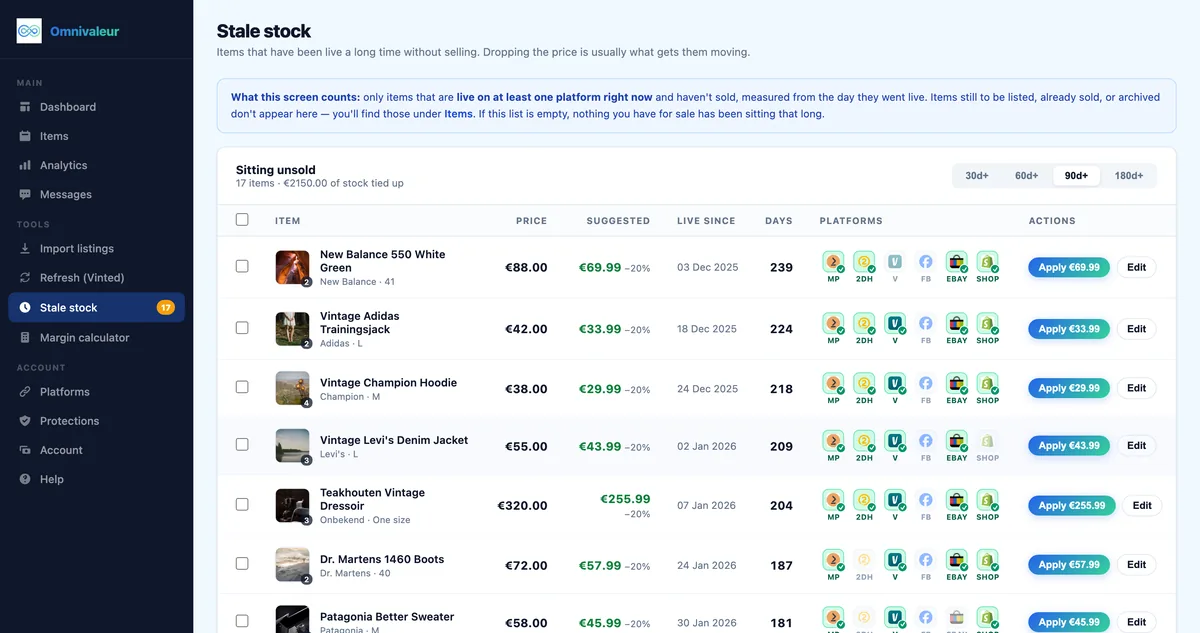
How Much Do Marketplace Fees Take From a Sale in the Netherlands and Belgium?
Fees vary enough between channels that the same item can return a different margin depending on where you list it. Here's a realistic 2026 snapshot for a reseller operating in the Netherlands or Belgium.
| Platform | Typical seller fee | Notes |
|---|---|---|
| Marktplaats | Free for private sellers; subscription + per-listing fee for Pro accounts in certain categories | See the full Marktplaats fees breakdown for category-specific costs |
| 2dehands | Same fee structure as Marktplaats (Belgian sister platform) | Cross-posting both sites doubles reach without doubling fees |
| Vinted | 0% seller fee | Buyer pays the protection fee, so your listed price is what you keep minus shipping if you cover it |
| eBay | ~12.8% final value fee + small fixed per-order fee | Varies by category; business sellers also see payment processing built into the rate |
| Facebook Marketplace | Free for local pickup; ~5% (or a small flat minimum) for shipped orders | Beta support for automated listings is improving through 2026 |
| Shopify / WooCommerce (own store) | Payment processing only, roughly 1.5%-2.9% + fixed fee | No marketplace commission, but you cover your own traffic and subscription cost |
Running the same jacket flip across different channels shows why this table matters more than it looks. The exact same €45 sale nets a noticeably higher margin on Vinted than it does on eBay, purely because of the fee line. That doesn't make eBay the wrong choice — eBay often reaches buyers willing to pay more for the same item, especially for collectibles and electronics, which can offset the higher fee. It just means the fee has to be in the calculation before you decide where to list, not after.
What Is a Good Profit Margin for Resellers in 2026?
There's no single universal number, but category benchmarks exist for a reason, and resellers who know theirs price faster and second-guess themselves less.
- Fast fashion and everyday clothing: 40-60% margin, because cost of goods is low and volume carries the business.
- Designer and branded clothing: 50-70% margin possible on a good find, but acquisition cost swings wildly.
- Electronics and mobile phones: 15-25% margin, since cost of goods is high relative to resale price and testing/repair time eats into profit.
- Furniture: 30-50% margin, with transport cost as the biggest variable.
- Collectibles, vinyl, and vintage toys: highly variable, from 20% on common pieces to 200%+ on a genuine rare find.
Rather than chasing a percentage in isolation, set two thresholds for every category you flip: a minimum acceptable margin and a minimum acceptable euro profit. A 60% margin on a €5 item is €3 profit — barely worth the listing time. A 25% margin on a €200 item is €50 profit, which is worth far more of your afternoon. Decide both numbers before you buy, not after you've already sunk money into the item.
- ✓Write down the purchase price you actually paid for the item
- ✓Note the marketplace fee percentage and any fixed listing or payment fees
- ✓Add up fulfilment costs: shipping label, box, padding, and tape
- ✓Calculate total cost by adding purchase price plus all fees and fulfilment
- ✓Divide profit by sale price, multiply by 100 to get your margin percentage
- ✓Compare margins across platforms before deciding where to list the item
Should You Count Your Time as a Cost?
Yes, and this is where most reseller math falls apart. Every item costs time, not just money: sourcing, cleaning, photographing, writing a description, listing on each channel, answering buyer questions, packaging, and dropping it at a parcel point. Add that up honestly and a "quick €22 profit" jacket that took 35 minutes of total work pays out at roughly €37 an hour. That's a fine hourly rate. A €22 profit item that took two hours of fiddly photo editing and back-and-forth negotiation pays €11 an hour, which isn't.
Cross-listing is where time cost quietly multiplies. Manually re-listing the same item on Marktplaats, 2dehands, Vinted and eBay means retyping the same description four times and re-uploading photos four times. Cross-listing tools exist to cut that down, but speed has limits worth knowing: Omnivaleur runs its publishing one browser tab at a time on purpose, because parallel publishing across several marketplace tabs at once is exactly what gets seller accounts rate-limited or flagged. A slightly slower, sequential publish that keeps your account healthy protects your margin far more than shaving ninety seconds off a listing run.
If time cost is eating your margin, the fix usually isn't working faster on each item — it's organizing your workflow so less time gets wasted finding, photographing and relisting stock. Our guide on how to organize inventory for reselling covers the batching habits that cut listing time per item without cutting corners on photos or descriptions.
Do You Calculate Margin Before or After Taxes?
Calculate your operational margin before tax, and track tax as a separate line below it. Mixing the two hides whether your pricing is actually working. There's also a second, more specific tax question for second-hand sellers in the Netherlands and Belgium: the VAT margin scheme.
Under the margin scheme, VAT-registered resellers only pay VAT on the difference between what they paid for an item and what they sold it for — not on the full sale price. That changes your true net margin meaningfully if you're registered for VAT and buying from private sellers without a deductible input VAT. Our full breakdown of the VAT margin scheme for second-hand goods walks through the registration thresholds and how to apply it per item rather than per batch.
Separately, platform reporting rules affect your records even if they don't change your margin math directly. Under DAC7, Vinted and similar platforms report sellers who cross 30 transactions or €2,000 in sales within a calendar year to tax authorities, as confirmed by both the Belastingdienst's DAC7 guidance for sellers and the European Commission's DAC7 overview. That reporting doesn't reduce your margin, but it means the profit you calculated per item is the same figure a tax authority may eventually cross-check against your declared income. Our dedicated guides on DAC7 reporting rules on Vinted in the Netherlands and Belgian tax rules for selling on Vinted cover exactly where those thresholds sit for 2026 and what happens once you cross them.
What About Unsold Items and Failed Flips?
Margin calculated per sold item only tells half the story. If you buy ten items for €10 each, sell eight at an average of €30, and the other two sit unsold for six months before you donate them, your real margin on that batch is lower than the "per sold item" number suggests. The math: €100 spent on ten items, €240 earned on eight sales, zero recovered on two. Gross profit is €140, but divided across the original €100 spent on all ten items — not just the eight that sold — your actual return drops noticeably compared to looking at the eight winners in isolation.
Track your sell-through rate alongside margin. An item sitting unsold for months isn't just a loss on paper — it's tying up money and shelf space that could be working on faster-moving stock. If an item hasn't moved after a reasonable window, the fix usually isn't a steep discount that tanks your margin; it's a relist with a cleaner title and better photos, or a price adjustment based on what similar sold listings actually fetched. Our guide to relisting versus bumping second-hand listings breaks down which approach actually gets an item back in front of buyers without resetting your account's trust signals the wrong way.
Is There an App That Calculates Resale Profit Automatically?
Dedicated profit calculator apps exist, and a simple spreadsheet with four columns — cost, fees, shipping, sale price — gets you 90% of the way there for free. Set a formula column that does the margin math automatically for every row, and you'll spot underperforming categories within a month of tracking.
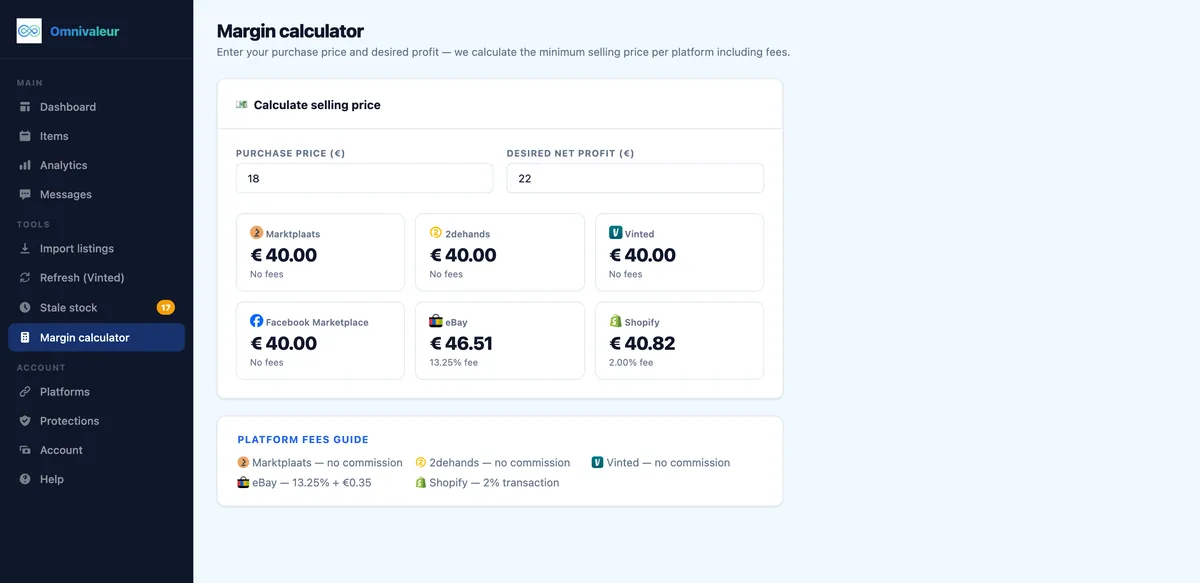
Where this gets harder is at the cross-listing stage, because the same item often sells on a different platform than the one you expected, with a different fee structure attached. If you list a camera on Marktplaats, 2dehands, Vinted and eBay simultaneously and it sells on eBay, your margin calculation needs eBay's fee rate applied, not Vinted's. Omnivaleur publishes the same listing to seven channels — Marktplaats, 2dehands, Vinted, eBay, Shopify, WooCommerce and Facebook Marketplace in beta — from a single intake form, which keeps the item details consistent across platforms even though each one takes a different cut on sale. That consistency matters for margin tracking: you're comparing the same cost basis against different fee structures, rather than retyping details differently on each site and losing track of which numbers belong to which listing.
None of this replaces knowing your formula. A tool that lists faster across more channels only improves your margin if you're still applying real cost data per item once a sale comes in. Speed helps you sell through stock faster and avoid holding dead inventory, which protects margin indirectly — but the calculation itself still comes down to sale price, minus every cost, divided by sale price.
Frequently asked questions
How do you set a maximum buying price if you want a specific margin?
How do you calculate margin on items bought as part of a bulk lot?
Does the VAT margin scheme change the profit margin formula itself?
How does currency conversion affect margin on cross-border eBay sales?
Should a buyer's return be subtracted from the original sale's margin or from that month's totals?
Keep reading



Stop copying listings by hand
Omnivaleur publishes your item to every platform at once and syncs stock automatically when something sells.
Start free trial