Belgian Tax Rules for Selling on Vinted in 2026: What You Actually Owe
Vinted must report your sales to Belgian tax authorities under DAC7 once you hit 30 sales or €2,000 in a calendar year, but reporting isn't the same as owing tax. Belgium only taxes Vinted income when selling stops being occasional decluttering and starts looking like a business — then it's taxed at 33% or more.
Key takeaways
- DAC7 reporting kicks in at 30 sales or €2,000 a year, regardless of whether you owe any tax
- Belgium taxes occasional "speculative" profit at a flat 33%, while habitual trading is taxed as business income up to roughly 50% plus social contributions
- Selling your own used belongings, even at a loss or just to declutter, is generally not taxable in Belgium even if Vinted reports it
- Non-declaration penalties in Belgium range from a 10% to a 200% tax increase on top of the tax actually owed
- Keep purchase proof and sale records for at least seven years in case FOD Financiën asks questions
Crossing the DAC7 threshold on Vinted does not automatically mean you owe tax in Belgium. It means Vinted now has a legal duty to hand your sales data to the tax authorities. What happens after that depends entirely on whether your selling counts as "normal management of private assets" or something that looks more like a business. That distinction, not the DAC7 number itself, is what actually decides your tax bill.
Most casual sellers clearing out a wardrobe never owe a cent, even if Vinted reports them. Some sellers who stay well under the DAC7 thresholds already owe tax because of how they operate. The rules below walk through both situations with real euro figures, so you know exactly where you stand in 2026.
Does Vinted report your sales to the Belgian tax authorities?
Yes, but only above specific thresholds, and only since 2023. Under the EU's DAC7 directive, digital platforms including Vinted, eBay, Marktplaats and Etsy must collect seller identification details and report transaction data to the tax authority in the seller's country of residence once a seller crosses either 30 sales transactions or €2,000 in total payments received within a calendar year.
In practice Vinted asks you to confirm your identity (national registry number, address, bank account) once you get close to either threshold. If you cross it, Vinted compiles your annual totals and sends them to the Belgian FOD Financiën / SPF Finances by 31 January of the following year. The directive itself is EU-wide, and the European Commission's DAC7 overview explains the mechanics in more detail than most sellers ever need.
What the directive does not do is decide whether you owe tax. It is a reporting rule, not a tax rule. A student who sold 35 items of her own clothing for a total of €1,400 will be reported to FOD Financiën exactly the same way as someone running a part-time resale operation — the data gets sent regardless of intent. If you also sell on other marketplaces, the DAC7 Vinted reporting rules for the Netherlands are a useful comparison if you have Dutch customers or split your inventory across Marktplaats and Vinted.
- ✓Export your full Vinted sales history for the current and previous year from your account settings
- ✓Separate personal items you sold from any stock you bought specifically to resell
- ✓Calculate your net profit by subtracting original costs, shipping, and Vinted fees from actual sale prices
- ✓Keep proof of original purchase, bank statements, and shipping records for at least three years
- ✓Register with KBO/BCE if your reselling looks organised and repeated, before tax authorities flag it
When does occasional selling become a taxable business in Belgium?
Belgian income tax law splits personal selling into three buckets, and the line between them is behavioural, not numerical:
- Normal management of private assets — selling your own belongings, occasionally, without organisation or profit-seeking intent. Not taxed, no matter how much money changes hands.
- Diverse/speculative income (divers inkomen) — an occasional but profit-driven transaction, outside normal private management. Taxed at a flat 33% on the net profit.
- Professional income — habitual, organised, repeated selling with the aim of generating regular income. Taxed as business income at progressive personal income tax rates, plus self-employed social security contributions.
Unlike DAC7's clean 30-sales-or-€2,000 line, Belgium has no legal euro threshold that flips you from private to professional. FOD Financiën looks at a cluster of signals: how often you sell, whether you buy stock specifically to resell, whether you advertise systematically, whether you specialise in a category, and whether the activity looks organised rather than incidental.
A person who sells 60 items from their own closet over a year, built up over a decade of normal shopping, is almost certainly still inside "normal management" even though DAC7 reports them twice over. Someone who buys ten jackets a month at thrift shops specifically to flip on Vinted, lists consistently, and treats it like a side income stream, is in professional territory from the very first sale — even if they never hit 30 transactions. For a deeper look at where that line sits under Belgian law more broadly, see our guide on second-hand sales tax in Belgium, and for the Dutch equivalent of this same question, check when reselling becomes a business under KVK rules.
What counts as "occasional" selling under Belgian rules in 2026?
The clearest way to understand this is to run the numbers on two real scenarios.
Example 1: wardrobe clear-out
Sofie sells 42 items from her own closet in 2026, totalling €2,650 in sales. She originally paid far more than that for the clothes combined. Vinted reports her to FOD Financiën because she crossed both the 30-sale and €2,000 thresholds. But she sold at a loss compared to what she originally paid, she didn't buy anything to resell, and the activity was a one-off clear-out, not a pattern. Result: reported, but not taxable, because there's no profit and no organised intent.
Example 2: part-time flipping
Karim buys sneakers at outlet sales and thrift shops specifically to resell on Vinted. He makes 58 sales in 2026 totalling €4,900, with stock costs and Vinted fees of €2,850. His net profit is €2,050. Because this is organised, repeated, and profit-seeking, it's taxed as diverse income at 33% — that's roughly €677 in tax, assuming it's still classed as occasional rather than professional. If he's doing this every month, year after year, with growing volume, FOD Financiën could reasonably argue it has become professional income instead, taxed at his marginal personal income tax rate (which can run from 25% up to roughly 50% depending on his total income) plus self-employed social contributions of around 20.5% on net profit.
The gap between those two outcomes — 33% flat versus progressive-plus-social-security — is exactly why the category matters more than the DAC7 number. Sellers moving actual stock across multiple categories (clothing one month, electronics the next) should also look at how our guide to pricing second-hand items handles margin tracking, since knowing your real cost basis per item is what separates a defensible 33% calculation from a guess.
How much tax do you actually pay if your Vinted sales cross the line?
Once you're past "normal management," the bill depends on which of the two taxable categories you fall into.
| Category | Tax base | Rate | Extra obligations |
|---|---|---|---|
| Diverse/speculative income | Net profit (sale price minus purchase price, fees, shipping) | Flat 33% | Declare in personal tax return, no VAT or KBO registration required |
| Professional income | Net profit, as business income | Progressive: roughly 25%–50% | KBO/BCE registration, social security contributions (~20.5% on net profit), possible VAT registration above €25,000 turnover |
| Normal management of private assets | N/A | 0% | None, but still subject to DAC7 reporting if thresholds are crossed |
The VAT angle trips people up. Belgium's small-business VAT exemption scheme covers turnover up to €25,000 a year, so most part-time professional resellers stay outside VAT obligations initially — but the income tax and social security side kicks in regardless of VAT status, from the first euro of profit once the activity is deemed professional. For the EU-wide framework behind this, Your Europe's VAT rules for online sellers is the official reference point, though Belgian national thresholds take priority for day-to-day decisions.
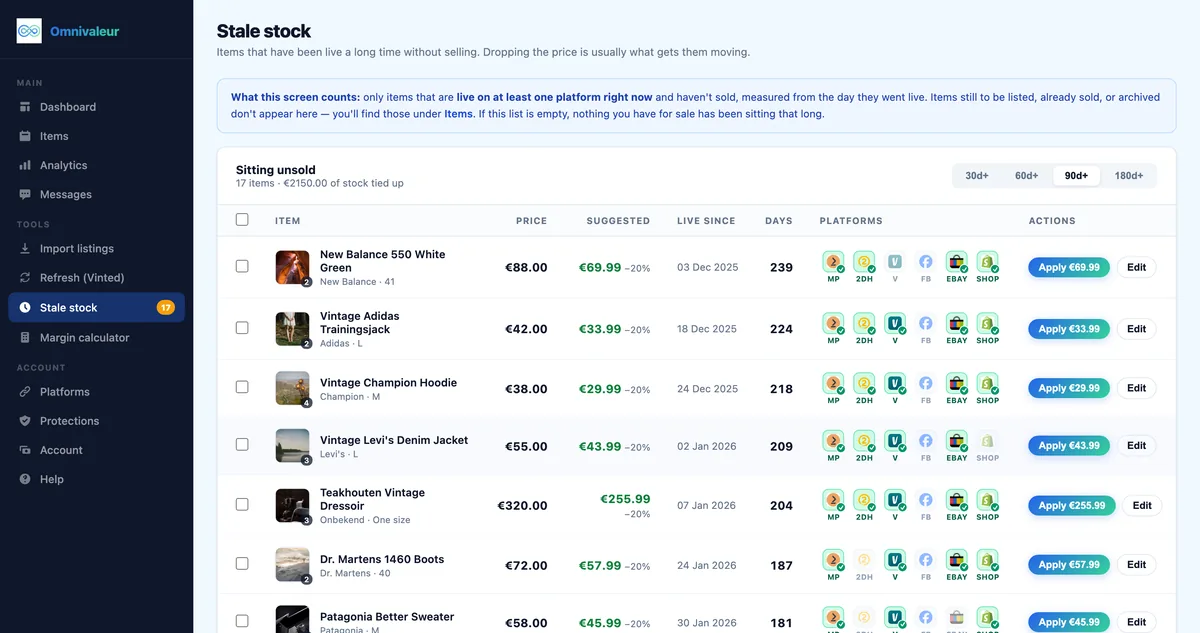
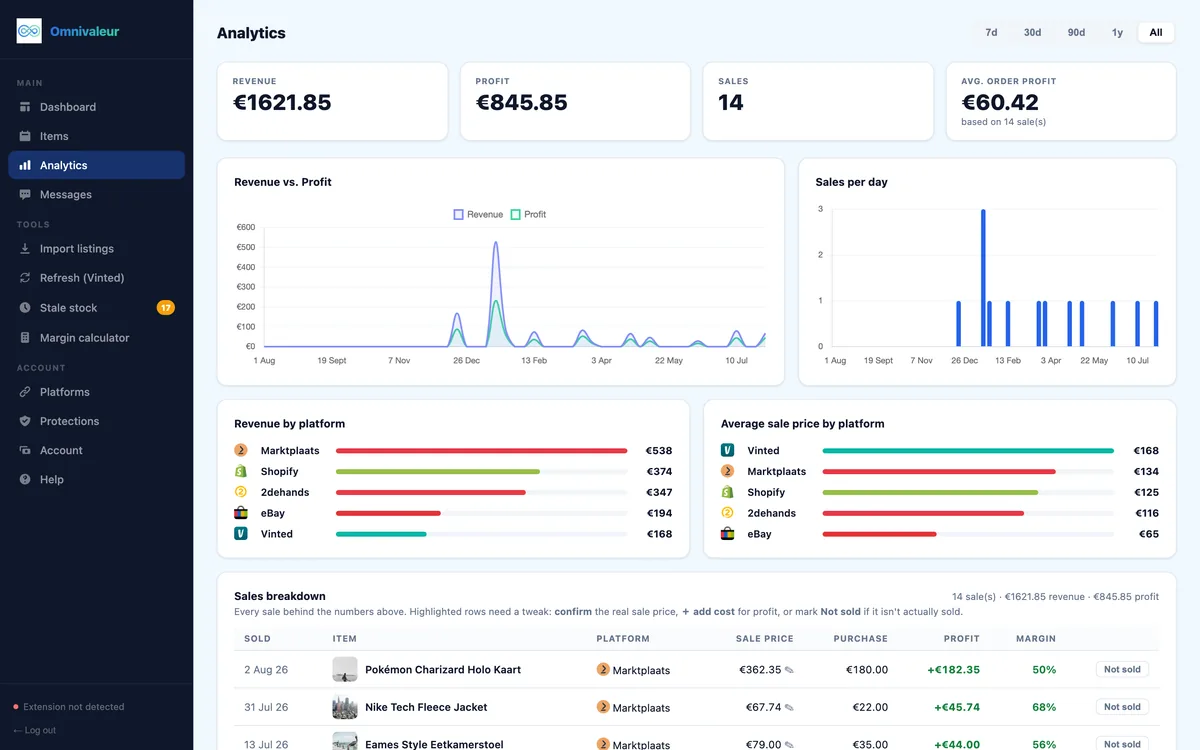
One detail competitors on this topic tend to gloss over: the 33% speculative-income rate applies to net profit, not revenue. Sellers who only track their asking price, rather than what they actually received after offers, bundle discounts and fees, consistently overstate their tax exposure or underreport it in the wrong direction. This is one reason accurate per-item profit tracking matters more than people assume — Omnivaleur's analytics, for instance, calculate profit from the confirmed sale price per transaction rather than the original asking price, because on second-hand marketplaces the two typically differ by 10% to 20% once negotiation and bundling are factored in.
What records do Belgian Vinted sellers need to keep?
Belgium's standard tax audit period is three years, extendable to seven in cases of presumed fraud, and FOD Financiën can and does cross-reference DAC7 data against declared income automatically. That means your records need to survive scrutiny well after the sale is closed, not just at year-end.
Keep, at minimum:
- Proof of original purchase for anything you resell as stock — receipts, bank statements, or screenshots of the original listing if bought second-hand yourself.
- Your full Vinted sales history export, including dates, item descriptions, sale prices and fees deducted.
- Shipping cost records, since these are deductible against profit for both diverse and professional income.
- Bank statements showing Vinted payouts, to reconcile against platform reports.
- A simple running log distinguishing "personal items sold" from "stock bought to resell," since this is the single biggest factor FOD Financiën uses to categorise your activity.
A practical habit worth adopting: confirm the real sale price on every transaction rather than letting the asking price stand as your record, especially if you negotiate often or bundle items for shipping discounts. This is exactly the gap that trips up sellers during an audit — their declared profit doesn't match what the platform reported, simply because nobody tracked the actual agreed price per sale. If you're also selling across Marktplaats or 2dehands alongside Vinted, consolidating that history becomes more important, and tools built for cross-listing between Marktplaats and Vinted can at least keep your inventory and sale confirmations in one place rather than scattered across four apps.
What happens if you don't declare Vinted income in Belgium?
Penalties scale with how obviously you avoided declaring, and whether it's a first offence.
- First-time, good faith omission: typically a 10% tax increase on the unpaid amount, plus late payment interest.
- Repeated or negligent non-declaration: increases of 20% to 50% are common once FOD Financiën has flagged a pattern.
- Deliberate concealment or fraud: penalties can reach 200% of the tax owed, and serious cases can be referred for criminal prosecution under Belgian tax fraud law.
What makes this more pressing in 2026 than it was a few years ago is automation on the tax authority's side. DAC7 data arrives in a structured format that's trivially easy to match against your annual tax return. A mismatch between what Vinted reported and what you declared doesn't need a human auditor to notice it anymore — it gets flagged by the system, and the inquiry letter follows automatically. The European Commission's DAC7 page confirms this was precisely the intended effect of the directive: close the gap between platform income and declared income across all 27 member states.
How does Belgium compare to the Netherlands for Vinted sellers?
If you're a Belgian resident selling to Dutch buyers, or you run inventory across both markets, the tax treatment diverges in ways that matter.
| Aspect | Belgium | Netherlands |
|---|---|---|
| DAC7 reporting threshold | 30 sales or €2,000/year | 30 sales or €2,000/year (EU-wide, identical) |
| Tax authority receiving DAC7 data | FOD Financiën / SPF Finances | Belastingdienst |
| Occasional-seller test | "Normal management of private assets" vs speculative intent | "Bron van inkomen" test: profit sought, profit expected, participation in economic activity |
| Occasional but profit-driven selling | Taxed at flat 33% on net profit | Taxed as "resultaat uit overige werkzaamheden," progressive Box 1 rates |
| Professional/habitual selling | Progressive income tax (~25%–50%) + ~20.5% social contributions | Progressive Box 1 rates up to ~49.5%, plus Zvw contribution if self-employed |
| VAT registration threshold | €25,000 turnover (small business exemption) | €20,000 turnover (KOR small business scheme) |
The practical upshot: Belgium's flat 33% rate on occasional speculative profit is often simpler to calculate than the Dutch "source of income" test, but Belgium's professional bracket can run slightly higher once social contributions stack on top of income tax. If your buyers or suppliers are mostly Dutch, our dedicated breakdown of DAC7 reporting rules in the Netherlands goes into the Belastingdienst's documentation requirements in more detail, and the official Belastingdienst DAC7 page is the primary source if you need to confirm anything directly.
What should you do right now to get compliant?
Treat this as a five-step process rather than a single decision, especially if you're not sure which category you fall into yet.
- Export your full Vinted sales history for the current and previous calendar year. Vinted's selling help centre explains how to pull transaction records from your account.
- Separate personal items from resale stock in that export. This single step does most of the work in determining your tax category.
- Calculate net profit per category, not revenue — subtract original purchase cost, shipping, and Vinted's selling fees from what you actually received.
- If profit from resale activity is organised and repeated, register with the KBO/BCE before scaling further, rather than waiting for FOD Financiën to ask why your activity looks professional but isn't registered.
- Talk to an accountant once the numbers get non-trivial — a few hundred euros of occasional profit rarely justifies professional advice, but a few thousand in repeated flipping profit does.
One thing worth flagging directly: some resellers try to dodge the DAC7 threshold by spreading sales across multiple Vinted accounts, or by using automation tools aggressively to push visibility without triggering platform attention. Neither trick changes your Belgian tax liability — the categorisation test is about your behaviour, not your account count — and both carry real platform risk. Vinted's own terms of service prohibit running duplicate accounts to circumvent platform rules. Automation can genuinely help with the operational side of selling, but it can't make compliance risk disappear. Omnivaleur's own Vinted refresh tool deliberately caps itself at 8 free refreshes per day, and we say plainly that no tool, including ours, can guarantee a marketplace won't flag an account for unusual activity — that's a platform decision, not a software one.
If your actual bottleneck is operational rather than legal — keeping listings synced, repricing consistently, or not duplicating effort across Marktplaats, eBay and Vinted — that's where cross-listing tools genuinely help, and our Vinted reselling automation guide covers what's realistic to automate versus what still needs a human decision.
Keep the two problems separate in your head: tax compliance is about correctly categorising and declaring your profit, while platform compliance is about following Vinted's own rules on listings, accounts and fulfilment. Confusing the two is how sellers end up either over-declaring harmless decluttering or under-declaring genuine business income — both of which cause more friction with FOD Financiën than getting it right the first time.
Frequently asked questions
Do you need to register as self-employed (KBO) before your very first professional sale on Vinted?
What if you sell both personal items and resale stock on the same Vinted account?
Does Vinted charge VAT on its own selling fees to Belgian sellers?
Is 118 707 the number for Vinted's customer service in Belgium?
How do you cancel an order on Vinted if a buyer or seller changes their mind?
If Vinted doesn't report you because you're under the DAC7 thresholds, are you automatically exempt from tax?
Keep reading

Stop copying listings by hand
Omnivaleur publishes your item to every platform at once and syncs stock automatically when something sells.
Start free trial