Board Games and Tabletop Reselling Automation in 2026
Board game and tabletop reselling automation means listing a single item once — with photos, component checklist and price — and publishing it simultaneously to Marktplaats, 2dehands, Vinted, eBay, Etsy and Shopify. Tools like Omnivaleur sync sold status across all six, so a game sold on eBay gets pulled from the other five within minutes, avoiding double sales and refund disputes.
Key takeaways
- Omnivaleur publishes one intake form to six marketplaces, not just two or three.
- A single board game listing typically stays live on 3-5 platforms at once, each tracked separately.
- Big box games over 2kg often trigger higher parcel tiers than sellers expect on Vinted and 2dehands.
- DAC7 thresholds (30 sales or €2,000/year) arrive faster for tabletop resellers than fashion resellers, because average sale prices run higher.
- Listing expansions and Kickstarter exclusives separately, not bundled, gets more search visibility on eBay and Etsy.
What does board game and tabletop reselling automation actually mean?
It means you stop retyping the same listing six times. A reseller flipping a used copy of Wingspan or a sealed Gloomhaven box manually has to photograph it, write a title, describe condition, count components, set a price — then repeat that entire process on every marketplace they sell on. Automation collapses that into one intake form that pushes the listing out everywhere at once.
With Omnivaleur, that one form publishes to six marketplaces: Marktplaats, 2dehands, Vinted, eBay, Etsy and Shopify. A typical board game listing ends up live on three to five of those platforms simultaneously, and the app tracks each platform's status on its own — sold, active, or delisted — so you're never guessing where an item still needs attention.
This matters more for tabletop games than for, say, t-shirts. A board game has forty small cardboard tokens, a rulebook, sometimes three expansions, and a box that dents in shipping. Getting that description right once and reusing it everywhere saves real time and prevents the inconsistent descriptions that cause disputes later.
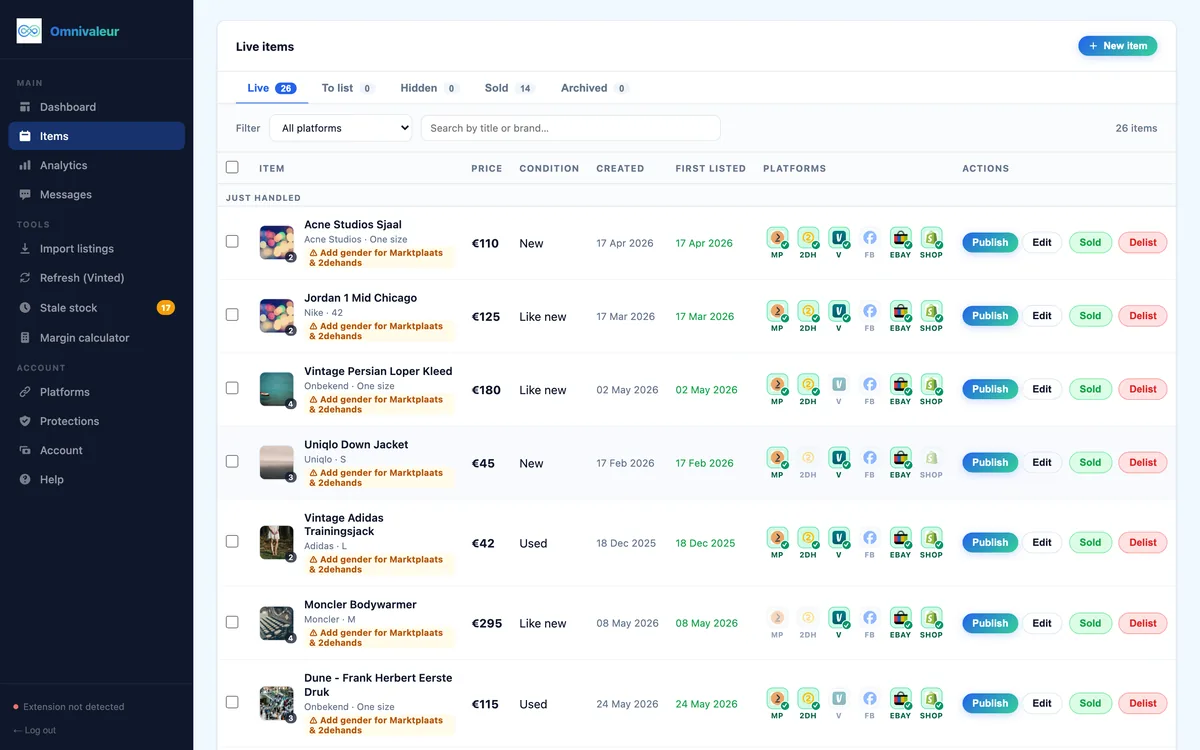
Which marketplaces actually work for board games in 2026?
Not every platform fits every game. A €15 card game sells differently than a €180 out-of-print strategy box. Here's how the six platforms compare for tabletop resellers in 2026.
| Platform | Best for | Typical fee | Watch out for |
|---|---|---|---|
| Marktplaats | Local pickup of heavy/bulky games | Free for private sellers, low pro fee | Buyers expect to test/inspect before buying |
| 2dehands | Belgian buyers, same category behaviour as Marktplaats | Free for private sellers | Slower response times outside evenings |
| Vinted | Smaller card and party games, lighter boxes | Buyer pays protection fee, seller pays 0% | Heavier box games push buyers into a pricier shipping tier |
| eBay | Out-of-print, rare, and international buyers | ~10-12% final value fee | Return policy defaults can favour the buyer on "missing piece" claims |
| Etsy | Custom inserts, painted minis, upgrade accessories | $0.20 listing + ~6.5% transaction fee | Raw used board games underperform vs handmade add-ons |
| Shopify | Your own storefront once you have repeat buyers | 0% marketplace commission, you pay payment processing | No built-in audience — you drive the traffic |
Most active resellers we talk to run Marktplaats or 2dehands for the bulky base games nobody wants to ship, and eBay or Etsy for the smaller, rarer pieces that travel well by post. If you're weighing up which combination fits your specific niche, the Gaming Equipment Reselling Automation Guide covers console and accessory crossover cases that often show up in the same collections as tabletop games. If you're moving stock specifically between Dutch and Belgian buyers, the Marktplaats to Vinted crosslisting guide walks through the category mapping.
How do you handle missing pieces and component counts without losing buyer trust?
Board games are the one reselling category where "used, good condition" isn't enough. A buyer wants to know: is the rulebook there? Are all the meeples present? Did the box get water damage? Skip this and you get returns.
Build a simple three-line template and reuse it on every listing:
- Verified complete — checked against the publisher's component list, nothing missing.
- Missing/replaced — name the exact piece (e.g. "missing 1 red resource cube, replaced with a spare from another set").
- Box condition — corner wear, shrink wrap intact or removed, any writing inside the box.
This isn't just about honesty. Under EU consumer shopping rights, buyers can request a refund or replacement if an item isn't as described — and "as described" is judged against whatever you wrote in the listing, not what's reasonable to assume for a secondhand game. Write the component note once inside your intake form and let it sync identically across all your listings, rather than writing it fresh (and inconsistently) on Marktplaats versus eBay versus Vinted.
Condition grading also helps: New/sealed, Like New (played once or twice), Good (visible shelf wear, all pieces present), Played (box damage, but complete), and Incomplete (list exactly what's missing, price accordingly — usually 40-60% below a complete copy).
What shipping and weight limits catch tabletop resellers out in 2026?
This is where board game resellers lose margin without noticing. A game like Scythe or Terraforming Mars weighs 2-3kg. Gloomhaven, fully expanded, can hit 9-10kg. Most shipping calculators on marketplaces are tuned for clothing and electronics, not oversized cardboard boxes.
A few concrete traps:
- Vinted's cheapest label tiers are built around envelope-sized fashion items. A heavy board game box regularly bumps you into the "large parcel" tier, which eats €3-6 more than a casual seller expects.
- 2dehands and Marktplaats default to local pickup for a reason — it avoids this problem entirely for the bulkiest titles, which is why many resellers keep the heaviest games local-only and reserve eBay/Etsy shipping for smaller boxes.
- eBay's international shipping calculator can underestimate dimensional weight on box-shaped games, especially to non-EU buyers, leaving the seller to cover the difference.
Weigh and measure the box once, store that number in your listing profile, and reuse it across all six platforms instead of re-measuring every time you list the same title again. This is exactly the kind of repetitive step automation removes — you set the dimensions once per SKU and they carry through.
How does 2026 tax reporting affect resellers who sell games across borders?
Digital platforms in the EU are required to report seller activity once you cross 30 transactions or €2,000 in a calendar year under DAC7 rules. Tabletop resellers hit that threshold faster than fashion resellers do, because average sale prices for board games often run €20-€60 rather than €5-€15 for a t-shirt. A single convention haul or a bulk lot purchase, flipped over a few months, can push a casual seller past the reporting line without them realising it.
The Belastingdienst's DAC7 information page explains exactly what gets reported to the Dutch tax authority once you cross the threshold on a given platform, and the European Commission's DAC7 overview covers how this applies across EU member states, useful if you're selling to 2dehands buyers in Belgium as well as Marktplaats buyers in the Netherlands.
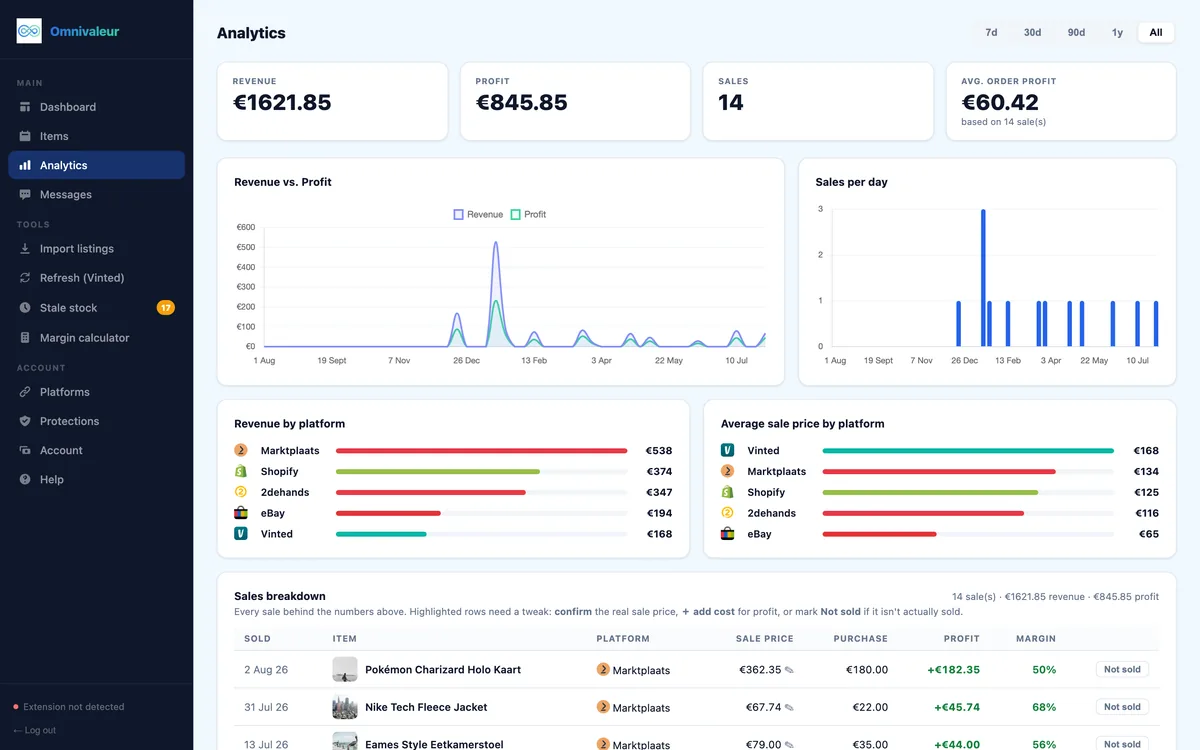
Practically, this means keeping a clean record of sold price per platform. If you're running the same board game across Marktplaats, eBay and Etsy, you need to know which one it actually sold on and for how much — not guess at year-end. Automation tools that track per-platform sold status make this bookkeeping step far less painful than reconstructing it from six separate seller dashboards.
- ✓Weigh and measure your board game box, store those dimensions in your profile once
- ✓Write your component checklist template with verified complete, missing pieces, and box condition sections
- ✓List expansions and Kickstarter exclusives as separate items, not bundled together
- ✓Photograph your game flat with box open, components laid out, following the same photo order each time
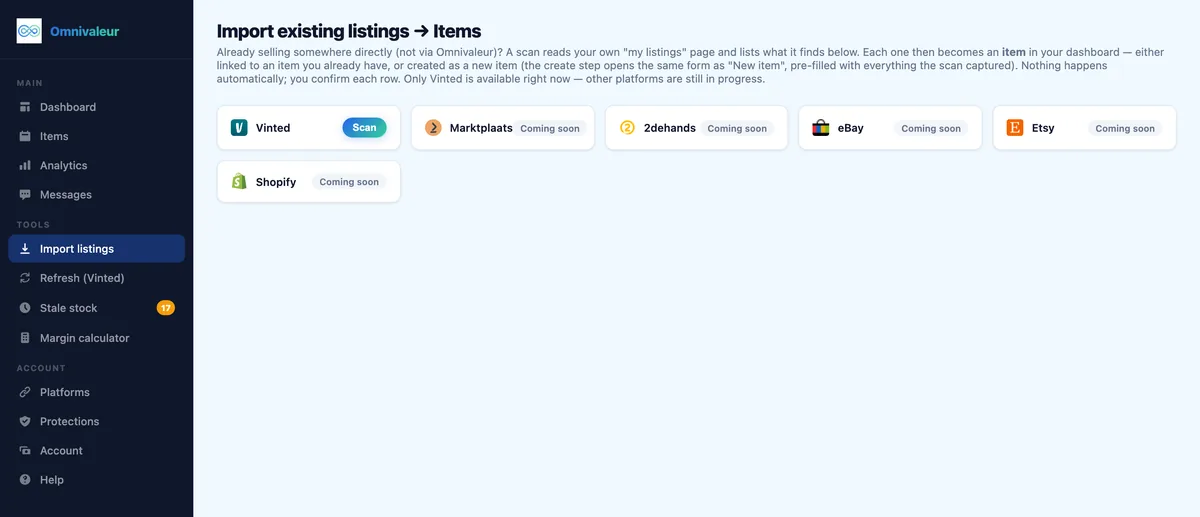
- ✓Import your first batch of listings into an automation tool and verify status syncs across all platforms
Should you separate expansions, promos and sealed Kickstarter exclusives when listing?
Yes, almost always. Bundling a base game with three expansions into one listing feels efficient, but it kills search visibility. A buyer searching "Terraforming Mars Prelude expansion" on eBay won't find your listing if the title says "Terraforming Mars bundle with 3 expansions" — the search algorithm favours exact matches.
List each expansion as its own item, then cross-reference in the description ("also selling the base game and two other expansions separately — see my other listings"). On Shopify, where you control the storefront, you can offer a bundle discount as a variant option without hurting individual search visibility elsewhere.
Kickstarter exclusives — special miniatures, promo cards, alternate art — deserve their own listing template entirely. These often sell for 2-5x retail on eBay and dedicated board game marketplaces because they were never available at retail. Lumping a KS-exclusive mini into a generic "board game lot, various pieces" listing buries value that a specialised buyer would happily pay a premium for. Tag these clearly with "Kickstarter exclusive" or "KS promo" in the title so they surface in the right searches.
This same logic — separating high-value variants from generic bulk stock — comes up constantly in adjacent collectible categories. The Collectibles Reselling Automation Guide and Vintage Toy Reselling Automation Guide both cover similar sorting decisions for sealed vs loose items, which maps closely onto sealed-vs-punched board game components.
How much time does cross-listing automation actually save a tabletop reseller?
Do the math on a single item. Photographing a board game, writing a title, listing condition and component notes, and setting a price manually takes roughly 12-15 minutes per platform once you factor in re-uploading photos and adjusting category fields. Do that across five platforms and you've spent an hour on one item before it's even gone live anywhere.
With an intake-once workflow, that same item takes about 8-10 minutes to enter fully — including the component checklist — and then publishes to all six platforms at once. Selling status syncs automatically, so when the game sells on 2dehands, it disappears from Vinted, eBay, Etsy and the rest without you touching five separate dashboards. For someone moving through a 40-game collection lot, that's the difference between a weekend of listing work and an evening of it.
If you're evaluating tools rather than building this manually, it's worth comparing feature sets directly. The Omnivaleur vs List Perfectly comparison and Omnivaleur vs OneShop comparison both break down how cross-platform sync, category mapping and pricing rules differ between the main options resellers consider in 2026.
One more practical note: board games photograph better flat, with the box open showing components laid out, than stacked on a shelf. Whatever template you build, keep a standard photo order — box front, box back, components laid flat, rulebook, any damage close-up — and reuse that sequence across every listing. It speeds up your own workflow and gives buyers on every platform the same buying confidence, whether they found the listing on Etsy or Marktplaats.
Frequently asked questions
Can I legally resell a board game that's missing a few components?
Do I need to register as a business to resell board games regularly?
What happens if the same board game sells on two platforms at the same time?
How do I price a board game that's out of print?
Can I bundle a base game with its expansions in one Shopify listing but sell them separately elsewhere?
Keep reading
Stop copying listings by hand
Omnivaleur publishes your item to every platform at once and syncs stock automatically when something sells.
Start free trial