Thrift Store Reselling Automation: The 2026 Cross-Listing Playbook
Thrift store reselling automation means using one intake form to photograph, describe and publish a secondhand find to multiple marketplaces at once — instead of manually re-typing the same listing six times. In 2026 the bottleneck isn't finding good stock, it's listing speed, inventory sync, and staying under each platform's rate limits.
Key takeaways
- Cross-listing tools save the most time on delisting a sold item everywhere else, not on the first listing itself.
- Publishing one item to all six marketplaces from a single intake form is now standard, not a premium feature.
- Listing too many items too fast on new accounts triggers rate limits faster than most resellers expect.
- DAC7 reporting means Dutch marketplaces already share your sales data with the tax authority above certain thresholds.
- One-of-a-kind thrifted items need different photo and title handling than multiples bought at retail.
Thrift store reselling automation is the practice of turning a single sourcing trip — one photo session, one condition check, one price decision — into listings on Marktplaats, 2dehands, Vinted, eBay, Etsy and Shopify without re-doing the work six times. The AI-heavy articles on this topic love to talk about "revolution" and "future outlook." Resellers actually want to know: how many items can I get live before dinner, and what breaks when I try to scale past 20 items a week?
What Does "Thrift Store Reselling Automation" Actually Mean in 2026?
It's not one tool. It's a workflow with three separate jobs: sourcing (what to buy and at what price), intake (photos, measurements, condition notes), and distribution (getting that listing live on every marketplace where your buyer might be looking). Most "AI reselling" content bundles all three under one buzzword, but they solve different problems.
Sourcing apps use price-comparison databases to flag underpriced items on the shelf. Intake tools clean up photos and suggest titles. Distribution tools — like Omnivaleur compared with List Perfectly — take that single listing and push it to multiple storefronts. Confusing these three is why a lot of resellers buy an "AI tool" expecting it to publish for them, then discover it only estimates resale value.
For thrifted goods specifically, distribution is the part that eats the most hours, because unlike wholesale stock, every thrifted item is unique. You can't copy-paste a listing template across ten identical units. Each piece needs its own photos, its own condition description, its own price.
How Do You Turn a Thrift Store Haul Into Listings Across Six Marketplaces?
The practical flow looks like this once you've built a habit around it:
- Photograph the item against a plain background — four to six angles, one close-up of any flaw.
- Fill in one intake form: category, brand (if any), size or dimensions, condition, price.
- Let the cross-listing tool adapt that single entry into the format each marketplace expects — Vinted wants a casual title, eBay rewards a keyword-stuffed one, Etsy wants a story.
- Publish, then move to the next item.
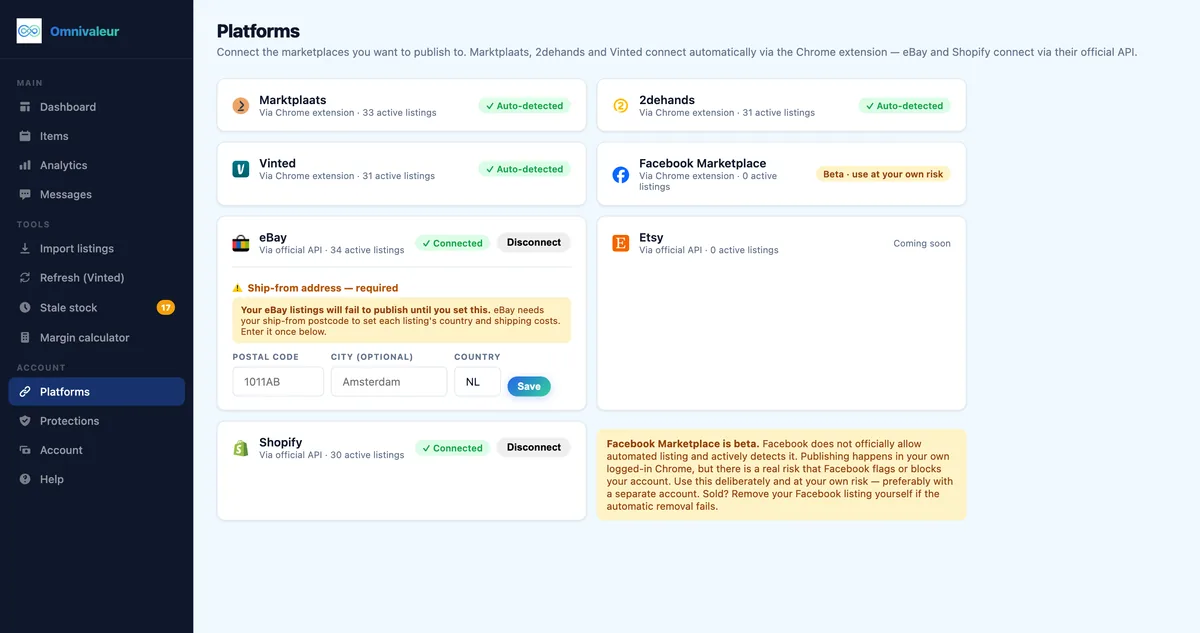
With Omnivaleur, that intake form pushes the listing to all six marketplaces — Marktplaats, 2dehands, Vinted, eBay, Etsy and Shopify — from a single entry, instead of six separate logins and six separate uploads. For a reseller doing 15-25 thrifted items a week, that's the difference between two hours of listing work and twenty minutes.
Category matters here. Clothing, decor, toys and books each have their own quirks worth reading up on separately — see the vintage clothing reselling automation platforms guide and the vintage decor reselling automation guide if those are your main thrift categories.
Why Does Listing Speed (Not Just AI) Determine Whether You Get Rate-Limited?
This is the part almost no competing article mentions, and it's the one that actually causes accounts to get flagged. Marketplaces watch for behavior that looks automated: dozens of listings published within seconds of each other from the same IP, identical timing patterns, or several tabs hammering the same account simultaneously.
Omnivaleur deliberately publishes in one browser tab at a time. It's slower on paper, but it's the setting that keeps accounts out of rate-limit trouble — parallel publishing across five tabs is exactly what gets flagged by platforms watching for bot-like posting patterns. A tool that brags about listing "50 items in 60 seconds" is usually the one that gets a seller account temporarily suspended two weeks later.
Rate limits vary by platform and change without much warning. In 2026, Vinted still caps daily uploads on new accounts more aggressively than established ones, eBay throttles new sellers' monthly listing count until sales history builds trust, and Marktplaats applies stricter checks to accounts posting many items in the same category within a short window. None of these limits are published as hard numbers — they're enforced quietly, which is exactly why steady, throttled publishing beats a burst upload every time.
Which Marketplace Fees and Rules Actually Matter for Thrifted Goods in 2026?
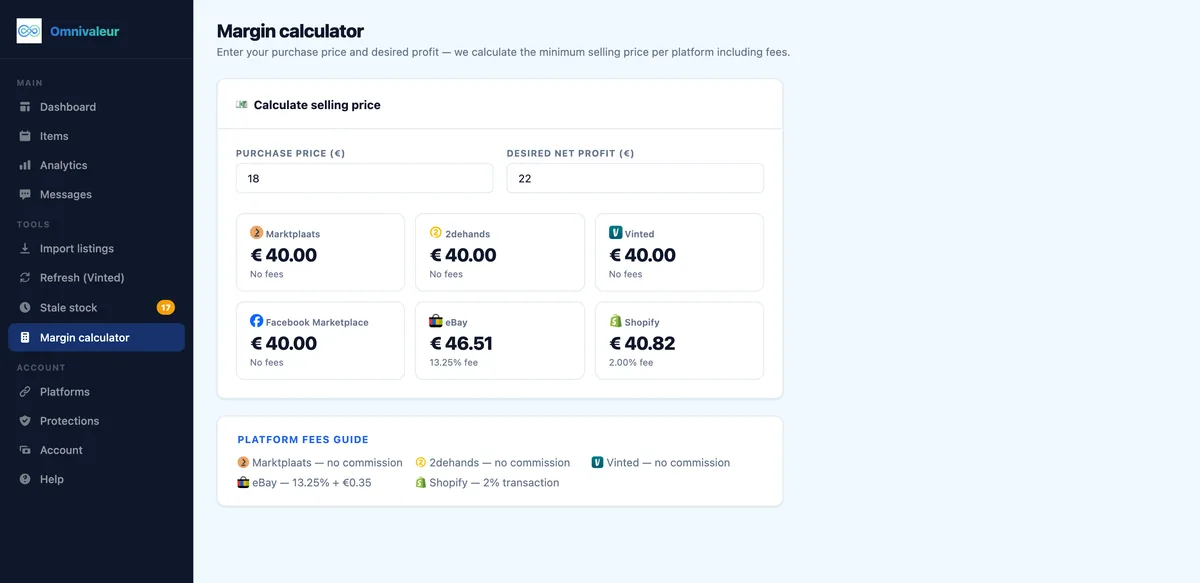
Fee structures shift yearly, and thrifted goods sit in an odd spot: often under €30, often one-of-a-kind, often sold at a loss on the first few listings while you learn a category. Here's the current landscape:
| Platform | Selling fee | Best for thrifted goods |
|---|---|---|
| Vinted | Buyer pays protection fee; seller fee is 0% | Clothing, accessories, small items |
| Marktplaats | Free listing; paid boosts optional | Furniture, bulky decor, local pickup |
| 2dehands | Free listing; paid boosts optional | Belgian buyers, same category strengths as Marktplaats |
| eBay | ~13% final value fee (category-dependent) | Collectibles, electronics, niche brands |
| Etsy | 6.5% transaction fee + $0.20 listing fee | Vintage (20+ years old) and handmade-adjacent finds |
| Shopify | Monthly subscription, 0-2% payment processing | Building a repeat-buyer storefront |
Etsy's "vintage" category rule is worth flagging separately: items must be genuinely at least 20 years old to qualify. A lot of thrift resellers mislabel 2010s items as "vintage" and get listings pulled. If vintage-specific categories are your focus, the vintage toy reselling automation guide and collectibles reselling automation guide both go deeper into category-specific listing rules.
How Does DAC7 Tax Reporting Affect Thrift Store Resellers?
If you sell more than 30 items or earn over €2,000 in a calendar year on an EU marketplace, that platform is required to report your sales data to tax authorities under DAC7. This isn't optional and it isn't new for 2026, but plenty of casual thrift resellers still don't realize Marktplaats, Vinted and eBay are already collecting this data automatically.
The Dutch tax authority publishes exactly what gets reported and when, on the Belastingdienst DAC7 information page for sellers. The European Commission's DAC7 overview covers how this applies across all EU member states, not just the Netherlands. If you're cross-listing the same thrifted items on both Marktplaats and Vinted, both platforms report independently — the thresholds aren't combined across platforms in your favor, so keep your own running total rather than assuming you're under the line.
This is also where automation actually helps beyond speed: a tool that logs what you listed, where, and for how much gives you a paper trail if you ever need to reconcile your own records against a platform's DAC7 report.
- ✓Photograph against plain background in four to six angles with close-up of any flaw
- ✓Fill one intake form with category, brand, size or dimensions, condition and price
- ✓Let cross-listing tool adapt the single entry into format each marketplace expects
- ✓Publish from one browser tab at a time to avoid rate-limit flags
- ✓Monitor sold status across all platforms to delist immediately when item sells elsewhere
What Should You Do When an Item Sells on One Platform While Still Listed on Five Others?
This is the single most common thrift-reselling headache, and it's what most competitor articles skip entirely in favor of talking about AI valuation. A one-of-a-kind item sold cross-platform has to disappear from every other listing the moment it sells, or you're heading toward an angry buyer and a refund under EU consumer shopping rights, which guarantee refunds and returns regardless of which marketplace processed the sale.
Manual resellers handle this by checking five tabs after every sale — realistically, they don't, and they oversell instead. Automated cross-listing tools solve this by delisting or marking "sold" across the remaining platforms as soon as one sale is confirmed. This single feature is usually worth more time savings than the listing automation itself, because overselling damages your account rating on every platform involved, not just the one where the mistake happened.
If your workflow includes moving stock between a Dutch marketplace and an international one, worth reading the Marktplaats to Vinted crosslisting guide or, for Belgian resellers, the 2dehands to Etsy crosslisting guide — both cover the sold-item sync question in more platform-specific detail.
Which Categories of Thrifted Goods Are Easiest to Automate First?
Not every thrift find is worth full six-platform distribution. Bulky furniture rarely justifies shipping-based platforms like Etsy or eBay — keep that local, on Marktplaats or 2dehands. Small, shippable, identifiable categories automate best:
- Books — often have an ISBN, which speeds up listing data entry. See the book reselling automation guide.
- Vinyl records — condition grading is standardized (Discogs-style grading), which makes cross-platform descriptions consistent.
- Cameras and electronics — buyers expect detailed specs, which rewards a good intake template. The vintage camera reselling automation guide covers the spec fields worth capturing once and reusing.
- Board games — completeness checks (missing pieces) matter more than brand, and that's a one-time note you can reuse in every listing template.
Clothing sits in the middle: high volume, but every piece needs its own measurements. That's where a repeatable intake habit — same six photo angles, same measurement points — pays off faster than any AI valuation tool, because valuation only tells you what to charge; it doesn't get the listing published.
What's the Realistic Time and Cost Trade-Off of Automating Thrift Reselling?
A reseller listing manually across six platforms spends roughly 12-18 minutes per item once photos are taken — retyping titles, resizing images per platform, adjusting category fields. At 20 items a week, that's 4-6 hours just on re-entry, before any customer messages or packing. Cross-listing tools cut that intake-to-published time to 2-4 minutes per item, because the description, photos and condition notes only get written once.
The cost side is less dramatic than marketing pages suggest. Most cross-listing subscriptions run €15-40 a month depending on item volume and platform count. For a thrift reseller doing €800-1,500 a month in sales, that's a small percentage — the real return isn't the subscription cost, it's the extra selling hours it frees up, and the reduced risk of overselling an item you can no longer source a replacement for, since thrifted stock is one-off by nature.
Frequently asked questions
Do I need to register a business to resell thrifted items regularly on Marktplaats or Vinted?
Can I reuse the same photo set across Vinted, eBay and Etsy, or does each platform need different image specs?
How many thrifted items can I realistically list per day once I'm using automation?
Does cross-listing work for one-of-a-kind thrifted items that have no barcode or EAN code?
What happens if a thrifted item turns out to be damaged after a buyer receives it?
Keep reading
Stop copying listings by hand
Omnivaleur publishes your item to every platform at once and syncs stock automatically when something sells.
Start free trial