Cosmetics and Beauty Reselling Automation: The Complete 2026 Cross-Listing Guide
Cosmetics and beauty reselling automation means cross-listing sealed, lightly used, or vintage beauty items across Marktplaats, Vinted, eBay, Etsy and Shopify while respecting each platform's hygiene bans, expiry disclosure rules, and hazmat shipping limits on perfume and nail products. Automation tools like Omnivaleur handle the repetitive listing work; you still own the compliance decisions.
Key takeaways
- Vinted and eBay both restrict or ban used cosmetics that have touched skin, not just "used items" in general
- EU cosmetics rules require either a minimum durability date or a PAO jar symbol on every listed product
- Perfume and nail polish count as flammable liquids for shipping, which limits cross-border sales more than people expect
- Omnivaleur's stale-stock view catches unsold beauty inventory before it expires on the shelf
- Cross-listing one tab at a time avoids the rate-limit bans that hit sellers who batch-publish beauty lots
- Resellers moving real volume in cheap drugstore haul lots can hit the DAC7 reporting threshold faster than they think
Reselling beauty products isn't like reselling a vintage camera or a pair of sneakers. A bottle of foundation has an expiry date. A perfume is legally a flammable liquid once it leaves the shelf. And three of the six marketplaces most resellers use won't even let you list a used lipstick, no matter how gently it was swiped. Automating the cross-listing side only helps if the underlying rules are handled first.
Which marketplaces even allow reselling used cosmetics in 2026?
This is the question most beauty resellers get wrong before they touch any tool. The platforms don't treat "used cosmetics" as one category — they split hygiene-risk items from sealed or collectible ones, and the line moves depending on where you sell.
Vinted bans opened cosmetics outright in most categories. Sealed, unused items are fine, and "new without box" makeup is generally tolerated if the fill level is visible in photos, but a used mascara or a swiped lipstick gets pulled fast, often after a single report. eBay follows a similar logic through its prohibited items policy: cosmetics that have been in contact with skin or mouth (lipstick, foundation, mascara, lip liner) are blocked from resale even if barely used, while sealed, factory-fresh stock and vintage packaging sold explicitly as collectible — a 1970s perfume bottle, for instance — are treated differently. Etsy leans into that collectible angle: vintage compacts, discontinued perfume bottles, and antique vanity sets sell well there as decorative or collector items, but you can't market them as safe to apply to skin. Marktplaats and 2dehands have no beauty-specific rule written into their terms, but hygiene complaints trigger manual removals just as fast, and buyer protection disputes on used makeup are disproportionately high for the category. On your own Shopify store you set the rules, but EU consumer law still applies — including the fact that the standard 14-day right of withdrawal does not cover sealed hygiene goods once the seal is broken, per the EU's consumer shopping rights guidance.
| Marketplace | Used cosmetics allowed? | Best fit for beauty resale |
|---|---|---|
| Vinted | No — sealed/new only | Unused drugstore and designer haul lots |
| eBay | No if skin-contact, yes if sealed | Sealed sets, vintage bottles, job-lot bundles |
| Etsy | Vintage/collectible only | Antique compacts, discontinued perfume packaging |
| Marktplaats / 2dehands | No formal ban, high dispute risk | Local sealed stock, gift sets |
| Shopify | Your own policy, EU law still applies | Your own curated, sealed inventory |
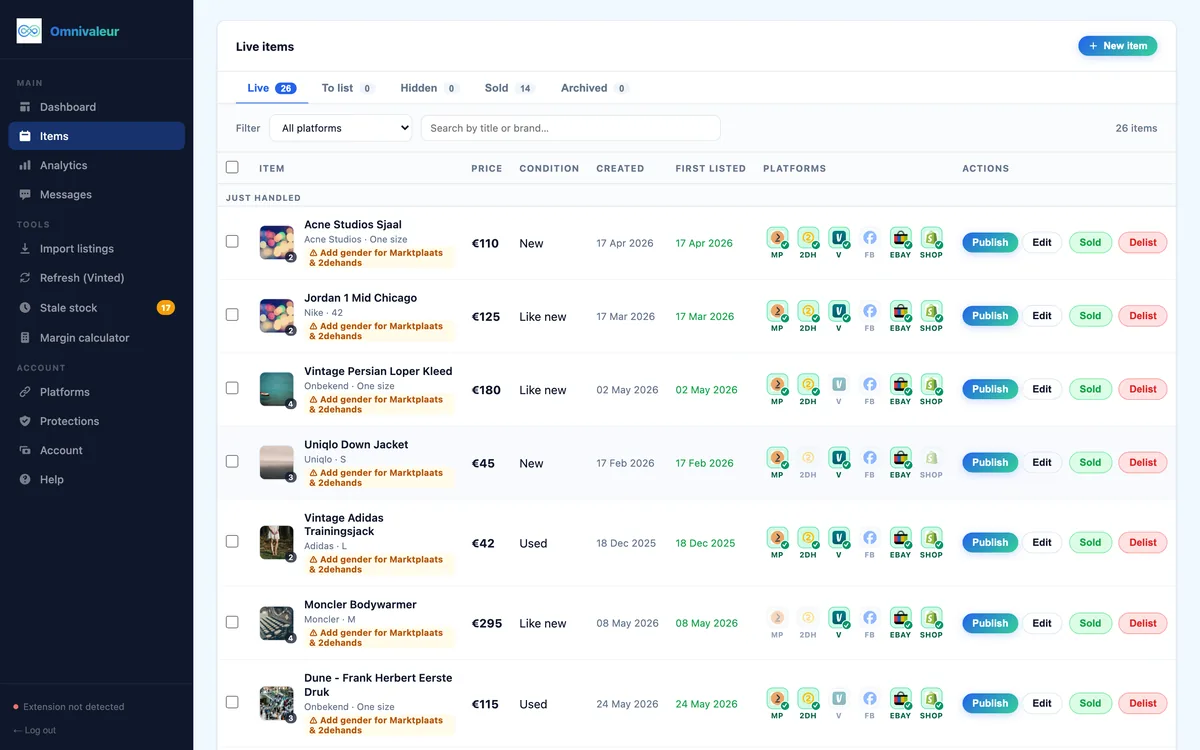
If your workflow already spans several of these — say a Vinted haul that also needs a home on eBay — the mechanics of moving a listing between them without retyping everything are covered in the Marktplaats to Vinted crosslisting guide, and the same logic applies in reverse from 2dehands to Vinted.
How do EU rules on batch codes and expiry dates affect your listings?
Every cosmetic sold in the EU carries either a minimum durability date or a Period-After-Opening (PAO) symbol — that little open-jar icon with "6M" or "12M" printed inside — under EU Cosmetics Regulation 1223/2009. Products with a shelf life under 30 months need the actual date printed. Anything longer relies on the PAO symbol instead. As a reseller, that symbol is your listing's best friend: it tells the buyer exactly what they're getting, and it protects you from a return claim based on "this was already off."
Batch codes are usually stamped on the bottom of the container or the base of the box, and the format is brand-specific — Estée Lauder, L'Oréal and MAC all encode manufacture dates differently. Independent batch-code checkers exist for most major brands and let you convert that code into an approximate production date in seconds. Put that date, or at minimum "verified batch code, checked [date]," directly in your listing description. It's the single fastest way to cut return requests on beauty items, and it doubles as proof against counterfeit claims later.
What shipping rules apply to perfume, nail polish and other flammable beauty items?
Most eau de parfum and eau de toilette contain enough ethanol to be classified as a flammable liquid for transport purposes. Nail polish, nail polish remover, and most aerosols — dry shampoo, hairspray, setting spray — fall into the same bracket. That classification matters more than sellers expect once a parcel crosses a border.
- Domestic ground shipping within the Netherlands or Belgium is generally fine for consumer-quantity perfume and nail products.
- International tracked mail (PostNL, bpost, DHL) often caps volume or ethanol concentration for cross-border parcels, and undeclared dangerous goods can get a parcel seized at customs rather than just delayed.
- Air freight is stricter again — some couriers refuse aerosols entirely, regardless of size, for air legs of an international route.
- eBay's and Etsy's own carrier integrations don't always warn you about this before you print a label, which is how sellers end up with a returned or destroyed parcel and no clear refund path.
The practical fix is boring but effective: keep perfume and aerosol listings limited to domestic buyers unless you've confirmed your carrier's dangerous goods terms in writing, and say so plainly in the listing so buyers abroad don't try to check out anyway.

How do you prove a beauty item is authentic before a marketplace flags it?
Counterfeit beauty products are one of eBay's most active enforcement categories under its Verified Rights Owner program, and Vinted removes suspected fakes on sight, no warning issued first. Chanel, Dior, and Charlotte Tilbury are reported disproportionately often, mostly because the packaging is easy to replicate but the batch code isn't.
Photograph the batch code clearly, cross-check it against the brand's own verification tool where one exists, and keep the original receipt or invoice if you still have it. If you bought the item as part of a bulk lot with no paperwork, say so honestly in the listing rather than implying provenance you can't back up — a vague "genuine, trust me" description is exactly what triggers manual review. The same authentication discipline applies to small luxury goods generally; the jewelry reselling automation guide walks through a near-identical batch-verification workflow for hallmarks and maker's marks.
- ✓Check which marketplace allows your item type (opened vs sealed, skin-contact vs collectible)
- ✓Photograph the batch code clearly and verify it against the brand's own tool if available
- ✓Note the PAO symbol or expiry date in your listing description word for word
- ✓For flammable items like perfume, confirm your carrier's dangerous goods policy in writing first
- ✓Write honest condition wording and include a seal or fill level photo
- ✓Publish one tab at a time across platforms, never blast all listings live at once
How does cross-listing automation stop beauty stock from expiring on the shelf?
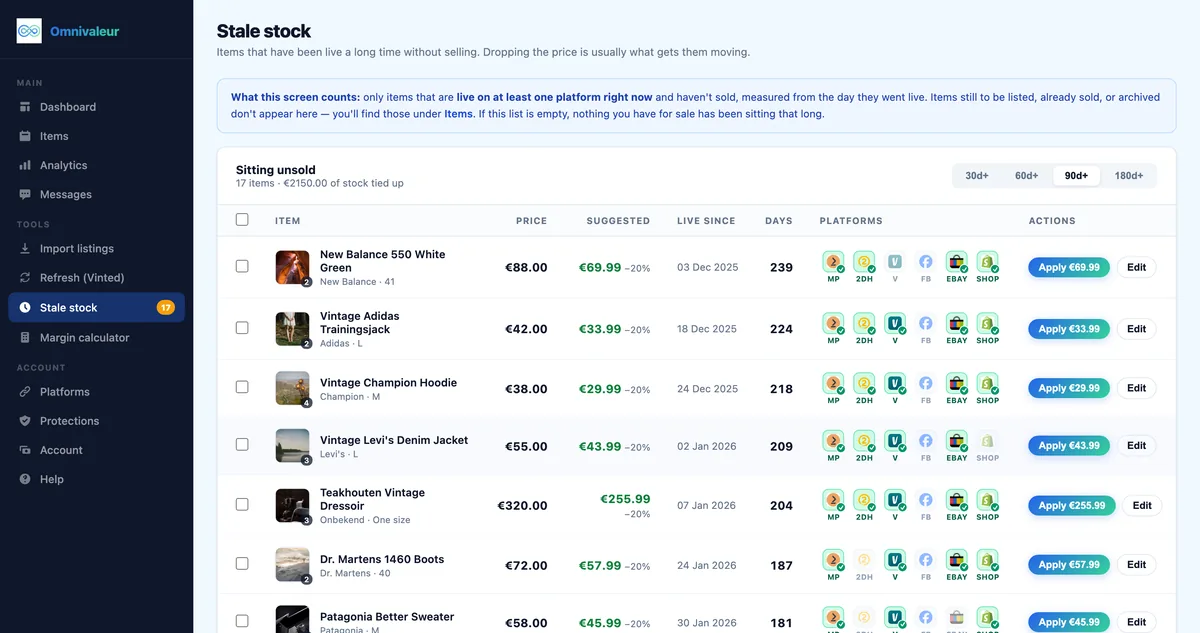
Unlike a vinyl record or a vintage toy, a bottle of serum genuinely goes bad. Stock that sits unsold for four months isn't just tying up cash — it's ticking toward the point where you'd have to disclose it as past its PAO window or pull it entirely. Most sellers don't notice a slow listing until it's buried on page six of their own inventory.
This is exactly what Omnivaleur's stale-stock view is built to catch: it flags listings that have been sitting unsold for a set period so they surface at the top of your dashboard instead of quietly sinking. For beauty inventory specifically, that means you see the six-month-old highlighter set before its PAO clock runs out, not after — giving you time to reprice, bundle it, or pull it before a buyer complains about shelf life.
Why does listing one tab at a time matter more for beauty sellers than other niches?
Beauty resellers tend to move in lots — a haul of 20 discontinued lipsticks, a bundle of drugstore samples, a box of gift-with-purchase minis. The temptation is to blast all 20 listings live at once across every marketplace to save time. That's precisely the pattern that gets accounts rate-limited or temporarily suspended for "unusual activity," especially on Vinted and eBay, where rapid-fire bulk publishing from a new or mid-tier account reads as bot behavior.
Omnivaleur runs cross-listing one browser tab at a time on purpose. Parallel publishing is what gets marketplace accounts flagged, and a rate-limit ban costs far more time than a slightly slower, sequential upload ever does. It's a deliberate trade-off: a few extra minutes per batch against the risk of losing a seller account entirely, which for a high-volume beauty flipper can mean months of relisting from scratch. If you're weighing this kind of tool against alternatives, the Omnivaleur vs List Perfectly comparison breaks down how different platforms handle publishing speed versus account safety.
Do you need to report cosmetics resale income for tax purposes in 2026?
If you're flipping drugstore hauls or discontinued sets at scale, the euro amounts per item are usually small — but the transaction count adds up fast, and that's exactly what DAC7 tracks. Under the EU's DAC7 rules, digital platforms report seller activity to tax authorities once a seller crosses 30 transactions or €2,000 in a calendar year, whichever comes first. A reseller moving 40 low-price beauty items a month can cross that threshold within weeks, well before they'd hit it doing the same revenue in higher-ticket categories like electronics or designer clothing.
The Dutch tax authority explains exactly what gets reported and when in its DAC7 information for sellers, and the European Commission's DAC7 overview covers the framework across all EU member states. Neither document is beauty-specific, but the high-volume, low-unit-price nature of cosmetics resale makes this one of the categories where sellers get caught off guard by the threshold. Keep basic records — purchase cost, sale price, platform fees — from day one rather than reconstructing them after a reporting notice arrives.
This is also where cross-listing consistency helps beyond convenience. Resellers who run multiple niches side by side — beauty alongside vintage clothing or thrift finds — often use the same dashboard to track sold status across platforms, which is the same underlying need covered in the thrift store reselling automation guide and the Vinted reselling automation setup.
How should a beauty listing be written to pass moderation on the first try?
Beauty listings get pulled or shadow-limited more often than most categories because moderation systems are trained to catch exactly the hygiene and authenticity issues covered above. A listing that survives review usually includes, in this order: a clear front-facing photo showing the seal or fill level, a visible batch code photo, the PAO symbol or expiry date stated in text, honest condition wording ("sealed, never used" rather than "like new"), and — for anything over roughly €30 — a note on how authenticity was verified. Skipping any one of these is what triggers a manual review queue instead of an instant approval, which on some platforms can take days rather than minutes.
None of this is difficult once you've done it a few times, but doing it manually across five or six marketplaces for a haul of twenty items is where most sellers burn their evening. That's the actual gap cross-listing automation fills for this niche: not writing better copy, but not having to rewrite the same compliant description five times over.
Frequently asked questions
Can I resell samples, minis, and gift-with-purchase items I never opened?
Do I need a business license to resell beauty products regularly in the Netherlands?
How do I handle a listing that gets removed for "hygiene policy" without warning?
Is it worth cross-listing a small beauty haul, or should I just sell it on one platform?
What happens if a buyer claims a cosmetic item arrived expired?
Keep reading

Stop copying listings by hand
Omnivaleur publishes your item to every platform at once and syncs stock automatically when something sells.
Start free trial