Second-Hand Sales Tax in Belgium: The Full 2026 Reseller Guide

Private sellers in Belgium don't pay tax on occasional second-hand sales. Once you sell regularly for profit, you must register as self-employed, charge VAT above the €25,000 exemption threshold, and apply the margin scheme (Art. 58 §4 WBTW) on used goods bought without VAT. Platforms also report your sales to tax authorities under DAC7.
Key takeaways
- Occasional sales of your own used belongings stay tax-free in Belgium, no matter how many times you list them.
- Regular buying-to-resell activity triggers VAT registration once the FOD Financiën sees profit intent and organisation.
- The small business VAT exemption covers turnover up to €25,000 a year in 2026, but you must still register and invoice.
- DAC7 forces Vinted, eBay, 2dehands and Etsy to report sellers who cross 30 sales or €2,000 in a calendar year.
- The margin scheme taxes only your profit margin, not the full sale price, if you bought the item VAT-free.
Most people selling their old clothes on Vinted or an unused drill on 2dehands never owe a cent of tax on it. The moment you start buying stock specifically to flip it — thrifting on Tuesday, listing on Wednesday, doing this every week — Belgium treats you as a reseller, and that comes with VAT obligations, registration duties, and reporting rules that didn't exist for you five years ago. The lines are clearer than most sellers assume, and the numbers below show exactly where they sit for 2026.
Do Private Sellers in Belgium Pay Tax When Selling Second-Hand Items?
No. If you're clearing out your closet, selling a bike you've owned for years, or offloading furniture after a move, that's a private, non-taxable transaction. Belgian tax law (and EU VAT rules for online sellers) only taxes economic activity — buying or producing goods with the intention of making a profit through repeated sales. Selling your own used possessions, even for more than you originally paid, doesn't count as economic activity on its own.
There's no legal cap on how many personal items you can sell per year as a private person. The threshold that actually matters isn't a number of listings — it's whether you're selling things you bought for yourself versus things you bought to resell. A reseller who buys ten jackets at a flea market specifically to list them on Vinted is doing something categorically different from someone emptying a wardrobe, even if both end up with ten listings.
When Does Occasional Selling Become a Taxable Business Activity in Belgium?
The FOD Financiën (Belgian tax authority) looks at a handful of factual indicators rather than one hard rule:
- Regularity — selling every week versus a one-off clear-out
- Intent to profit — buying stock below market value specifically to resell it
- Organisation — a dedicated shop, branded listings, a storage setup, bulk sourcing trips
- Volume and value — dozens of transactions a year versus a handful
No single factor triggers business status alone. Selling 40 items in a year because you're finally decluttering a house isn't a business. Sourcing 40 items from thrift stores specifically to resell them for profit, even part-time, generally is — and the same logic applies whether you're in Antwerp or Amsterdam. Our guide on when reselling becomes a business and how registration works walks through the equivalent Dutch framework, which the Belgian tax office applies almost identically in practice.
Do You Need to Register as a Self-Employed Reseller in Belgium?
Once your activity qualifies as a business, you need an ondernemingsnummer through a recognised "ondernemingsloket" (business counter), and you must affiliate with a social insurance fund even if reselling is just a side activity (bijberoep) alongside a day job. Side-activity status still means real obligations: quarterly or annual VAT filing, income tax declarations under business income rather than miscellaneous income, and social contributions once your net profit crosses roughly €1,700 per year.
Many resellers register as a "bijberoep" first to test the waters before going full-time. That's completely legal, but it doesn't reduce your VAT or invoicing duties — the rules below apply from the moment your turnover is business turnover, not from the moment you quit your job. If you're scaling from occasional thrift finds to a steady pipeline, our thrift store reselling automation setup guide covers the operational side of sourcing and relisting at volume once registration is sorted.
How Does the Belgian Margin Scheme (Margeregeling) Work for VAT on Used Goods?
This is the part resellers get wrong most often. Once you're VAT-registered, you don't automatically charge 21% on your full selling price. If you bought the item from a private person, another margin-scheme reseller, or anyone who couldn't charge you VAT, Article 58 §4 WBTW lets you apply the margin scheme: VAT is calculated only on your profit margin, not the full price.
Worked Example: Per-Item Method
You buy a second-hand armchair from a private seller for €40 (no invoice, no VAT charged to you). You clean it up and sell it for €90.
- Margin = €90 − €40 = €50
- This €50 is treated as VAT-inclusive, so excl. VAT margin = €50 ÷ 1.21 = €41.32
- VAT due = €50 − €41.32 = €8.68
You owe €8.68 in VAT on that sale — not €18.90 (21% of the full €90), which is what you'd pay under standard VAT rules. The margin scheme exists precisely because you can't reclaim input VAT on a purchase where none was charged, so taxing the full price twice would be unfair.
Worked Example: Globalisation Method
For low-value, high-volume stock — secondhand books, small toys, costume jewellery — tracking margin per item is impractical. The globalisatiemethode lets you calculate margin across a batch per VAT period instead.
Say you buy a lot of 50 second-hand paperbacks for €200 total and sell them across a month for a combined €350.
- Total margin = €350 − €200 = €150
- VAT-inclusive margin → excl. VAT = €150 ÷ 1.21 = €123.97
- VAT due for the period = €26.03
You can't mix methods freely within one category of goods — choose per-item or globalisation per activity and stay consistent, since switching back and forth is one of the first things an audit flags.
Mandatory Invoice Wording
Every invoice issued under the margin scheme must carry specific wording required by KB 53, in Dutch or French depending on your region — something to the effect of "Bijzondere regeling – Gebruikte goederen" (special scheme — second-hand goods). Leaving this off the invoice is treated as a formal VAT error even if the calculation itself is correct, so build it into your invoice template once and don't touch it.
Which Second-Hand Goods Actually Qualify for the Margin Scheme?
The scheme applies to furniture, clothing, electronics, musical instruments, vehicles, art, antiques and collectibles — provided you bought them from a non-VAT-charging source. It does not apply when:
- You bought the item new or from a VAT-registered supplier who charged you deductible VAT
- The goods are precious metals or gemstones sold loose (not set in jewellery)
- You're a car dealer using goods that don't meet the "used vehicle" definition under Belgian rules
This is why keeping clean purchase records per category matters — a mixed inventory of margin-scheme clothing and new-with-tags stock sourced from a wholesaler needs two separate VAT treatments on the same invoice run. Specialised categories like vintage watches, luxury handbags or vintage cameras usually qualify cleanly since they're almost always sourced second-hand, but mixed-source inventory needs more careful bookkeeping.
- ✓Decide if your activity qualifies as business based on regularity, intent, and volume
- ✓Get an ondernemingsnummer through a recognised business counter if you're doing this regularly
- ✓Affiliate with a social insurance fund even if it's a side activity alongside your day job
- ✓Set up margin-scheme invoicing with the required wording per KB 53 in your region's language
- ✓Keep an aankoopregister logging date, seller details, description, and purchase price for each buy
- ✓Choose either per-item or globalisation method for margin calculation and stay consistent
What Is the Small Business VAT Exemption Threshold in Belgium for 2026?
Belgium's "vrijstellingsregeling kleine ondernemingen" exempts businesses with annual turnover under €25,000 from charging VAT at all, for 2026. You still need an ondernemingsnummer and still must invoice customers, but you don't add VAT to the price and can't reclaim input VAT either. This threshold is calculated on total turnover, not profit — so a reseller doing €24,000 in sales on a 30% margin stays exempt, while one doing €26,000 doesn't, regardless of how thin the margin actually is.
If you sell across borders — shipping from Belgium to German or French buyers via eBay or Etsy — the EU's One-Stop-Shop (OSS) scheme can apply once your cross-border sales exceed €10,000 a year, a separate threshold from the domestic exemption. The EU's official VAT rules for online sellers cover how OSS registration works if you're actively selling into multiple EU countries rather than just occasionally shipping there.
Does DAC7 Reporting Apply to Belgian Sellers on Vinted, eBay and 2dehands?
Yes, and this is the piece none of the margin-scheme guides mention. Under the EU's DAC7 directive, online platforms — Vinted, eBay, 2dehands, Etsy, Marktplaats — must report sellers who hit 30 transactions or €2,000 in total payouts within a calendar year to the tax authority in the seller's country of residence. For a Belgian resident, that's FOD Financiën. For a Dutch resident, the equivalent reporting goes to the Belastingdienst, since the directive applies across the EU with near-identical thresholds.
DAC7 reporting isn't itself a tax bill. It's an information-sharing duty: the platform tells the tax office your name, bank account, and total sales, and the tax office cross-checks it against what you've declared. Cross 30 sales in a year as a private seller offloading your own wardrobe, and nothing changes — you still owe no tax, you just appear on a data feed. Cross that threshold while buying stock specifically to resell, and you've effectively handed the tax office the paper trail that proves you should have been VAT-registered from the start. Our breakdown of DAC7 reporting rules on Vinted goes deeper into exactly what data gets shared and when sellers get notified.
Which Platforms Work Best for Registered Resellers in Belgium in 2026?
Platform choice affects how easy invoicing, DAC7 reporting, and VAT documentation are to manage day to day.
| Platform | Business invoicing support | DAC7 reporting | Typical fees | Best for |
|---|---|---|---|---|
| Vinted | Limited — no native VAT invoice fields | Yes, 30 sales / €2,000 | Buyer protection fee, no seller fee | Clothing, accessories |
| 2dehands / Marktplaats | Manual, seller-managed | Yes | Mostly free, paid boosts optional | Furniture, local pickup items |
| eBay | Business seller accounts with VAT invoice fields | Yes | Final value fee ~10-13% | Electronics, collectibles, cross-border |
| Etsy | Business account + VAT settings | Yes | Listing fee + 6.5% transaction fee | Vintage, handmade, art |
| Shopify | Full VAT/invoice control | Not platform-reported (your own store) | Subscription + payment processing | Established resellers building a brand |
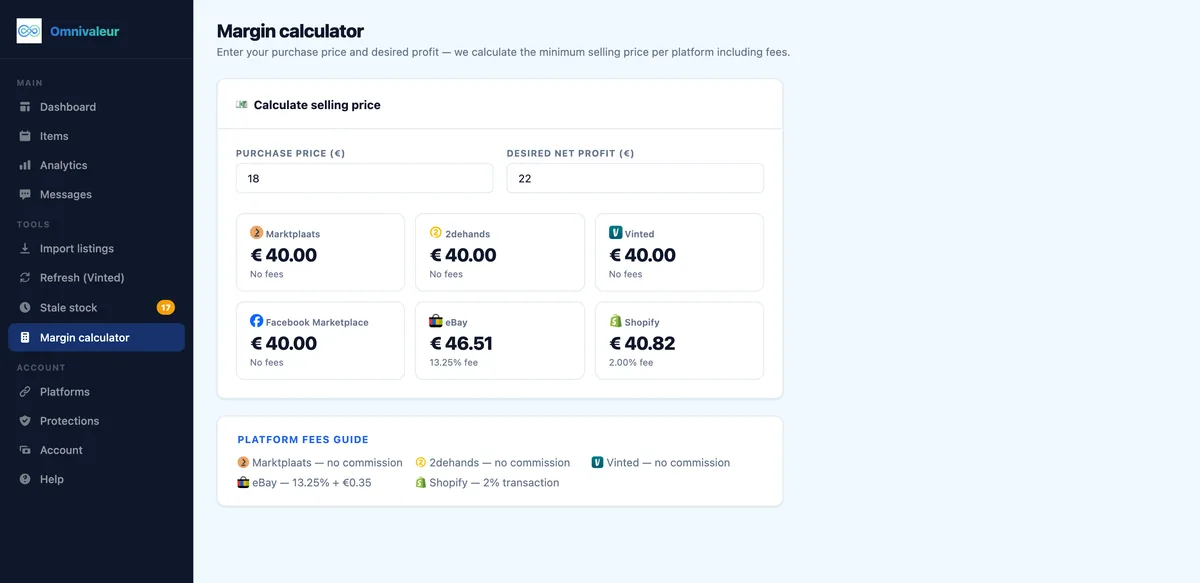
Running the same stock across all five means juggling five different invoicing quirks, which is where most resellers lose track of margin-scheme paperwork. Spreading listings manually across Marktplaats and 2dehands or Vinted and Marktplaats is manageable at low volume, but once you're registered and VAT-liable, inconsistent records across platforms are exactly what an audit picks apart first.
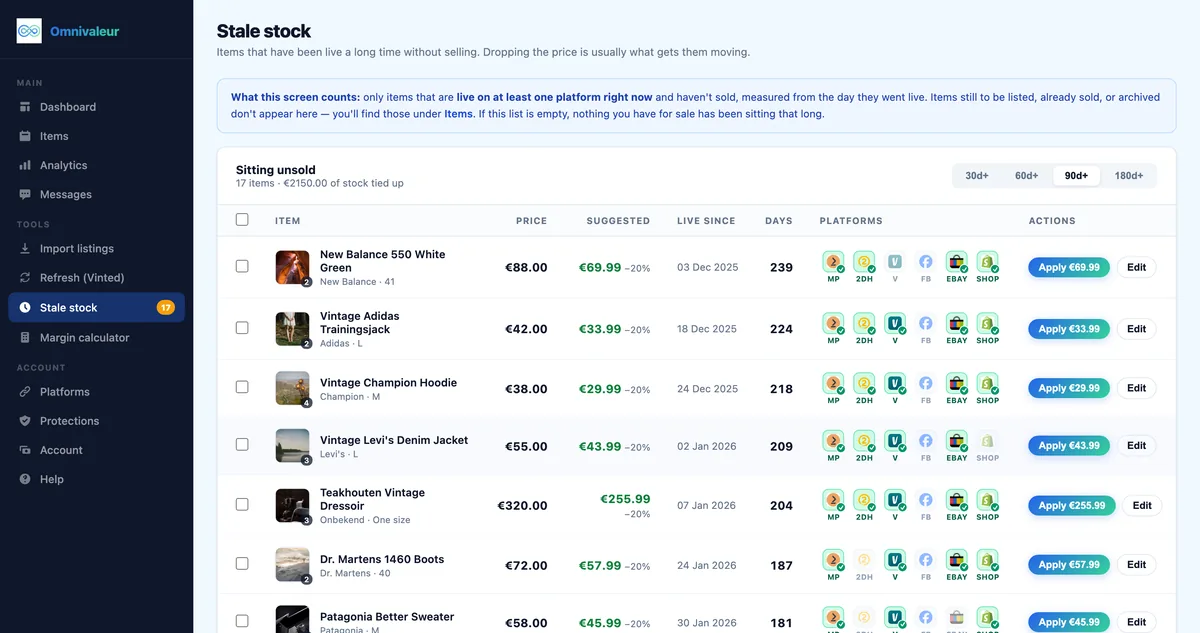
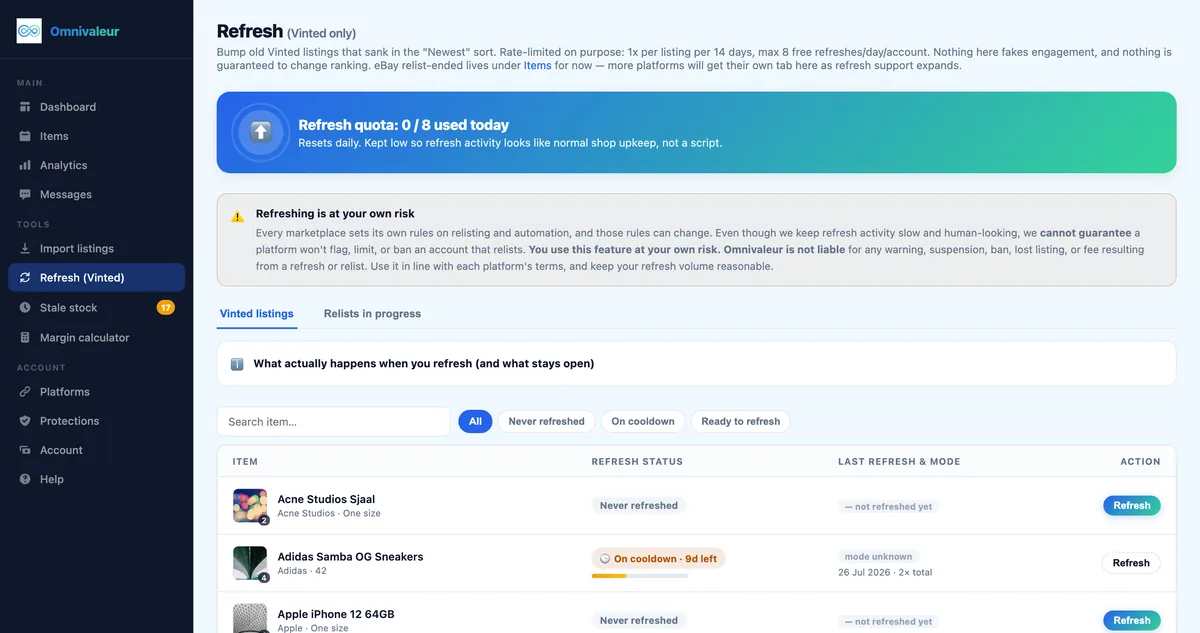
Omnivaleur's stale-stock view flags listings that have been sitting unsold for a while, so slow inventory surfaces instead of quietly sinking to the bottom of your dashboard — useful for spotting which margin-scheme purchases are tying up cash without moving. And cross-listing in Omnivaleur runs one browser tab at a time on purpose, because parallel publishing across five marketplaces is what gets accounts rate-limited or flagged, which is the last thing a VAT-registered seller needs during an active audit window.
What Records and Invoices Must a Belgian Reseller Keep?
Once you're applying the margin scheme, you need an aankoopregister (purchase register) logging every acquisition: date, seller details, description, purchase price. For purchases from private individuals, an aankoopborderel — a simple purchase note you draft yourself with the seller's signature — substitutes for an invoice you obviously can't get from a non-business seller. If you use the globalisation method, you also need a vergelijkingsregister comparing purchase and sale totals per period. Keep everything for seven years, the standard Belgian retention period for VAT records.
For proof of actual sales and buyer disputes, platform transaction records matter too — our guide to how Marktplaats buyer protection works and advice on pricing second-hand items consistently both help build the kind of paper trail that supports clean margin calculations when you're logging sale prices across multiple platforms.
What Happens If You Don't Comply With Belgian Reselling Tax Rules?
Non-compliance usually surfaces one of three ways: a DAC7 data mismatch, a buyer dispute that exposes business-level activity, or a routine FOD Financiën review of high-volume Vinted or eBay sellers. Consequences scale with how long the activity has run unregistered:
- Retroactive VAT assessment on past sales, often with a flat penalty percentage added
- Backdated social security contributions if the activity should have been declared as self-employment
- Fines for missing or incorrectly worded margin-scheme invoices, even when the VAT math itself was right
None of this is designed to punish someone selling an old bike. It targets the pattern the tax office actually cares about: sourcing stock to resell, doing it regularly, and never registering. If you're already past a handful of sales a month and buying with resale in mind, registering now costs far less than a backdated assessment later. Consumer protection rules also shift once you're a registered business seller — buyers gain stronger return rights under the EU's consumer shopping rights framework, which don't apply to purely private sales between individuals.
Scaling a registered reselling operation across categories — furniture, jewelry, or collectibles — tends to multiply the invoicing workload fast, which is exactly when most resellers start looking for tools that keep listings, prices, and sold status synced across platforms rather than tracked by hand in five separate tabs.
Frequently asked questions
Can I lose my private-seller status just by selling on multiple platforms at once?
Does the margin scheme still apply if I import second-hand goods from outside the EU?
What if I only sell as a side hustle and stay under €2,000 a year?
Can I apply the margin scheme and the small business VAT exemption at the same time?
Do second-hand car sales follow the same margin scheme rules as other goods?
Keep reading


Stop copying listings by hand
Omnivaleur publishes your item to every platform at once and syncs stock automatically when something sells.
Start free trial