Mobile Phone Reselling Automation in 2026: Cross-List Faster and Safer

Mobile phone reselling automation means using one tool to list a used or refurbished phone across Marktplaats, 2dehands, eBay, Vinted, Etsy and Shopify simultaneously, syncing stock so it disappears everywhere the moment it sells. In 2026, the real challenge isn't listing speed — it's IMEI tracking, DAC7 tax reporting, and avoiding duplicate-sale disputes across five marketplaces at once.
Key takeaways
- A single phone typically runs on 3-5 active listings at once, and losing track of even one leads to a duplicate sale
- DAC7 reporting kicks in at just 30 transactions or €2,000 in annual sales, a threshold most active phone flippers cross by March
- Vinted restricts most electronics categories, making it a weak channel for phones themselves but a decent one for cases and accessories
- No cross-listing tool, including Omnivaleur's Vinted refresh feature, can guarantee a marketplace won't flag your account for unusual activity
- eBay and Marktplaats remain the two strongest channels for actual phone sales in 2026, not Etsy or Vinted
Selling ten phones a month by hand across five marketplaces means ten sets of photos, ten descriptions, and ten inboxes to check every hour. Automation software fixes the repetitive part — listing, relisting, delisting — but phones carry risks that a t-shirt or a paperback never will: IMEI blacklists, warranty claims, and tax authorities that now get told exactly how much you sold last year.
What Counts as Mobile Phone Reselling Automation in 2026?
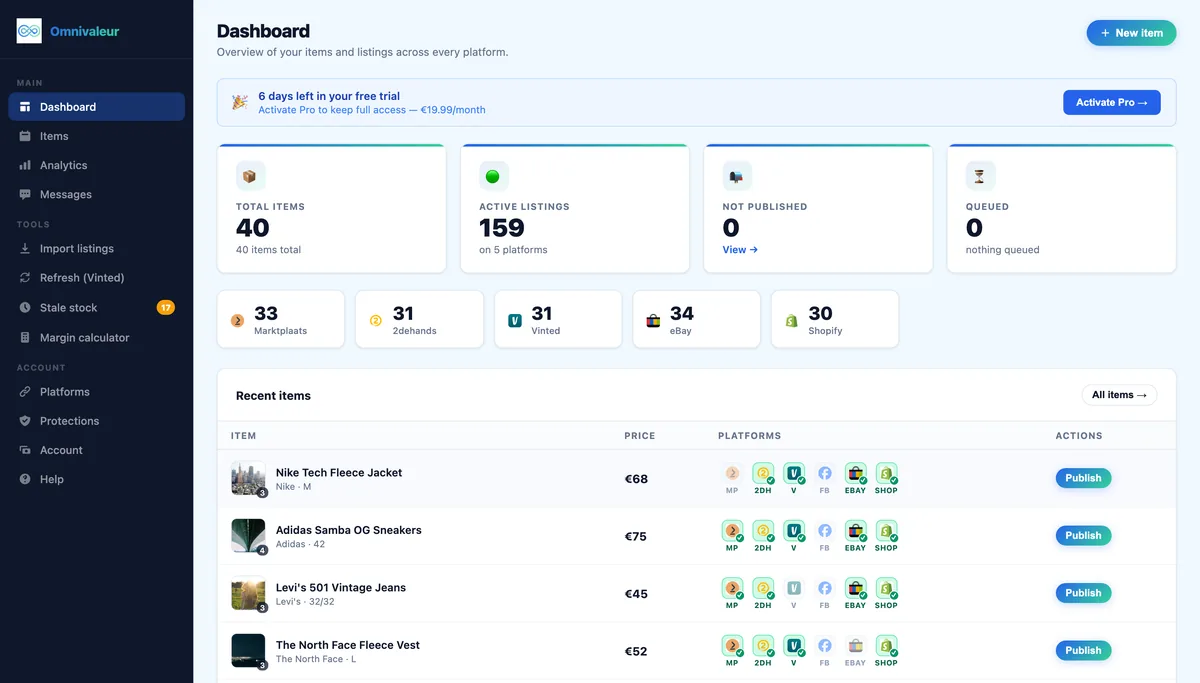
At its core, it's software that takes one product entry — photos, price, condition grade, IMEI or serial number — and pushes it to multiple marketplaces at once, then keeps every listing in sync. When the phone sells on eBay, the tool pulls it from Marktplaats and Vinted within minutes instead of hours.
That last part matters more for phones than almost any other category. A €450 iPhone that sells twice in one afternoon isn't a minor inconvenience — it's a refund, a shipping cost eaten, and possibly a strike against your seller account. With Omnivaleur, a single item typically carries 3-5 active listings at once, and the app tracks each platform's status separately rather than assuming one central "sold" flag will always fire instantly everywhere.
This is different from the AI grading and inventory tools built for bulk refurbishers processing thousands of units a month. Those tools focus on device testing and wholesale logistics. A solo or small-team reseller flipping 20-100 phones a month needs something lighter: fast listing, reliable delisting, and clean tax records.
Which Marketplaces Actually Allow Phone Listings in 2026?
Not every platform in your cross-listing stack wants phones. This trips up a lot of resellers who assume "cross-list everywhere" is always the right move.
| Platform | Phones allowed? | Typical fee | Notes for 2026 |
|---|---|---|---|
| Marktplaats / 2dehands | Yes, core category | Free listing, optional paid boosts | Strongest local demand for used phones in NL/BE |
| eBay | Yes, dedicated electronics category | ~12.8% final value fee | Requires functional description; IMEI checks on disputes |
| Vinted | Restricted — mostly accessories, not devices | Buyer pays service fee | Cases, chargers, screen protectors sell; handsets often get removed |
| Etsy | Vintage/collector phones only | €0.20 listing + 6.5% transaction fee | Not built for functional device resale |
| Shopify | Yes, your own storefront rules | Monthly subscription + payment processing | No marketplace caps, but you handle all traffic yourself |
The practical takeaway: build your automation stack around Marktplaats/2dehands and eBay as primary sales channels, use Shopify as your own branded storefront, and treat Vinted and Etsy as secondary spots for phone accessories rather than handsets. If you already cross-list clothing or accessories, the setup for Marktplaats naar Vinted crosslisten workflow applies almost unchanged to phone cases and chargers — just not to the phones themselves.
How Does DAC7 Tax Reporting Affect Resellers Selling Multiple Phones?
This is the subtopic almost every generic "AI in reselling" article skips, and it's the one that actually costs money. Since 2023, EU marketplaces are legally required to report seller activity to tax authorities once you cross 30 transactions or €2,000 in sales within a calendar year. For someone reselling phones, that threshold is embarrassingly easy to hit — three or four handsets can already clear €2,000.
Marktplaats, eBay and Vinted all now collect your ID and bank details for this reason, and they file it directly with tax authorities under the DAC7 framework. In the Netherlands specifically, the Belastingdienst's DAC7 seller information page spells out exactly what gets shared and when.
Practical fallout for phone resellers:
- Keep purchase receipts for every phone you flip — without them, the full sale price can look like taxable profit.
- If you're spread across five platforms, DAC7 data from each one gets combined by tax authorities, not viewed in isolation.
- Casual sellers offloading their own old devices rarely hit the threshold; anyone buying to resell almost always does within a few months.
This is also why serious resellers move from ad-hoc spreadsheets to a proper cross-listing tool with export logs — when the tax office asks for a transaction history, "check five apps manually" isn't an acceptable answer.
What Happens When You List the Same Phone on 5 Platforms at Once?
You get more views, faster sales, and one specific new problem: the risk of selling the same unit twice. This is where phone reselling diverges hardest from fashion or vinyl reselling, because a phone buyer expects same-day shipping and a working IMEI, not a "sorry, already sold" message three days later.
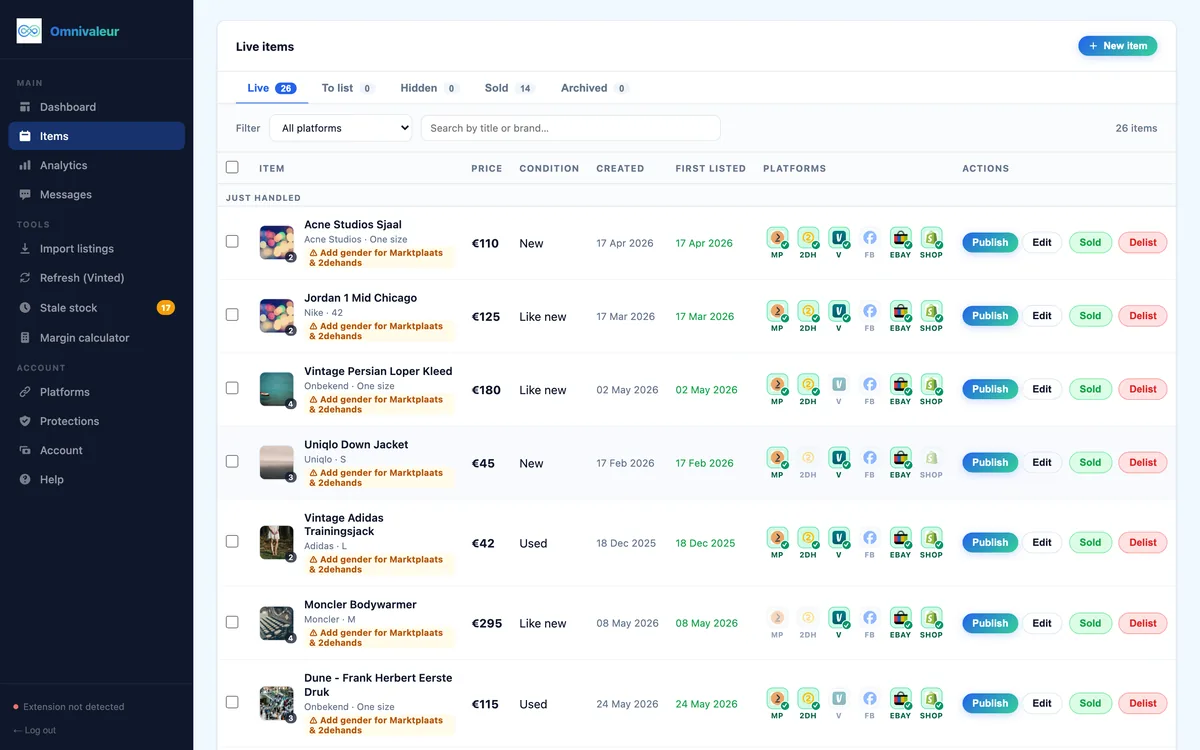
A phone in Omnivaleur typically sits as 3-5 simultaneous active listings, and each platform's status is tracked independently rather than merged into a single "live/sold" toggle. That distinction matters: eBay might confirm a sale instantly through its API, while Marktplaats relies on the buyer marking it sold manually. If your tool treats both the same way, you'll get a phantom delay on one platform where the listing stays live for 10-20 minutes after it actually sold elsewhere — long enough for a second buyer to grab it.
The IMEI duplication problem
Phones are also unique in that buyers can (and do) check IMEI blacklist status before paying. If you're cross-listing a device with a slightly damaged screen described differently across platforms — "hairline crack" on one, "like new" on another — you risk a return dispute the moment the buyer compares your own listings side by side. Keep condition descriptions and IMEI/serial references consistent across every channel, ideally generated from one master listing rather than rewritten five times.
Resellers who also move electronics accessories or gaming hardware alongside phones tend to hit the same sync issues; the setup guidance in the electronics reselling automation platforms comparison covers stock-sync speed in more detail if that's your main bottleneck.
How Do EU Consumer Rights Affect Used Phone Listings?
Selling as a business (even a small side-hustle one) means EU consumer protection rules apply, not just marketplace terms of service. Under the EU's consumer shopping rights guidance, buyers of second-hand electronics from a business seller are generally entitled to a minimum one-year legal guarantee (member states can extend it), plus a right to withdraw from distance sales within 14 days in most cases.
This changes how you should write phone listings:
- State battery health and functional test results honestly — "70% battery capacity, all functions tested" protects you far more than vague wording.
- Note that private, one-off sellers (someone offloading their personal phone) are treated differently from repeat business sellers under most national consumer laws — but if you're cross-listing regularly across five platforms, marketplaces and tax authorities alike will classify you as a business seller regardless of what you call yourself.
- Photograph the actual IMEI/serial screen, not a stock photo, so returns disputes have a paper trail.
Getting this wrong doesn't just cost you a return — under DAC7-linked verification, mismatched seller status can trigger account reviews on Marktplaats or eBay.
What Are the Biggest Account Flagging Risks for Phone Resellers?
High-value items attract more scrutiny than a €15 sweater. Selling 15 phones a month from one Marktplaats or Vinted account is exactly the pattern anti-fraud systems are tuned to catch, because it overlaps heavily with stolen-device resale patterns.
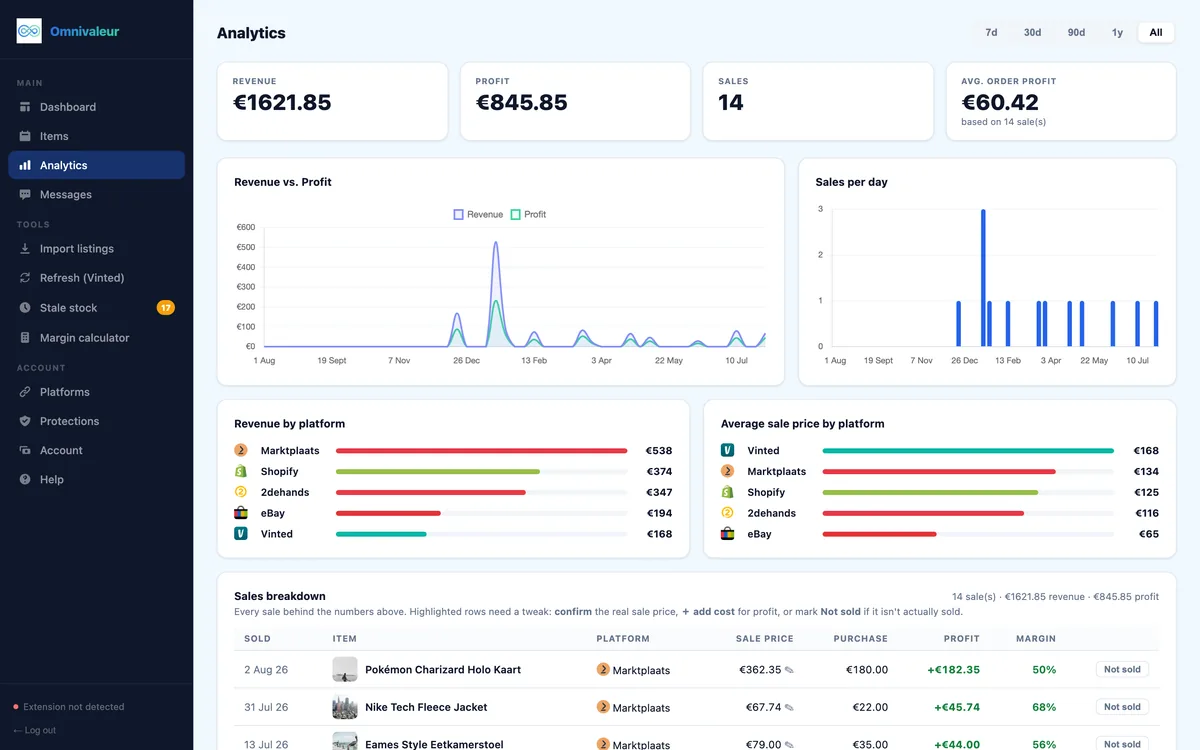
Refresh and re-list frequency matters here. Omnivaleur's Vinted refresh tool deliberately caps itself at 8 free refreshes per day and states plainly that no automation tool can guarantee an account won't get flagged — that's a platform-side decision, not a software one. Treat any tool that promises "unlimited safe refreshes" with suspicion; it's marketing, not a technical guarantee anyone can back up.
Other flagging triggers specific to phones:
- Posting the exact same stock photos across multiple accounts (common with wholesale-sourced refurbished units).
- Rapid price drops right after listing, which some platforms read as a sign of a rushed, potentially stolen-goods sale.
- High return rates tied to undisclosed IMEI blacklist status.
- Selling from a residential address that suddenly ships 20+ packages a week.
If you're comparing tools specifically for flagging risk versus features, the breakdowns in Omnivaleur vs Vendoo and Omnivaleur vs List Perfectly both cover how each platform handles refresh limits and rate-limiting, which is really an account-safety question dressed up as a feature comparison.
Which Features Actually Matter in a Phone Reselling Automation Tool?
Skip the feature lists built for clothing resellers. Phones need a slightly different checklist:
- IMEI/serial field support — a dedicated field, not a note buried in the description.
- Per-platform status tracking — so a sale on eBay doesn't silently leave a stale Marktplaats listing live for an hour.
- Condition grading templates — consistent wording for "Grade A/B/C" across every marketplace, not five separately written descriptions.
- Rate-limited refreshing — capped, not unlimited, to avoid tripping fraud detection.
- Export logs for tax reporting — a clean CSV of every sale, matching what DAC7 reporting will show, saves hours at tax time.
Generic list-anywhere tools often skip the IMEI field entirely because most of their user base sells clothing. If phones are your main category, that single missing field is worth checking before you commit to a subscription — it's covered in more depth in the Omnivaleur vs OneShop comparison.
How Do You Set Up Cross-Listing for Phones Step by Step?
Here's the sequence that avoids most of the problems above:
- Photograph the phone including a close-up of the IMEI/serial number and any physical damage.
- Write one master description with battery health percentage, functional test notes, and included accessories.
- Choose your primary two channels — for handsets, that's almost always eBay and Marktplaats/2dehands.
- Add accessories (cases, chargers, screen protectors) to Vinted and Etsy separately, since the handsets themselves rarely stay listed there.
- Set a floor price and let the tool auto-adjust rather than manually price-matching five tabs.
- Delist manually within minutes of any offline sale (a phone sold to a walk-in buyer, for instance) — automation only syncs what it knows about.
- Export your sales log monthly so DAC7 figures match your own bookkeeping.
If you're moving inventory between platforms rather than starting fresh — say, migrating a Marktplaats catalog to eBay for better electronics reach — the process closely mirrors the one described in the Marktplaats to eBay crosslisting guide, minus the fashion-specific sizing fields.
One more 2026-specific wrinkle: Marktplaats and 2dehands (both owned by Adevinta) rolled out stricter verified-seller badges this year for electronics categories specifically, partly in response to fraud complaints. Unverified accounts now see reduced visibility on phone listings over roughly €200 — verify your account early rather than after your first slow sale.
Frequently asked questions
Can I list a phone with a blacklisted or blocked IMEI?
Do I need a separate business account to resell phones regularly?
How quickly should I delist a phone after an in-person cash sale?
Is Shopify worth setting up just for phone reselling?
Keep reading

Stop copying listings by hand
Omnivaleur publishes your item to every platform at once and syncs stock automatically when something sells.
Start free trial