Used Office Furniture Reselling Automation: A 2026 Cross-Listing Guide
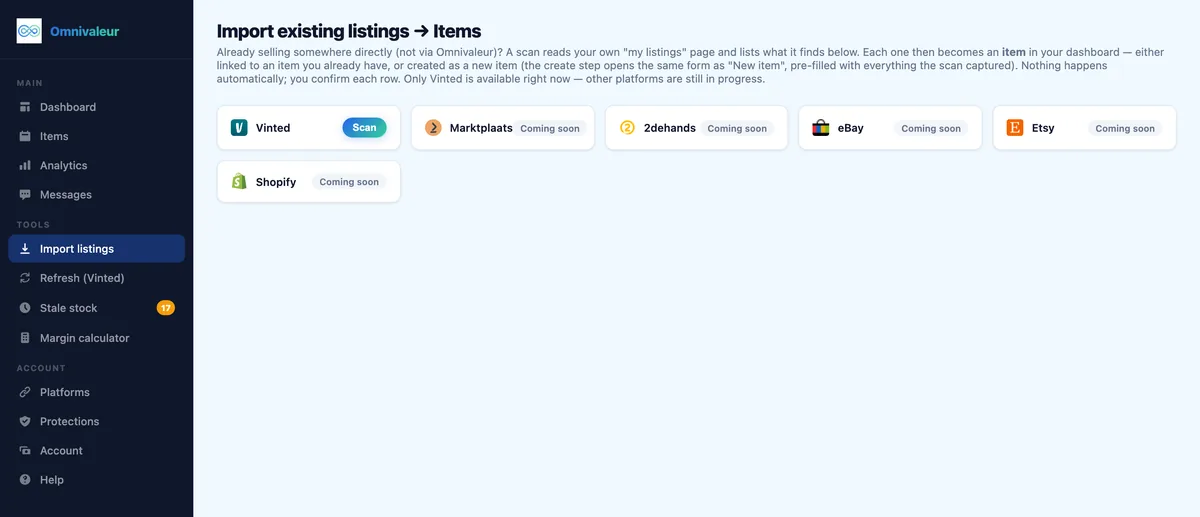
Used office furniture reselling automation means listing desks, chairs and cabinets on Marktplaats, 2dehands, eBay, Etsy and Shopify from one intake form instead of retyping each listing. Omnivaleur publishes to six marketplaces this way, one tab at a time, so accounts don't get flagged for bulk-listing behavior — the biggest risk with bulky, high-volume inventory like office liquidations.
Key takeaways
- Vinted rejects furniture listings outright, so office liquidation stock skips that platform entirely.
- Etsy only accepts office furniture as "vintage" if it's genuinely 20+ years old — modern liquidation stock needs eBay, Marktplaats or Shopify instead.
- Cross-listing in Omnivaleur runs one browser tab at a time, which keeps marketplace accounts from getting rate-limited during bulk relists.
- Selling more than roughly 30 items or €2,000 a year on a platform can trigger DAC7 reporting to tax authorities under EU rules.
- Omnivaleur publishes the same intake form to Marktplaats, 2dehands, Vinted, eBay, Etsy and Shopify at once, cutting relisting time for liquidation-scale inventory.
Reselling used office furniture at any real volume — a dozen desks from a downsizing startup, forty task chairs from an office closure — breaks down fast if you're manually retyping listings on every marketplace. Automation here means one intake form, six possible destinations, and software that handles the repetitive part while you handle sourcing and pickup logistics.
The competitor sites ranking for this topic are physical liquidators with showrooms and coupon codes. None of them cover the part that actually matters for a reseller working online in 2026: which marketplaces will even accept bulky furniture, what the platform fees look like on a €400 desk versus a €40 chair, and how tax reporting changed for anyone selling this stuff regularly.
Which marketplaces actually accept used office furniture in 2026?
Not all six platforms treat furniture the same way, and this trips up resellers who assume cross-listing means "everywhere at once."
- Marktplaats and 2dehands — both handle furniture well, especially for local pickup-only listings. No size restriction, and buyers expect to arrange their own transport for anything larger than a chair.
- eBay — accepts furniture but bulky-item shipping fees eat margin fast. Many sellers mark items "collection only" to avoid courier quotes altogether.
- Etsy — only if the piece qualifies as vintage, meaning genuinely 20+ years old under Etsy's own policy. A 2019 ergonomic chair from a bankrupt startup doesn't qualify; a 1980s oak boardroom table might.
- Vinted — does not accept furniture at all. It's a clothing-and-accessories marketplace, full stop. Don't waste intake-form time trying to force a filing cabinet in there.
- Shopify — works as your own storefront with no category restrictions, useful for building a repeat-buyer base of local businesses.
That leaves five realistic destinations instead of six for most office furniture, which changes how you should configure any cross-listing tool from the start.
How do platform fees compare on office furniture specifically?
Fee structures matter more on furniture than on small items because absolute margins are bigger and shipping costs are wildly uneven.
| Platform | Typical fee | Shipping reality |
|---|---|---|
| Marktplaats | Free for private listings | Local pickup, buyer arranges transport |
| 2dehands | Free for private listings | Same as Marktplaats, Belgian market |
| eBay | ~10-12% final value fee | Courier quotes or collection-only |
| Etsy | 6.5% transaction + listing fee | Freight quotes for large pieces |
| Shopify | Monthly subscription, no marketplace cut | You set your own delivery zone |
A €300 desk sold on eBay with a €40 courier fee nets less than the same desk sold "collection only" on Marktplaats for €280. Run the numbers before defaulting to whichever platform gets the most traffic.
Do you need to worry about DAC7 tax reporting for office furniture liquidation?
Yes, if you're doing this at any real volume. Since 2023, EU marketplaces must report seller activity to tax authorities once a seller crosses roughly 30 transactions or €2,000 in a calendar year on that platform. Office furniture liquidation, where one deal produces twenty separate listings, hits that threshold quickly. The Belastingdienst's DAC7 information for sellers lays out exactly what gets reported and when, and the European Commission's DAC7 overview covers the same rule across all EU marketplaces, not just the Dutch ones.
Practical implication: if you're liquidating office stock as a side business, keep basic records — what you paid for the lot, what each piece sold for, on which platform. Once you're clearly a business seller rather than someone clearing out a spare room, the same reporting threshold applies but the expectation shifts toward proper bookkeeping. This is the same tax logic that applies to any high-volume secondhand category; the same considerations show up in our guide to tool and equipment reselling automation, another category where liquidation-scale sourcing collides with DAC7 thresholds fast.
How does cross-listing automation actually prevent account bans on bulky inventory?
Marketplaces watch for bot-like behavior, and nothing looks more like a bot than forty identical-format listings appearing on an account within an hour. This is exactly what happens when someone tries to relist an entire office liquidation manually using ten browser tabs at once, or with a scraper tool that fires listings in parallel to save time.
Omnivaleur deliberately publishes one listing at a time, in a single browser tab, even when pushing to all six marketplaces. It's slower to watch, but it mimics how a real person lists — which is precisely what keeps accounts off rate-limit flags on Marktplaats, 2dehands and eBay. Parallel publishing across a dozen tabs is the single most common cause of a sudden listing freeze on a previously healthy account.
For a business clearing forty chairs and a dozen desks in one week, that one-tab-at-a-time approach is the difference between a smooth relist and a suspended account mid-liquidation.
What listing details do office furniture buyers actually check before contacting a seller?
Furniture buyers behave differently from clothing or electronics buyers. They want:
- Exact dimensions — width, depth, height, and whether it fits through a standard 80cm doorway. Missing this generates the same three questions from five different buyers.
- Weight, especially for anything a courier might quote by kilo rather than by volume.
- Assembly state — flat-packed, needs two people, or ready to use.
- Wear photos of corners, casters and upholstery seams, not just a clean front-on shot.
Build these fields into your intake form once, and every cross-listed version — Marktplaats, eBay, Etsy — inherits the same detail without retyping. That single-source-of-truth approach is the actual time saver, more than the publishing step itself.
Should you sell office furniture locally or ship it, and what does that mean for cross-listing?
Desks, filing cabinets and conference tables are expensive to ship and cheap to move locally. This pushes most volume toward Marktplaats and 2dehands, where "pickup only" listings are the norm and buyers expect to bring a van.
eBay and Etsy work better for smaller, higher-value pieces — a design-brand task chair, a mid-century credenza that qualifies as vintage — where shipping cost as a percentage of sale price stays reasonable. If you're regularly moving inventory between a Dutch pickup-heavy listing and a shippable eBay version, the workflow overlaps closely with what's covered in our guide on crosslisting from Marktplaats to eBay, which walks through exactly this local-versus-shipped split for bulky goods.
For anyone running both a Dutch and Belgian pickup network, the practical steps look a lot like our Marktplaats to 2dehands cross-listing guide, since both platforms share the same buyer expectations around collection and negotiation.
How do you price a batch of office furniture across five different platforms?
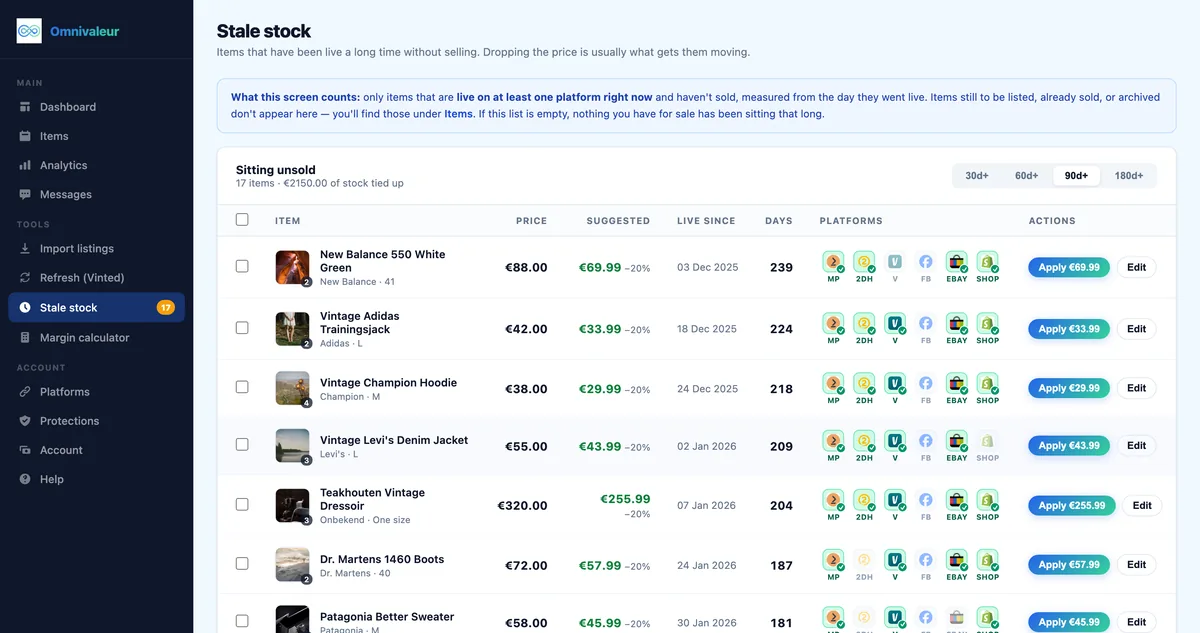
Pricing consistency matters more here than in most resale categories, because buyers on Marktplaats will screenshot your eBay listing and ask why the price differs. A workable rule: price 10-15% higher on shippable platforms (eBay, Etsy) to absorb courier cost, and keep local-pickup platforms (Marktplaats, 2dehands) at your real target price since there's no shipping buffer needed.
A worked example: a set of 8 ergonomic chairs bought as a lot for €480 (€60 each) sells for €90 on Marktplaats pickup-only, or €105 on eBay once you add a €15 shipping buffer for a courier quote that actually costs €18. Both net roughly the same margin after fees; the eBay listing just needs the higher sticker price to break even.
If a piece genuinely qualifies as vintage — a 1970s Scandinavian office chair, for instance — it's worth testing on Etsy at a premium, since that audience pays specifically for design provenance rather than function. Our 2dehands to Etsy crosslisting guide covers how to reframe a purely functional listing description into one that appeals to vintage-design buyers, which matters far more for furniture than for most categories.

What happens once an item sells — how does delisting work across platforms?
This is where liquidation-scale sellers lose the most time manually. A desk sells on Marktplaats at 9am; if the eBay, Etsy and Shopify copies aren't pulled within minutes, you're fielding a "sorry, that one's gone" message from a second buyer who already committed to a pickup slot.
Automated delisting closes every other copy the moment one platform confirms a sale, which matters more for furniture than for small items simply because buyers plan a van trip around the pickup — a cancelled deal costs them real time, not just disappointment.
If you're comparing tools specifically for this kind of multi-platform delisting reliability, our honest breakdown in Omnivaleur vs List Perfectly covers how each handles same-item delisting speed across five-plus marketplaces, which is the feature that actually prevents the double-sale headache described above.
What do buyer protection rules mean for private sellers of office furniture?
Selling as a private individual versus a registered business changes what buyers can demand back. Under EU consumer protection rules, business sellers owe buyers a right of withdrawal and warranty obligations that private sellers generally don't. The Your Europe consumer shopping rights guide spells out where that line sits, and it's worth reading before labelling a liquidation operation as "private seller" listings just to avoid the extra obligations — DAC7 reporting thresholds and marketplace policy both tend to reclassify high-volume private accounts as businesses anyway.
If your liquidation sourcing regularly clears out more than a few offices a year, register accordingly. The tax exposure of getting caught misclassified outweighs whatever admin time you save.
Frequently missed detail: what about matching sets and bulk lots?
Office liquidations rarely come as single items — they come as 12 matching chairs, or a full boardroom set. Listing each piece individually usually outsells one bulk lot listing, since most buyers want one or two chairs, not twelve. But it multiplies your listing count by 12, which is exactly where manual cross-listing collapses and automated intake forms earn their cost. One template, one set of photos taken once, twelve near-identical listings pushed to five platforms without twelve separate rounds of manual typing.
Final word on setting up an automated workflow for this category
Office furniture rewards a slightly different setup than clothing or small collectibles: fewer viable platforms, heavier weight on local pickup, bigger absolute margins per item, and a real DAC7 exposure once you're clearing more than one office a year. Build your intake template around dimensions, weight and assembly state once, skip Vinted entirely, and let the publishing tool handle the repetitive part one listing at a time so none of your five remaining platforms flags the account mid-liquidation.
Frequently asked questions
Can you list the same office chair on Marktplaats and eBay at the same price without losing money?
Does Etsy require proof that office furniture is actually vintage?
What's the fastest way to photograph a large office furniture lot for cross-listing?
Is there a weight or size limit that blocks a furniture listing on any of the six marketplaces?
How do you handle a buyer who wants to negotiate price across two platforms at once?
Keep reading



Stop copying listings by hand
Omnivaleur publishes your item to every platform at once and syncs stock automatically when something sells.
Start free trial