Used Phone Reselling Automation in 2026: Cross-List Faster Without Losing Compliance

Used phone reselling automation means creating one listing with condition, IMEI, and battery-health details, then pushing it automatically to Marktplaats, 2dehands, eBay, Vinted, Etsy and Shopify at once — with real-time stock sync so a single-unit phone gets pulled everywhere the moment it sells, avoiding double-sales and DAC7 reporting headaches.
Key takeaways
- Omnivaleur publishes one phone listing to six marketplaces from a single intake form, cutting relisting time to minutes.
- Each phone typically runs 3-5 active listings simultaneously, with status tracked per platform so a sale on eBay auto-delists it on Vinted.
- DAC7 obliges platforms to report sellers who hit 30 transactions or €2,000 in sales per calendar year — most active phone flippers cross that line by March.
- Not every marketplace accepts current-generation phones the same way: Etsy wants genuinely vintage devices, Vinted's electronics category is limited by country.
- Battery health and IMEI disclosure aren't optional extras in 2026 — buyers and several platforms now expect them in the listing itself.
Reselling used phones is unlike reselling a t-shirt or a paperback. You've got one physical unit, a serial number that can be checked against blacklists, a battery that degrades on a schedule, and at least four different marketplaces with four different rules about what "used" even means. Automation here isn't about writing prettier descriptions — it's about not selling the same iPhone twice and not getting a nasty letter from the tax office in February.
Most articles on this topic focus on grading algorithms and AI-driven pricing models for wholesale refurbishers. That's useful if you're processing pallets. If you're a solo or small-team reseller sourcing phones from trade-ins, estate sales, or bulk lots and flipping them individually across consumer marketplaces, the real pain points are different: platform category rules, disclosure requirements, stock sync, and tax reporting thresholds that sneak up faster than people expect.
What does "used phone reselling automation" actually mean in 2026?
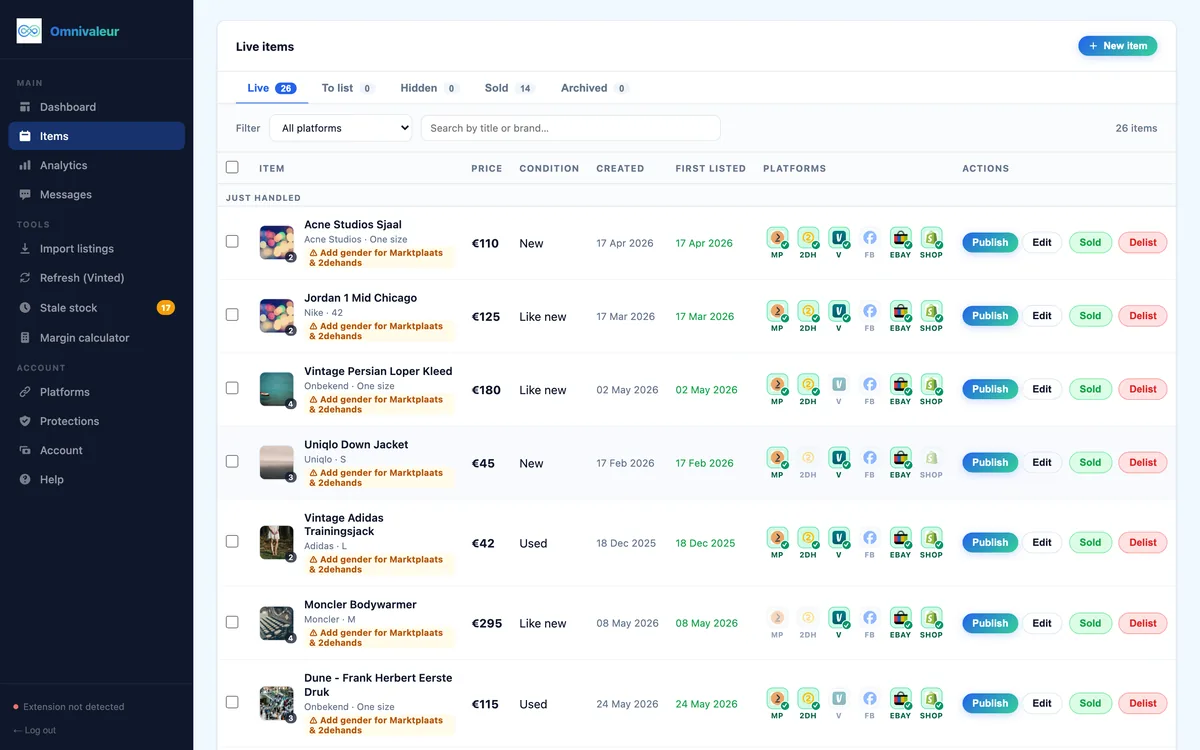
In practice, it means three things working together. First, a single intake form where you enter the phone's specs once — model, storage, IMEI, battery health, cosmetic grade, included accessories. Second, a tool that reformats that data to match each marketplace's field requirements and publishes it everywhere relevant. Third, a sync layer that watches for a sale and pulls the listing from every other platform within minutes, not hours.
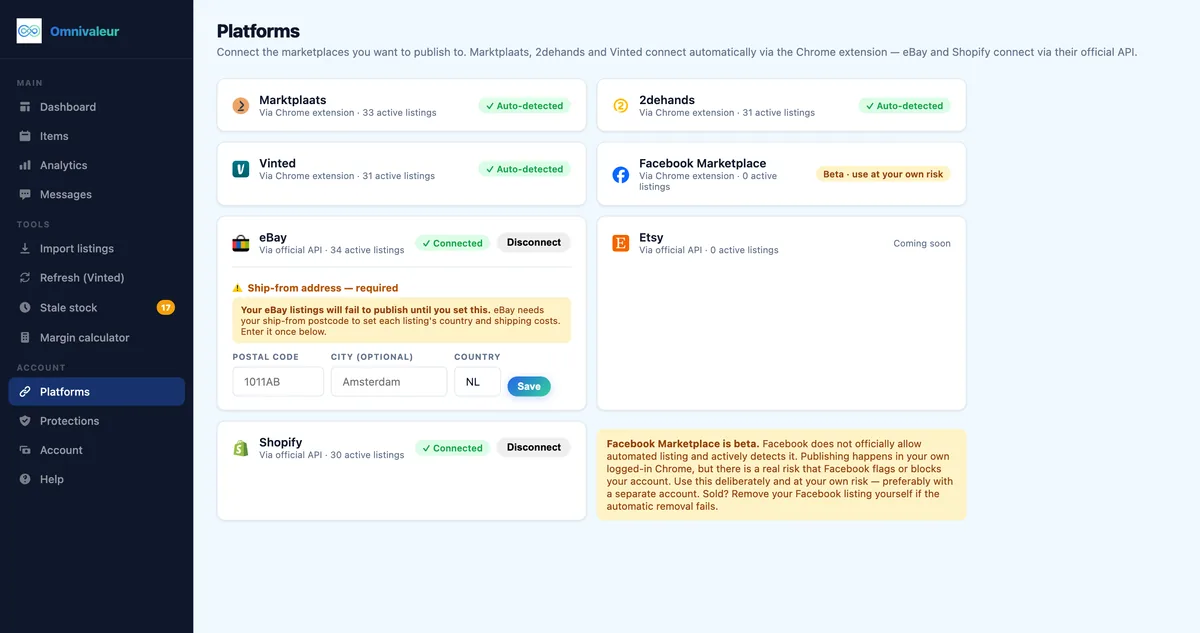
With Omnivaleur, that intake-to-publish step happens once and pushes to six marketplaces — Marktplaats, 2dehands, Vinted, eBay, Etsy and Shopify — from the same form. A typical phone listing ends up live on 3-5 of those platforms simultaneously, and the app tracks each platform's status independently, so you always know whether a listing is active, sold, or pending on a given channel without opening six tabs.
Which marketplaces actually allow used phone listings, and what are the catches?
Not every platform treats phones the same way, and assuming otherwise is how resellers get listings pulled.
| Platform | Good fit for phones? | Key catch in 2026 |
|---|---|---|
| Marktplaats / 2dehands | Yes, strong local demand | Buyers expect battery health % and often ask for proof of purchase or IMEI check before meeting |
| eBay | Yes, dedicated cell phone category | Required item specifics: IMEI/serial, carrier lock status, storage, condition grade — missing fields hurt search ranking |
| Vinted | Limited, category varies by country | Electronics categories are narrower than fashion; check local availability before batch-listing phones there |
| Etsy | Only genuinely vintage devices (20+ years) | A three-year-old smartphone doesn't qualify as "vintage" — Etsy is for retro/collectible handsets, not recent trade-ins |
| Shopify | Yes, for your own refurb brand | You own the warranty terms and return policy — no marketplace buffer if a buyer disputes condition |
The lesson: don't cross-list a used iPhone 14 to Etsy expecting vintage buyers, and don't assume Vinted behaves like Marktplaats for electronics. A tool that lets you exclude specific platforms per item — rather than force-publishing everywhere — saves you from category rejections and policy strikes. If you're weighing which platforms suit electronics specifically, the Best Electronics Reselling Automation Platforms 2026 breakdown compares this in more depth.
How do you avoid double-selling a phone that only exists once?
This is the single biggest operational risk in phone reselling, and it's rarely mentioned in grading-focused guides. A t-shirt reseller who double-sells can often source a replacement. You can't conjure a second unit with the same IMEI. If a phone sells on eBay at 14:02 and someone messages you on Marktplaats at 14:05 asking to buy the same unit, you're now cancelling an order, refunding a payment, and possibly eating a platform penalty for non-fulfillment.
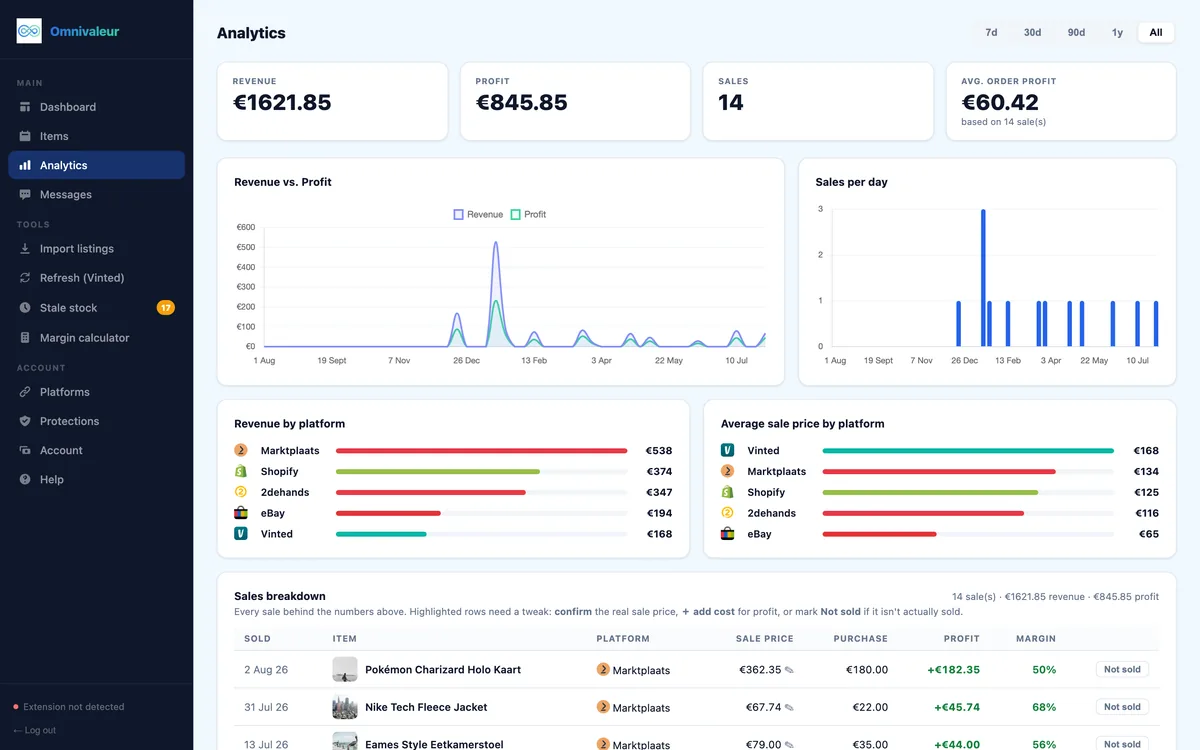
Real-time delisting is the fix, not a "nice to have." When Omnivaleur detects a sale on one channel, it pulls the listing from the others automatically — no manual relogging into five dashboards while a buyer is mid-checkout on a sixth. For workflows moving stock between specific pairs of platforms — say, sourcing on Marktplaats and selling internationally on eBay — the Marktplaats to eBay Crosslisting 2026 guide covers the sync mechanics in detail, and the same logic applies going from 2dehands to eBay or into Vinted from Marktplaats for accessory bundles.
A practical edge case: bundled listings. If you sell a phone with a case and charger as one lot on Marktplaats but list the case separately on Vinted, your sync tool needs to understand that selling the bundle should also delist the standalone case. Not every cross-listing tool handles bundle logic — check this before you commit inventory to it.
What do DAC7 and EU consumer rights mean for phone resellers?
Phones are high-value items relative to most secondhand goods, which means resellers hit tax reporting thresholds faster than they expect. Under DAC7, digital platforms across the EU must report sellers who complete 30 or more transactions, or earn over €2,000, in a calendar year. Sell 15-20 phones at an average €150 each, and you've crossed that €2,000 line before summer. The Belastingdienst's DAC7 guidance for sellers lays out exactly what data platforms collect and share — your name, address, and transaction totals, aggregated across the platforms you sell on.
This matters more for phones than for clothing or books precisely because the average sale value is higher and thresholds get hit with fewer transactions. If you're cross-listing across six platforms, keep your own running total rather than assuming each marketplace's individual dashboard gives you the full picture — DAC7 reporting aggregates per person, not per platform.
On the buyer side, remember that EU consumer shopping rights still apply to used goods sold by a business or habitual seller — even secondhand, buyers can retain rights around goods matching the description given. If your listing says "battery health 92%" and it's actually 78%, that's a description mismatch, not a grey area. Getting the condition data right at intake avoids most disputes before they start.
How should you handle IMEI, battery health, and condition disclosure across platforms?
Buyers in 2026 expect more than "used, works fine." A minimum disclosure set that holds up across all six marketplaces looks like this:
- IMEI or serial number — not always shown publicly, but ready to provide on request; some buyers now run it through carrier-blacklist checkers before paying
- Battery health percentage — pulled from device settings, stated as a number, not "good" or "great"
- Storage and carrier lock status — unlocked vs. carrier-locked changes the buyer pool significantly
- Cosmetic grade — use a consistent scale (A/B/C or a percentage) across every listing so repeat buyers know what to expect
- Included accessories — original charger, box, cable — these affect price by €10-30 depending on model
The advantage of entering this once in a structured intake form is that eBay's required item specifics, Marktplaats's free-text description, and Shopify's product attributes all get populated from the same source data, formatted correctly for each. Manually retyping IMEI and battery health six times per phone is exactly the kind of repetitive task that causes typos — and a wrong IMEI in a listing is worse than no IMEI at all, since it can flag the item incorrectly during a buyer's blacklist check.
What does a real cross-listing workflow look like for a phone reseller?
Take a concrete example: a reseller sourcing 40 trade-in phones a month, averaging €180 resale each — roughly €7,200 in monthly turnover. Doing this manually means 40 separate listing sessions, each requiring re-entry of specs across whichever 3-4 platforms that phone suits, plus manual monitoring for sales to avoid duplicate orders. At even 15 minutes per listing per platform, that's 40+ hours a month just on data entry, before sourcing or grading time.
With automated cross-listing, the workflow compresses to: grade the phone, fill one intake form (specs, photos, price, condition notes), select which of the six platforms suit that specific model (skip Etsy unless it's a genuinely retro device, skip Vinted if your country's electronics category doesn't fit), and publish. The tool distributes formatting per platform automatically. When it sells anywhere, the rest delist within minutes.
Pricing is also worth automating carefully rather than guessing. eBay's sold listings give you real comparable data for a specific model, storage size, and grade combination — check those before setting a price rather than copying a competitor's asking price, since asking prices and actual sold prices for phones often differ by 15-20%.
This same intake-once, publish-everywhere logic applies whether you're moving stock between 2dehands and eBay or building out a broader multi-category shop that also carries accessories like controllers or headsets — the Gaming Equipment Reselling Automation Guide covers a similar high-value, serial-numbered electronics niche if you're diversifying beyond phones.
What platform fees and limits should you budget for in 2026?
Fees eat into margin fast on a €150-250 item, so factor them in before pricing.
| Platform | Typical seller fee | Listing limit consideration |
|---|---|---|
| eBay | ~10-13% final value fee on electronics | Category-specific insertion limits for new sellers, raised gradually with sales history |
| Marktplaats | Free for private, paid packages for business/pro sellers | Business sellers must register as such once volume is regular |
| Vinted | Buyer pays protection fee, seller side largely free | Electronics category caps and rules vary by country |
| Etsy | Listing fee + ~6.5% transaction fee | Only accepts genuinely vintage (20+ year old) electronics |
| Shopify | Monthly subscription + payment processing (~2-3%) | No marketplace fee per sale, but you handle all support and disputes |
On a €180 phone sold via eBay, expect roughly €20-24 gone to fees before shipping. Building that into your minimum acceptable price up front avoids the surprise of a "profitable" sale that barely covers sourcing cost once fees land.
Is cross-listing worth the switch from a single dominant platform?
Plenty of phone resellers start on one marketplace and expand once volume justifies the tooling. The honest answer is that it depends on your monthly volume: below 10-15 phones a month, managing two or three platforms manually is still manageable. Past that, the time saved by automated publishing and sync starts outweighing subscription cost within a few weeks. If you're comparing tools rather than building your own spreadsheet workaround, the Omnivaleur vs List Perfectly comparison walks through feature and pricing differences for resellers evaluating options in 2026.
Whatever tool you choose, prioritize three things for a phone-specific workflow: real-time stock sync (non-negotiable for single-unit items), structured fields for IMEI and battery health (so you're not retyping technical specs six times), and per-platform category control (so you're not trying to force a two-year-old Samsung into Etsy's vintage section). Get those three right, and the rest of the automation — pricing suggestions, bulk photo uploads, templated descriptions — is genuinely just convenience on top.
Frequently asked questions
Can I cross-list the same phone to Vinted and eBay at the same time without breaking either platform's rules?
Do I need to register as a business seller to resell used phones regularly?
How do I handle a phone that fails an IMEI blacklist check after I've already listed it?
What's a realistic battery health cutoff for listing a phone as "good condition"?
Should I photograph the IMEI or serial number for every listing?
Keep reading
Stop copying listings by hand
Omnivaleur publishes your item to every platform at once and syncs stock automatically when something sells.
Start free trial