Vintage Poster Reselling Automation: The Complete 2026 Cross-Listing Guide

Vintage poster reselling automation means writing one listing and letting software like Omnivaleur publish it across Marktplaats, 2dehands, Vinted, eBay, Etsy and Shopify, syncing stock and price. In 2026 the real friction isn't finding buyers — it's oversized shipping costs, Etsy's vintage-age rule and marketplace rate limits on fast posting.
Key takeaways
- Posters are a "flat, oversized, fragile" category — most reselling automation problems come from shipping and photos, not demand.
- Etsy only allows the vintage label on items 20+ years old, which disqualifies a lot of reprint posters resellers mistakenly cross-list.
- Cross-listing one tab at a time avoids the rate limits that get poster-heavy accounts throttled on eBay and Etsy.
- A stale-stock view matters more for posters than clothing, because niche film and concert posters can sit unsold for months.
- DAC7 reporting thresholds apply to poster sellers the same as any other reseller — 30 transactions or €2,000 a year triggers it.
What Actually Counts as Vintage Poster Reselling Automation in 2026?
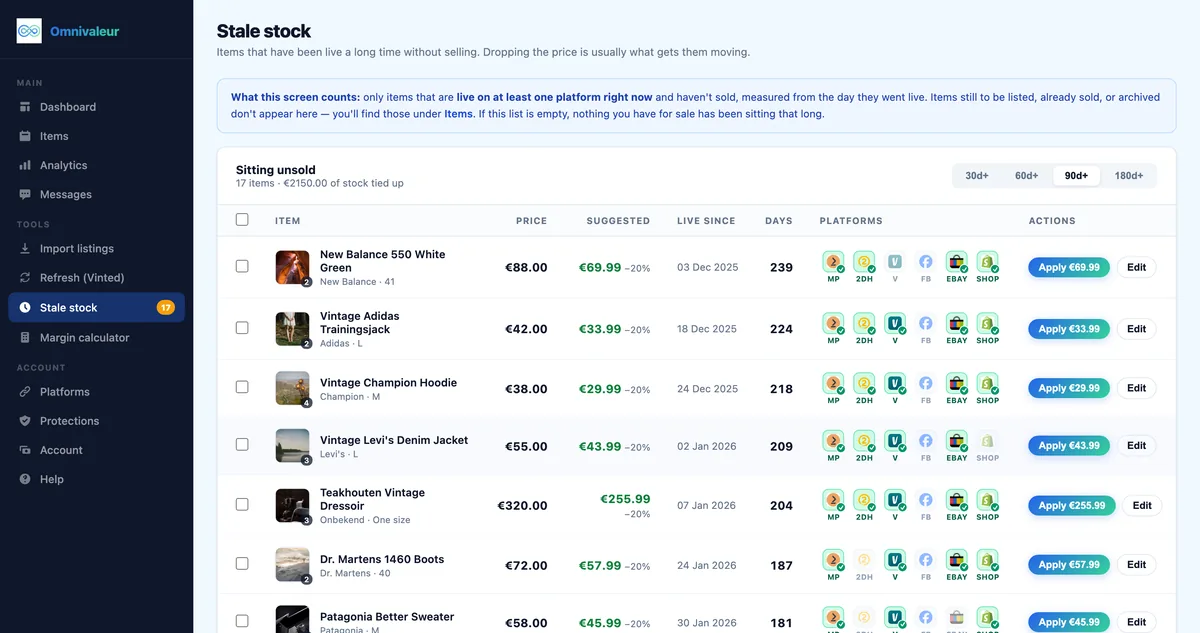
Reselling automation for vintage posters means you build the listing once — title, description, size, condition notes, photos — and software pushes it out to every marketplace you sell on, instead of you retyping the same listing six times. For most posters resellers that's some combination of Marktplaats, 2dehands, Vinted, eBay, Etsy and a Shopify storefront for the higher-ticket original prints.
What's different about posters compared to clothing or books is the physical format. A poster isn't just "an item with a photo" — it has a paper size standard, a fold or roll condition, and often a country-specific format (a Dutch filmposter is a different size than a US one-sheet). Automation tools that only understand size charts for shoes or dresses tend to break down here, because the fields resellers actually need — linen-backed or not, folded vs rolled, edition number — don't exist as dropdowns. Omnivaleur handles this by letting you build a custom field template once per poster category and reuse it, rather than forcing everything through a clothing-shaped listing form.
Which Marketplaces Are Actually Worth Cross-Listing Vintage Posters To?
Not every platform is equally good for paper collectibles. Here's how the six main ones stack up for posters specifically in 2026:
| Platform | Fee structure | Best for | Poster-specific note |
|---|---|---|---|
| Marktplaats | Free listing, paid boosts | Local pickup on large/framed pieces | Avoids courier damage risk on framed posters |
| 2dehands | Free listing, paid boosts | Belgian buyers, same local-pickup logic | Mirrors Marktplaats behaviour and fees |
| Vinted | Buyer pays service fee | Lower-value reprints and decor posters | Weakest search visibility for original film posters |
| eBay | ~12-13% final value fee | Genuine vintage movie & concert posters | Strong collector search, dimensional weight matters |
| Etsy | Listing fee + ~6.5% transaction fee | Curated original vintage & art prints | Enforces the 20-year vintage rule strictly |
| Shopify | Monthly plan + payment processing | Your own brand for higher-value original prints | No marketplace fee cut, but you drive the traffic |
If you're weighing whether a dedicated tool is worth it over doing this manually, it's worth reading a fair comparison like Omnivaleur vs List Perfectly: Honest 2026 Comparison before committing to a monthly subscription — the feature set that matters for clothing resellers isn't always the same one that matters for paper goods.
What Poster-Specific Listing Rules Trip Up New Cross-Listers?
Three mistakes show up over and over with new poster sellers.
Size standards nobody explains up front
A US one-sheet is roughly 27x41 inches. A UK quad is 30x40 inches. Dutch and Belgian filmposters often run closer to A1 or A0. If your listing template doesn't force you to enter exact dimensions in centimeters and inches, buyers assume the wrong size and you get returns — or worse, disputes.
Original vs reproduction — say it out loud
This is the single biggest complaint category in vintage poster resale. A reproduction print isn't fraud if you disclose it clearly, but "vintage-style" language buried at the bottom of a description isn't disclosure. Under EU consumer shopping rights, buyers are entitled to accurate information before purchase — and platforms increasingly enforce this themselves with automated flagging.
Etsy's 20-year vintage rule
Etsy's "vintage" category requires the item to be at least 20 years old. A 2010s reproduction poster of a 1970s film cannot legally sit in that category, even if the design is decades old. Resellers who cross-list a mixed inventory of reprints and originals need a template that separates the two before publishing, not after a complaint. This same age-verification problem shows up in adjacent categories too — the vintage postcards and ephemera automation guide covers it from the paper-collectibles angle if you sell both.
How Should You Handle Shipping and Packaging Costs When Cross-Listing Posters?
Shipping is where poster margins get eaten alive. A rolled poster in a mailing tube runs roughly €6-9 within the EU depending on length, but a folded poster in a flat rigid envelope can go as low as €3-4 — the trade-off is that folding devalues collector-grade originals. Framed posters basically force local pickup on Marktplaats or 2dehands, because courier damage claims on glass are a nightmare to process across borders.
eBay and Etsy both apply dimensional weight pricing in 2026, meaning a lightweight but long tube can cost more to ship than a heavier, compact box. If you're cross-listing the same poster across five platforms with different shipping calculators, get your dimensions and weight entered once, correctly, and let the sync push it everywhere — re-entering package dimensions manually five times is where sellers introduce pricing errors that eat their margin. This is the same lesson that applies to bulkier decor items generally; the vintage decor reselling automation guide walks through packaging cost math for oversized, fragile pieces in more depth.
Why Does Parallel Cross-Listing Get Poster Sellers Rate-Limited in 2026?
Marketplaces watch for accounts that publish dozens of listings in rapid bursts across multiple browser sessions — it's a common bot signature, and poster sellers with large back-catalogs are especially prone to it because they often try to bulk-upload 50+ items at once when they first digitize a collection.
Cross-listing in Omnivaleur runs one browser tab at a time on purpose. Parallel publishing across several tabs is exactly what gets marketplace accounts rate-limited or temporarily locked — eBay in particular has tightened its automated-activity detection this year. A slower, sequential publish queue looks like normal human behaviour to the platform, even when you're listing 40 posters in an afternoon. If you're moving inventory from Marktplaats onto eBay specifically, the mechanics of that queue are covered step by step in the Marktplaats to eBay Crosslisting 2026 guide.
How Do You Stop Slow-Moving Posters From Sinking Your Listings?
Posters age differently than clothing. A niche 1960s jazz concert poster might take eight months to find the right collector. A mainstream movie one-sheet from a popular franchise might sell in a week. The problem is that most sellers can't tell the difference just by scrolling their own inventory — everything blends together after month three.
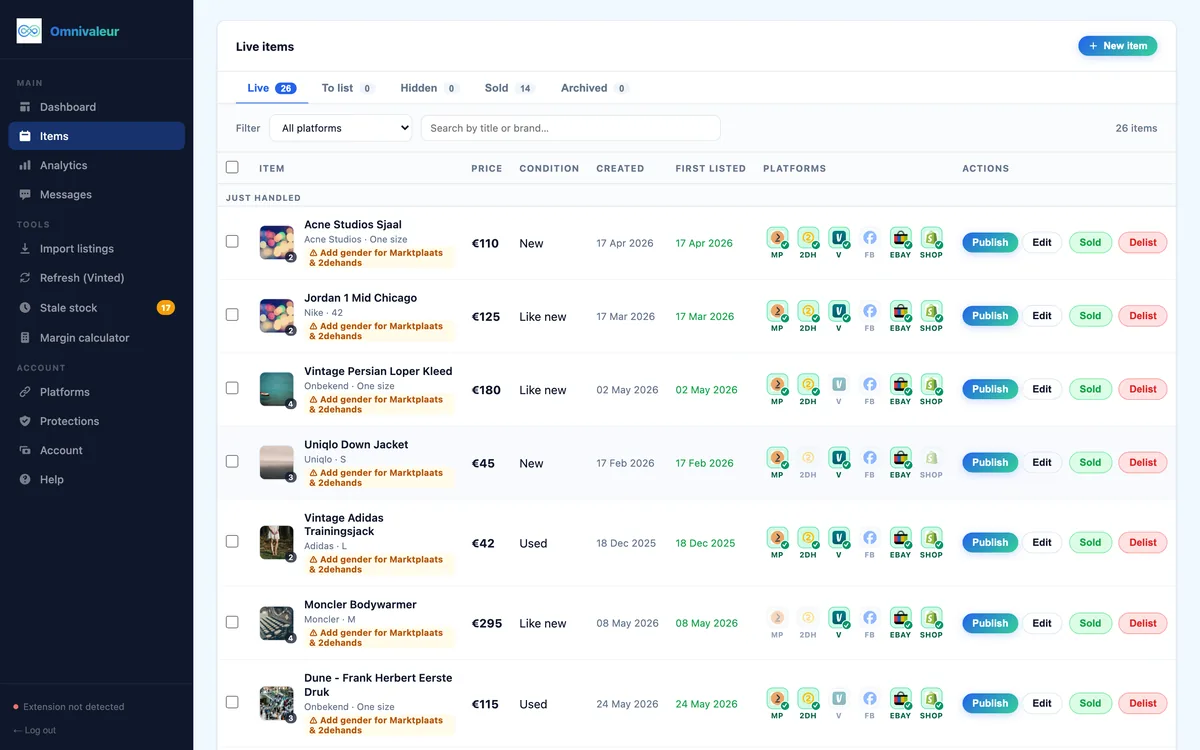
Omnivaleur's stale-stock view flags listings that have been sitting unsold for a set period, so slow inventory surfaces at the top of your dashboard instead of quietly sinking down the list where you forget about it. For posters, that usually means a price cut, a re-photograph with better lighting, or a move to a different platform entirely — a poster that's dead weight on Vinted might do fine relisted on Etsy where the collector search intent is stronger. The same triage logic applies to slow-moving vintage clothing or books; the vintage book reselling automation guide and the vintage clothing reselling automation platforms guide both cover relist cadence if you run a mixed vintage store.
What Tax and Compliance Rules Apply to Poster Resellers in 2026?
If you sell through digital marketplaces and cross a threshold of roughly 30 transactions or €2,000 in a calendar year, platforms are required to report your sales data to tax authorities under DAC7. This applies to poster resellers the same as anyone else — there's no collectibles exemption. The Belastingdienst's DAC7 guidance for sellers lays out exactly what gets reported and when, and the European Commission's DAC7 overview covers how this works across the EU if you're selling to buyers in multiple member states.
Practically, this means keeping cleaner records than you might have in the past — purchase price, sale price, platform, and date, for every poster. If you're already cross-listing through a tool that logs sales across all six platforms in one place, this reporting becomes a lot less painful than reconstructing it from six separate seller dashboards at tax time.
Should You Cross-List Posters the Same Way You Cross-List Everything Else?
Mostly yes, with two adjustments. First, your photo set needs to show the full sheet flat and any damage close-up — pinholes, fold lines, edge tears — because posters get more condition disputes than almost any other collectible category. Second, your description template should have a mandatory field for "original or reproduction" that can't be skipped, because that single missing detail is responsible for most of the negative feedback poster sellers get.
Beyond that, the workflow is the same one you'd use for any niche: list once, sync stock everywhere, let stale listings surface automatically, and keep your publishing pace slow enough that platforms don't flag your account. Resellers moving between Marktplaats, Vinted and Etsy specifically can find the exact click-by-click flow in the Vinted naar Marktplaats Crosslisten 2026 guide and the Marktplaats naar Etsy Crosslisting 2026 guide, both of which apply directly to paper and print collectibles.
Frequently asked questions
Can you cross-list a framed poster the same way as a rolled one?
Do reproduction posters need different keywords than original prints?
How many photos does a poster listing actually need?
Is it worth listing the same poster on both Vinted and Etsy?
What happens if a poster sells on two platforms at once?
Keep reading
Stop copying listings by hand
Omnivaleur publishes your item to every platform at once and syncs stock automatically when something sells.
Start free trial