Vintage Postcards and Ephemera Reselling Automation in 2026
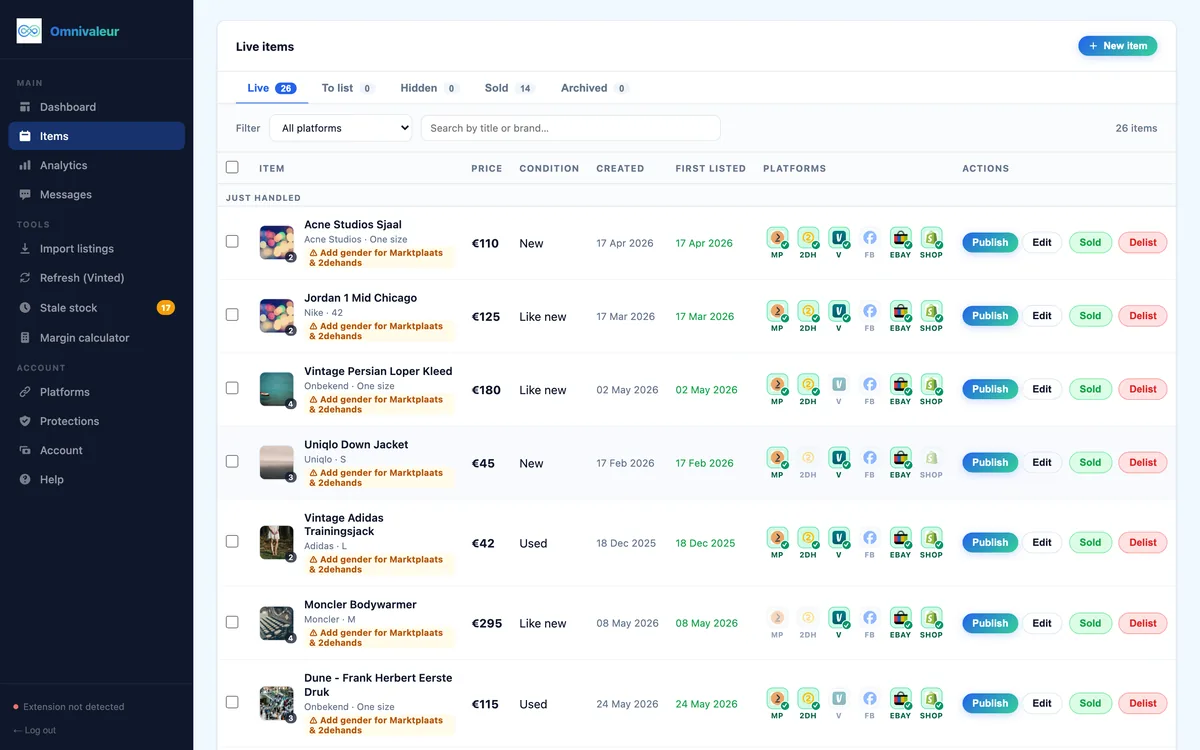
Cross-listing vintage postcards and ephemera works best on Etsy, eBay and Vinted, where collectors search by era, topic and region. Automation tools like Omnivaleur handle bulk photos, condition tags and stock syncing across platforms, so a sold postcard doesn't get relisted twice, and thin per-item margins stay profitable through batch listing instead of one-by-one uploads.
Key takeaways
- Etsy requires vintage items to be at least 20 years old, which most ephemera easily meets, but reproductions must be labeled as such
- DAC7 reporting often catches postcard sellers through transaction count, not revenue, since a €50 lot can involve 40 individual items sold separately
- Bundling postcards into lots of 10 to 50 amortizes listing fees that otherwise eat a €0.50 item alive
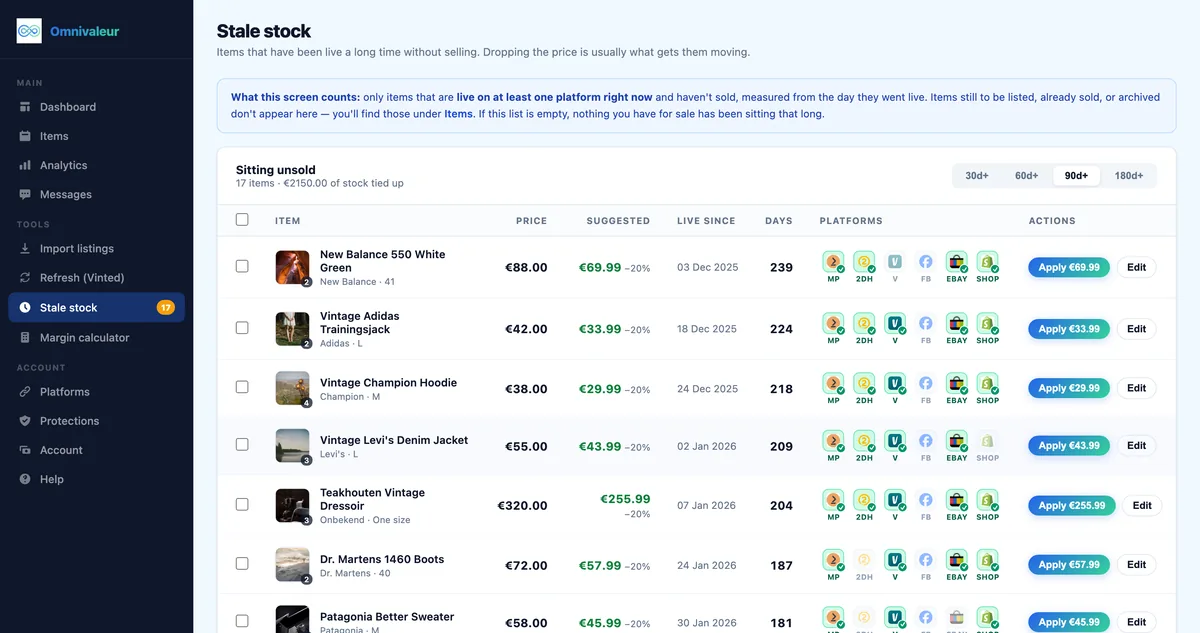
- Omnivaleur's stale-stock view flags listings sitting unsold instead of letting them sink silently down search results
- Sequential, one-tab-at-a-time publishing avoids the rate-limiting that hits accounts running parallel bulk uploads
What Makes Postcards and Ephemera Different From Other Vintage Niches to Cross-List?
Volume is the whole story here. A reseller flipping vintage cameras handles maybe 20 items a month. A postcard and ephemera reseller might process 500 pieces in a single flea market haul: real photo postcards, movie tickets, matchbook covers, advertising cards, letterheads, stock certificates, sheet music. Each item is worth anywhere from €0.50 to €80, and the median is closer to the low end.
That changes the math on everything. Listing fees that barely register on a €200 vintage coat become a real cost when you're listing a €2 postcard. Photography time matters more, because you're shooting front and back of dozens of items per session, not one hero shot per garment. And condition grading has to be fast and repeatable, not a paragraph of prose per listing, or you'll never clear the backlog.
This is also a category where lot selling (bundles of 10, 20, 50 related postcards) competes directly with single-item listing. Deciding which items go solo and which get bundled is the first automation decision you make, and it affects everything downstream, from photo count to shipping weight to which marketplace even makes sense.
What 2026 Marketplace Rules Should Postcard Resellers Know About?
Etsy classifies anything sold as "vintage" as needing to be at least 20 years old, and enforcement tightened again heading into 2026 after complaints about reproduction postcards being sold as originals. If you're selling a modern reprint of a 1920s advertising card, it has to be labeled as a reproduction, not just "vintage style." Buyers can and do file item-not-as-described disputes, and under EU consumer shopping rights, they have real recourse if a listing misrepresents originality.
eBay's collectibles category still restricts certain historical ephemera categories (some wartime propaganda material, for instance) and requires accurate era dating in the item specifics fields, which now feed directly into eBay's search ranking algorithm. Skip the fields and your postcard lot ranks lower, full stop.
Vinted remains the outlier. It was built for clothing, and while it added a home and collectibles corner, category fit for paper ephemera is weak compared to Etsy or eBay. If you're already cross-listing clothing on Vinted, don't assume postcards will perform the same way there; treat it as a secondary channel at best.
Marketplace listing limits also shift yearly. New eBay sellers in several EU markets still face a cap on free monthly listings before insertion fees kick in, which matters enormously when you're trying to list 300 postcards in a weekend.
Which Platforms Actually Sell Vintage Postcards and Ephemera Best in 2026?
| Platform | Best for | Typical fees | Lot listing support |
|---|---|---|---|
| Etsy | Curated originals, themed collections | €0.20 listing fee + 6.5% transaction fee + ~4% payment processing | Strong, buyers expect bundles |
| eBay | Specific collector niches, rare/graded items | ~13.25% final value fee on most categories | Good, "lot" search term recognized |
| Marktplaats / 2dehands | Local collectors, bulk box lots | Free listings, promoted spots optional | Good for large mixed lots |
| Vinted | Occasional overflow, not primary channel | Buyer-paid protection fee, no seller fee | Weak |
| Shopify | Your own storefront once you have repeat buyers | Monthly subscription, no per-item fee | Full control |
Notice the shape of that table: Etsy and eBay both take a percentage cut, but Marktplaats and 2dehands don't, which is why a lot of resellers keep bulk box lots for the local free-listing marketplaces and save the individually graded, higher-value pieces for Etsy and eBay. If you're already running listings across the Dutch marketplaces and want to push the same stock onto Etsy without re-photographing everything, the 2dehands to Etsy Crosslisting 2026 guide walks through the field-mapping specifics.
How Should You Price and Bundle Low-Value Paper Items Without Losing Money to Fees?
Do the fee math before you list anything. A €2 postcard sold on eBay at 13.25% final value fee nets you €1.73, minus payment processing, minus your time photographing and packing it. That's not a business model, that's a hobby.
Bundling fixes this. Ten related postcards (same town, same era, same publisher) sold as a €18 lot spreads one listing fee, one photo session and one shipping label across ten items instead of ten separate transactions. Your effective margin per item roughly triples.
A rough rule that works for most sellers: anything under €5 individually goes into a themed lot of at least eight pieces. Anything with a graded condition, a rare cancellation mark, or documented provenance sells solo, because collectors will pay a premium for the one piece that's actually special, and bundling it would bury the value.
This same bundling logic shows up in other paper-heavy niches. If you also handle vintage books alongside your ephemera stock, the Vintage Book Reselling Automation 2026 guide covers similar lot-versus-single decisions for that category, and a lot of the fee arithmetic carries over directly.
How Does DAC7 Tax Reporting Affect High-Volume, Low-Value Ephemera Sellers?
This is the part most postcard resellers underestimate. DAC7 reporting thresholds trigger at 30 transactions or €2,000 in a calendar year, whichever comes first. A reseller moving 40 individual postcards a month easily crosses the transaction count long before touching the revenue threshold, even while making very little actual profit.
Marketplaces are required to report seller data to tax authorities once you hit either trigger, and the Belastingdienst's DAC7 information for sellers spells out exactly what gets reported and when. The European Commission's DAC7 overview confirms this applies across all EU member states, not just the Netherlands, so selling on a German or Belgian marketplace doesn't sidestep it.
Practically, this means keeping a running count of individual sold items, not just revenue, if postcards and ephemera are your main stock. Spreadsheet tracking works until volume gets past a couple hundred a month; past that point most resellers want a dashboard that already separates sold, listed, and stale inventory by platform.
- ✓Sort items into solo sellers (rare, graded, with provenance) and bundle candidates (under €5 each)
- ✓Bundle related postcards in themed lots of at least eight pieces to spread fees across items
- ✓Calculate fees per platform before listing anything, especially for low-value pieces on eBay or Etsy
- ✓Photograph front and back of every postcard on neutral background under consistent light
- ✓Set up stale-stock flagging to surface unsold items before they sink down search results
- ✓Space out your 300-postcard upload across a realistic time window to avoid rate limiting
How Can Automation Stop Your Ephemera Stock From Going Stale?
Postcard inventories rot silently. You list 200 pieces, sell the obvious winners in week one, and the remaining 150 sink down search results on every platform because algorithms reward recency and sales velocity, not just relevance. Six months later you've forgotten half of what's still sitting there.
Omnivaleur's stale-stock view exists specifically for this problem: it flags listings that have been sitting unsold for a set stretch of time, so slow inventory surfaces at the top of your dashboard instead of quietly sinking to the bottom of a 500-item list. For a niche where the whole point is high item count and low individual value, that flagging is the difference between actually clearing a box lot and just accumulating digital clutter across five marketplaces.
The same discipline that works for postcards works for other collectible-heavy niches. If your stock also includes vinyl, vintage decor pieces, or general collectibles, the Collectibles Reselling Automation 2026 guide and the Vintage Decor Reselling Automation guide cover the same stale-stock mechanics applied to different categories.
How Do You Avoid Getting Your Accounts Rate-Limited When Listing Hundreds of Postcards at Once?
This is where a lot of high-volume ephemera sellers get themselves banned without realizing why. Marketplaces watch for unnatural listing patterns: 300 items published within an hour from one account reads as bot behavior, and eBay, Etsy and Vinted all apply rate limits or temporary listing freezes when they see it.
Omnivaleur cross-lists one browser tab at a time, on purpose. It's slower than parallel publishing tools that fire off dozens of listings simultaneously, but parallel publishing is exactly what gets marketplace accounts flagged and rate-limited. A sequential approach spreads your 300-postcard upload across a realistic time window that looks like a human actually did the work, because a human did.
If you source most of your ephemera from flea markets and thrift shops alongside other secondhand goods, the sourcing and workflow patterns in the Thrift Store Reselling Automation guide apply directly, since the account-safety logic doesn't change by category.
Worth comparing tools directly before committing to one. The Omnivaleur vs List Perfectly comparison breaks down how publishing speed, account safety settings and stale-stock handling differ between the two, which matters more for high-volume, low-value niches like postcards than it does for someone listing ten designer bags a month.
What Photography and Shipping Details Actually Matter for This Category?
Two photos per postcard, minimum: front and back, since collectors care about postmarks, stamps and handwritten messages as much as the printed image. Shoot on a flat, neutral background under consistent light, because color accuracy on a 1940s tinted postcard is part of what buyers are paying for.
Shipping is genuinely cheap for single postcards (a rigid mailer and a stamp), but bundled lots of 50+ pieces get heavy fast and need proper padding to survive transit without corner damage. Buyers filing damage disputes over crushed corners is one of the most common friction points in this niche, and it's largely preventable with a stiff cardboard sandwich around the lot before it goes in the envelope.
Frequently asked questions
Do I need to disclose whether a postcard is an original or a reproduction under EU rules?
Can I list the exact same lot of postcards on both Etsy and eBay at once?
How do marketplace search algorithms treat "lot" listings versus single-item listings?
What happens if a platform flags one of my postcards as counterfeit or reproduction?
Is it worth setting up a Shopify store for ephemera once I have repeat buyers?
Keep reading
Stop copying listings by hand
Omnivaleur publishes your item to every platform at once and syncs stock automatically when something sells.
Start free trial