Etsy to Shopify Crosslisting Automation: The Complete 2026 Guide

Etsy to Shopify crosslisting automation means using a tool to publish the same product on both platforms, sync stock in near real time, and adjust pricing per platform's fee structure — without manually rebuilding listings. In 2026, the main friction points are variation limits, tax-reporting differences, and Shopify's API changes affecting third-party sync tools.
Key takeaways
- Etsy acts as a marketplace facilitator while your Shopify store makes you the merchant of record, which changes who handles VAT and buyer disputes.
- A single item typically needs 3-5 active listings tracked separately across platforms, since Etsy and Shopify update stock on different schedules.
- Etsy caps listings at two variation attributes; Shopify allows up to three options and 100 variants per product, so mapping isn't always one-to-one.
- DAC7 reporting applies differently depending on whether a sale happens through Etsy's facilitated checkout or your own Shopify store.
- No sync tool, including automated refresh features, can guarantee a marketplace won't flag an account for unusual activity.
Why does cross-listing from Etsy to Shopify need a different playbook than Etsy-to-eBay?
Most cross-listing guides treat every platform pair the same way: copy title, copy photos, copy price, done. That logic works reasonably well between two marketplaces like Etsy and eBay, because both act as facilitators — they collect payment, handle disputes, and in many EU cases remit VAT on your behalf. Shopify doesn't do any of that. It's your own storefront. You are the merchant of record, the one issuing invoices, the one responsible for tax remittance, and the one Etsy's buyer-protection policies simply don't cover once a sale moves off their platform.
That distinction matters more in 2026 than it did a few years back. Etsy has tightened its seller policy around off-platform communication and repeat listing duplication, and Shopify has pushed third-party apps toward its GraphQL Admin API, changing how quickly external tools can pull and push product data. A sync tool built for two facilitator marketplaces doesn't automatically handle the ownership shift that comes with adding your own store.

What actually breaks when you copy an Etsy listing to Shopify manually?
Try it once by hand and you'll hit friction within the first ten minutes. Etsy limits listings to two variation attributes — typically size and color — with a set number of options each. Shopify's product management system allows up to three option types and 100 variants per product, so a handmade item sold in five sizes and four colors on Etsy needs restructuring before it fits cleanly into Shopify's variant grid.
Photos cause the second headache. Etsy renders images as squares by default; Shopify respects whatever aspect ratio you upload, which means a photo set optimized for one platform often looks cropped or oddly framed on the other. Tags are the third mismatch: Etsy gives you 13 tags at 20 characters each for its internal search algorithm, while Shopify's SEO relies on meta titles, meta descriptions, and URL slugs — a completely different field structure that manual copy-paste simply ignores.
Then there's pricing. Etsy's transaction fee sits around 6.5% plus payment processing, plus a $0.20 listing fee per item every four months. Shopify's costs are a monthly subscription plus payment processing, usually 2.6%-2.9% + a fixed fee depending on plan and region. Selling the same item at the same price on both platforms means a different net margin on each — something a lot of sellers don't notice until they reconcile a quarter of sales.
A quick side-by-side of the two platforms
| Factor | Etsy | Shopify |
|---|---|---|
| Role | Marketplace facilitator | Your own storefront |
| Variation limit | 2 attributes | 3 options / 100 variants |
| Listing fee | $0.20 per item / 4 months | None (subscription-based) |
| Transaction fee | ~6.5% | 0% with Shopify Payments (processing fee only) |
| VAT handling | Often collected by Etsy in EU | Seller's own responsibility |
| Buyer protection | Etsy's own policy | Governed by EU consumer shopping rights |
How do Etsy's and Shopify's 2026 rules affect automated cross-listing?
Two changes are worth flagging for anyone building a cross-listing habit this year. First, Shopify has been migrating public apps away from its older REST Admin API toward GraphQL, which affects how fast third-party tools can read stock changes and push updates back. Sync delays that used to be near-instant can now depend on how well a tool's integration has been rebuilt for the new API version — worth checking before you commit to a provider.
Second, Etsy continues to expand its off-site ads program, which becomes mandatory once a shop crosses $10,000 in trailing twelve-month sales. That 12-15% ad fee only applies to Etsy sales generated through those ads, but it changes the real margin comparison between an Etsy sale and a Shopify sale of the identical item — another reason flat "same price everywhere" pricing rarely makes sense once volume grows.
Etsy has also been stricter about flagging shops that look like dropshipping or reseller operations without disclosure, particularly for vintage and handmade categories. If you're moving inventory that started life as a Marktplaats or 2dehands find before landing on Etsy, the disclosure rules are worth reading directly rather than assuming your old listing habits still apply — see our guide on Marktplaats to Etsy crosslisting for the category-specific detail.
Who is responsible for VAT and DAC7 reporting when you sell through Etsy and your own Shopify store?
This is the part most cross-listing guides skip entirely, and it's exactly where sellers get caught out. Under DAC7, digital platforms operating in the EU — Etsy included — must report seller income to tax authorities once a seller crosses 30 transactions or €2,000 in a calendar year. Etsy handles that reporting for sales made through its checkout. Your Shopify store does not report anything to anyone automatically; you're the one keeping records and filing.
Dutch sellers specifically should check the Belastingdienst's DAC7 guidance, because income from the same inventory sold across a marketplace and a private store gets tracked separately even though it's the same business. Splitting sales across Etsy and Shopify doesn't reduce your reporting obligation — it just means you now have two ledgers to reconcile instead of one, and a cross-listing tool that logs sales per platform makes that reconciliation considerably less painful come tax season.
How does inventory sync work when the same item is listed on both platforms?
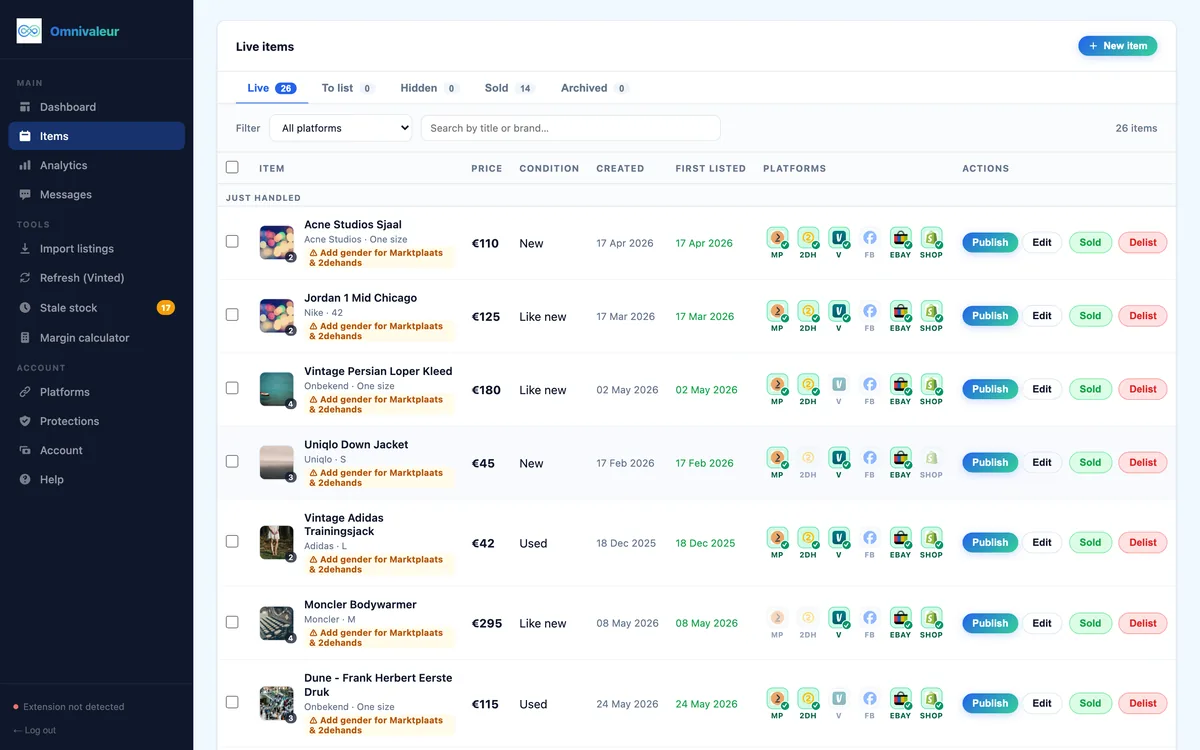
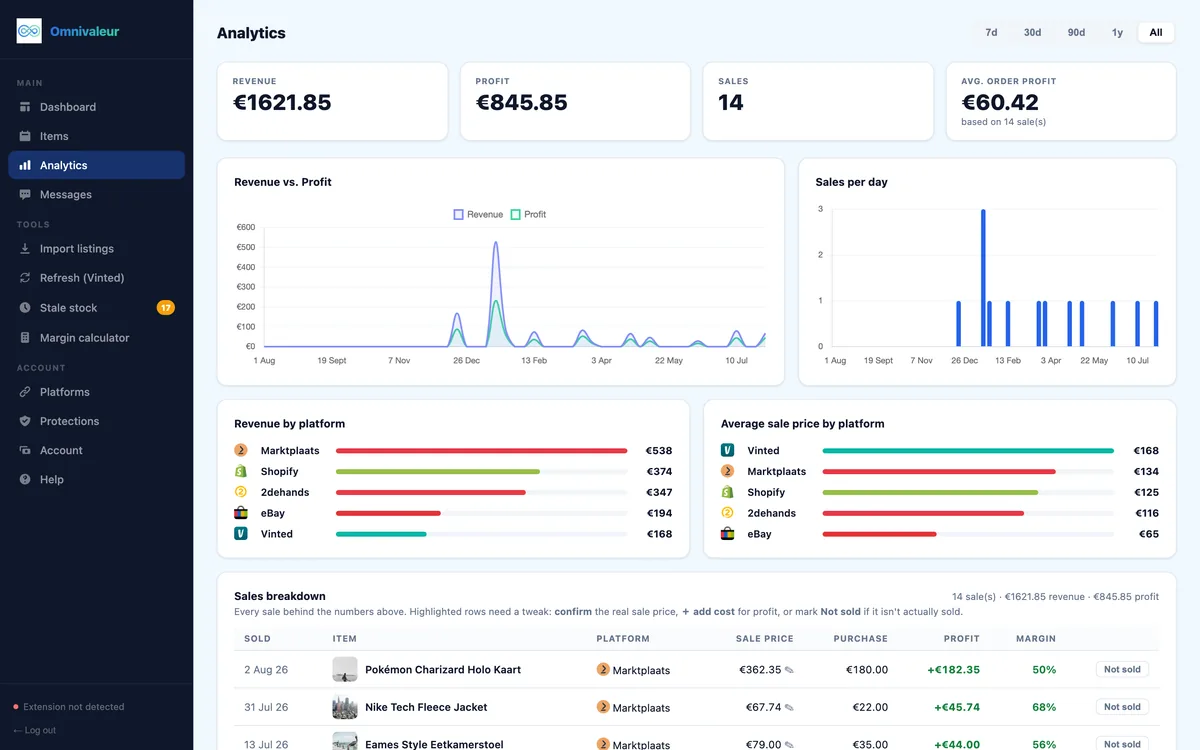
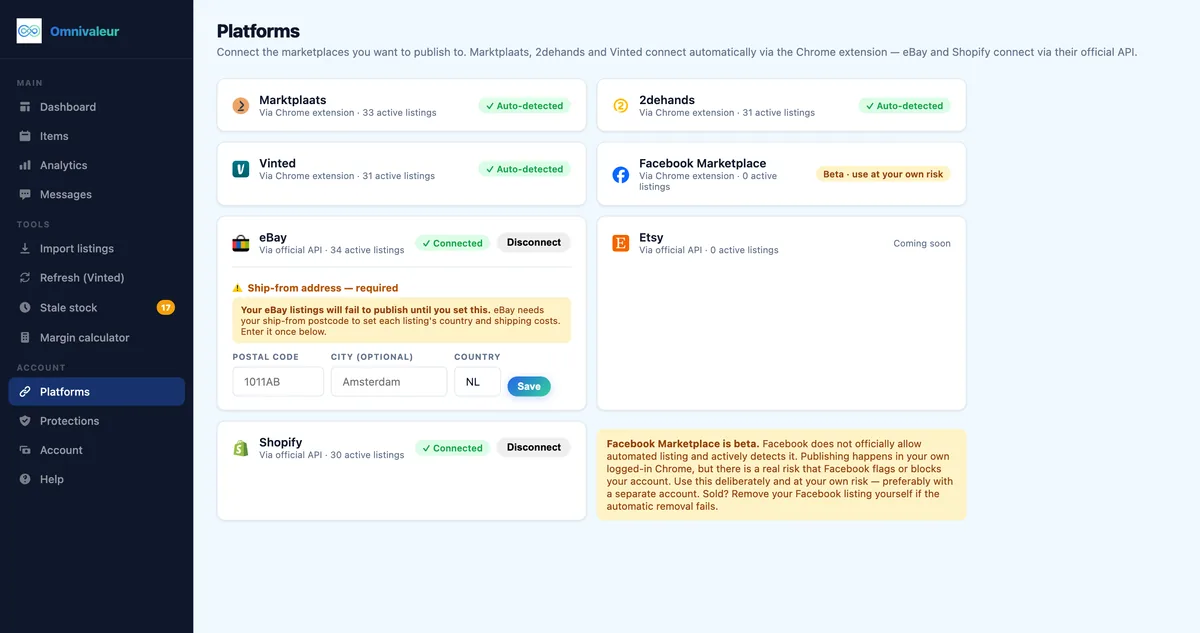
Here's the mechanic most sellers actually care about. When you cross-list an item, it doesn't become one listing that magically appears in two places — it becomes two (or more) separate listings, linked by a shared inventory count. A tool like Omnivaleur tracks status per platform individually, because Etsy and Shopify each report sold, active, or draft state on their own schedule. In practice, a single item in Omnivaleur typically carries 3-5 active listings at once across the connected marketplaces, each one flagged with its own live/sold/pending status rather than a single blended number.
That granularity matters for edge cases. Say you list a one-of-a-kind vintage brooch on Etsy, Shopify, and Vinted simultaneously. A buyer purchases it on Etsy at 14:32. If your sync tool batches updates every 15 minutes instead of pushing near-instantly, there's a real window where a second buyer could purchase the same item on Shopify before the stock count catches up. Good automation tools minimize that window, but nobody should assume it's mathematically zero — build in a buffer for anything genuinely one-of-a-kind, or hold back the final unit from auto-publishing until you've confirmed it manually.
Sellers running vintage or one-off inventory across more channels — vinyl, cameras, books — hit this exact issue constantly. Our vintage camera reselling automation guide walks through buffer strategies for single-unit stock specifically.
- ✓Connect both stores to your sync tool and pull your existing Etsy catalog
- ✓Map how Etsy's two-attribute variation limit translates to Shopify's three-option system
- ✓Set platform-specific pricing rules so fees don't silently cut different margins
- ✓Check that photos render correctly and tags don't become meta descriptions oddly
- ✓Monitor that sold items on Etsy mark as sold on Shopify within minutes automatically
What does a realistic Etsy-to-Shopify automation workflow look like in practice?
A working setup usually follows four steps. First, connect both stores to the sync tool and let it pull your existing Etsy catalog. Second, map your variation structure — decide how Etsy's two-attribute limit translates into Shopify's three-option system, especially for handmade items with material, size, and color all relevant. Third, set platform-specific pricing rules so Etsy's transaction fee and Shopify's processing fee don't quietly eat different margins on an identical item. Fourth, publish and monitor: check that photos render correctly on both platforms, and confirm tags on Etsy don't accidentally get pushed as meta descriptions on Shopify, which reads oddly to search engines.
After that initial setup, the ongoing work is mostly monitoring, not re-listing. A sold item on Etsy should mark itself as sold on Shopify within minutes, not require you to log in and manually pull the listing. Sellers who also run a Vinted account for clothing-adjacent inventory should know that refresh tools on that platform work differently — Omnivaleur's Vinted refresh feature caps itself at 8 free refreshes per day and is upfront that no automation tool can guarantee Vinted (or any marketplace) won't flag an account for unusual bump activity. That's worth knowing before assuming every platform behaves the same way under automation.
How much does cross-listing automation cost compared to doing it manually?
Manually maintaining parallel listings on Etsy and Shopify costs time, not money upfront — but time adds up fast. Relisting one item across two platforms by hand takes roughly 8-12 minutes once you include photo cropping, tag rewriting, and price adjustment. At 30 items a week, that's 4-6 hours purely on duplication, before you've packed a single order.
Automation tools typically run a flat monthly fee rather than a per-listing charge, which makes the math favor volume sellers quickly. If you're evaluating providers, our comparisons of Omnivaleur vs List Perfectly and Omnivaleur vs OneShop break down the actual per-listing economics rather than headline pricing, which is where most tools try to look cheaper than they end up being at real volume.
Should you add Vinted, eBay or Marktplaats to your Etsy-Shopify setup in 2026?
Once Etsy and Shopify are syncing cleanly, adding a third channel is usually less work than the first integration — the hard part was reconciling the marketplace-versus-owned-store logic, which you've already solved. Clothing-heavy Etsy vintage shops often add Vinted next; our Vinted to Etsy crosslisting guide covers the category restrictions specific to that pairing. Sellers coming from Dutch classifieds sites frequently go the other direction, moving inventory from 2dehands or Marktplaats onto a Shopify storefront before layering Etsy on top — see the 2dehands to Shopify crosslisting guide for that specific flow, or Shopify to Vinted crosslisting if you're starting from your own store outward.
The decision usually comes down to inventory type rather than platform preference. Handmade goods with high margins tend to do best kept mostly on Etsy and Shopify, with Vinted or eBay reserved for overstock. Vintage clothing and general secondhand goods benefit more from wide distribution across four or five platforms simultaneously, which is exactly the setup our vintage clothing reselling automation platforms guide is built around.
Frequently asked questions
Can I set a different price for the same item on Etsy versus Shopify?
What happens to my Etsy shop reviews if a buyer purchases the same item through my Shopify store instead?
Does cross-listing violate Etsy's or Shopify's terms of service?
How do returns work when an item sells on Shopify but the listing originated from Etsy?
Will using Etsy's SEO tags on my Shopify store hurt my own site's search ranking?
Keep reading



Stop copying listings by hand
Omnivaleur publishes your item to every platform at once and syncs stock automatically when something sells.
Start free trial