
Etsy shipping settings sit under Shop Manager > Settings > Shipping Settings, where you build profiles for carrier, cost and processing time, then attach them to listings. In 2026, use calculated shipping for variable-weight stock, fixed profiles for consistent sizes, and only offer free shipping once your margin absorbs the cost — commonly above a $35 order threshold for US buyers.
Key takeaways
- Etsy shipping profiles live in Shop Manager, not individual listings — set them once, apply them to hundreds of items
- Calculated shipping protects margin on variable-weight stock; fixed shipping wins on uniformity and buyer trust
- Free shipping over $35 for US buyers boosts Etsy search ranking but can erase margin on low-ticket EU-to-US parcels
- Shipping income counts toward Dutch DAC7 reporting thresholds and affects VAT margin scheme bookkeeping
- Cross-listing resellers need separate shipping logic per platform — Etsy profiles don't transfer to Marktplaats or Vinted automatically
Resellers who only sell on Etsy treat shipping settings as a one-time setup task. Resellers who also list on Marktplaats, Vinted and eBay treat it as a recurring math problem, because every platform calculates shipping differently and Etsy's own rules shift every year. Here's what actually matters in 2026, with euro and dollar examples you can copy directly into your shop.
How do you set up Etsy shipping profiles in 2026?
Go to Shop Manager > Settings > Shipping Settings. This is where Etsy builds the structure most sellers never touch after their first week, and resellers with 50+ SKUs really should revisit it every quarter.
A shipping profile bundles together:
- Origin country and ZIP/postal code, used to calculate carrier rates
- Processing time — how many business days before you hand the parcel to a carrier
- Primary and secondary shipping cost (fixed) or carrier + package type (calculated)
- Destination-specific rates, including domestic, EU and rest-of-world tiers
- Handling fee, an optional add-on charged on top of the carrier rate
You don't attach these settings per listing one at a time. You build a profile called, say, "Small parcel NL domestic" or "Vintage jewelry international," then assign it to every relevant listing in bulk through the Listings tab. If you're selling 200 vintage items, you might only need four or five profiles total: small flat, medium parcel, large parcel, and one international override for fragile goods.
One thing the official Etsy help docs gloss over: profile names are internal only. Buyers never see "Small parcel NL domestic" — they see the calculated or fixed price and the estimated delivery window. So name profiles for your own sanity, not for marketing.
Processing time matters more than most new sellers realize. Etsy's Star Seller program checks your on-time shipping rate, and in 2026 that threshold sits at 95% of orders shipped within your stated processing window. Set processing time to 1–2 business days only if you actually pack daily. Setting 3–5 business days and shipping same-day doesn't hurt you — Etsy rewards early dispatch — but the reverse, promising 1 day and shipping on day 4, tanks your Star Seller badge and your search visibility.

What is the difference between calculated and fixed shipping on Etsy?
This is the single biggest setting decision for resellers, because unlike Etsy's typical maker selling one product type, resellers often stock wildly different weights and sizes under one shop.
| Feature | Calculated shipping | Fixed shipping |
|---|---|---|
| How price is set | Etsy pulls live carrier rates based on weight, size and destination | You set one flat number per profile, regardless of actual carrier cost |
| Best for | Mixed inventory: clothing, electronics, books, varying weights | Uniform inventory: jewelry, prints, small accessories |
| Buyer experience | Price can look odd at checkout (e.g. $11.42) but matches real cost | Clean, round numbers buyers trust more at a glance |
| Margin risk | Low — you rarely under- or over-charge | Moderate — a heavier-than-average item can eat your profit |
| Setup effort | Higher — needs accurate package dimensions and weight per listing | Lower — set once, forget it |
If you're reselling a mix of vintage cameras, trading cards and vinyl records under one shop, calculated shipping is almost always the right call — the weight spread between a 35mm camera body and a stack of records is too wide for one fixed number to cover without either overcharging light buyers or losing money on heavy ones. If you specialize in one narrow category — say, flat-rate-mailable jewelry — fixed shipping keeps the checkout experience cleaner and conversion slightly higher, because buyers don't like seeing a shipping cost recalculate after they add a second item.
Resellers who already cross-list vintage cameras or similar gear across platforms will recognize this tension — it's the same weight-vs-flat-rate decision covered in the Vintage Camera Reselling Automation Guide, just applied to Etsy's specific checkout logic instead of Marktplaats or eBay.
How much should you charge for shipping on Etsy as a reseller?
Neither of the official Etsy guides gives you real numbers, so here's a worked example with actual euro figures for a Netherlands-based reseller shipping internationally.
Say you sell a vintage leather handbag, 900 grams boxed, shipping from Rotterdam:
- Domestic (NL) via PostNL parcel: roughly €6.95–€7.95 depending on insurance
- EU via PostNL international parcel: roughly €12–€16 depending on destination zone
- US via PostNL or a discounted Etsy label partner: often €18–€26 for a 1kg tracked parcel
If you charge a flat €15 shipping fee across all destinations, you're losing roughly €3–€11 on every US order and overcharging domestic buyers by €7–€8. That overcharge doesn't just annoy buyers — Etsy's search algorithm now factors "shipping cost relative to item price" into ranking, so consistently inflated shipping on domestic orders can quietly suppress your listings.
The fix most experienced resellers land on: calculated shipping with accurate weights, plus a small handling fee (€1–€2) baked in to cover packaging materials and the few minutes of labor per order. That handling fee is legitimate and buyers rarely notice it when it's folded into a realistic calculated rate rather than tacked onto a flat fee.
For resellers running the numbers across their whole catalogue rather than item-by-item, it's worth running shipping cost through the same framework used in How to Calculate Profit Margin Reselling — shipping isn't a side cost, it's a line item that directly moves your margin, especially on anything under €25 sale price where a €15 shipping miscalculation can flip a profitable sale into a loss.

Should you offer free shipping on Etsy, and when does it actually pay off?
Etsy's search algorithm gives a visible ranking boost to listings with free shipping on orders of $35 or more shipped within the US — this has been stable policy for several years and remains unchanged going into 2026, per Etsy's official seller policy. The catch almost no beginner guide spells out: this boost only applies cleanly to US-domestic shipping. If you're an EU-based seller targeting US buyers, "free shipping" on a $35+ order means you're quietly absorbing a €18–€26 international shipping cost yourself.
Here's the actual math. Suppose you sell a vintage brooch at $40 with free US shipping baked in. Your real shipping cost is $22. Etsy's transaction fee is 6.5%, and payment processing runs roughly 3% + a fixed fee depending on currency. After fees and shipping, your net before item cost drops to roughly $15 — fine if your brooch cost you $3 at a flea market, disastrous if it cost you $12.
Practical rule for EU resellers: build free shipping into your item price rather than treating it as a discount. If true shipping cost is €20, price the item at (your target net) + €20, then mark shipping as free. The buyer sees the same total either way, but you keep the search ranking bump without eating the cost blind. This only works, of course, if your item price stays competitive against similar listings that charge shipping separately — check comparable sold listings before you bake in the full cost.
For low-ticket items under $20, skip free shipping entirely. The ranking boost rarely offsets the margin hit at that price point, and buyers browsing under-$20 categories are used to paying separate shipping.
How do you handle combined shipping and shipping upgrades without losing money?
Combined shipping lets a buyer purchase multiple items in one order and pay a reduced rate for shipping the second and subsequent items, since they're going in the same box. Etsy calculates this automatically when items share a shipping profile and the buyer checks out in one transaction — there's no separate toggle to "enable" it, which trips up a lot of sellers who expect a dedicated setting.
To make combined shipping actually save you money rather than cost you money, set the secondary cost field inside your shipping profile realistically. If your first item ships for €8 and a second identical item adds only 100g, your secondary cost might reasonably be €2–€3, not €0. Setting secondary cost to zero feels generous but means you're fully subsidizing every additional unit a buyer adds to cart — fine for lightweight stackable items like prints or stickers, expensive for anything with real weight like books or glassware.
Shipping upgrades are a separate mechanism: an optional add-on buyers can select at checkout, typically for expedited delivery or additional insurance. You configure these inside the same shipping profile editor, listing an upgrade name, carrier method and price. Buyers are charged the upgrade price on top of your base shipping cost — Etsy doesn't let buyers swap the upgrade in place of standard shipping, it's always additive. If you offer a $6 express upgrade on a $5 base shipping rate, the buyer at checkout pays $11 total for shipping, and that full amount passes through to you minus normal payment processing fees.
Resellers who already print their own labels through other channels — for example using the process described in Print Shipping Labels on Marktplaats: 2026 Guide — will notice Etsy's upgrade system is more buyer-facing and less carrier-integrated than Marktplaats' native label flow. You're setting a price promise on Etsy, then fulfilling it with whatever carrier actually meets that promise, rather than picking a carrier service directly at label-purchase time.

Can you opt out of shipping to specific countries, and should EU resellers do it?
Yes. Inside each shipping profile, Etsy lets you restrict which countries or regions you ship to, either by building an allow-list or by excluding specific countries from an otherwise global profile. This matters for two practical reasons beyond the obvious customs-hassle countries.
First, certain destinations carry disproportionate shipping costs relative to likely sale price — small Pacific island nations or parts of South America can cost €35–€45 to reach by tracked parcel from the Netherlands, which makes almost no vintage item under €60 worth shipping there. Second, under EU consumer shopping rights rules, once you accept an order and confirm shipping, you're committed to the terms you displayed — so excluding a country upfront is cleaner than cancelling an order after the fact because the actual carrier quote came in higher than your flat rate assumed.
A sensible middle ground many NL/BE resellers use: ship to all of the EU, UK, US, Canada and Australia by default, and require a custom quote request (via Etsy conversation) for anything outside that list rather than blanket-excluding every other country. This keeps your addressable market wide without exposing you to surprise losses on rare orders.
What happens if you sell very bulky or heavy items on Etsy?
Etsy's calculated shipping handles most weight ranges fine, but once a package exceeds roughly 20–30kg or has dimensions that trigger carrier "oversized" surcharges — think vintage furniture, large mirrors, or crated artwork — standard calculated shipping often underquotes the real cost, because Etsy's rate engine is tuned for typical parcel-sized goods.
For genuinely bulky items, most experienced sellers do one of three things:
- Set shipping to "no shipping" and mark the listing local pickup only, common for furniture sold regionally
- Use a flat, deliberately conservative fixed-shipping number calculated from an actual freight quote, then message buyers before confirming international orders
- Route the item to a marketplace built for local, heavy-item logistics instead of Etsy at all
That third option is worth taking seriously. Furniture, large appliances and similarly bulky categories genuinely move faster — and ship cheaper, via local pickup — on platforms like Marktplaats or 2dehands than on Etsy, where buyers expect a mailed parcel by default. If bulky inventory is a meaningful part of your stock, the Vintage Furniture Reselling Automation Guide covers how to route those listings to the right channel instead of forcing them through Etsy's parcel-first shipping model.
How do Etsy shipping settings affect resellers who cross-list to Marktplaats, Vinted and eBay?
Here's the part none of the Etsy help docs mention, because Etsy only cares about Etsy: your carefully built shipping profiles don't transfer anywhere. Marktplaats and 2dehands default to local pickup or buyer-arranged shipping, with no equivalent to Etsy's calculated-rate engine. Vinted runs its own integrated label system through its approved carriers, with pricing tiers based on parcel size category rather than exact weight. eBay sits closer to Etsy's model but uses its own shipping calculator and label marketplace entirely.
Practically, this means a reseller who lists the same vintage brooch on Etsy, Vinted and Marktplaats needs three separate shipping decisions, not one. Get this wrong and one of three things happens: you undercharge on the platform with the highest real carrier cost, you overcharge on the platform where buyers expect free local pickup, or — most commonly — you forget to update one platform after a carrier price increase and it sits wrong for months.
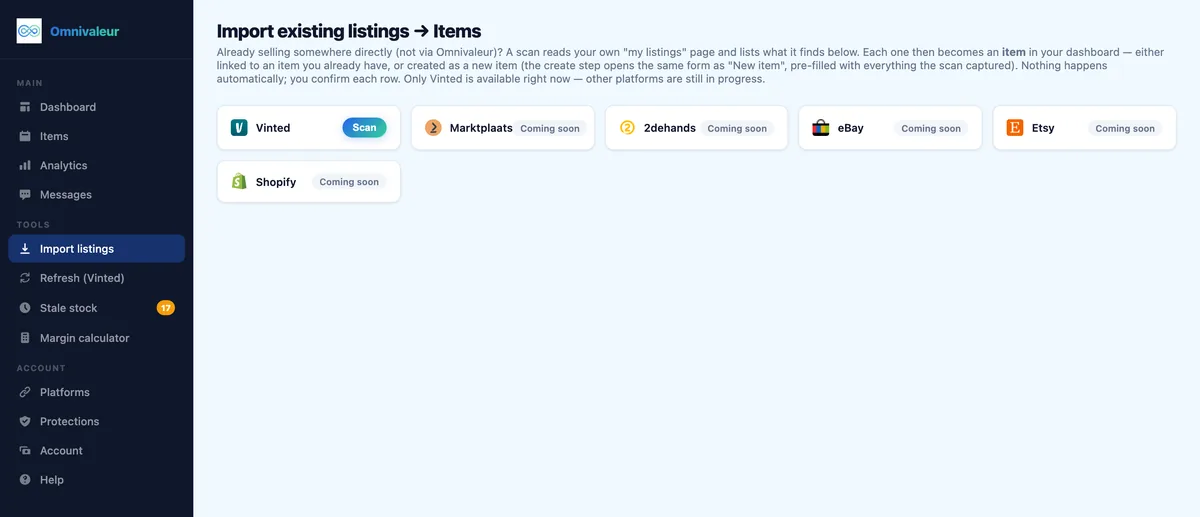
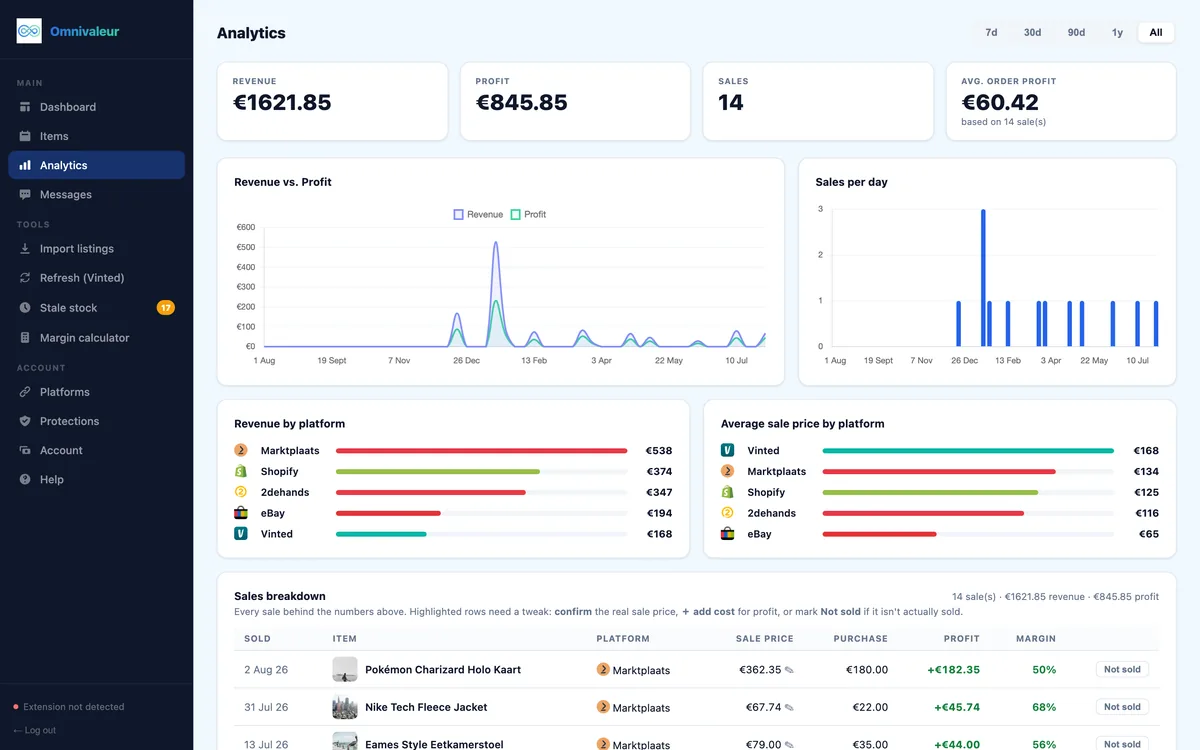
This is exactly the kind of repetitive, platform-specific detail that Omnivaleur exists to take off your plate. Omnivaleur publishes from one intake form to seven channels — Marktplaats, 2dehands, Vinted, eBay, Shopify, WooCommerce and Facebook Marketplace (beta) — and applies the correct shipping logic per destination automatically, rather than forcing you to re-enter weight, carrier and cost for each platform by hand. And because parallel publishing is one of the fastest ways to get a marketplace account flagged or rate-limited, Omnivaleur deliberately runs cross-listing one browser tab at a time, trading a few extra seconds per listing for accounts that stay in good standing.
If Etsy is your primary shop and you're expanding into Dutch or Belgian marketplaces for the first time, the Marktplaats to Etsy Crosslisting 2026 Guide and 2dehands to Etsy Crosslisting Guide both walk through the reverse direction — bringing local listings onto Etsy — with the same shipping-mismatch problem flagged early. Going the other way, from Etsy outward, the Etsy to Vinted Crosslisting Automation Guide and Etsy to eBay Crosslisting Guide cover how shipping fields map between the two systems without you re-keying everything manually.
What 2026 shipping rule changes should Etsy resellers watch for?
Three things changed or tightened heading into 2026 that are worth knowing if you set your shipping profiles up years ago and haven't revisited them.
Star Seller thresholds got stricter. The on-time dispatch requirement now sits at 95%, up from a looser standard in earlier years. If your processing time is set unrealistically short just to look responsive, it's now actively costing you the Star Seller badge — and that badge carries a real search-ranking weight.
Tax reporting thresholds affect how you treat shipping income. If you sell across borders and your total annual sales or transaction count crosses the relevant threshold, platforms including Etsy are obligated to report your activity under DAC7 rules. Shipping charges collected from buyers generally count as part of gross transaction value for reporting purposes, not as a separate exempt category — worth confirming against the Belastingdienst's DAC7 guidance or the broader European Commission DAC7 overview if you're close to the thresholds. Dutch and Belgian resellers running Vinted alongside Etsy should also read the Vinted DAC7 reporting guide, since the same reporting logic applies across platforms, not just one.
Margin-scheme bookkeeping gets trickier with shipping bundled in. If you're a Dutch or Belgian second-hand reseller using the VAT margin scheme, shipping charged separately versus shipping folded into item price changes how your margin calculation reads on paper. The VAT Margin Scheme for Second-Hand Goods Guide breaks down exactly where shipping sits in that calculation, which matters more once you're baking shipping into "free shipping" listings the way this article recommended earlier.
None of these changes require you to rebuild your shop from scratch. They do mean a quarterly fifteen-minute review of your shipping profiles — processing times, calculated vs fixed assignment, and free-shipping thresholds — pays for itself in avoided Star Seller penalties and avoided margin surprises far more than it costs in time.
Frequently asked questions
Does shipping income count toward Etsy's DAC7 reporting threshold in the Netherlands?
Can I use my own PostNL or bpost contract rates instead of Etsy's built-in label discounts?
What happens to my shipping profiles if I pause or close my Etsy shop temporarily?
Does offering free returns change my Etsy shipping settings?
How does Omnivaleur handle the fact that Etsy, Vinted and Marktplaats all calculate shipping differently?
Keep reading



Stop copying listings by hand
Omnivaleur publishes your item to every platform at once and syncs stock automatically when something sells.
Start free trial