eBay to Shopify Crosslisting in 2026: The Full Reseller Guide

eBay to Shopify crosslisting means pushing your eBay inventory to a Shopify store so you sell on both without double data entry. In 2026, the practical challenges are eBay's API rate limits, Shopify's separate return-policy obligations under EU consumer law, and DAC7 income reporting once combined marketplace sales cross €2,000.
Key takeaways
- eBay and Shopify are structurally different: one is a marketplace, one is your own storefront with separate legal duties.
- DAC7 reporting now aggregates income across marketplaces like eBay, not Shopify direct sales, so bookkeeping gets messier when you run both.
- eBay caps API calls per day; large catalogs need throttled syncing tools, not manual CSV re-uploads.
- Shopify has no built-in return-policy template, so EU sellers must write their own 14-day withdrawal notice manually.
- Omnivaleur syncs stock and price changes both ways so a sold eBay item disappears from Shopify within minutes, not hours.
Crosslisting eBay to Shopify sounds simple until you actually try it with 300+ active listings. eBay is a marketplace with its own buyer protection, search algorithm and fee structure. Shopify is your own website — you own the customer relationship, but you also own every legal obligation that comes with running a webshop in the EU. Moving inventory between the two isn't a copy-paste job, and the tools that treat it that way tend to break something on the Shopify side within a week.
What exactly happens when you crosslist from eBay to Shopify in 2026?
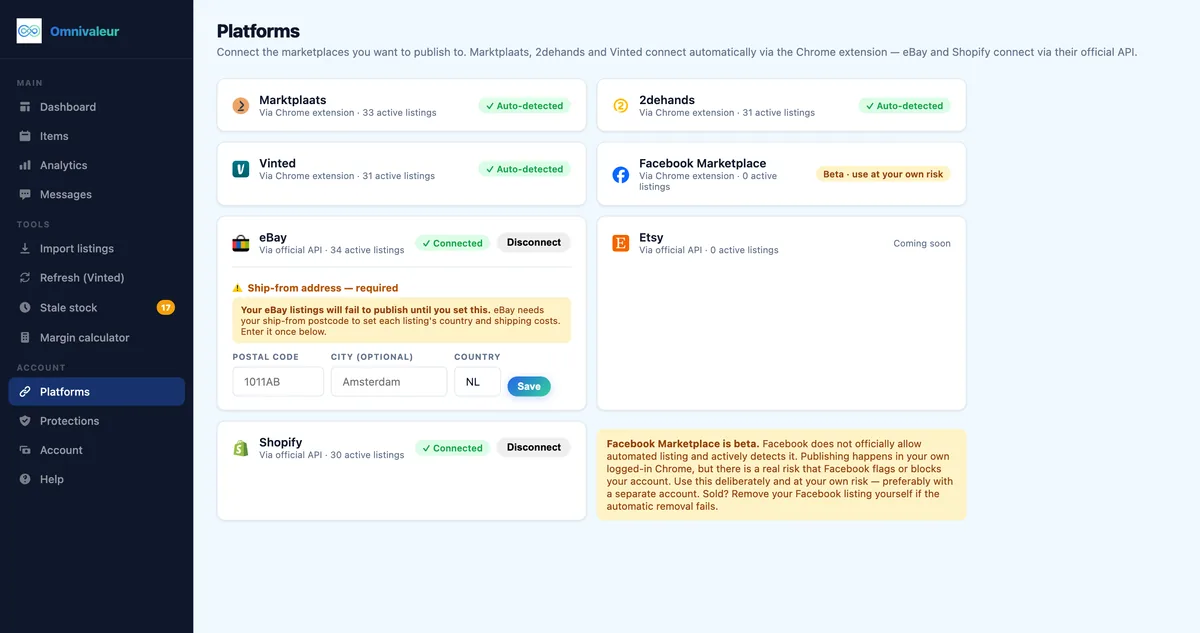
A crosslisting tool pulls your active eBay listings — title, images, price, stock count, item specifics — and creates matching products in your Shopify admin. Good tools keep a live link between the two: when an item sells on eBay, Shopify stock drops automatically. Cheap tools do a one-time export and then leave you to manually update both platforms forever, which defeats the entire point.
The real 2026 wrinkle is that eBay tightened its listing creation and management rules, requiring more structured item specifics before a listing can go live in categories like electronics and clothing. If your Shopify feed doesn't map those fields correctly, the eBay side of the sync can silently fail while Shopify looks fine.

Why do EU resellers run eBay and Shopify at the same time instead of picking one?
eBay brings existing buyer traffic and trust. Shopify brings full control over branding, pricing and — critically — no per-item marketplace fee cutting into your margin on repeat customers. Resellers who've built a following on eBay often open a Shopify store specifically to capture repeat buyers without paying eBay's final value fee a second time.
The trade-off: Shopify traffic is zero on day one. You're building an audience from scratch while eBay hands you buyers immediately. Most serious sellers run both for years, not as a transition plan.
What are the biggest technical limits eBay and Shopify put on crosslisting in 2026?
- eBay API rate limits: most seller accounts get 5,000 API calls per day on the standard tier; large catalogs syncing every price change can burn through that fast.
- Shopify variant limit: 100 variants per product, which trips up sellers who list eBay items with many size/color combinations as one listing.
- Image count mismatch: eBay allows up to 24 photos per listing; Shopify themes often only display 8-10 cleanly, so extra images get buried.
- Category mapping: eBay's structured categories don't map 1:1 to Shopify collections, so automated tools need a translation layer or listings land in the wrong place.
If you're also running Vinted alongside these two, the sync logic gets even more layered — see our Vinted to eBay Crosslisting guide for how that combination behaves differently from eBay-to-Shopify.
How does DAC7 tax reporting affect sellers running eBay and Shopify together?
This is the part almost nobody covers, and it matters. Under EU DAC7 rules, marketplaces like eBay must report your sales data to tax authorities once you cross 30 transactions or €2,000 in a calendar year. Shopify, as your own webshop, is not a "platform" under DAC7 and does not report your direct sales this way — you're responsible for declaring that income yourself.
Practically, this means your eBay income gets reported automatically by eBay to the Belastingdienst (or your national tax office), while your Shopify income sits entirely on you to declare. Mixing the two without separate bookkeeping is how resellers end up with mismatched numbers at tax time. Keep separate revenue tags per platform in whatever accounting tool you use, from day one.

How do EU consumer rights differ between eBay and Shopify?
eBay applies its own buyer protection and return framework across the marketplace. Shopify gives you a blank page — you write your own returns and refund policy, and under EU consumer rights rules, private customers buying from your Shopify store still get a 14-day withdrawal right regardless of what your policy page says. A lot of first-time Shopify sellers skip publishing this notice entirely, which is a compliance gap, not a minor detail.
Fee and policy comparison
| Factor | eBay | Shopify |
|---|---|---|
| Typical selling fee | ~10-12% final value fee | 0-2% payment processing only (no marketplace cut) |
| Return policy | eBay Money Back Guarantee, platform-enforced | Seller-written, must include EU 14-day withdrawal |
| Buyer trust at launch | High, built-in | Zero, must be earned |
| Tax reporting (DAC7) | Automatic via eBay | Self-declared by seller |
| Listing image limit | 24 per listing | Theme-dependent, often 8-10 shown well |
- ✓Check if your Shopify theme can handle the number of variants your eBay listings have
- ✓Write and publish a returns policy page that includes the EU 14-day withdrawal notice
- ✓Set up separate bookkeeping tags for eBay income and Shopify income from day one
- ✓Verify your eBay API call allowance if you're syncing 200 or more SKUs
- ✓Test the sync with one cheap item before pushing your full catalog live
What does an eBay-to-Shopify fee comparison actually mean for margin?
On a €50 item, eBay takes roughly €5-6 in fees before payment processing. The same item sold direct through Shopify costs you closer to €1-1.50 in payment fees only. That's the entire pitch for running Shopify alongside eBay — repeat buyers you can push toward your own store save you real margin, especially on items over €30 where the percentage gap compounds fast.
How does Omnivaleur handle the eBay-to-Shopify sync in practice?
Omnivaleur pulls active eBay listings, maps item specifics into Shopify product fields, and keeps stock synced in both directions. Sell on eBay, and the Shopify listing marks out of stock within minutes rather than hours. Price changes push both ways too, so you're not manually updating two admin panels every time you adjust a listing. If you've already compared tools for Vinted or Marktplaats workflows, the logic is the same core engine — just pointed at a different platform pair. If you're weighing this against other cross-listing software before committing, our Omnivaleur vs Vendoo comparison breaks down where the sync speed and pricing actually differ.
What should you check before your first eBay-to-Shopify sync?
- Confirm your Shopify theme supports the variant count your eBay catalog needs.
- Write and publish a proper returns policy page with the EU 14-day notice included.
- Separate your bookkeeping categories now — eBay-reported income versus self-declared Shopify income.
- Check your eBay account's daily API call allowance if you're syncing 200+ SKUs.
- Test one low-value item first before pushing your full catalog live.
None of this is complicated on its own. It just gets skipped because most crosslisting guides only talk about the listing mechanics, not the tax and legal layer sitting underneath it in 2026.
Frequently asked questions
Can I automatically crosslist eBay's Best Offer listings to Shopify?
Does connecting eBay to Shopify require a paid Shopify plan?
Will my eBay feedback score transfer or matter on Shopify?
Can I reuse the same product photos on eBay and Shopify without breaking any rules?
How many SKUs can I realistically sync before hitting eBay's rate limits?
Do I need a separate VAT registration to sell on Shopify if I already sell on eBay?
Keep reading


Stop copying listings by hand
Omnivaleur publishes your item to every platform at once and syncs stock automatically when something sells.
Start free trial