Retro Gaming Reselling Automation in 2026: The Complete Cross-Listing Guide
Retro gaming reselling automation means using one tool to list a console, cartridge or accessory once and push it to Marktplaats, 2dehands, Vinted, eBay, Etsy and Shopify at the same time — while tracking condition notes, region variants and stale stock, so you spend time sourcing instead of retyping listings six times.
Retro gaming resale is one of the messiest niches to scale by hand. A boxed PAL Game Boy Color, a loose NTSC cartridge, a modded SNES with a new capacitor kit — each needs its own condition language, its own region disclosure, its own set of photos showing save-battery corrosion or missing manuals. Doing that six times per item, once per marketplace, is where most sellers burn their evenings. Automation fixes the repetition, not the judgment calls.
What Does Retro Gaming Reselling Automation Actually Mean in 2026?
It means writing the listing once — title, condition grade, region, tested-working status, photos — and letting software replicate it across every marketplace where retro buyers actually shop. That's Marktplaats and 2dehands for local pickup buyers who don't want to pay import duty on a PAL console, Vinted for smaller accessories and loose cartridges, eBay for the international collector market, Etsy for curated or repaired/modded units, and Shopify if you've built a standalone storefront around a specific console brand.
The trap is treating this like clothing resale. A T-shirt description barely changes between platforms. A cartridge listing has to communicate save-battery status, region lock, box completeness (CIB, loose, or box-only) and whether it's been professionally tested — details buyers actually search for, and details that differ per unit even within the same batch of stock.
Which Marketplaces Matter Most for Retro Games, Consoles and Accessories?
Not every platform pulls its weight for retro hardware. Here's how the six main ones actually perform for this category in 2026:
| Platform | Best for | Typical fee | Retro-specific note |
|---|---|---|---|
| Marktplaats | Bulky consoles, local pickup, CRT TVs | Free listing, paid boosts optional | Dutch buyers avoid shipping fragile CRTs; local-only listings sell faster |
| 2dehands | Belgian equivalent, same buyer behaviour | Free listing, paid boosts optional | Duplicate listings need the local Belgian region spelled out (PAL confirmation) |
| Vinted | Small loose accessories, controllers, cables | Buyer pays a service fee, seller keeps the price | Vinted's search doesn't reward console-specific keywords the way eBay does |
| eBay | International collectors, sealed/graded games | ~12.8% final value fee plus payment processing | Widest audience for rare titles, but also where reproduction cartridges get reported most |
| Etsy | Restored/modded units, curated bundles | €0.20 listing fee + ~6.5% transaction fee | Buyers pay a premium for "ready to play" framing over raw specs |
| Shopify | Repeat buyers, your own brand | Monthly subscription + payment processing | No marketplace fee per sale, but you own all traffic generation |
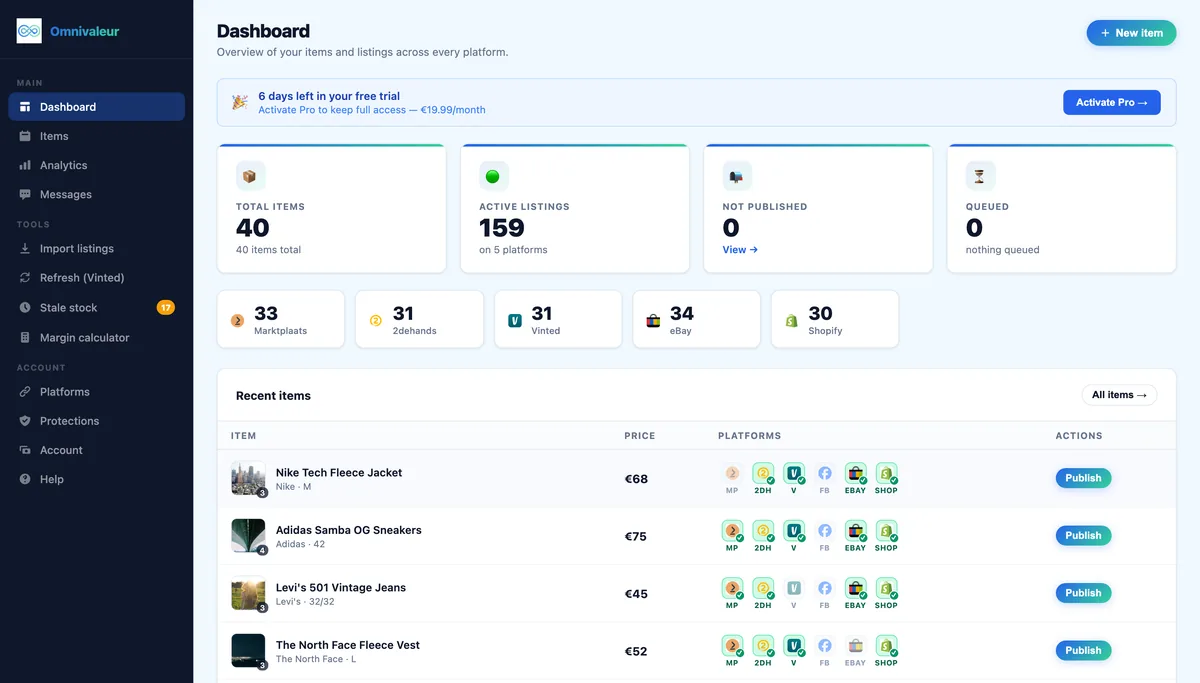
Most serious retro resellers run four or five of these at once. That's exactly the setup Omnivaleur was built for — you're not choosing one channel, you're choosing which four or five to automate.
How Do You Handle Condition Grading and Authenticity for Retro Hardware?
Retro gaming has a counterfeit problem that clothing resale doesn't: reproduction cartridges. Famicom and NES repro carts, bootleg Game Boy games, and re-shelled "new-in-box" units show up constantly on marketplaces, and buyers have gotten sharp about spotting them. If your automation tool lets you standardise a condition template, use it to force yourself to answer the same three questions every time: is the label original, does the PCB match known authentic boards, and has the unit actually been powered on and tested?
Grading terminology also needs to stay consistent across platforms:
- CIB (Complete In Box) — cartridge, box and manual, all matching
- Loose — cartridge or disc only
- Box-only — collectors buying empty boxes to complete a shelf set
- Tested/untested — always disclose this; eBay and Vinted buyer protection claims spike on untested lots
Sellers dealing in higher-value modded or repaired items should also read up on the collectible-hardware overlap with vintage toy reselling automation, since the authenticity-disclosure logic (original parts vs. replacements) is nearly identical.
What Are the Biggest Platform Rule Changes Retro Sellers Need to Know for 2026?
Three changes are catching sellers off guard this year. First, eBay has tightened its "item not as described" resolution window for electronics, which means retro consoles need more explicit disclaimers about known faults (yellowed plastic, drift, non-functional battery backup) or you'll eat more forced refunds. Second, Vinted has expanded its banned/restricted items list for anything that could be classed as a reproduction or modified electronic device without CE markings — check current wording before listing a modded console. Third, Marktplaats and 2dehands both now push local-pickup listings harder in search rankings for bulky electronics, rewarding sellers who set a real pickup radius instead of offering nationwide shipping on a 14kg CRT-era console bundle.
None of these are dramatic overhauls, but they change what "safe" listing copy looks like, and a tool that lets you edit a template once and push the fix everywhere saves you from manually patching five listings per item.
How Should You Price and Track Slow-Moving Retro Stock?
Retro demand is spiky. A specific Zelda cartridge can be dead stock for four months, then sell within a day because a YouTuber mentioned it. The opposite happens too — a console that seemed hot at purchase can sit for a season while a newer emulation trend eats its resale value. Manually re-checking forty listings a week to spot what's gone cold isn't realistic once your inventory passes a couple hundred units.
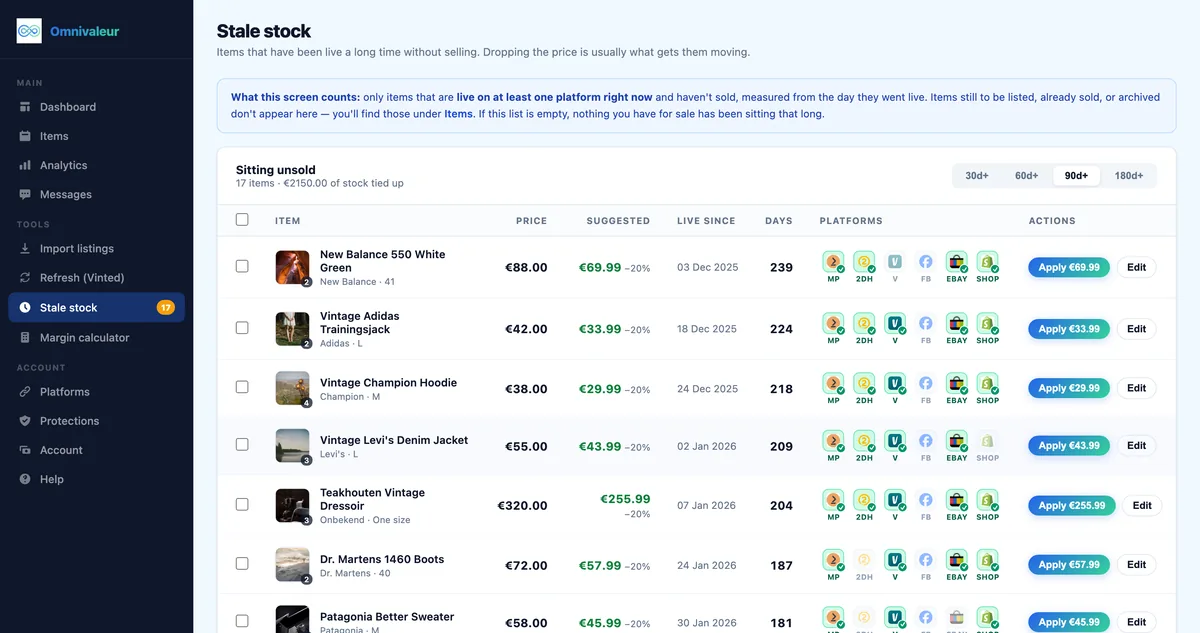
This is where Omnivaleur's stale-stock view earns its keep: it flags listings that have been sitting unsold instead of letting them quietly sink to page four of your own dashboard. For retro sellers specifically, that means you catch the cartridge that's been listed at €45 for 90 days before it becomes dead capital — and you can decide to reprice, bundle it with an accessory, or pull it and sell it to a specialist buyer instead.
Bundling is worth building into your pricing strategy from day one. A loose cartridge that won't move at €12 often sells within a week bundled with two others from the same console generation at €30 total — buyers browsing Vinted and Marktplaats for retro lots respond well to "starter bundle" framing that a single-item listing can't replicate.
How Does DAC7 Tax Reporting Affect Retro Game Resellers?
If you're selling retro consoles and games as a side income across Marktplaats, Vinted or eBay, DAC7 rules still apply the same way they do to any other resale category. Once you hit either 30 transactions or €2,000 in sales on a single platform within a calendar year, that platform is required to report your sales data to the Dutch tax authority. The Belastingdienst's DAC7 information for sellers spells out exactly what gets reported and when, and the European Commission's DAC7 overview covers how this works across other EU member states if you're also selling through 2dehands into Belgium.
Retro sellers often underestimate how fast the €2,000 threshold arrives when a single sealed graded game can sell for €300–€800. Selling a handful of high-value consoles will cross that line faster than selling forty t-shirts would. Keep your own sales log per platform rather than relying purely on marketplace dashboards, since export formats differ and you'll want one clean record at tax time.
Buyers, meanwhile, are protected under standard EU consumer shopping rights when purchasing from a business seller, which matters if you're selling repaired or modded units through Etsy or Shopify under a registered business — return rights on "not as described" electronics claims are stricter there than on private Marktplaats sales.
How Do You Avoid Getting Rate-Limited While Cross-Listing Retro Inventory?
This is the mistake that costs sellers entire accounts, not just listings. Batch-listing tools that push twenty items to eBay and Vinted simultaneously through parallel browser sessions look like bot activity to marketplace fraud systems — and both platforms have gotten stricter about flagging that pattern in 2026, especially on electronics categories where counterfeit activity is already elevated.
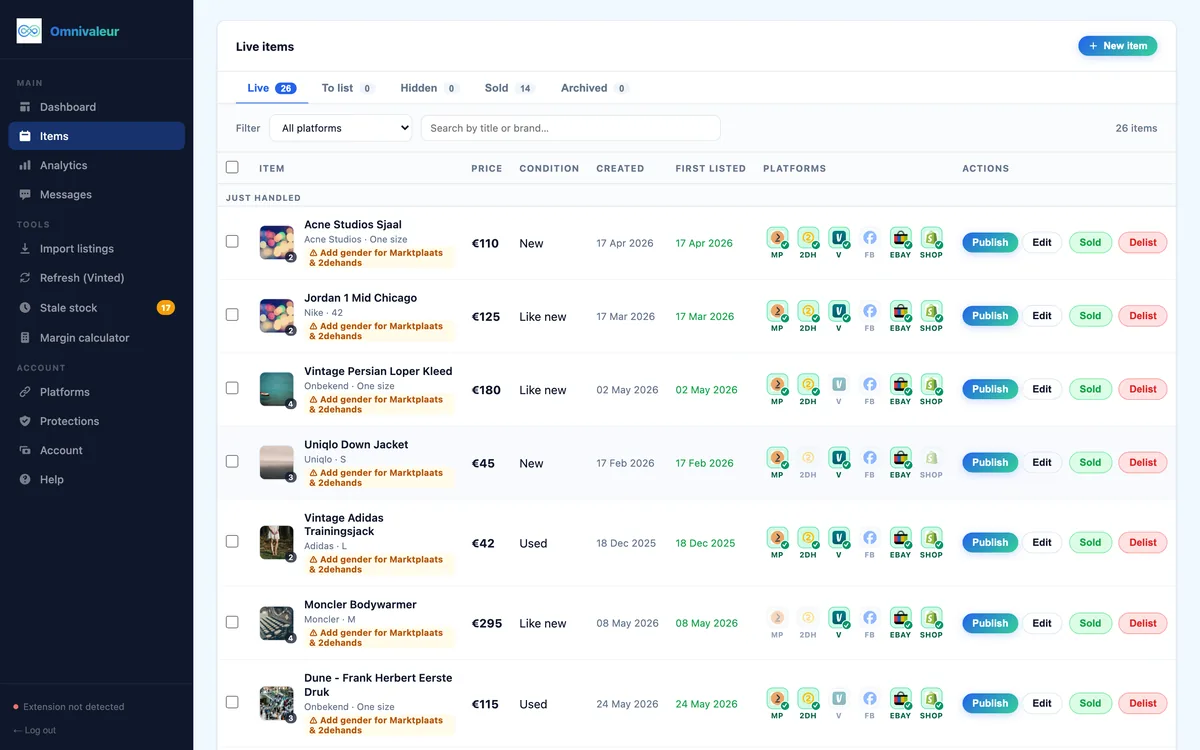
Cross-listing in Omnivaleur runs one browser tab at a time on purpose. It's slower per batch, but parallel publishing is exactly what gets marketplace accounts rate-limited or temporarily restricted — and a restricted eBay account mid-console-sale-season costs you far more than the few extra minutes sequential publishing takes. If you're moving 30-plus retro items a week, this single design choice is the difference between a stable account history and a support ticket you can't resolve for two weeks.
What Does a Realistic Retro Gaming Cross-Listing Workflow Look Like?
A typical weekly cycle for a mid-volume retro reseller looks like this:
- Source at a car boot sale, thrift store, or clearance lot — photograph on arrival, before cleaning, to document original condition
- Test every cartridge or disc; note battery-backup status for anything with save memory
- Write one master listing per item: title, condition grade, region, tested status, box completeness
- Push to Marktplaats and 2dehands first for local pickup interest, then eBay and Vinted for wider reach, staggering publish times
- Check the stale-stock view weekly and reprice or bundle anything past the 60-day mark
- Log DAC7-relevant sales totals monthly per platform
If you're already running this workflow between Marktplaats and Vinted, the mechanics overlap heavily with what's covered in the Marktplaats to Vinted crosslisting guide. Sellers expanding from 2dehands into Etsy for higher-margin restored units should also check the 2dehands to Etsy crosslisting guide, since Etsy's buyer expectations around "ready to play" framing need a different tone than a bare Marktplaats ad.
Retro accessories — controllers, memory cards, RGB cables — sell in higher volume than the consoles themselves for many sellers, and the automation logic there is closer to general electronics resale than to collectibles. The gaming equipment reselling automation guide covers that adjacent category in more depth if accessories make up a meaningful share of your stock.
Board game collectors overlap with retro gaming buyers more than you'd expect, especially around licensed tie-in titles and limited print runs — the board game and tabletop reselling automation guide is worth a look if you're branching into that shelf space too.
Finally, if you're comparing tools before committing to one, don't just look at feature lists. Check how each one actually publishes listings under the hood — the Omnivaleur vs List Perfectly comparison breaks down the sequential-vs-parallel publishing difference in more detail, which matters more for electronics categories than for almost any other resale niche given how sensitive eBay and Vinted are to account-flagging on games and consoles right now.
Retro gaming resale rewards patience and precision more than volume. A seller moving 15 well-documented, correctly graded items a week consistently outperforms one dumping 60 vague listings, because retro buyers research before they buy and abandon anything that reads like a copy-paste job. Automation should remove the typing, not the judgment — the condition notes, the region checks, the "is this cartridge actually authentic" question still belong to you.
Frequently asked questions
Can I list a PAL console on eBay and have it appear correctly for US buyers?
How do I disclose a modded or repaired retro console without scaring off buyers?
Is it worth getting rare cartridges professionally graded before selling?
What's the biggest mistake new retro resellers make when cross-listing?
Do I need separate photos for each marketplace?
Keep reading
Stop copying listings by hand
Omnivaleur publishes your item to every platform at once and syncs stock automatically when something sells.
Start free trial