Omnivaleur vs Nifty: Which Inventory Tool Fits Your Reselling Business in 2026?
Omnivaleur is built specifically for cross-listing across European and global marketplaces like Marktplaats, Vinted, and eBay with automatic stock sync. Nifty serves an entirely different niche, focusing on Indian stock market analytics and trading strategies. For e-commerce resellers, Omnivaleur automates inventory, while Nifty offers no e-commerce features.
Key takeaways
- Omnivaleur connects e-commerce platforms like Marktplaats, 2dehands, Vinted, eBay, Etsy, and Shopify in one dashboard.
- Nifty is a financial trading and stock market analysis platform unrelated to online reselling.
- Resellers need inventory sync, local marketplace integrations, and automated profit calculations to prevent overselling.
- Choosing the right tool depends entirely on whether you trade financial instruments or physical second-hand goods.
If you run a second-hand reselling business and search for software comparisons, you occasionally hit strange overlaps in search engine results. When looking at inventory automation platforms, names pop up that belong to entirely different industries. That brings us to a common point of confusion for digital operators: comparing Omnivaleur against Nifty. These two software options serve radically different users, and understanding which one matches your actual daily workflow saves you from wasted subscriptions and messy setups.
As an experienced reseller working across European markets, I spend my days managing listings, dodging double-sales, and figuring out how to handle tax reporting requirements like the rules outlined in the European Commission DAC7 overview. When evaluating software to scale a business, you need clear facts about what a platform actually touches. Let us break down both tools honestly, look at their core mechanics, and clarify why comparing them is usually an apples-to-oranges scenario.
What is Omnivaleur and how does it support modern resellers?
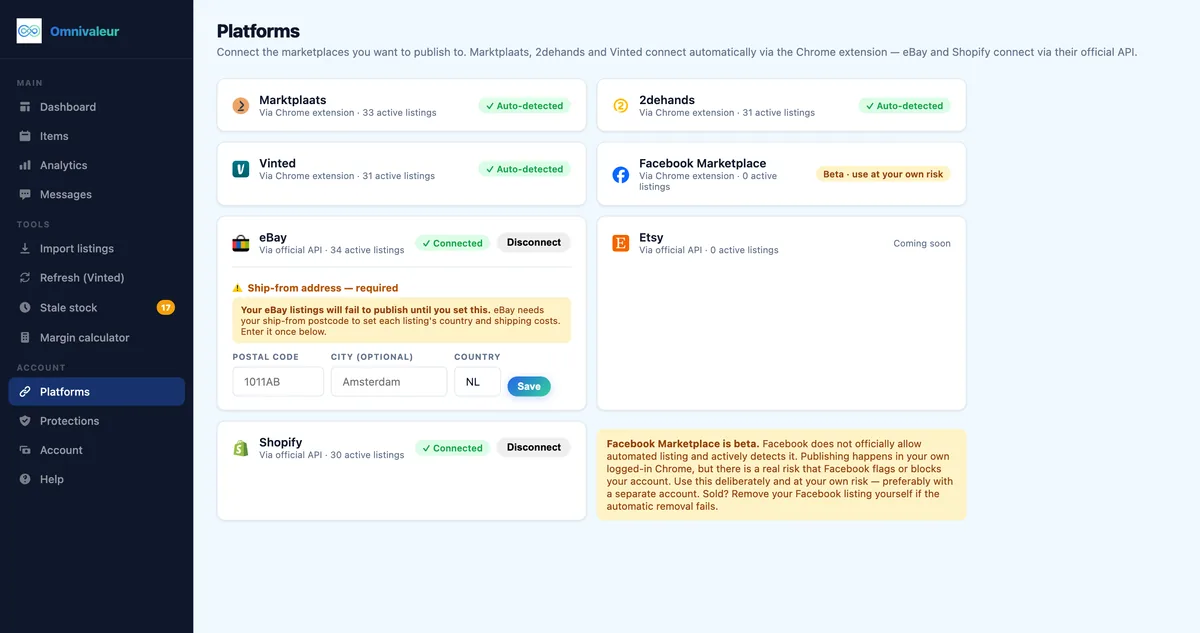
Omnivaleur is a dedicated e-commerce automation and cross-listing SaaS built for independent resellers, thrift store operators, and small online boutiques. The platform allows sellers to create a listing once and push it across multiple marketplaces simultaneously, including Marktplaats, 2dehands, Vinted, eBay, Etsy, and Shopify. DAC7 compliance and reporting rules, such as those monitored by the Belastingdienst DAC7 information for sellers, make accurate tracking essential. Omnivaleur helps maintain clean financial logs by calculating profit from the real sale price rather than the initial asking price—which matters because, on second-hand platforms, the two figures typically differ by roughly 10% to 20% due to buyer offers and negotiations.
The story behind Omnivaleur stems from the sheer frustration of manual inventory control. Anyone who has ever sold a vintage jacket on Vinted only to realize ten minutes later that someone else bought it on Marktplaats knows the sinking feeling of having to cancel an order. Omnivaleur solves this by instantly pulling listings down across all connected channels the moment an item sells anywhere. Furthermore, for sellers transitioning their hobby into a registered enterprise, understanding legal thresholds is vital, as detailed in our guide on When Does Reselling Become a Business? KVK & Tax Rules.
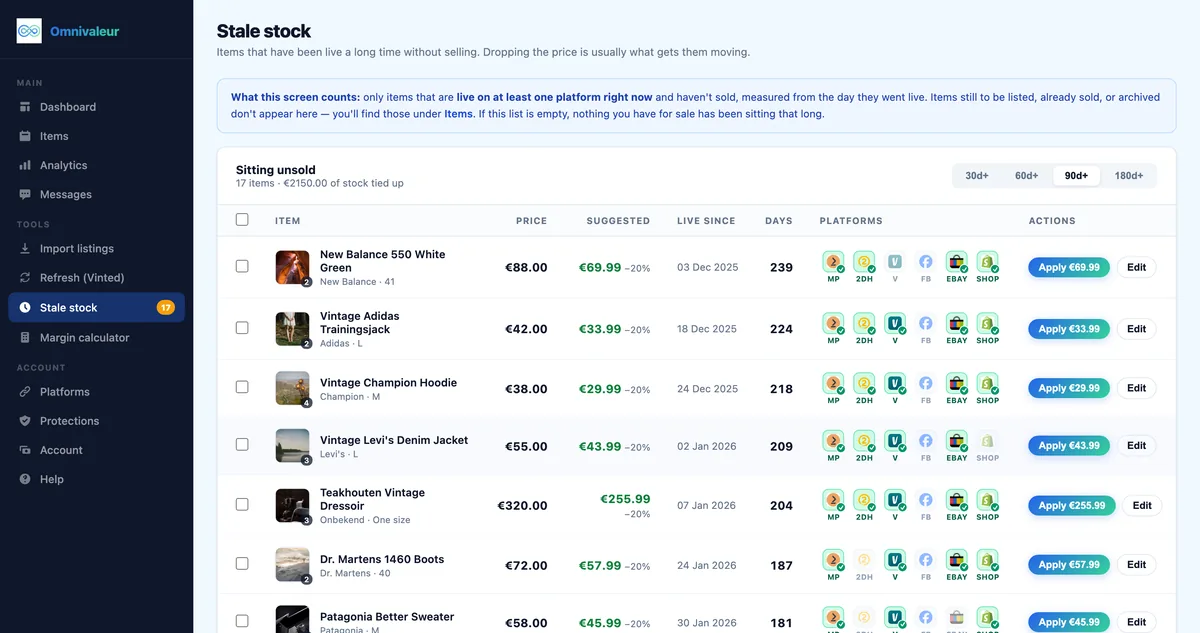
Beyond basic cross-listing, the platform includes a stale-stock view that flags items sitting unsold in your inventory for too long. Instead of letting old stock sink to the bottom of your dashboard, the system highlights slow-moving items so you can reprice them, bundle them, or push them to a different marketplace. If you are comparing inventory automation tools, you might also want to review our Omnivaleur vs Zipsale: Honest 2026 Reseller Comparison to see how feature sets stack up across the board.
What is Nifty and what market does it actually target?
While Omnivaleur is designed for physical inventory and online marketplaces, Nifty refers to tools and platforms built for financial traders—specifically the NIFTY 50 index in Indian financial markets. Platforms under the Nifty umbrella provide real-time stock market intelligence, options analytics, charting capabilities, and automated algorithmic trading backtesting for stock brokers and financial speculators.
If you stumbled across Nifty while looking for e-commerce tools, it is simply because search engines occasionally cross-reference brand names with unrelated financial software blogs. Nifty platforms have zero integration with Marktplaats, cannot sync your vintage clothing inventory, and do not track shipping labels or buyer messages. They deal in candlestick charts, options strategy builders, and stock screeners. Therefore, if you sell physical goods online, Nifty will not help you cross-list a single item.
For online sellers who want to evaluate actual e-commerce automation alternatives instead of financial trading platforms, looking at marketplace-specific guides is far more productive. For instance, if you specialize in vintage apparel, our Vintage Clothing Reselling Automation Platforms 2026 Guide breaks down how to manage soft-goods inventory across multiple European channels effectively.
How do core features compare between e-commerce automation and financial tools?
When comparing software categories, examining the feature set side by side reveals why direct competition between Omnivaleur and Nifty does not exist. E-commerce platforms focus on supply chain, multi-channel publishing, translation, and order management. Financial software focuses on asset pricing, volatility, and order execution on stock exchanges.
| Feature Category | Omnivaleur (E-commerce SaaS) | Nifty (Financial / Trading Tools) |
|---|---|---|
| Primary User | Online resellers, vintage dealers, boutique owners | Stock market traders, financial analysts |
| Marketplaces Supported | Marktplaats, 2dehands, Vinted, eBay, Etsy, Shopify | None (Connects to stock brokerages like Zerodha) |
| Inventory Sync | Automatic cross-platform stock removal on sale | Real-time ticker and asset price feeds |
| Profit Tracking | Calculated from actual closed sale prices minus fees | Portfolio P&L, capital gains, options pay-offs |
| EU Compliance Support | DAC7 data tracking and consumer rights alignment | SEBI and Indian financial regulatory compliance |
As the comparison table illustrates, these tools solve entirely different operational problems. If you are managing consumer rights, you should also review the standards set by Your Europe consumer shopping rights to ensure your return policies align with EU cross-border selling regulations. For sellers expanding into specialized niches, our dedicated guides—such as the Vintage Camera Reselling Automation 2026 Guide and the Best Sneaker Reselling Automation Platforms 2026—provide deep dives into category-specific workflows that neither financial tools nor generic cross-listers can match.
Why do resellers need specialized multi-channel software?
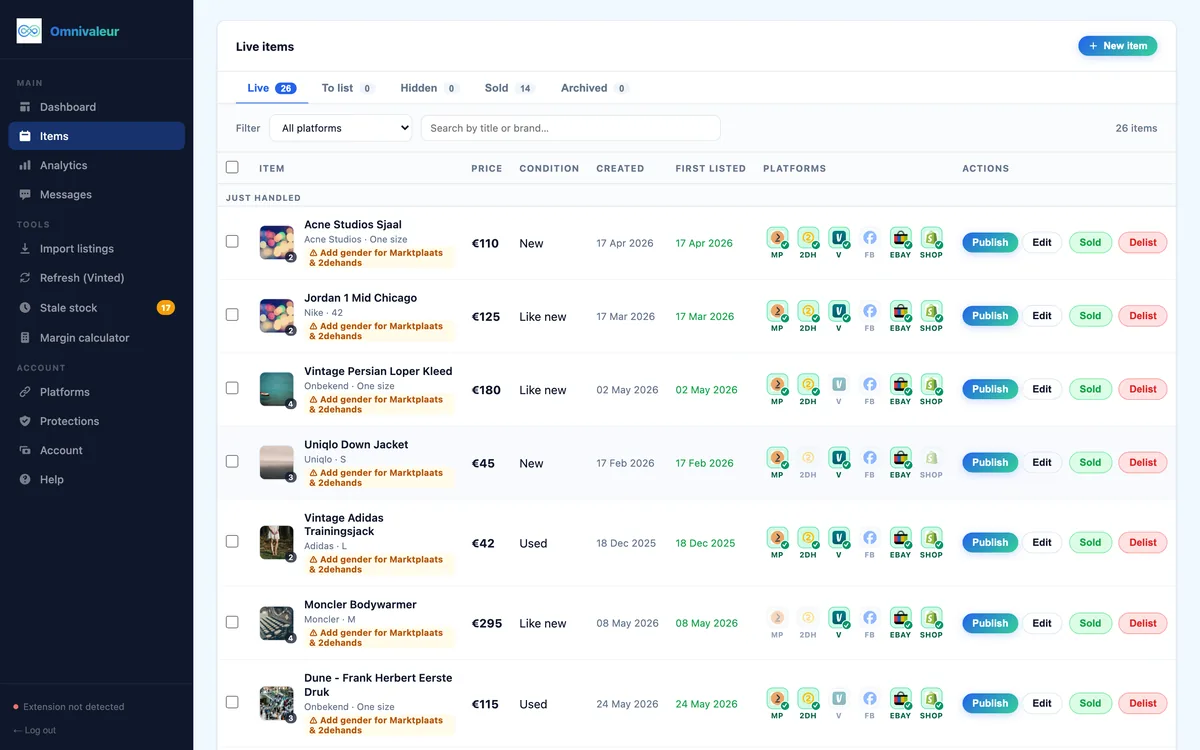
Running a reselling business across multiple platforms manually is a recipe for burnout. If you list an item on Marktplaats, copy it to 2dehands, paste it into Vinted, and list it on eBay by hand, every single edit—like lowering the price or updating measurements—requires you to log into four different accounts. Worse, when the item finally sells on one platform, you have to remember to manually delete it from the other three before someone else buys it.
Specialized cross-listing software automates this entire lifecycle. When an item is imported into your central dashboard, you can optimize titles, attach categorized tags, set your desired markup, and push it live everywhere in seconds. When a buyer makes a purchase, background webhooks trigger inventory updates across all connected channels instantly. This eliminates the risk of overselling, which hurts your seller ratings and wastes hours in customer support messages explaining cancellations.
For collectors and specialized dealers, automation also extends to niche platforms. Whether you deal in rare pressings covered in our Vinyl Record Reselling Automation 2026 guide, or high-value items detailed in our Luxury Handbag Reselling Automation resource, keeping precise track of inventory condition grades and serial numbers across marketplaces protects your profit margins.
- ✓check whether the platform supports regional channels like marktplaats
- ✓verify that inventory sync pulls listings down instantly after a sale
- ✓review profit tracking against real closed sale prices rather than asking prices
- ✓ensure local currency and translation parameters match your target markets
How does inventory synchronization prevent marketplace penalties?
Marketplaces like Vinted and Marktplaats take inventory accuracy seriously. If your account frequently accepts orders for items that are already out of stock, algorithms flag your profile for poor fulfillment rates. This can lead to reduced search visibility, temporary suspensions, or permanent bans.
Robust synchronization relies on fast API connections or secure automation scripts that check for sales events continuously. When a sale registers on Shopify or eBay, the central database immediately flags that SKU as sold and dispatches removal requests to every connected marketplace API. This automated feedback loop is something financial trading platforms do not possess because stock trading is instant and centralized through stock exchanges, whereas online marketplaces are fragmented across independent web properties with varying API limits.
To understand how cross-platform workflows operate in practice, many sellers review our platform comparisons, such as the Omnivaleur vs Crosslist: Honest 2026 Reseller Comparison or the Omnivaleur vs List Perfectly: Honest 2026 Comparison. These comparisons highlight how different e-commerce automation tools handle speed, translation, and image management.
What are the primary technical considerations when choosing an e-commerce automation tool?
When selecting software to run your reselling operation, several technical factors deserve close scrutiny. First, look at platform support. If you operate primarily within the European market, your tools must support regional giants like Marktplaats and 2dehands alongside international platforms like Vinted and Etsy. Many US-centric cross-listers ignore Marktplaats entirely, leaving European sellers stranded.
Second, evaluate how the software handles data translation and localization. Selling an item from the Netherlands into Belgium or France often requires translating descriptions and adjusting currency or shipping parameters. Omnivaleur handles per-platform localization smoothly, ensuring your listings adhere to local marketplace guidelines without manual rewriting.
Third, examine reporting depth. Simple listing tools only show you what is currently active. Advanced tools track your inventory turnover rate, days-to-sale metrics, and real net profit after accounting for platform fees, shipping costs, and purchase prices. For sellers focusing on specific categories like home goods or hardware, our guides on Home Decor Reselling Automation 2026 and Tool & Equipment Reselling Automation Guide 2026 explore how category nuances affect profit tracking.
What is the final verdict on Omnivaleur versus Nifty for your workflow?
The conclusion here is straightforward. If you are an e-commerce reseller looking to scale your inventory, save time on listing creation, and prevent double-sales across Marktplaats, Vinted, eBay, and Shopify, Omnivaleur is built specifically for your exact business model. It automates the tedious administrative work of reselling so you can focus on sourcing and growing your revenue.
If you are a financial trader analyzing the Indian stock market, Nifty tools are what you need for charts and options strategies. However, if your daily routine involves packing boxes, printing shipping labels, and hunting for profitable second-hand goods, Nifty is entirely irrelevant to your business. For online sellers ready to streamline their operations, setting up a unified inventory dashboard is the single most effective step you can take this year.
Frequently asked questions
Can Nifty tools be used to manage or sync e-commerce inventory?
Why do search results sometimes group Omnivaleur and Nifty together?
Does Omnivaleur support regional European marketplaces like Marktplaats and 2dehands?
How does Omnivaleur calculate profit differently from basic listing tools?
What should a reseller look for when replacing manual inventory methods?
Keep reading
Stop copying listings by hand
Omnivaleur publishes your item to every platform at once and syncs stock automatically when something sells.
Start free trial