Footwear and Shoe Reselling Automation: The 2026 Cross-Listing Guide
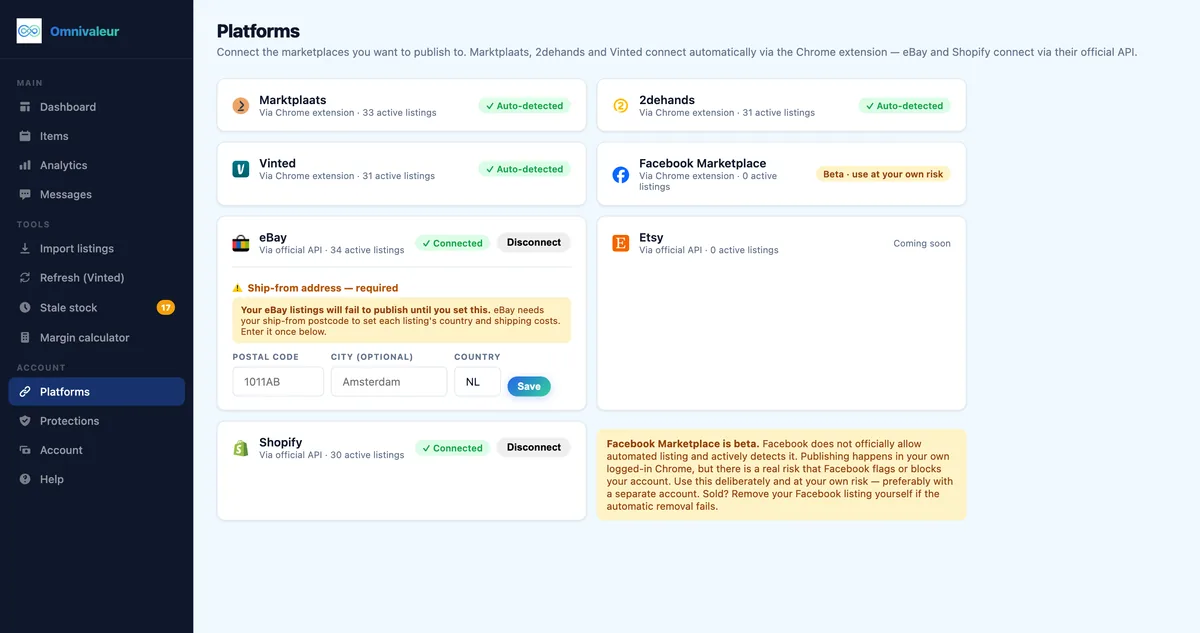
Footwear and shoe reselling automation means using one tool to list a pair once and push it, with correct size and condition data, to Marktplaats, 2dehands, Vinted, eBay, Etsy and Shopify simultaneously — syncing stock, prices and delistings so a sold pair disappears everywhere within minutes, not hours.
Key takeaways
- Shoe listings need three size fields (EU, UK, US) mapped correctly per platform, not just one number
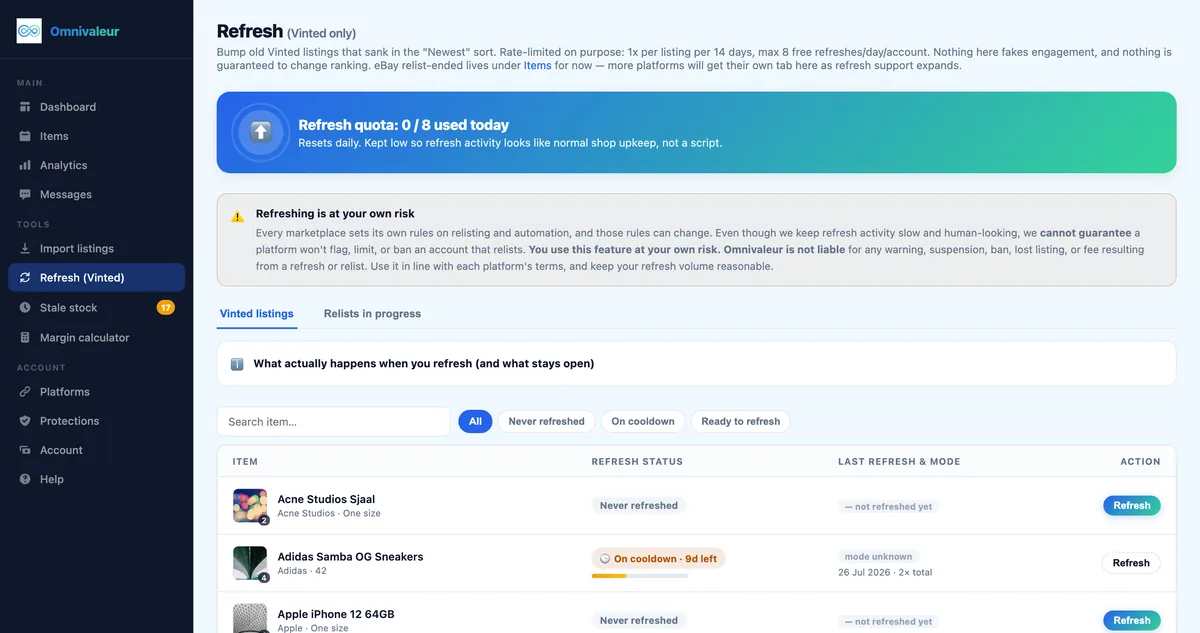
- Vinted's refresh tool caps at 8 free refreshes a day and cannot promise your account stays safe from flags
- DAC7 obliges Dutch marketplaces to report sellers who cross 30 sales or €2,000 a year, sneakers included
- Profit tools that use the asking price instead of the confirmed sale price overstate margin by 10-20%
- eBay's authenticity checks and Etsy's handmade rules mean not every pair belongs on every channel
Sneakers move fast. A clean pair of Jordan 1s can sell within an hour on Vinted and still be sitting unsold on Marktplaats three days later. Footwear reselling automation exists because manually re-typing size, condition and price across six marketplaces eats the margin you just fought to find at the thrift store or outlet run. The real work isn't listing — it's keeping six listings in sync after the first sale.
What does footwear reselling automation actually solve for a reseller?
It solves three specific problems that shoe flippers hit harder than clothing or electronics sellers: size duplication, fast stock desync, and photo-heavy relisting. Shoes sell in pairs but get listed as single SKUs with a size attribute, and every marketplace structures that attribute differently. Sneakers also sell quickly relative to other categories — a hyped release can move in under an hour — so a five-minute delay in delisting after a sale means a duplicate order and an angry buyer on the second platform.
A cross-listing tool like Omnivaleur pushes one listing draft to Marktplaats, 2dehands, Vinted, eBay, Etsy and Shopify at once, then pulls a "sold" signal back to delist the same pair everywhere else automatically. That single feature — instant cross-platform delisting — is worth more to a shoe reseller than almost any other automation, because footwear inventory turns over faster than most other resale categories.
Which marketplaces are actually worth cross-listing sneakers to in 2026?
Not every platform suits every shoe. Beaters and everyday trainers do better on Marktplaats and 2dehands where local buyers avoid shipping costs. Hyped or limited releases do better on eBay and Vinted, where a wider buyer pool pushes price competition. Etsy only makes sense for genuinely vintage or handmade footwear — not current-season sneakers.
| Platform | Best for | Shoe-specific quirk in 2026 |
|---|---|---|
| Vinted | Casual sneakers, everyday trainers | Free listings, but algorithm favors frequently refreshed items |
| eBay | Hyped releases, boxed deadstock | Authenticity Guarantee applies to sneakers over a set resale value |
| Marktplaats / 2dehands | Local pickup, bulky boxed pairs | No shipping fees, but smaller buyer pool for rare sizes |
| Etsy | Vintage leather shoes, handmade boots | Current mass-market sneakers get flagged as non-compliant |
| Shopify | Your own brand or curated storefront | No marketplace fees, but you own all traffic acquisition |
Running a pair across all five at once used to mean five separate listing sessions. If you're already comparing dedicated tools for this category, the Best Sneaker Reselling Automation Platforms 2026 guide breaks down which tools actually handle size variants without breaking, and the Dutch version, Best Sneaker Reselling Automation Platforms 2026, covers the same ground for the Benelux market.
How do shoe size and condition fields trip up automated cross-listing?
This is the part every competing article skips, and it's where most footwear cross-listing actually breaks. A size 42 on Marktplaats is a EU size. eBay defaults to US sizing for a lot of categories. Vinted lets you pick EU, UK or US depending on the buyer's region setting. If your automation tool copies a raw number instead of mapping the size system, you end up with a "size 42" listing on eBay that's actually a US 9 — three sizes off from what the number implies.
Condition grading has the same problem, but worse, because footwear condition isn't binary. "Used, good condition" on Vinted doesn't map cleanly to eBay's "Pre-owned" grading, and Etsy has no standard condition field for shoes at all — you're expected to describe wear in the listing body. A reliable cross-listing tool needs a condition-mapping layer, not a copy-paste field. When you're setting this up, check the item specifics against a general reference like the Vintage Clothing Reselling Automation Platforms 2026 Guide, which covers the same size/condition mismatch problem for apparel — the fix is nearly identical for shoes.
A worked example
Say you buy a pair of Nike Air Max for €35 at a warehouse sale. You list it at €89 on Vinted and cross-list the same draft to eBay and Marktplaats. If your size field says "42" without specifying EU, a UK buyer searching by UK size 8 never finds your listing — you lose visibility on the exact platform where sneaker search volume is highest. Fixing the size taxonomy once, at listing time, recovers that visibility permanently.
Can automation guarantee your Vinted account won't get flagged for constant relisting?
No, and any tool claiming otherwise is lying to you. Omnivaleur's own Vinted refresh feature caps itself at 8 free refreshes per day precisely because pushing refreshes too aggressively is what gets accounts flagged in the first place — the tool states outright that no automation can guarantee a marketplace won't flag an account, however careful the pacing. Vinted's algorithm rewards recently bumped listings, which is exactly why sneaker resellers lean on refresh tools, but treating the refresh limit as a soft suggestion rather than a hard rule is how accounts end up restricted mid-season, right when a hyped colorway is selling.
The practical rule for 2026: stay well under any platform's stated or implied daily action limit, spread refreshes across your catalog rather than hammering the same five pairs, and treat any "unlimited refresh" claim from a competing tool as a red flag rather than a feature.
How does DAC7 tax reporting affect sneaker resellers selling across borders?
If you're flipping shoes across Marktplaats, Vinted and eBay and crossing either 30 transactions or €2,000 in a calendar year, the platform is obligated to report your sales data to tax authorities under DAC7. This isn't a Vinted-specific rule — it applies across all EU digital marketplaces under the European Commission's DAC7 framework, and Dutch sellers can check exactly what gets reported through the Belastingdienst's DAC7 information page. Because sneaker flipping often crosses those thresholds faster than clothing resale — a handful of hyped releases can hit €2,000 in a month — footwear resellers are exactly the group DAC7 was built around.
The threshold applies per platform, not combined, so selling 25 pairs on Marktplaats and 20 on Vinted in the same year doesn't automatically trigger reporting on either individually — but it's close enough to the line that most serious flippers should keep their own sales log regardless. This is also where profit tracking becomes more than a nice-to-have. If your bookkeeping relies on your listed price rather than what actually cleared, your tax filing and your real margin drift apart.
- ✓Photograph new stock in batches with soles, insoles, box label and flaws
- ✓Map size correctly to EU, UK or US depending on each marketplace
- ✓Draft listing once with accurate condition grading for each platform
- ✓Push to all connected marketplaces at once through your automation tool
- ✓Set refresh cadence well under each platform's daily limits
- ✓Check sold notifications hourly during peak times to delist before duplicate orders
Why does tracking profit from the asking price get shoe resellers into trouble?
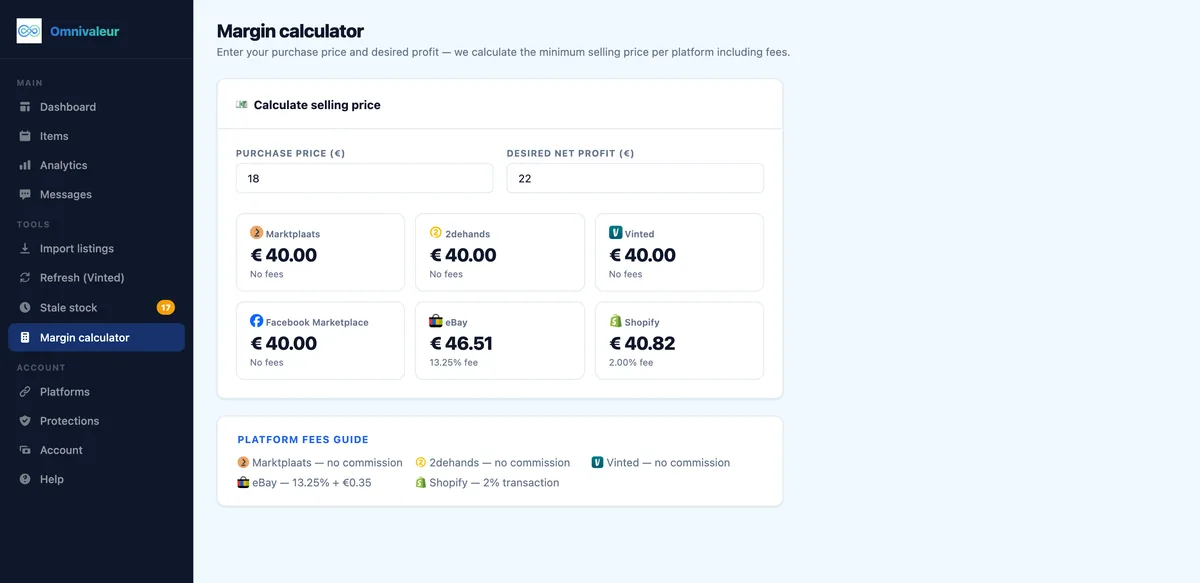
Sneaker prices move constantly, and negotiation is the norm, not the exception, on second-hand marketplaces. A pair listed at €95 might sell for €78 after a buyer negotiates, a bundle discount, or a "best offer" on eBay. On second-hand marketplaces that gap between listed and actual sale price typically runs 10-20% — and any profit dashboard that calculates margin off the asking price instead of the confirmed sale price is overstating your real earnings by exactly that much.
Omnivaleur's analytics calculate profit from the real sale price, which the seller confirms per transaction, not the number that was sitting in the listing. Over a month of 40 sold pairs, that 10-20% gap is the difference between thinking you cleared €1,200 and actually clearing €980 — a distinction that matters a lot when you're deciding whether to reinvest in more stock or pull back.
Does eBay's authenticity guarantee change how you should list sneakers?
Yes, and it's worth building into your listing workflow rather than discovering it after a sale gets held. eBay routes sneakers above a certain resale value through its Authenticity Guarantee program, which means the buyer's pair ships to an eBay-approved verification center before it reaches them — adding several days to delivery and, occasionally, resulting in a hold if photos or box condition don't match the listing description exactly. If you're cross-listing the same photos to Vinted and Marktplaats, where no such verification exists, make sure the listing description is accurate enough to survive eBay's stricter check, not just detailed enough for a casual Vinted buyer.
This is also where consumer protection cuts both ways. Under the EU's consumer shopping rights guidance, private buyers in most EU countries retain return rights that differ from platform to platform — a fake or misdescribed pair can trigger a return claim well after the sale closes, which is another reason accurate condition and authenticity notes matter more for shoes than almost any other resale category.
How do you decide which cross-listing tool fits a shoe reselling operation?
Compare tools on three things specific to footwear: how they handle multi-region size fields, how fast they delist a sold pair across every connected platform, and whether their refresh or relist automation respects each marketplace's daily limits. Generic cross-listing tools built primarily for clothing sometimes bolt shoe-size support on as an afterthought — worth checking directly rather than assuming.
If you're comparing named platforms, the Omnivaleur vs List Perfectly: Honest 2026 Comparison and the Omnivaleur vs OneShop comparison both cover how each tool handles category-specific attributes like size and condition, which matters more for footwear than for, say, books or vinyl. If Vinted is your primary channel for casual sneakers, the dedicated Vinted Reselling Automation 2026 guide covers refresh limits and listing frequency in more depth than a general footwear overview can.
What does a realistic footwear cross-listing workflow look like day to day?
Most footwear resellers running six figures in annual sales follow a rhythm rather than listing on impulse. Photograph new stock in batches — soles, insoles, box label and any flaws, since these are the four angles buyers and eBay's verification team both want. Draft the listing once with correct EU/UK/US size mapping. Push to all connected marketplaces. Set a refresh cadence that respects each platform's limits rather than maxing them out daily. Check sold notifications hourly during peak hours (evenings and weekends move fastest for sneakers) so delisting happens before a duplicate sale can occur.
Cross-border resellers moving stock between the Dutch second-hand market and Vinted's broader EU audience often start from a specific platform pairing rather than a blank setup — the Marktplaats to Vinted Crosslisting 2026 guide and its 2dehands equivalent, 2dehands to Vinted Crosslisting 2026 Guide, walk through exactly that pairing step by step, including the delisting timing that matters most for fast-moving footwear.
By 2026, the platforms themselves have tightened up: Vinted's algorithm weighs listing freshness more heavily than it did two years ago, eBay's verification thresholds for sneakers have expanded to cover more mid-range releases, and DAC7 reporting is now fully operational across every major EU marketplace rather than being phased in. None of that makes manual cross-listing impossible — it just makes the margin for error smaller, and automation exists to close that gap rather than replace the reseller's judgment on what to buy and when to sell.
Frequently asked questions
How do I handle shoe size conversions when cross-listing between EU and non-EU platforms?
What photos does eBay's Authenticity Guarantee actually check for sneakers?
How many times can I refresh a sneaker listing on Vinted per day without risking a flag?
Do I need to report sneaker resale income even if I only sell occasionally?
What happens if a buyer claims the sneakers I sold are fake?
Keep reading

Stop copying listings by hand
Omnivaleur publishes your item to every platform at once and syncs stock automatically when something sells.
Start free trial