Action Figures Reselling Automation 2026: The Complete Cross-Listing Guide
Action figures reselling automation means listing a MOC or loose figure once, in tools like Omnivaleur, and pushing it to Marktplaats, 2dehands, Vinted, eBay, Etsy and Shopify without retyping grading, wave numbers or condition terms on each site — while avoiding duplicate sales and rate-limited accounts.
Key takeaways
- Grading terminology (MOC, MIB, loose, AFA/UKG) needs translating into each platform's own condition dropdown, not copy-pasted.
- eBay's Authenticity Guarantee and buyer protection make it the strongest channel for graded or high-value figures over €100.
- DAC7 rules mean platforms report your sales once you pass 30 transactions or €2,000 in a calendar year.
- Cross-listing one tab at a time protects your account from rate limits that hit sellers who publish in parallel.
- A stale-stock view that flags unsold figures matters more here than in most niches, since chase variants can sit for months.
Action figures are one of the few resale categories where the packaging is sometimes worth more than the toy inside it. That single fact breaks most generic "how to sell online" advice, because a mint-on-card (MOC) 1985 G.I. Joe figure needs completely different photos, condition language and shipping method than a loose 2021 Hasbro reissue. Automation only helps if it respects those differences instead of flattening them into one generic template.
What Makes Action Figure Reselling Different From Other Collectibles?
Three things separate figures from, say, board games or vinyl: grading culture, variant chasing, and counterfeit risk.
Grading culture means buyers expect precise terms: MOC (mint on card), MIB (mint in box), loose, or professionally graded by AFA or UKG. A figure sold as "used, good condition" on Vinted with no mention of card bend or bubble yellowing will get returned or disputed. Variant chasing means the exact same character can have five wave numbers, three paint variants and a "chase" error version worth 10x the standard release — your title and item specifics need to carry that detail, not just the character name. Counterfeit risk is real: "KO" (knock-off) figures from unofficial factories circulate heavily in Star Wars, Marvel Legends and anime lines, and eBay in particular has tightened enforcement on this going into 2026, delisting sellers who can't prove sourcing on flagged toy lines.
Which Marketplaces Actually Work for Action Figures in 2026?
Not every platform suits every price point. A €12 loose McFarlane figure and a €400 graded Vintage Kenner Boba Fett need different homes.
| Platform | Best for | Fee structure 2026 | Watch-outs |
|---|---|---|---|
| Marktplaats / 2dehands | Local bulk lots, collections, pickup-only bundles | Free listings, paid boosts | Weak for shipping graded figures long distance |
| Vinted | Loose figures, casual buyers, lower price points | Buyer pays service fee, seller keeps sale price | Toy category rules limit some "adult collectible" listings |
| eBay | Graded, MOC, rare variants, international buyers | ~12-13% final value fee on most categories | Authenticity Guarantee checks on high-value listings |
| Etsy | Vintage, custom-painted, discontinued lines | Listing fee + ~6.5% transaction fee | Strict "vintage = 20+ years" rule for that label |
| Shopify | Your own brand, repeat collector customers | Subscription + payment processing | You own all traffic acquisition |
eBay remains the default for anything graded or above roughly €80, largely because of its EU consumer shopping rights framework giving buyers confidence on return protection for cross-border purchases. Vinted works well for the loose, everyday figures that make up 70-80% of most sellers' inventory by volume even if not by value. Marktplaats and 2dehands are still unbeaten for offloading bulky job-lots of loose figures nobody wants to sort individually.
How Do You Keep Grading and Condition Language Consistent Across Platforms?
Each marketplace has its own condition taxonomy, and none of them map cleanly onto AFA/UKG grading scales. eBay lets you write custom item specifics for "Grade," but Vinted only offers "New with tags," "Very good," "Good," or "Satisfactory" — none of which mean anything to a serious figure collector.
The fix is writing your grading detail into the description body every time, not relying on the dropdown. A practical template: state the platform condition tag first (for algorithm matching), then a plain-English grading line — "MOC, AFA 80, card has minor edge wear top-left, bubble intact, no yellowing." Automation tools that push descriptions verbatim across platforms save you from rewriting this five times, but you still write it once, carefully, per figure. This is the same discipline that works for vintage toy reselling automation generally — the automation handles distribution, you handle accuracy.
How Does Cross-Listing Automation Prevent Duplicate Sales and Account Bans?
Two failure modes kill figure resellers who scale too fast: selling the same 1978 Kenner Luke Skywalker on both eBay and Vinted within the same hour, and getting an account flagged for bot-like behaviour.
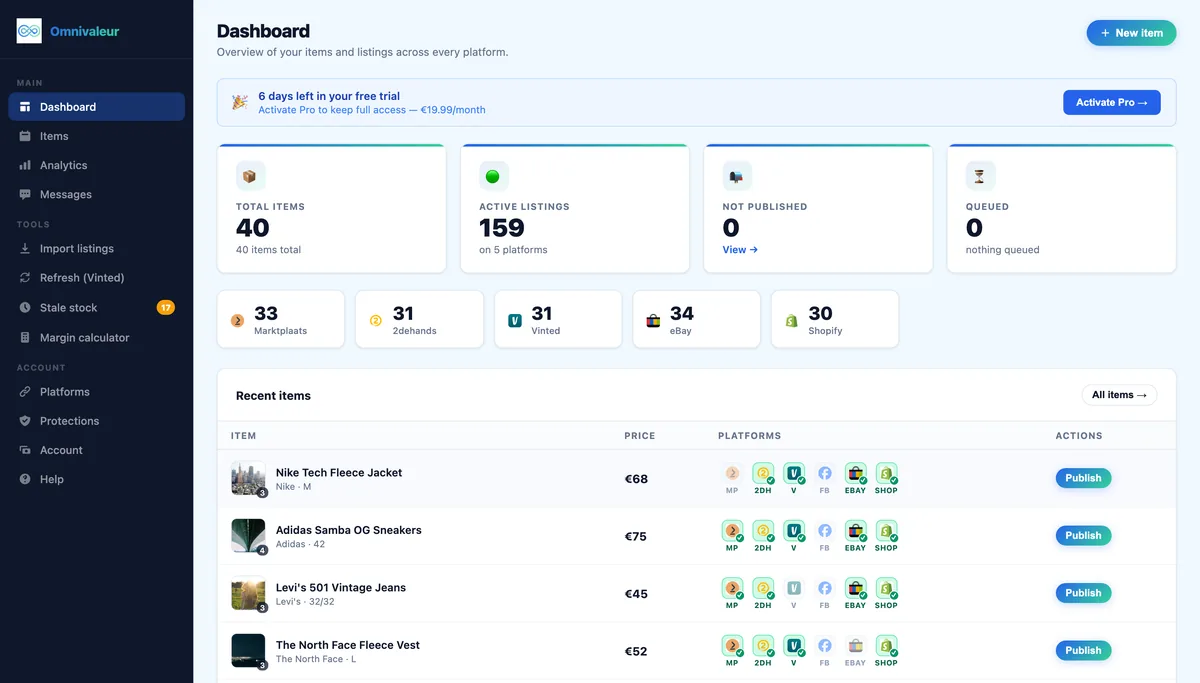
Duplicate sales get solved by inventory sync — when one platform confirms a sale, the listing pulls down everywhere else automatically instead of you manually checking six tabs. Account flags are trickier and mostly self-inflicted. Sellers who batch-publish 40 listings in parallel across multiple browser tabs regularly get rate-limited or temporarily suspended, because that pattern looks identical to scraper bots to a marketplace's fraud detection. Omnivaleur runs cross-listing one browser tab at a time, on purpose — publishing in parallel is exactly what gets marketplace accounts rate-limited, and a suspended eBay account mid-Christmas-season is a far bigger loss than a slightly slower batch upload.
This same logic applies whether you're moving from Marktplaats to Vinted or pushing figures from a sneaker-style multi-platform sneaker setup — the throttling discipline is category-agnostic.
What Are the 2026 Tax and Reporting Rules Resellers Need to Know?
If you're moving more than a handful of figures a year, DAC7 applies to you, whether you sell as a hobby or a registered business. Under the EU-wide rule, marketplaces must report sellers who hit 30 transactions or €2,000 in payments within a calendar year to the relevant tax authority. In the Netherlands that means Marktplaats, Vinted and eBay report your data directly to the Belastingdienst under its DAC7 seller information rules, and the underlying framework is detailed at EU level by the European Commission's DAC7 overview.
Practically, this means keeping a simple spreadsheet of cost basis per figure (what you paid, plus shipping) becomes worth doing from your very first sale, not once you "get serious." A collector clearing out 60 loose Marvel Legends figures at €15 each crosses the 30-transaction threshold without breaking €2,000 in total — reporting still triggers. Buyers also have return rights under the EU's consumer protection rules, which matters if you sell a "MOC" figure that turns out to have a resealed bubble; document condition with timestamped photos before shipping to protect yourself against disputed returns.
How Should You Price and Photograph Action Figures for Faster Sales?
Pricing figures wrong in either direction costs money. Underpricing a chase variant because you didn't check the wave number loses margin instantly. Overpricing a common figure because "it's from the 90s" just means it sits unsold for eight months.
- Title structure: Brand + Line + Character + Wave/Series number + Condition tag. Example: "Hasbro Marvel Legends Wolverine Wave 12 MOC AFA 80" beats "Cool old Wolverine figure" for search matching on every platform.
- Photograph the corners first: card corner wear and bubble stress marks are what collectors zoom in on. Shoot those before the hero shot.
- Include a scale reference: 1/12, 1/6 and 3.75-inch scale figures get confused constantly in search results without it stated plainly.
- Price against sold listings, not active ones: eBay's sold-item filter shows what actually cleared, not what someone's hopefully asking.
For discontinued or 20+ year old lines, Etsy's "vintage" label pulls in a different buyer than eBay's collectibles category — often willing to pay a premium for nostalgia-driven browsing rather than deal-hunting. That crossover works the same way it does for vintage posters or vinyl records: the older and rarer the item, the more Etsy's audience out-earns Vinted's per unit.
How Does Omnivaleur Handle Stale Stock and Listing Limits for Figure Sellers?
Chase variants and grail figures are the opposite problem from common loose figures: they don't sell fast, but they're worth holding for the right buyer. The risk is forgetting you have them, letting a listing rot at page 12 of search results with zero renewals.
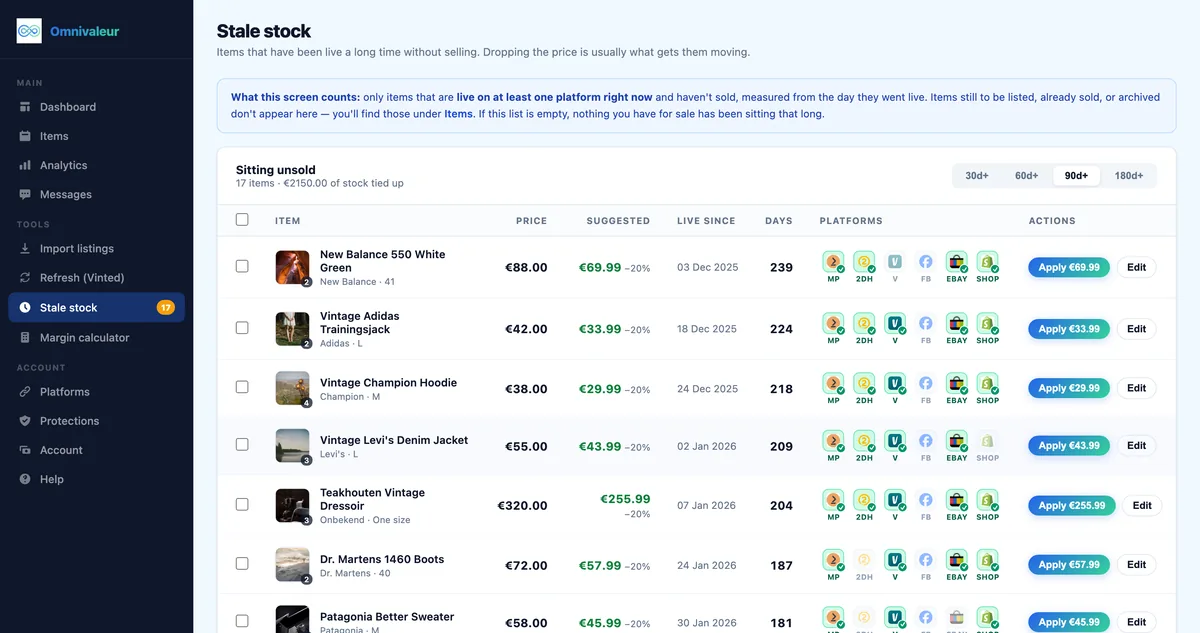
Omnivaleur's stale-stock view flags listings that have been sitting unsold, so a graded figure you priced correctly six months ago but never revisited surfaces back to your attention instead of quietly sinking. That's especially relevant for figure sellers, where a €150 grail piece not moving for four months is a bigger cash-flow drag than fifty €10 loose figures doing the same. Combine that visibility with cross-listing across Marktplaats, 2dehands, Vinted, eBay, Etsy and Shopify from one dashboard, and the collection you inherited or accumulated stops being a spreadsheet nightmare and starts being inventory you can actually track.
If you're deciding between tools, it's worth comparing feature sets directly — see how Omnivaleur stacks up in the Omnivaleur vs OneShop comparison or the Omnivaleur vs List Perfectly comparison before committing to a monthly plan. Sellers coming from adjacent niches, like gaming equipment or vintage clothing, tend to find the same cross-listing logic transfers directly once they add a figure category to their store.
Frequently asked questions
Can I legally resell bootleg or "KO" action figures if I disclose them as unofficial?
How do I ship a mint-on-card figure without damaging the packaging in transit?
Should loose figures and MOC figures from the same line be listed separately or bundled?
Do I need to declare accessories and weapons separately for customs on international sales?
How many photos should an action figure listing include?
Keep reading
Stop copying listings by hand
Omnivaleur publishes your item to every platform at once and syncs stock automatically when something sells.
Start free trial