The Best Flyp Alternative for Cross-Listing in 2026

For European resellers, the best Flyp alternative is a tool that actually supports Marktplaats, 2dehands, Vinted and eBay — which Flyp does not. Omnivaleur, List Perfectly and Vendoo all cross-list to EU marketplaces; Omnivaleur is the only one built specifically around Marktplaats/2dehands sync, euro pricing and one-tab-at-a-time posting that avoids rate limits.
Key takeaways
- Flyp is built for US resale apps (Poshmark, Depop, Mercari) and does not list to Marktplaats, 2dehands or Vinted at all.
- Omnivaleur cross-lists one browser tab at a time on purpose, because parallel posting is what gets marketplace accounts flagged or rate-limited.
- A stale-stock view in Omnivaleur surfaces listings that have sat unsold instead of letting them quietly sink to the bottom of your dashboard.
- Sync behavior — not price — is usually what breaks a cross-listing workflow, especially around attribute mapping and image fields.
- DAC7 reporting rules apply across EU marketplaces regardless of which cross-listing tool you use, so check them separately.
If you searched for a Flyp alternative because you sell across Marktplaats, 2dehands or Vinted, the short version is: Flyp was never built for you. It's a US-focused app aimed at Poshmark, Depop, Mercari and Grailed sellers, and it has no integration with any Dutch, Belgian or wider EU marketplace. That's not a knock on Flyp — it's just a different market. The real question is which cross-listing tool actually covers the platforms European resellers depend on, and how it behaves once you're running fifty or a hundred live listings instead of five.
This article compares Omnivaleur against the tools that keep coming up in "Flyp alternative" searches — List Perfectly, Vendoo, Crosslist — and is honest about where each one is genuinely strong. No tool here wins everything. By the end you should know which one fits your actual setup, not just which one has the flashiest landing page.
Why does Flyp show up in EU cross-listing searches when it doesn't support EU marketplaces?
Flyp ranks for "crosslisting" broadly because the term is generic and the US reseller market is huge. But if you check its supported platform list, you'll find Poshmark, Mercari, Depop, eBay (US-flavored), Grailed and a few others — no Marktplaats, no 2dehands, no Vinted listing automation, no native euro handling. A Dutch or Belgian reseller who signs up expecting to post a jacket to 2dehands and Vinted at the same time will hit a wall within the first ten minutes.
This matters because a lot of the "Flyp alternatives" articles floating around are written from a US-reseller lens too. They compare Vendoo, List Perfectly and PrimeLister against each other without ever mentioning that none of the big three US tools has deep Marktplaats or 2dehands support, and that Vinted automation across these tools varies a lot in quality. If your inventory lives in euros and your buyers are in Rotterdam or Antwerp, that gap is the whole ballgame.

What does "best Flyp alternative for crosslisting" actually need to mean for a European seller?
Three things, in practice. First, real support for the marketplaces you actually sell on — Marktplaats, 2dehands, Vinted, eBay.nl/eBay.be, and increasingly Shopify or WooCommerce if you run your own storefront alongside the marketplaces. Second, sync behavior that doesn't quietly break things — price changes, sold-status updates and delisting need to propagate correctly, or you end up selling the same item twice. Third, a pricing structure and setup process that doesn't assume you're a single-item hobbyist or, at the other extreme, a 500-SKU warehouse operation.
Flyp's own pricing sits around $9/month for its core tier, which is competitive in the US market. But price comparisons only matter once the platform coverage question is settled — a cheap tool that can't post to Vinted isn't cheap, it's useless for that use case. Selling on more than one marketplace is the whole point of cross-listing tools, so platform coverage has to come first in any comparison, not pricing.
Which marketplaces does each alternative actually support?
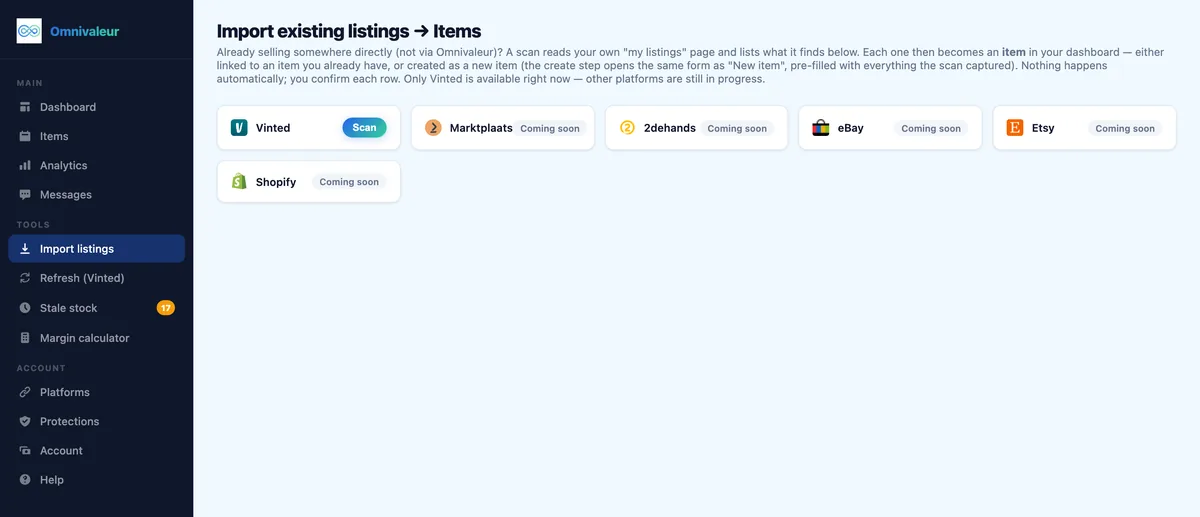
This is where most comparison articles get vague, so here's the concrete picture as of 2026. Omnivaleur covers Marktplaats, 2dehands, Vinted, eBay, Shopify, WooCommerce and Facebook Marketplace (currently in beta). List Perfectly and Vendoo are strong on the US resale apps (Poshmark, Mercari, Depop, eBay) with eBay being the main EU-relevant overlap, but Vinted and Marktplaats support has historically been thinner or added later as secondary integrations rather than core platforms. Crosslist leans into API-based posting for a similar US-heavy marketplace set.
If your business is genuinely transatlantic — say you buy vintage Levi's in Amsterdam and also sell on Poshmark — a tool like List Perfectly or Vendoo might cover more total ground. If your business is EU-first, with Marktplaats and 2dehands as your bread-and-butter and Vinted or eBay as secondary channels, a tool built around that stack handles the details (Dutch category fields, euro pricing, local shipping options) with far less manual patching.
Is Flyp really free, and how does its pricing compare to EU-focused tools?
Flyp advertises a free tier alongside its paid plan, which is standard in this category — most crosslisting tools give you a limited number of listings or cross-posts for free, then charge once you scale past a handful of active SKUs. The free tier is genuinely usable for someone testing the waters with five or ten items, but it stops being realistic once you're running real inventory turnover. That pattern holds across nearly every tool in this space, Omnivaleur included: free or low tiers exist to let you test sync behavior before committing.
Here's the honest pricing and feature comparison across the tools people search for as Flyp alternatives:
| Tool | EU marketplace coverage | Typical pricing tier | Sync/relist behavior | Setup effort |
|---|---|---|---|---|
| Flyp | None (US apps only) | Free tier + ~$9/mo paid | Auto-delist on US apps; not applicable to EU | Low, but irrelevant for EU sellers |
| Omnivaleur | Marktplaats, 2dehands, Vinted, eBay, Shopify, WooCommerce, Facebook Marketplace (beta) | Tiered monthly, EU-pricing in euros | One tab at a time by design; delists across channels when sold | Moderate — browser extension + account linking per marketplace |
| List Perfectly | eBay strong; Vinted/Marktplaats limited | Mid-range monthly | Bulk editing focus; cross-posting via browser automation | Moderate, steeper learning curve for bulk tools |
| Vendoo | eBay strong; EU marketplaces limited | Mid-range monthly, mobile app included | Auto-delist on supported platforms | Low, mobile-first onboarding |
| Crosslist | US-focused, API-based | Mid-range monthly | API-based posting, generally reliable sync | Moderate, more technical setup |
None of these prices are secrets, but they do change year to year — always check the current pricing page rather than trusting a 2025 screenshot, since most of these tools adjust tiers roughly annually. The structural point that doesn't change: price is the wrong first filter. Coverage and sync reliability decide whether the tool earns its subscription fee at all.
Does Flyp (or any crosslister) auto-delist sold items, and why does that matter more than it sounds?
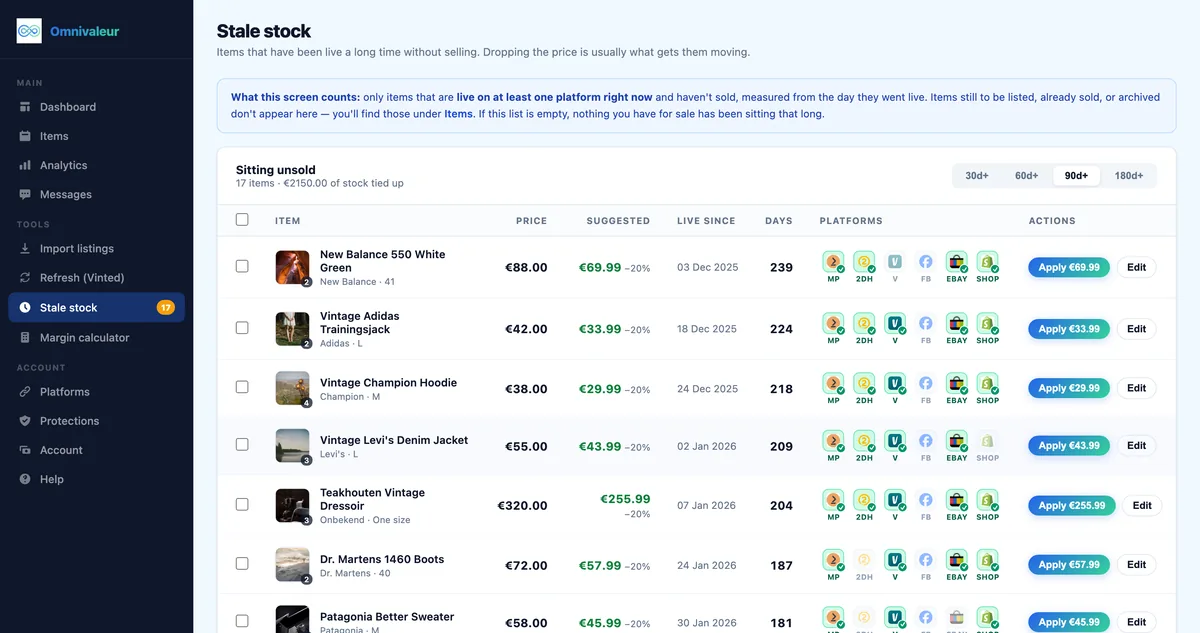
Flyp does auto-delist sold items on the marketplaces it supports — this is table stakes for any serious crosslisting tool in 2026, not a differentiator. The real question isn't whether a tool delists, it's how fast and how reliably, because the gap between "sold" and "delisted everywhere else" is exactly where double-sales happen. A buyer messages you on Vinted about a jacket that already sold on 2dehands twenty minutes earlier, and now you're issuing a refund and apologizing.
This is a genuinely common pain point, and it's worth reading through in detail if you've been burned by it before — our guide on how to avoid selling the same item twice walks through the specific failure modes. In Omnivaleur's case, the delist trigger fires from the sold-channel update and pushes removal across the other connected marketplaces, rather than waiting for a scheduled batch sync. That's not a claim that it's instant everywhere — marketplace APIs have their own latency — but the trigger logic avoids a "check once a day" model that leaves hours of exposure.
How does attribute, category and variation mapping change what actually gets published?
This is the part most "best alternative" articles skip entirely, and it's where cross-listing tools genuinely differ. Every marketplace has its own category tree and required fields. Marktplaats wants a specific category and condition field; Vinted wants brand, size and condition mapped to its own taxonomy; eBay wants item specifics tied to its category ID. When a tool maps your single source listing to each marketplace's fields automatically, cross-posting is fast and accurate. When mapping is shallow, you end up manually fixing category mismatches on every single listing, which defeats the purpose of automation.
Variation mapping is the sharper edge case: a sneaker listed in sizes 42, 43 and 44 needs each size tracked as inventory so that selling size 43 on Marktplaats actually reduces the size 43 count everywhere else, not the whole listing. Tools that treat variations as separate listings handle this cleanly. Tools that treat a product as one flat SKU tend to either oversell a size or force you to list each size as a separate item manually, which multiplies your listing workload. If you resell sneakers specifically, this is worth checking before you commit to any tool — our sneaker reselling automation guide goes through variation handling in more depth.
Attribute mapping failures are usually invisible until a buyer complains. A camera listed with "lens included: yes" on your source platform needs that same attribute translated correctly on 2dehands and Vinted — miss it, and you get disputes over what was actually included in the sale, which is exactly the kind of friction EU consumer shopping rights rules were designed to protect buyers against. Getting the mapping right upfront avoids that entirely.
How do listing duplication and bulk editing workflows actually differ between these tools?
Listing duplication — taking one item and generating cross-platform drafts from it — is the core job of every tool in this category, including Flyp, List Perfectly, Vendoo, Crosslist and Omnivaleur. The differences show up in the edges: how much manual cleanup you do after duplication, and how bulk edits propagate once listings are live.
List Perfectly has built its reputation specifically around bulk editing — changing price, description or photos across many listings at once from a spreadsheet-style interface. That's a genuine strength if you run a high-volume operation with hundreds of near-identical SKUs (think a reseller clearing out a wholesale pallet). Vendoo leans toward a cleaner single-item duplication flow with a mobile app attached, which suits sellers who list from their phone between other work. Crosslist's API-based approach tends to be more reliable for structured catalogs but asks more of you during initial setup.
Omnivaleur's duplication flow is built around a single source listing that generates marketplace-specific drafts, with the browser extension handling the actual field-filling per marketplace rather than relying purely on API calls (since Marktplaats, 2dehands and Vinted don't expose the same kind of open seller APIs that eBay does). That's a meaningful distinction for EU sellers: a lot of US-built tools assume API access that simply doesn't exist for Marktplaats or 2dehands, which is part of why their "EU support" tends to be thinner than their US support.
- ✓Check that the tool supports your actual marketplaces: Marktplaats, 2dehands, Vinted, eBay.nl or eBay.be
- ✓Test the auto-delist speed for sold items across channels to avoid double-sales
- ✓Review how the tool maps categories and required fields to each marketplace
- ✓If you list variations like shoe sizes, confirm the tool tracks each size separately
- ✓Look at bulk editing workflows if you manage many listings, or single-item flow if you list rarely
- ✓Set up a test listing with images to see how thumbnails and photo order display on each platform
What actually breaks when image sync and marketplace-specific fields are handled inconsistently?
Image sync sounds trivial until you've dealt with it at scale. Marktplaats and 2dehands have their own image ordering and compression behavior; Vinted enforces its own minimum resolution and crop expectations; eBay wants a clean primary image free of watermarks or heavy text overlays for certain categories. A tool that pushes the same raw image set to every marketplace without adjusting for these quirks will occasionally produce a listing with the wrong cover photo, a blurry thumbnail, or images that upload in the wrong order.
The practical failure mode: you upload eight photos of a vintage camera, the source platform shows them correctly, but 2dehands displays photo six as the thumbnail because of how the tool handled the array order during the sync. Buyers click through less when the thumbnail doesn't match the title. It's a small thing per listing, but across 80 active listings it's a real dent in click-through. If you resell cameras or anything photo-detail-sensitive, our vintage camera reselling automation guide covers photo handling specifically, including order-of-upload quirks per marketplace.
Marketplace-specific fields cause a related but separate problem: a field that's optional on one platform (like "material") might be required on another. Tools that silently skip unmapped fields will sometimes publish a listing missing a required attribute, which some marketplaces will flag or reject outright rather than publish with a gap. The fix isn't glamorous — it's just thorough field mapping maintained as marketplaces update their forms, which they do every year or two without much warning.
How should a Shopify or WooCommerce seller think about marketplace sync differently?
If you run your own storefront alongside marketplace listings, the sync direction matters more than the posting itself. You want inventory changes on Shopify or WooCommerce to push outward to Marktplaats, Vinted and eBay — not the other way around causing conflicting stock counts. Template-driven updates (change a price or description once, push everywhere) save real time here, but only if the tool actually respects your storefront as the source of truth rather than treating every connected platform as equally authoritative.
This is a common setup for resellers scaling past pure marketplace selling — our guides on Marktplaats to Shopify cross-listing and Shopify to Vinted sync go through the specific setup steps, including how order status should tie back to fulfillment so a Shopify order doesn't leave a now-sold item live on Vinted for another three hours.
How do Marktplaats, 2dehands, Vinted and euro pricing change the setup compared to a US-only tool?
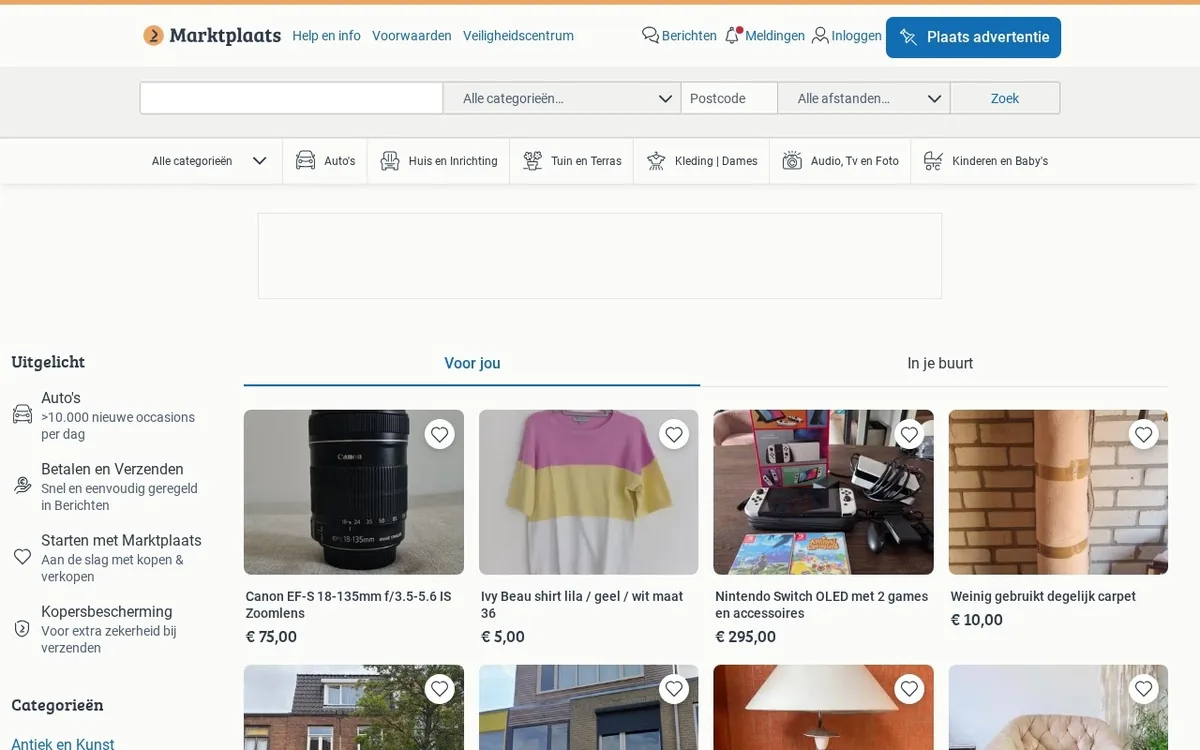
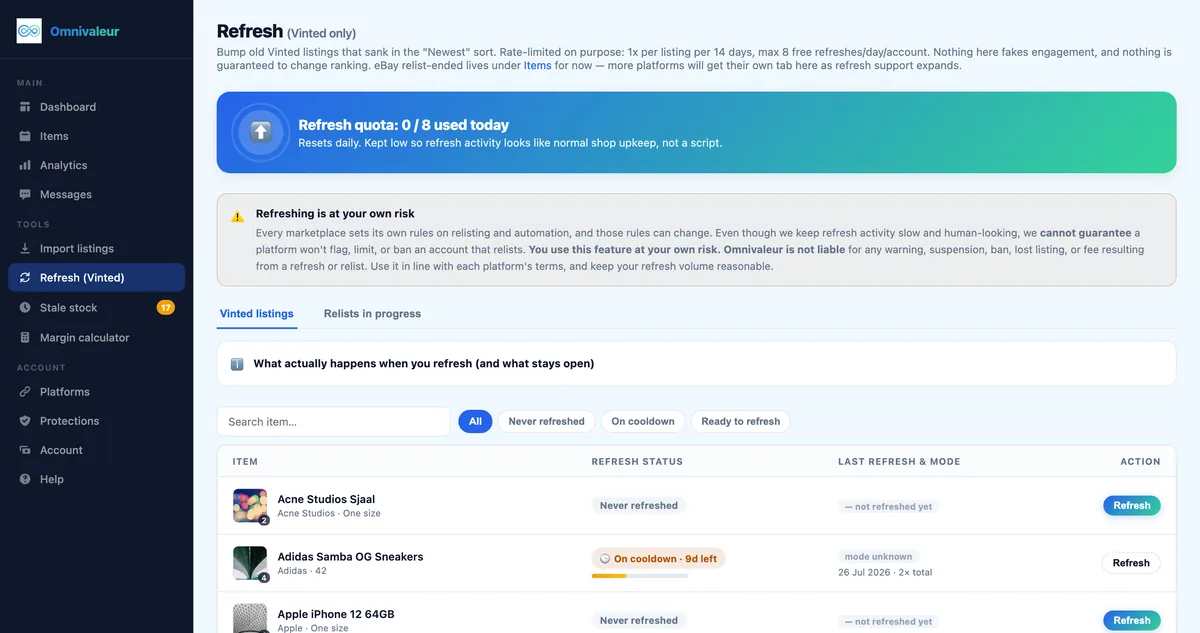
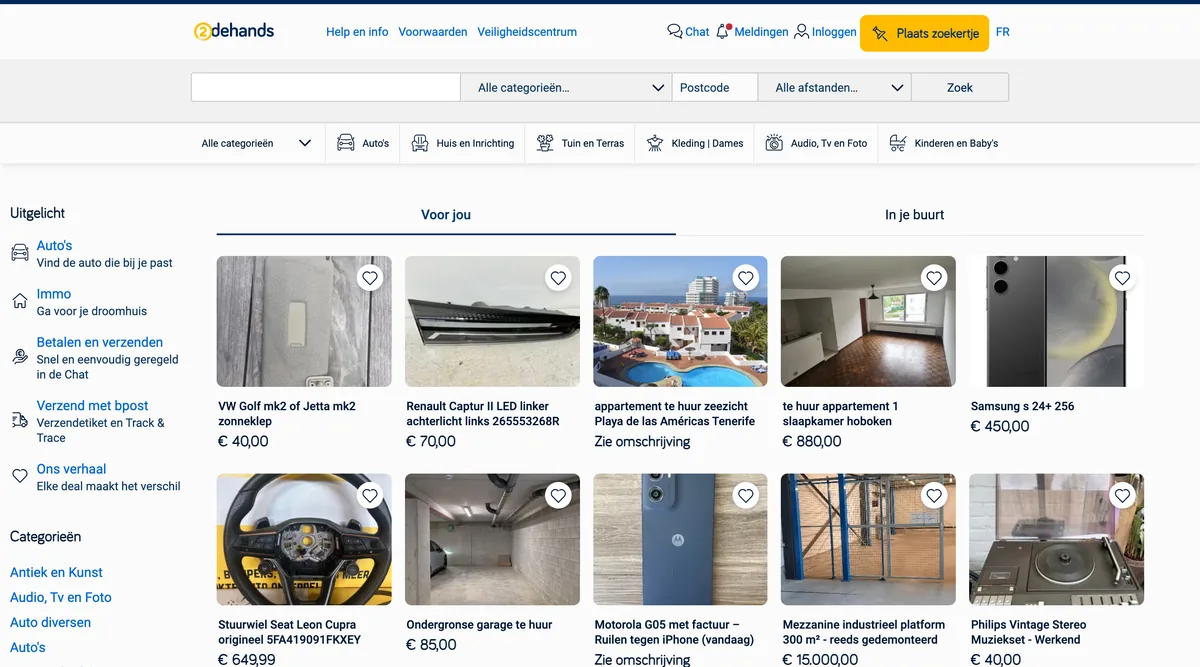
Three EU-specific details trip up tools and sellers that came from a US-first mindset. First, currency: listings need to be priced in euros natively, not converted on the fly from USD, because marketplace fee structures and buyer expectations are euro-based. Second, Marktplaats fee structures differ by category and listing type, and they change often enough that it's worth checking current rates rather than assuming last year's numbers — see our breakdown in Marktplaats fees explained. Third, 2dehands and Marktplaats are run by the same parent company but behave as genuinely separate marketplaces with separate listings, which is why cross-posting between them specifically is worth setting up as its own workflow — covered in our Marktplaats to 2dehands cross-listing guide.
There's also a tax-reporting layer that has nothing to do with which crosslisting tool you use but affects every EU reseller regardless: DAC7. Since 2023, digital platforms operating in the EU — including Vinted — are required to report seller income to tax authorities once you cross certain thresholds (roughly 30 sales or €2,000 in a calendar year, though always confirm current figures). This applies whichever tool you cross-list with; it's a platform-level obligation, not a cross-lister feature. The Belastingdienst's DAC7 information for sellers and the European Commission's DAC7 overview both explain the mechanics in detail, and our own DAC7 Vinted reporting rules guide breaks down what it means specifically for Dutch sellers using Vinted heavily.
Where does cross-listing commonly fail during CSV import and bulk editing, and how is it mitigated?
CSV import is where a lot of bulk-upload workflows quietly fall apart. Column mismatches, encoding issues with accented characters (common in Dutch and French listings), and inconsistent category naming between your spreadsheet and the tool's expected taxonomy all cause partial imports — the kind where 40 out of 50 rows succeed and you don't notice the other ten until a week later. The mitigation is almost always the same regardless of tool: run small test batches of five to ten rows before uploading a full catalog, and keep category names matched to the tool's dropdown values rather than free text.
Bulk editors carry a related risk: editing a price or description across 100 listings in one action is powerful, but if the edit pushes before you've reviewed a preview, a typo propagates instantly across every marketplace. List Perfectly's bulk editor is strong here precisely because it's been refined around this exact workflow for years — that's a genuine point in its favor for sellers doing high-volume, low-differentiation inventory. Our own comparison of the two approaches is laid out honestly in Omnivaleur vs List Perfectly, and a separate look at API-based posting versus browser-based posting is covered in Omnivaleur vs Crosslist.
How easy is setup and day-to-day use once the trial period ends?
Setup for most of these tools follows a similar pattern: install a browser extension, connect your marketplace accounts, import or create your first listing, and run a test cross-post before trusting it with real inventory. Vendoo's mobile-app-first approach is genuinely easier for someone who wants to list from a phone between other tasks — that's a real strength and worth acknowledging if your workflow is mobile-heavy. Omnivaleur runs through a desktop browser extension and intentionally posts one tab at a time rather than firing off parallel posts across every marketplace simultaneously.
That one-tab-at-a-time decision is deliberate, not a performance limitation we're apologizing for. Posting in parallel across five marketplace tabs at once is exactly the pattern that gets accounts flagged for bot-like behavior, since marketplaces watch for unnatural posting speed and simultaneous multi-tab activity from one account. Sequential posting takes a bit longer per batch, but it's the difference between a tool that works quietly for years and one that gets a seller account temporarily restricted after a growth spurt.
Day to day, the setup that matters more than first-time onboarding is how you handle slow-moving inventory. Items that sit unsold for weeks tend to silently sink to the bottom of a dashboard sorted by date, which means you stop seeing them and stop adjusting price or relisting them. Omnivaleur's stale-stock view exists specifically to counter that — it surfaces listings that have been sitting unsold instead of letting them disappear into page three of your inventory. Pairing that with a relisting strategy — our relisting vs bumping guide covers the tradeoffs — turns a passive dashboard into something you actually act on weekly.
How reliable is support when a sync breaks or a listing gets flagged?
This is the hardest category to compare fairly because support quality is inconsistent even within the same company month to month, and none of us can verify response-time SLAs we haven't personally tested recently. What's fair to say in general: tools with smaller, more specialized user bases (EU-focused tools serving Marktplaats/2dehands/Vinted specifically) tend to have support teams who've seen your exact marketplace-specific error before, simply because the pool of problems is narrower. Tools serving a huge, broad US reseller base have more support volume but also a wider range of unrelated issues competing for attention.
Reliability in practice comes down to two things: how fast a sync failure gets surfaced to you (not silently retried forever), and whether the tool tells you clearly which marketplace rejected a listing and why. A vague "listing failed" error with no marketplace-specific detail wastes more of your time than a slow support reply, because you're left guessing whether it's a category issue, an image issue, or a temporary marketplace outage.
Which Flyp alternative should you actually pick?
If your inventory and buyers are genuinely in the Netherlands or Belgium — Marktplaats, 2dehands and Vinted as your core channels, with eBay or Shopify as secondary — Flyp isn't in the running at all, and Omnivaleur or a similarly EU-aware tool is the realistic shortlist. If you're a high-volume US-based reseller running hundreds of near-identical SKUs and bulk editing is your daily bottleneck, List Perfectly's bulk tools are a legitimate strength worth paying for. If you want a mobile-first listing experience and your marketplaces are mostly US apps plus eBay, Vendoo fits that pattern well. If your catalog is structured and you're comfortable with a more technical, API-driven setup, Crosslist is worth evaluating — our side-by-side in Omnivaleur vs Vendoo digs into that comparison specifically for sellers weighing both.
None of this is a blanket "switch to Omnivaleur" conclusion. It's a fit question. A tool that doesn't support the marketplace where your buyers actually are isn't cheaper just because the subscription is lower — it's the wrong tool. Match the platform coverage to your actual sales channels first, then compare pricing and sync quality within that shortlist, and the decision gets a lot less confusing than any generic "top 6" list makes it look.
Frequently asked questions
Can I use Flyp alongside a separate EU-focused tool instead of switching entirely?
Does switching crosslisting tools affect my existing Marktplaats or Vinted seller reputation?
How long does it realistically take to migrate 50 active listings to a new cross-lister?
Does a Flyp alternative help with DAC7 reporting obligations?
Is it worth paying for a cross-lister if I only sell 10-15 items a month?
Keep reading
Stop copying listings by hand
Omnivaleur publishes your item to every platform at once and syncs stock automatically when something sells.
Start free trial