Flyp and Omnivaleur solve different problems. Flyp is a US-focused crosslister built around Poshmark, Mercari, Depop and eBay with a mobile-first app. Omnivaleur cross-lists across Marktplaats, 2dehands, Vinted, eBay, Shopify, WooCommerce and Facebook Marketplace (beta), built specifically for European resellers who need euro pricing and local marketplace rules.
Key takeaways
- Flyp is built around US resale apps like Poshmark, Mercari and Depop, not Marktplaats or 2dehands
- Omnivaleur covers Marktplaats, 2dehands, Vinted, eBay, Shopify, WooCommerce and Facebook Marketplace (beta) from one dashboard
- Flyp's publicly reported entry price sits near $9 a month; Omnivaleur plans are priced in euros and scale with listing volume
- Omnivaleur cross-lists one browser tab at a time on purpose, specifically to avoid marketplace rate limits
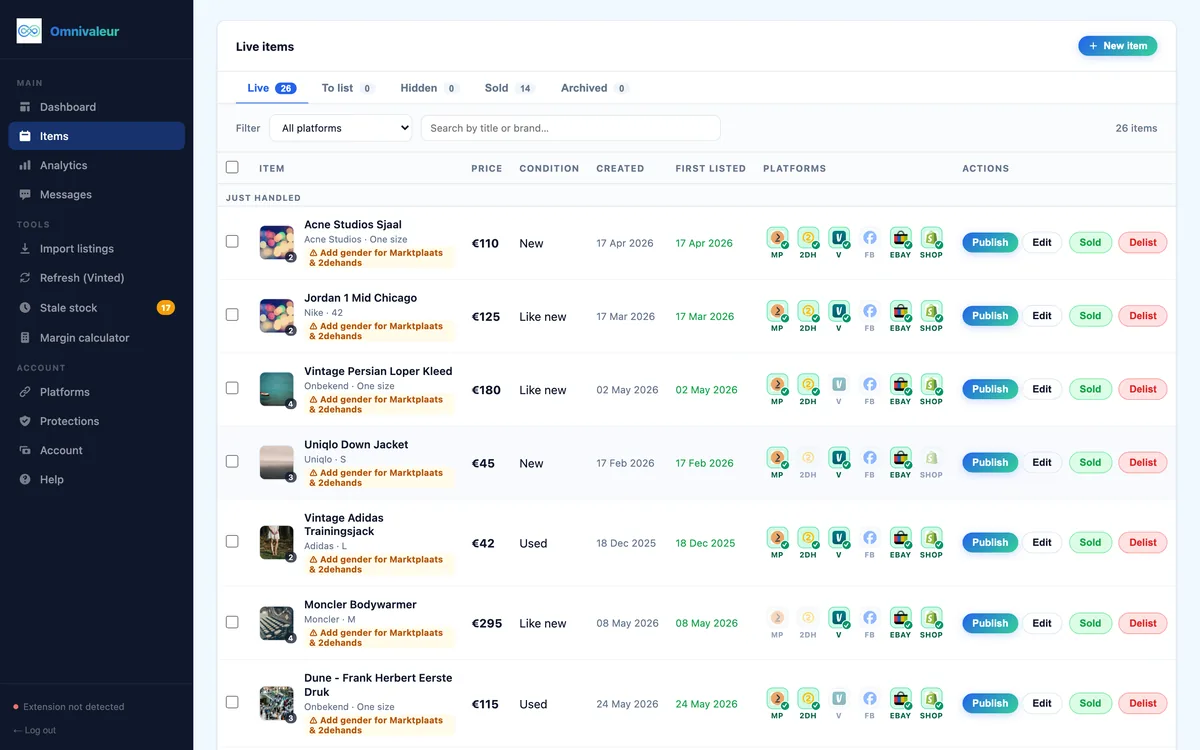
- Omnivaleur's stale-stock view flags listings sitting unsold, so slow inventory surfaces instead of sinking down the list
What is Flyp, and who was it actually built for?
Flyp is a US resale app. That matters more than most comparison articles admit. It was designed around the marketplaces American resellers use every day: Poshmark, Mercari, Depop, eBay, and in various reports Etsy and Facebook Marketplace as well. Its interface leans mobile-first, which fits a seller base that photographs inventory on a phone, writes a description on a phone, and publishes from a phone.
That focus is a genuine strength, not a weakness to dismiss. If your entire business runs on Poshmark closets and Mercari drops, a tool designed around that exact workflow will feel more native than something general-purpose. The trade-off is geography. Flyp was not built with Marktplaats, 2dehands or Vinted in mind as core, equally-weighted platforms — and in 2026, that gap is exactly what a Dutch or Belgian reseller runs into within the first ten minutes of testing it.
Omnivaleur takes the opposite starting point. It was built in and for the European second-hand market first, then extended outward to eBay, Shopify and WooCommerce. If you're searching for Omnivaleur vs Flyp crosslisting, this is usually the real question underneath: "does either of these actually work for the marketplaces I sell on?" The honest answer is that it depends entirely on which side of the Atlantic your buyers are on.
Which marketplaces does Omnivaleur support compared to Flyp?
Platform coverage is the first filter, before price or interface even matter. A tool that doesn't list on your core marketplace is disqualified regardless of how polished its dashboard looks.
Flyp's marketplace list centers on the major US resale apps — Poshmark, Mercari, Depop, eBay, and typically a handful of others depending on the plan. None of the public material around Flyp describes native support for Marktplaats, 2dehands, or Vinted's European listing flow, and we won't invent specifics the company hasn't published. If you sell exclusively on US apps, that's a non-issue. If you sell in the Netherlands, Belgium, or across the eurozone, it's the whole decision.
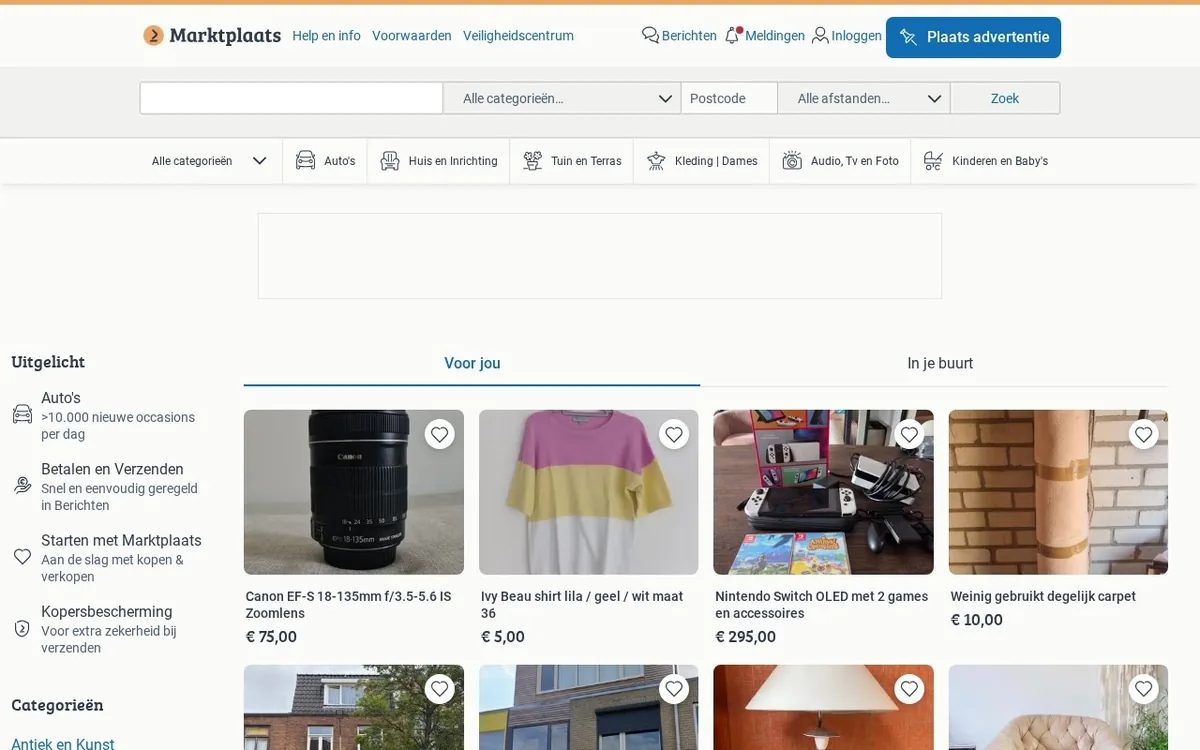
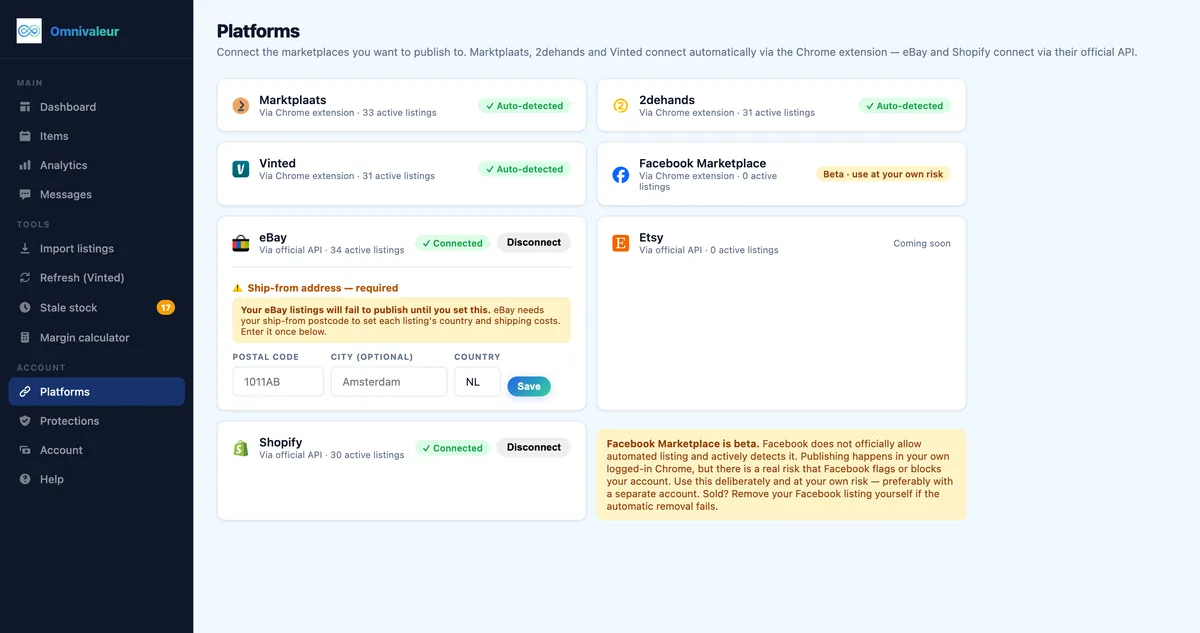
Omnivaleur's supported platforms as of 2026 are Marktplaats, 2dehands, Vinted, eBay, Shopify, WooCommerce, and Facebook Marketplace in beta. That list was chosen deliberately to mirror how a typical Dutch or Belgian reseller actually operates: a Marktplaats account for local pickup sales, a Vinted account for shipped clothing, an eBay account for international buyers, and often a Shopify or WooCommerce store once volume justifies owning a storefront. If your stock also includes designer pieces or vintage electronics that move well internationally, cross-listing from Marktplaats to eBay or from eBay to Shopify covers both ends of that funnel without re-typing anything.
Neither tool supports absolutely everything a reseller might touch — Whatnot, Grailed and Kidizen, for instance, sit outside both products' current scope. That's worth saying plainly rather than glossing over.
Omnivaleur vs Flyp at a glance
Here's the side-by-side. Pricing figures for Flyp reflect what is publicly reported for its entry tier; treat any number you can't verify yourself as a starting point for your own research, not gospel.
| Factor | Flyp | Omnivaleur |
|---|---|---|
| Core region | United States | Netherlands, Belgium, EU, UK |
| Marketplaces | Poshmark, Mercari, Depop, eBay (varies by plan) | Marktplaats, 2dehands, Vinted, eBay, Shopify, WooCommerce, Facebook Marketplace (beta) |
| Pricing currency | US dollars | Euros |
| Entry price | Reported around $9/month, free tier for limited listings | Tiered monthly plans scaling with active listing volume |
| Mobile app | Yes, mobile-first design | Browser-based dashboard, built for desktop cross-listing sessions |
| Sync method | Automated posting across supported US apps | Browser automation, one tab at a time by design |
| Stale inventory handling | Not publicly documented | Stale-stock view flags unsold listings automatically |
| Local tax/VAT context | Not EU-specific | Built around DAC7, VAT margin scheme and EU consumer rules |
How does Flyp pricing compare to Omnivaleur pricing in 2026?
Flyp's pricing is commonly cited as starting near $9 a month, with a free tier that caps how many listings or crosslists you get before you hit a paywall. That's a reasonable entry point for a casual seller moving a dozen items a month between Poshmark and Mercari. It's also priced in dollars, which means every invoice carries a currency conversion if you're billing from a Dutch or Belgian bank account — a small but real friction most comparison articles skip entirely.
Omnivaleur's plans are priced in euros from the start, scaled to the number of active listings you're running rather than a flat cap that forces an upgrade the moment you list one extra item. For a reseller running, say, 60 active listings across Marktplaats and Vinted plus another 20 on eBay, the relevant comparison isn't the sticker price on either tool — it's how much manual relisting time you save per week, multiplied by what your time is worth. If you flip even three hours a week of manual relisting into automated cross-listing, that's usually worth more than the subscription cost on its own. Understanding your actual profit margin per item makes that math concrete instead of a vague "it probably pays for itself" claim.
Also factor in marketplace fees themselves, which neither tool controls. Marktplaats has its own fee structure for certain categories and boosted listings, detailed in our breakdown of Marktplaats fees for 2026. A crosslisting tool's subscription price is only one line in the actual cost of selling.
How easy is it to set up cross-listing with each tool?
Setup speed is where a lot of resellers actually decide, before they've tested sync behavior or support quality. Flyp leans on its mobile app for onboarding: connect accounts, snap photos, let its listing assistant draft a description, publish. For someone used to listing from a phone already, that's a short, familiar path.
Omnivaleur's setup runs through a browser extension and dashboard. You connect each marketplace account once, build or import your item data, and the cross-listing engine handles publishing to each connected platform from there. The learning curve is slightly different from a phone-native tool — more like managing a spreadsheet-driven workflow than snapping and posting — but it scales better once you're past a few dozen active listings, because bulk edits, photo reuse and category mapping live in one screen instead of several app taps per item.
Neither approach is objectively "easier." A seller moving five items a week on Poshmark will find Flyp's phone-first flow faster. A seller juggling 80 listings across four European marketplaces will usually find a desktop dashboard faster once the initial account connections are done, simply because batch actions beat one-item-at-a-time taps at volume.
- ✓Check which marketplaces the tool actually supports where you sell now
- ✓Test the tool's sync behavior on a few items before committing to bulk listing
- ✓Calculate how many hours per week you spend on manual relisting and what that time costs
- ✓Verify support response times for the marketplaces you rely on most
- ✓Review pricing in your local currency and factor in monthly marketplace fees
How do Flyp and Omnivaleur handle sync and relisting after a sale?
This is the section most comparison articles gloss over, and it's where the real operational risk lives. "Auto-delist" sounds like a solved problem on every crosslister's marketing page. In practice, it depends entirely on how aggressively the tool checks marketplaces and how it publishes in the first place.
Crosslisting tools including Flyp generally advertise automatic delisting — the idea that once an item sells on one platform, the tool removes or marks it sold on the others. How frequently that check runs, and whether it's instant or batched, isn't something we can verify from the outside, so treat any specific delay claim with some skepticism until you've tested it on your own account.
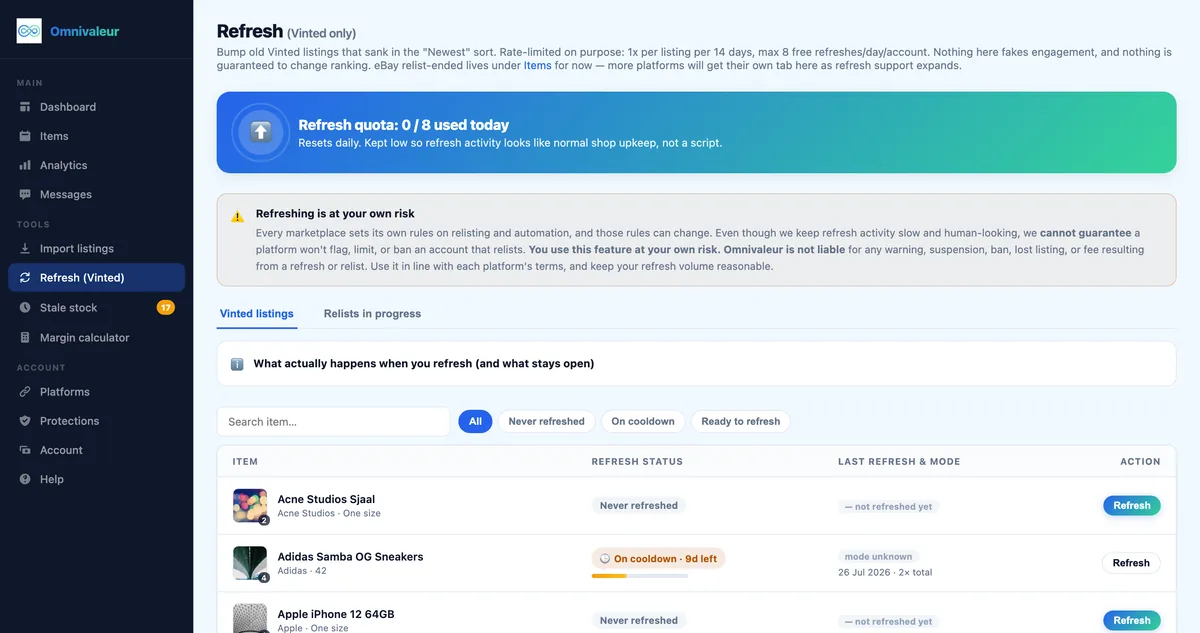
Omnivaleur's approach to the publishing side is intentionally conservative: cross-listing runs one browser tab at a time, not in parallel across five marketplaces simultaneously. That's a deliberate design choice, not a performance limitation. Parallel publishing across multiple marketplace sessions at once is exactly the pattern that gets accounts flagged or temporarily rate-limited by marketplaces watching for bot-like behavior. A slower, sequential approach costs a few extra seconds per listing and avoids the much bigger cost of a suspended account mid-season.
Relisting an unsold item is the other half of this. An item that's been sitting for six weeks with zero views needs a price cut, new photos, or a repost — not silence. Omnivaleur's stale-stock view surfaces exactly that: listings that have gone quiet get flagged instead of drifting to page four of your dashboard where you forget about them. If you've ever discovered an item was still listed at last year's price three months after you meant to drop it, this is the feature that catches that before a buyer does. Pairing that with a simple habit of checking your sell-through rate monthly tells you whether the stale items are a pricing problem or a photography problem.
There's also a duplicate-listing risk worth naming directly: selling the same physical item twice because two marketplaces both show it as available at the same moment. That's a support nightmare and occasionally a legal one. Our guide on how to avoid selling the same item twice across Marktplaats and Vinted walks through the exact failure modes and how sync timing avoids them.
How does each tool handle Marktplaats, 2dehands, Vinted and euro pricing?
This is the section where the gap between a US-built tool and an EU-built one shows up most concretely. Marktplaats and 2dehands are effectively the same underlying marketplace serving the Netherlands and Belgium respectively, with separate listing flows, separate category trees, and subtle differences in how boosted ads and fees work. A tool with no native understanding of that relationship treats them as two unrelated platforms instead of one pair that should sync together. Our guide on cross-listing between Marktplaats and 2dehands covers exactly where that distinction matters for pricing and category mapping.
Vinted carries its own 2026 complications that are unique to the EU: tax reporting thresholds under DAC7, bundle pricing behavior, and shipping label rules that differ from eBay or Marktplaats entirely. Since 2023, EU marketplaces including Vinted have been required to report seller activity once a threshold is crossed — 30 sales or €2,000 in a calendar year, whichever comes first — directly to tax authorities under the DAC7 framework. That's not a Vinted-specific quirk; it's an EU-wide rule, laid out by the European Commission's DAC7 overview and mirrored on the Dutch side by the Belastingdienst's DAC7 guidance for sellers. A tool with no EU context has no reason to even mention this to its users. We've broken down exactly what that threshold means in practice in our guide to DAC7 reporting rules for Vinted sellers in the Netherlands.
Euro pricing itself is a smaller but real friction point. A tool priced and built in dollars, with marketplace templates designed around US tax fields and shipping carriers, will handle a Marktplaats listing's euro price correctly as a number, but it won't natively understand VAT margin scheme pricing for second-hand goods, which is a real EU-specific rule affecting how resellers calculate what they owe. Our VAT margin scheme guide walks through why that distinction changes your actual take-home on certain categories of stock. Buyers across the EU also carry specific consumer protection rights on distance sales, outlined by the Your Europe consumer shopping rights portal, which matters if you're fielding returns or warranty questions from Vinted or Marktplaats buyers rather than US ones. If you sell second-hand goods professionally rather than as a hobby, the legal warranty obligations in the Netherlands are worth reading before your first dispute, covered in our legal warranty guide.
None of this is a criticism of Flyp specifically — it was never built for this market, so expecting EU tax context from it is like being annoyed a US tax calculator doesn't know about Dutch VAT. It's just a mismatch worth naming instead of discovering the hard way.
What happens when something breaks — how reliable is support?
Every crosslisting tool eventually hits a marketplace API change, a login hiccup, or a listing that silently fails to publish. What separates tools isn't whether this happens — it will, on every crosslister, every year — it's how fast support responds and how clearly they communicate known issues.
We don't have verified, apples-to-apples response time data for Flyp's support channel, so we won't invent a number. What's fair to say generally: a tool built around a large, mostly-US user base will prioritize fixes for the marketplaces that base actually uses — Poshmark, Mercari, Depop — and EU marketplace issues, if Flyp even connects to them, would understandably sit lower on that priority list.
Omnivaleur's support structure is built around the EU marketplace set specifically, which means a Marktplaats listing quirk or a Vinted shipping label change gets the same priority as an eBay sync issue, rather than being a secondary concern behind a larger US user base. Shipping label handling is a good concrete example — Marktplaats changed label generation flows in recent years, and resellers who hit that cold lose real time. Our guide to printing shipping labels on Marktplaats exists because support tickets kept asking the same question.
Reliability also shows up in smaller ways: can you clear a backlog of accidental drafts quickly, can you switch a 2dehands account's display language without starting over, can you set up Vinted bundles without manually re-pricing each item. These aren't flashy features, but they're the daily friction points that determine whether a tool feels solid or feels like extra work. We've documented the exact steps for clearing Marktplaats drafts, changing 2dehands language settings, and building Vinted bundles because they come up constantly in support conversations.
So which tool should you actually use — Flyp or Omnivaleur?
Here's the honest split, without pretending one tool wins every scenario.
Flyp makes sense if: your business runs on Poshmark, Mercari, Depop and US-based eBay, you list from your phone more than your laptop, and you want a lighter, cheaper entry point while your inventory is still small. If none of your buyers are in the EU, the Marktplaats and Vinted gap isn't a gap at all — it's irrelevant to you.
Omnivaleur makes sense if: you sell on Marktplaats, 2dehands, Vinted, or eBay to EU buyers, and you also want a path toward Shopify or WooCommerce once you're ready to own a storefront instead of renting one from a marketplace. It's built around euro pricing, EU tax rules like DAC7 and the VAT margin scheme, and marketplace pairings — Marktplaats-to-2dehands, Vinted-to-Marktplaats — that simply don't exist as a concept in a US-first tool.
If you're weighing other EU-focused options alongside this one, our comparisons of Omnivaleur vs Crosslist and Omnivaleur vs List Perfectly cover the two other tools that actually show up in EU reseller shortlists, rather than the US-first field Flyp sits in.
The category of what you're reselling matters too. A reseller moving designer clothing or luxury handbags across Vinted and eBay has different relisting urgency than someone moving vintage cameras or collectible stock that sits longer between sales. A fast-moving category benefits more from aggressive stale-stock alerts; a slow-moving one benefits more from strong cross-marketplace reach so a niche buyer can actually find the item at all.
In 2026, the biggest mistake isn't picking the "wrong" crosslister in some abstract sense. It's picking a tool built for a marketplace region you don't actually sell in, and then blaming the tool when Marktplaats category mapping doesn't exist or Vinted bundle pricing isn't supported. Match the tool to your actual buyer geography first. Everything else — pricing, interface, support speed — is a secondary decision once that's settled.
Frequently asked questions
Can I use Flyp if I only sell on Marktplaats and Vinted?
Does Omnivaleur have a mobile app like Flyp does?
What is Sell The Flip, and does it auto-delist sold items?
Is there a cheaper crosslister than Flyp for EU sellers specifically?
Can I run both Flyp and Omnivaleur at the same time for different marketplaces?
Does switching from Flyp to Omnivaleur mean re-listing everything from scratch?
Keep reading
Stop copying listings by hand
Omnivaleur publishes your item to every platform at once and syncs stock automatically when something sells.
Start free trial